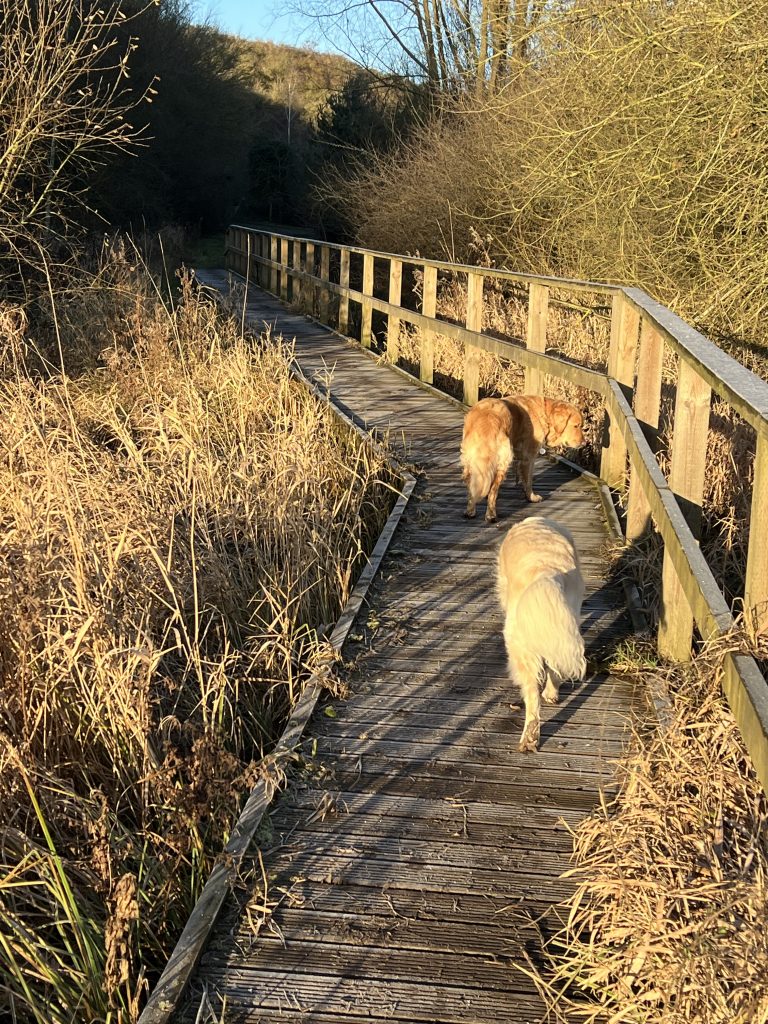
Watching the changing seasons during country dog walks
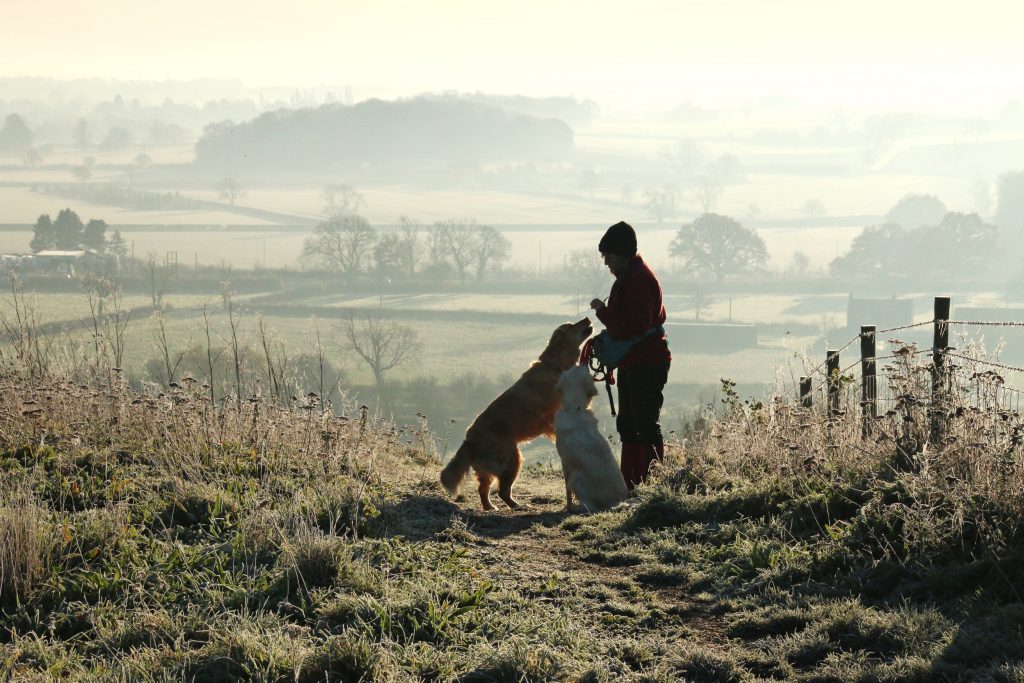
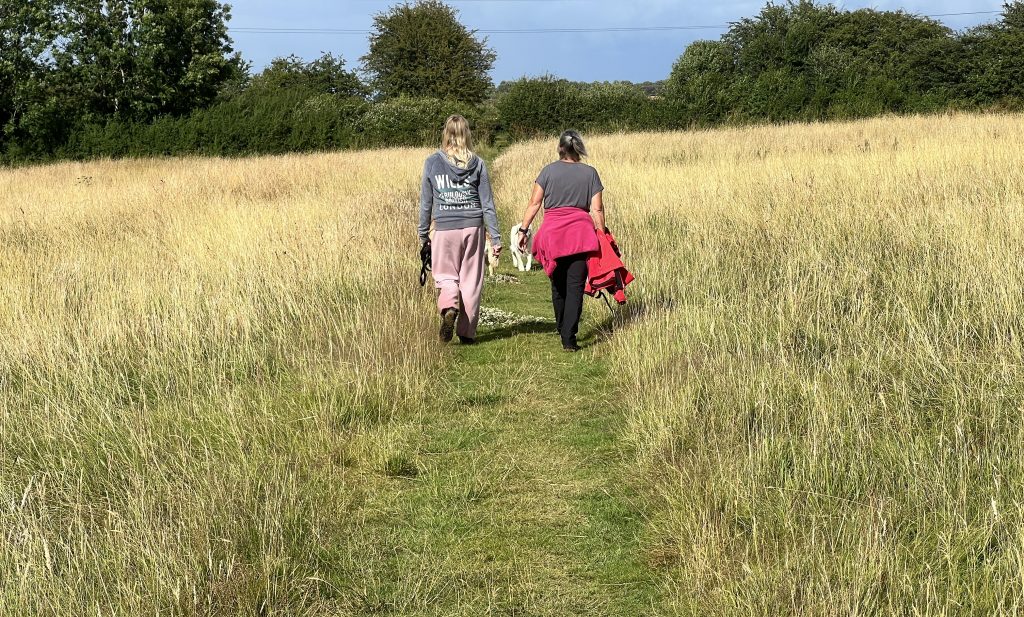
Come rain or shine we walk our two Golden Retrievers twice daily, often with friends and their dogs, and we see how the seasons change in the countryside around us, both in nature and agriculture.
We meet other dog walkers, many of them regulars, who we have come to know well over 20 years of walking local footpaths, first as “parents” of their pooches (“I saw Poppy the spaniel and her mum today”), then by name, and eventually, after many chats as we walk together, they have become personal friends
We hope that, whether or not you are able to get out and about in the countryside, you will enjoy seeing the changing seasons in the countryside and local farmland during our country walks, and maybe get to know some of our canine friends
28th September 2026
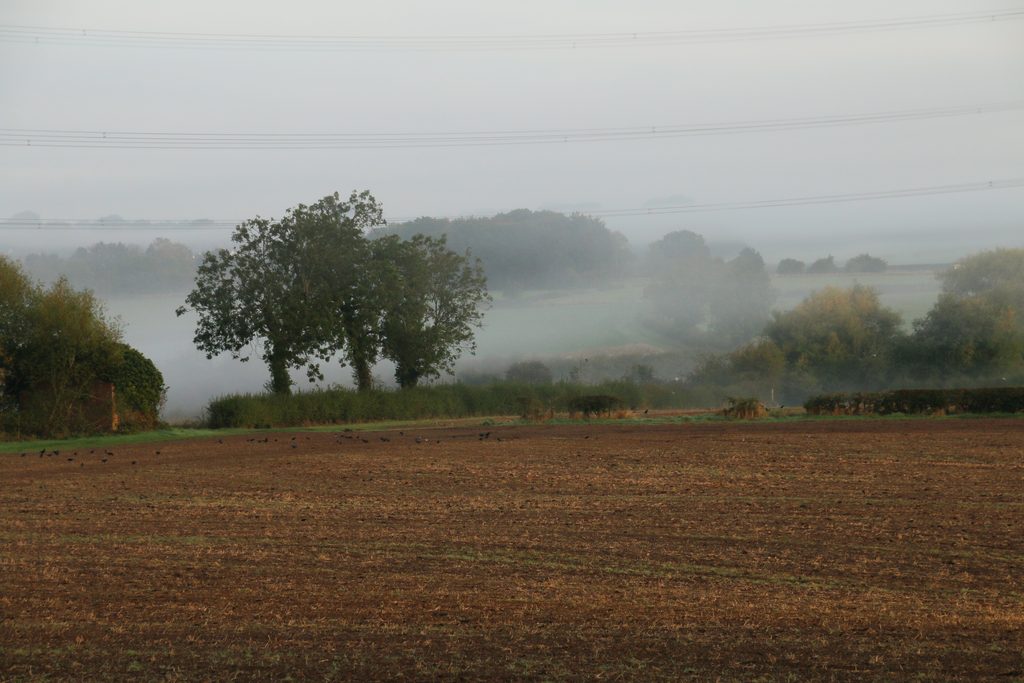
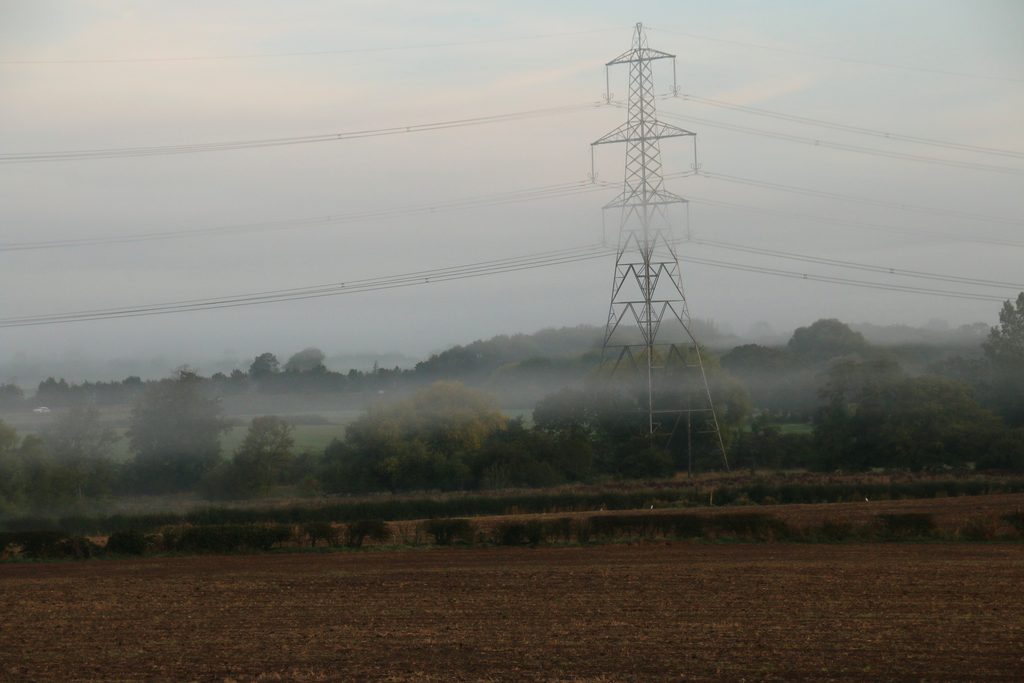
The first misty morning of the season – or at least the first mist at a time when I am up and about. It is still mild, not really autumnal, and we have still not had much rain. The days are noticeably shorter, and if our afternoon dog walk is later than usual, the sun is low in the sky by the time that we get home. On our weekly “dog walk” to the pub on a Tuesday evening, myself and three mates with four dogs, the dogs need collar lights on our journey down to the village as well as on the way home.
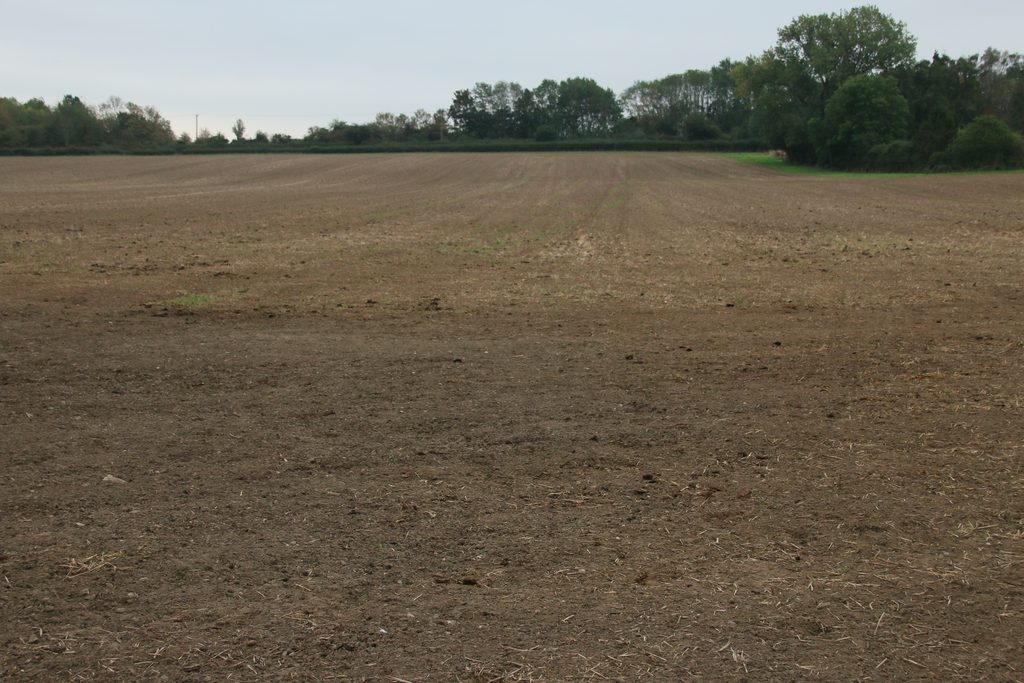
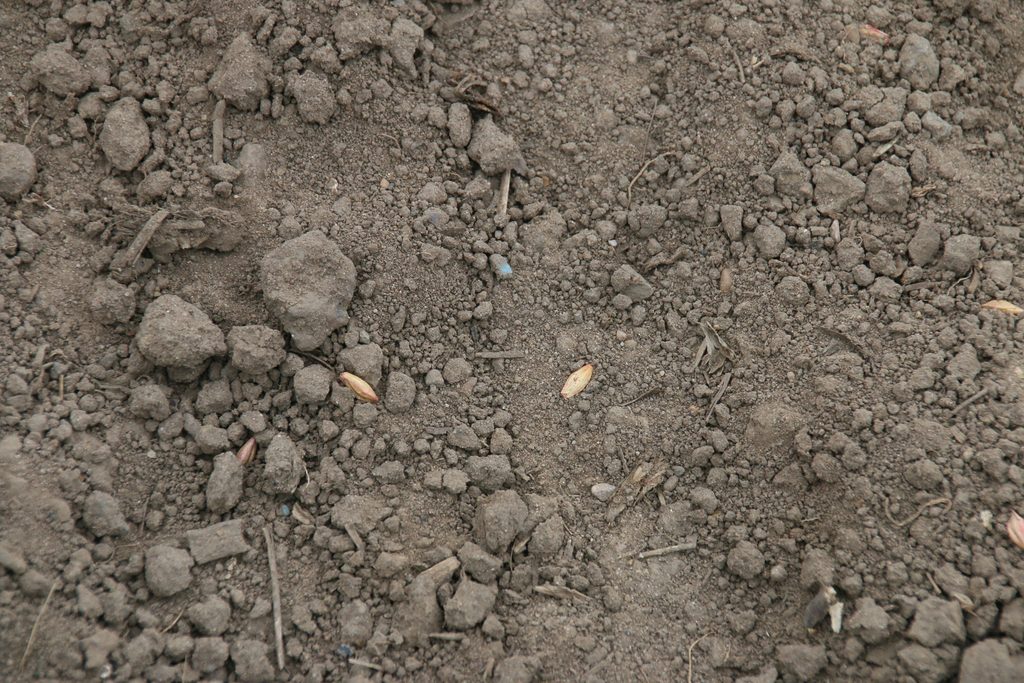
The field behind our home has been disced and raked, breaking up the surface and leaving a fine tilth, and a day or so later was drilled. As always after the crop has been sown, I look around for dropped seeds, to see what crop we will get next year. This year, for the second-year running, we have wheat. I am quite relieved – oil seed rape is also grown in this field, and the young leaves are a favourite snack with the dogs. Two years ago Sam was scratching more than usual, and one possible reason was an allergy to the rape leaves.
16th September 2026
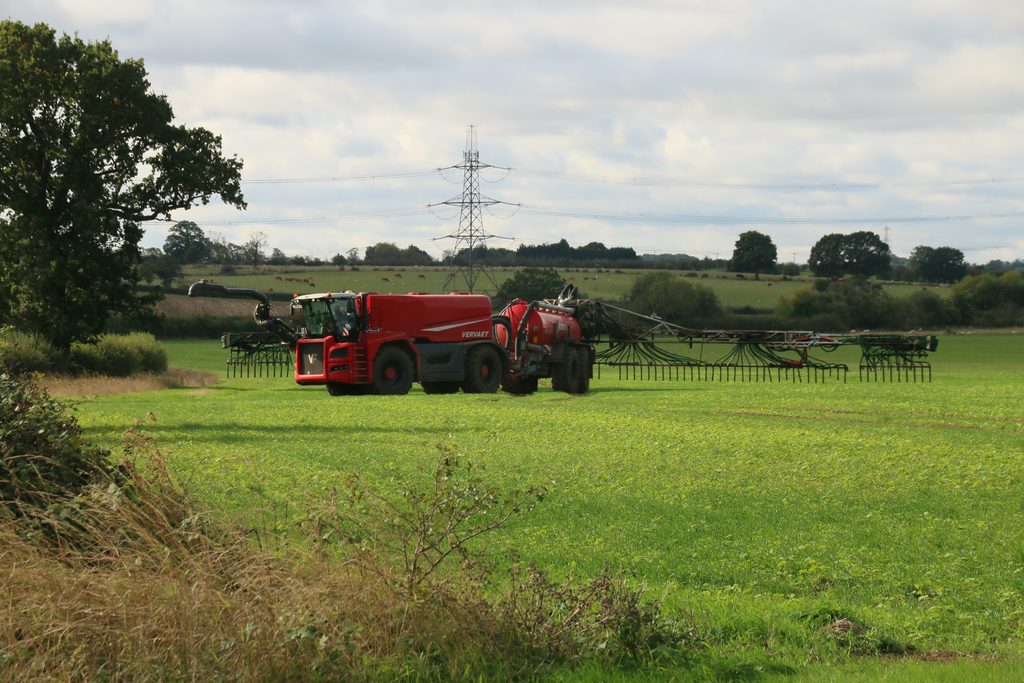
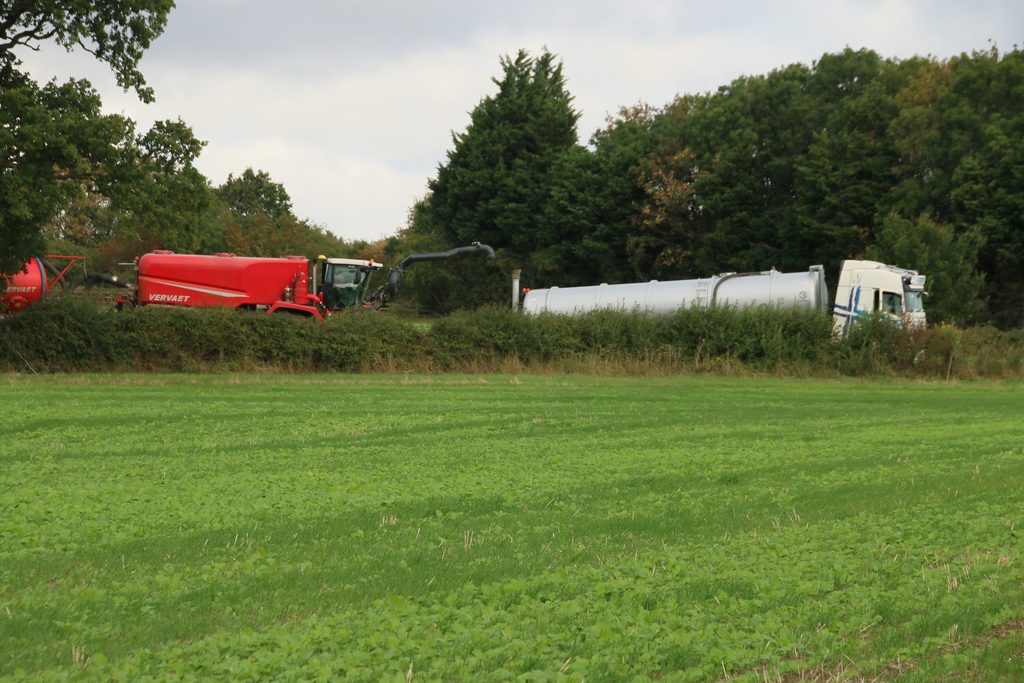
Beyond the Sheep Field, fortunately in a field away from the public footpath, slurry, liquid manure, is being injected into the ground, a road tanker making repeated trips along a dusty farm track to fill the tanks behind the tractor. Prongs from the spreader dig into the soil, injecting the slurry just below the soil surface, minimising odour. I keep the dogs close – although the footpath is separated from the activity by a hedge and the width of a field, if they see a hare they could end up in the field where heavy machinery is trundling up and down. We avoid the farm track – the road tanker driver is taking no prisoners in his relay between the source of the slurry, wherever that is, and the demands of the spreader
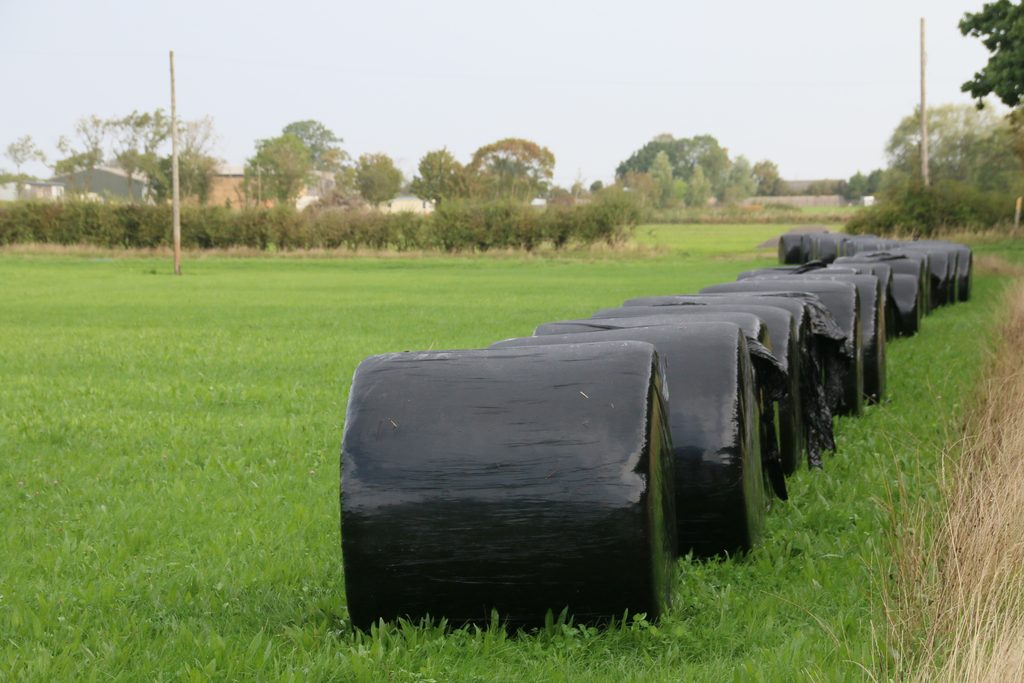
Crops of sileage have been taken from the grass fields that lie between our Lane and the village. Until a year ago many of these fields were arable, growing wheat or rape, but grass has been sown and established, and the fields are used to graze a dairy herd that supplies milk to the Long Clawson Stilton Cheese dairy. The herd is moved around the fields; each field being grazed for a few days before the cows are moved on to allow the grass to recover. During the summer the recently planted fields were brown, with just the odd patch of green, not enough to provide grazing for the dairy herd, who were restricted to the meadows of long-established grass. The more recently planted grass recovered after the first post-summer rain, growing vigorously enough to provide a crop of sileage, grass harvested and plastic-wrapped into round bales while green, fermenting for winter feed. Bales are scattered around the field opposite our house, but nearer the village are neatly lined up beside the footpath.
10th September 2026
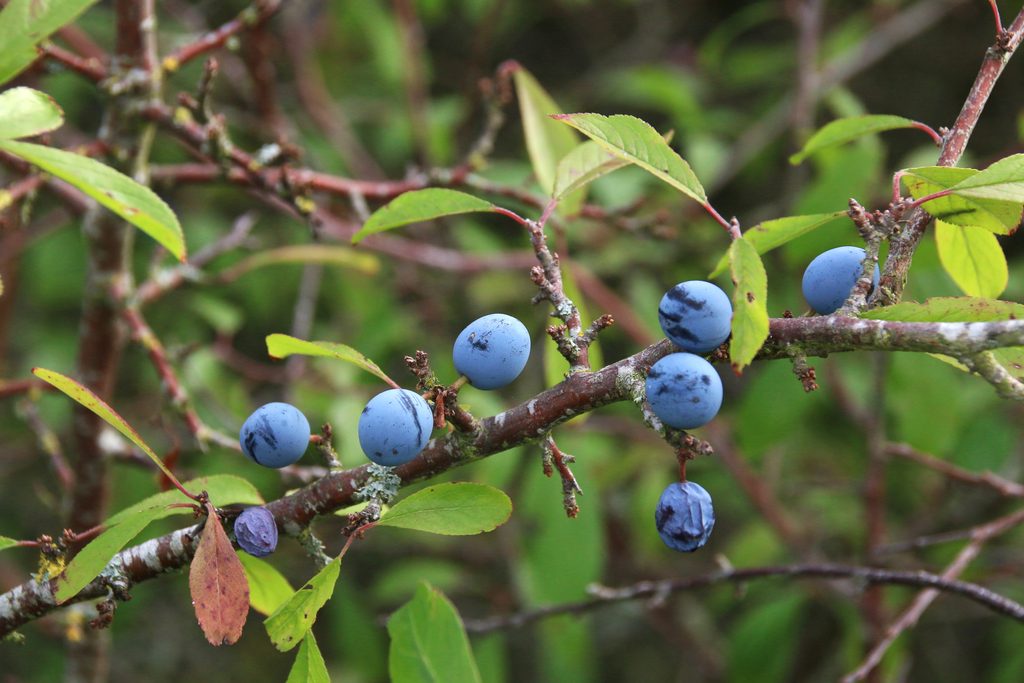
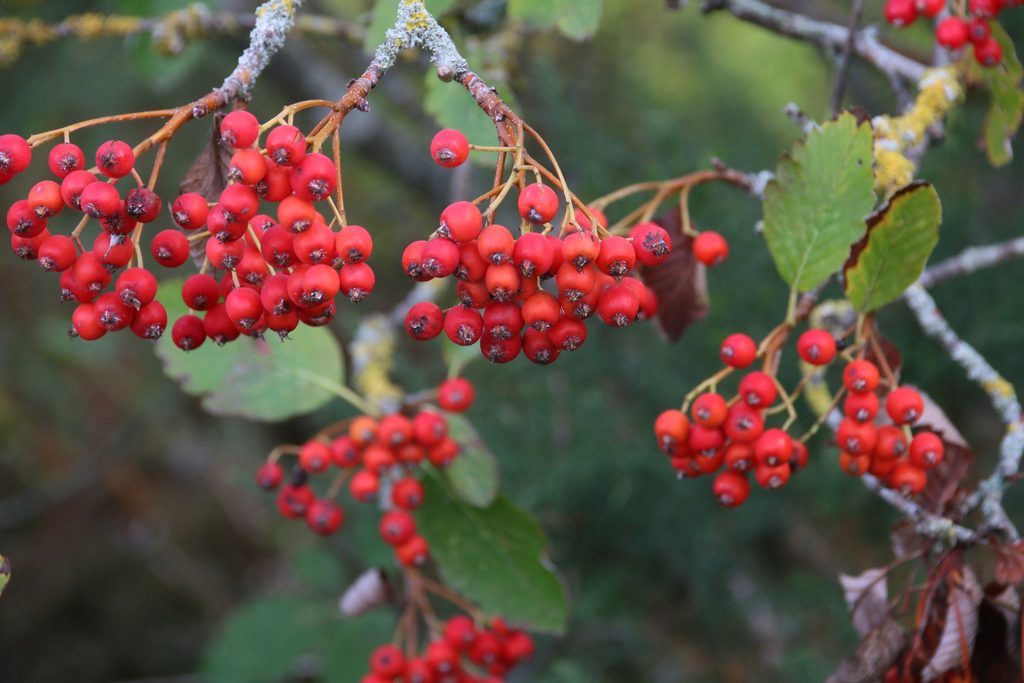
There is a chill in the damp air this morning, probably feeling a little chillier than it should. After a long hot summer, with daily temperatures in the mid to late 20s for weeks, early autumn seems to have arrived quite suddenly, a few days of rain preceding cool mornings. There will need to be a lot more rain to make up for deficit over summer, but the countryside is already showing signs of recovery. Berries have increased significantly in size over the last week or so, although blackberries have been over for a couple of weeks. Purple sloes are a good size, meaning less time picking to harvest the right quantity for sloe gin, although I have decided not to make any this year. I have produced a couple of litres each year for the last few years, but my production exceeds consumption. The red berries of Whitebeam, planted during the landscaping of the “New Hill” about 30 years ago, are popular with birds. This autumn harvest has come in time for birds getting into good condition for winter, or migrating across Europe, although the first migrants have already left.
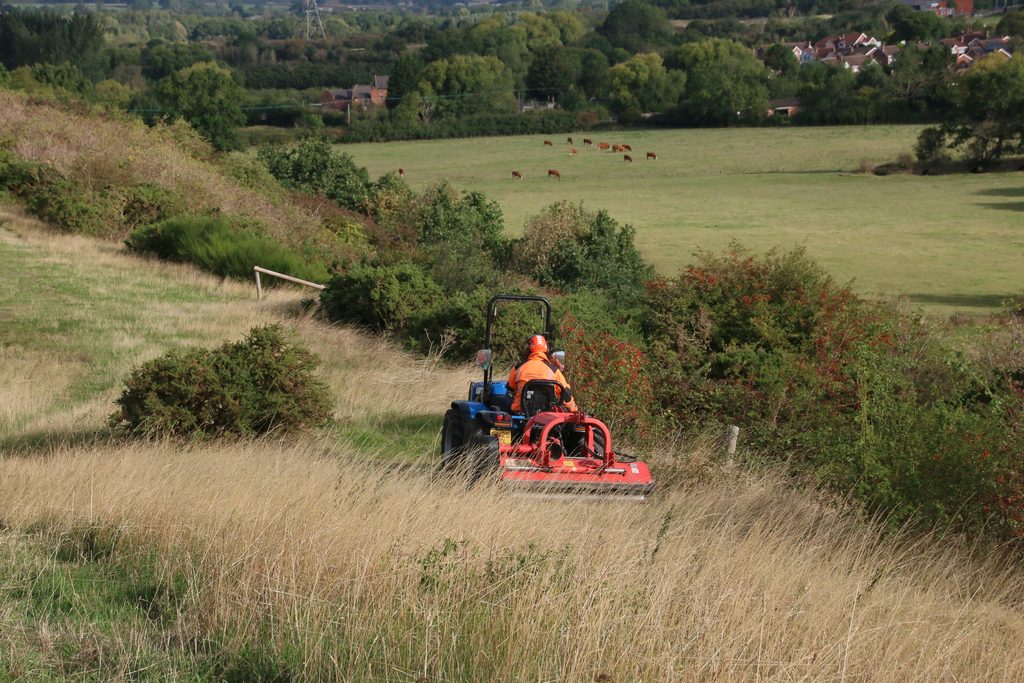
Further along the path the long grass of the open area higher above the quarry is being mown, initially in neat paths edged with tall grass, but by the following day all of the grass has been mown, allowing wildflower seeds to germinate next year. The dogs appreciate the newly opened space and run around following scents. Our walk has been quite a social one, meeting a lady on the New Hill, who we have not met before, with a young and very active spaniel, and a more sedate labrador. By the river we meet someone else that is not one of the regulars, also with a labrador, this time younger and more excitable, a bit much for Ellie who just wants to lie quietly in the cool shallow water, and so we move on. We meet a local, with no dog, but a regular walker nonetheless, who, following a knee operation, climbs Croft Hill, albeit slowly, every day.
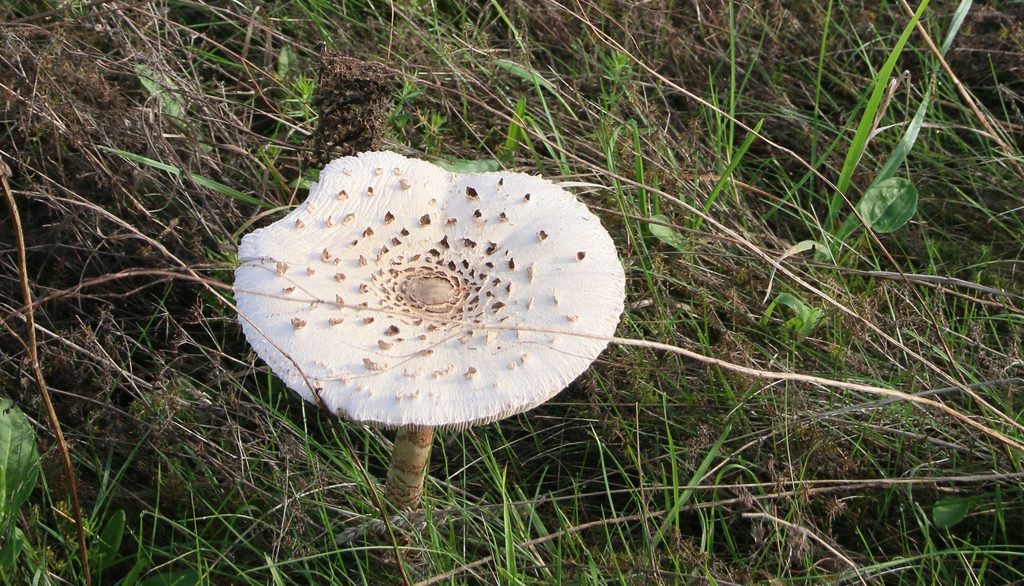
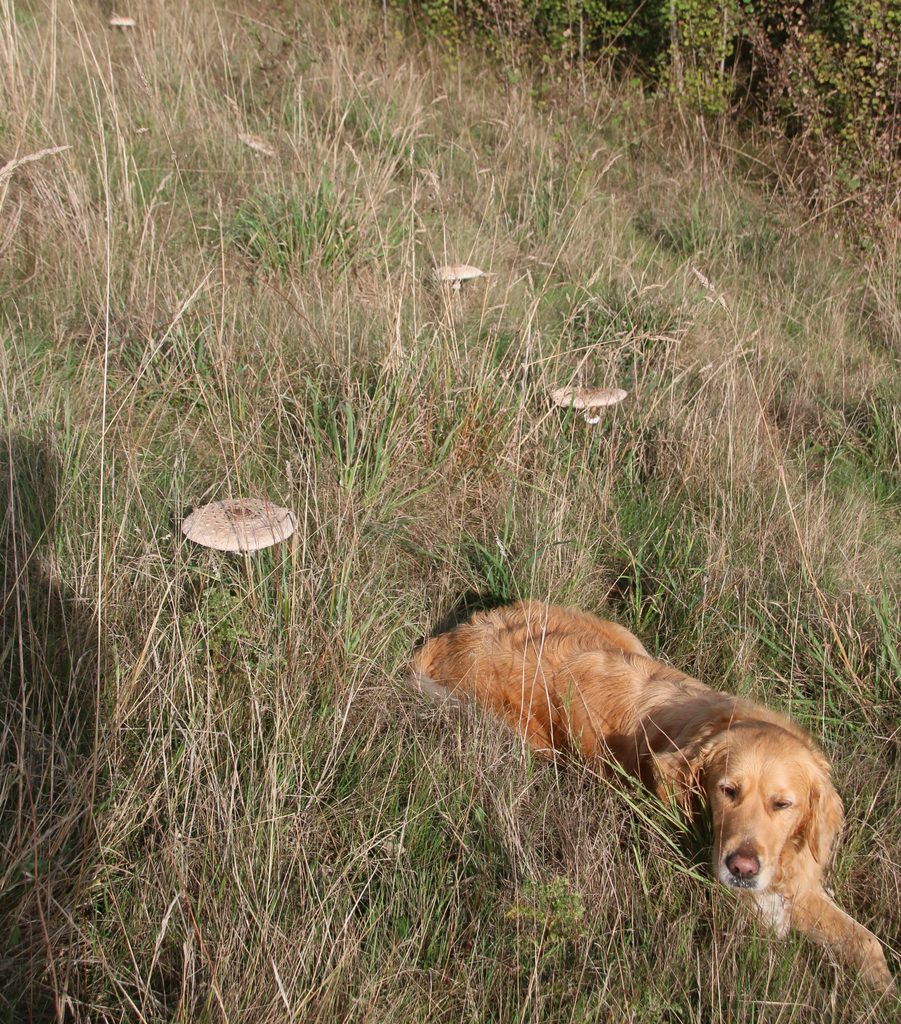
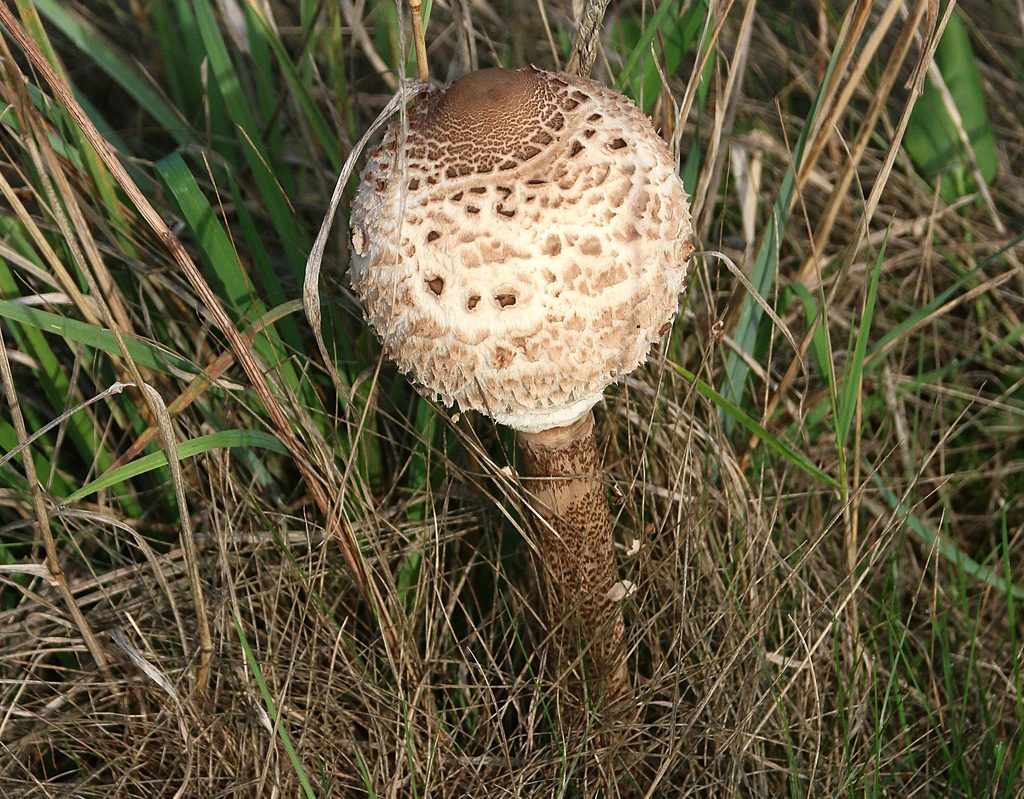
Mushrooms have appeared along all of our walking routes, the underground fungal mycelia, which spread beneath extensive areas of the countryside, reacting to recent rain by producing the fruiting bodies that we see above the grass. The fine fibres of the mycelia intertwine through and between the roots of trees and shrubs, and we are only just starting to understand the symbiotic relationship between fungi and trees, the mycelia not only changing the nature and nutrients in the soil, but maybe also providing subtle communication between trees, changes in one tree potentially affecting a separate tree several meters way, connected by the fine strands of mycelium in the soil between them. On Croft Hill and alongside the footpath down to the village Parasol Mushrooms have proliferated, sprouting in rings around the perimeter of the subterranean mycelium beneath the shallow soil on the side of the Hill. Along the footpath to the village, in the shade of trees, the Parasol Mushrooms have yet to open, still conical in shape.
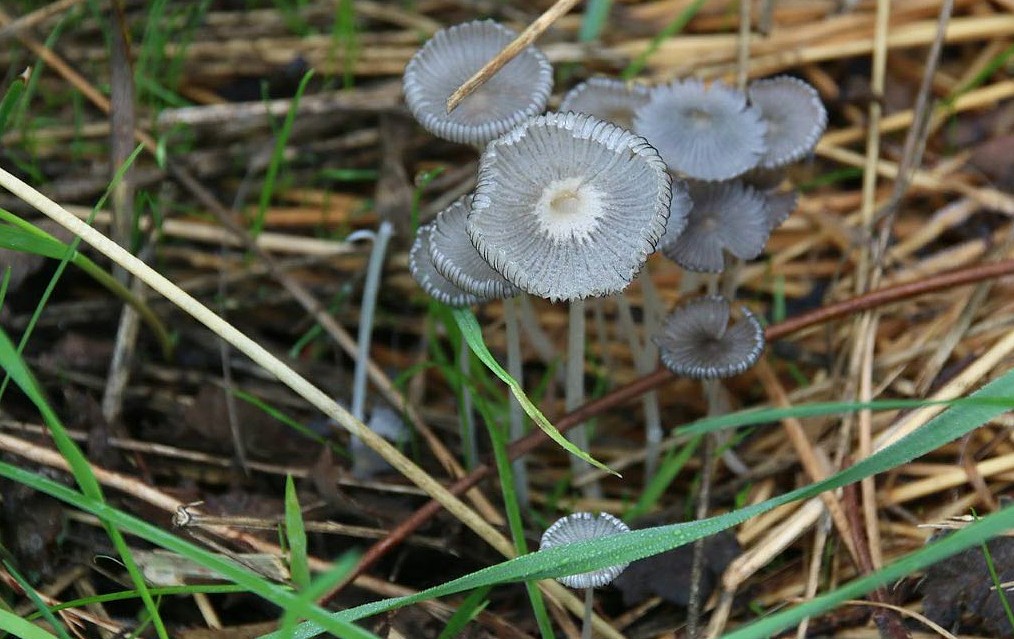
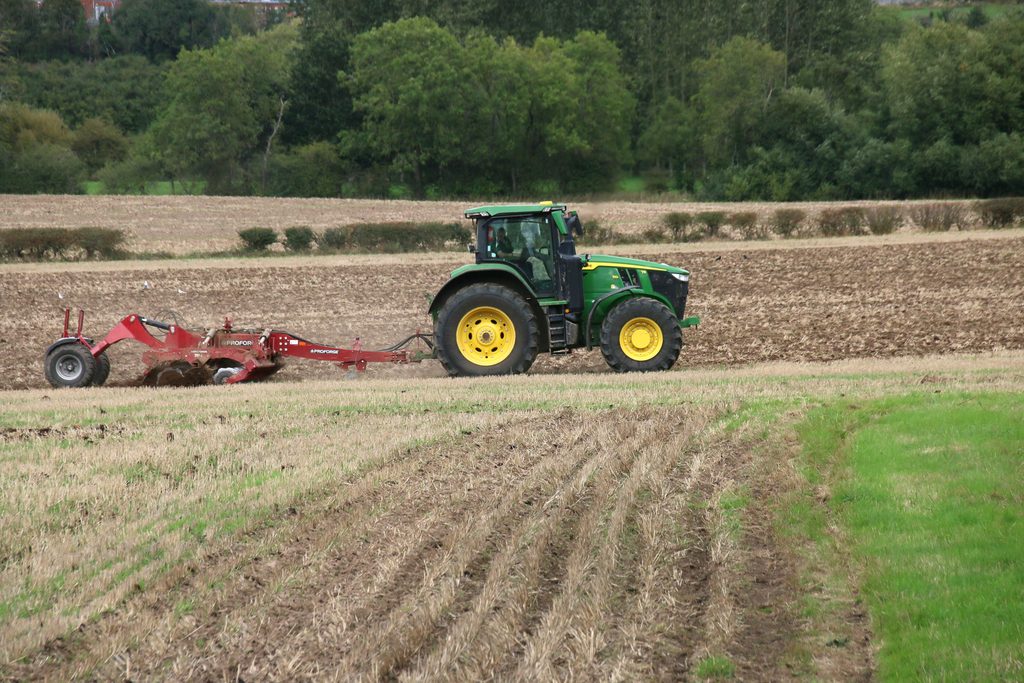
Among the long grass by the gate to the arable field behind our home, the grass now lush after recent rain, small grey Pleated Inkcap mushrooms have sprouted. These small, almost significant, fungi push up from the mycelium after overnight rain, produce spores, and die back, all within 24 hours. The patch that I observed will have gone tomorrow. The field has now been disced, following the discing of the lower field a few days ago, the top few cm of the surface broken up, and the stubble turned over and into the soil. We will see if “winter cereal” will be drilled this autumn, or whether the stubble will be allowed to break down over winter, and “spring cereal” will be sown in, as you would expect, spring.
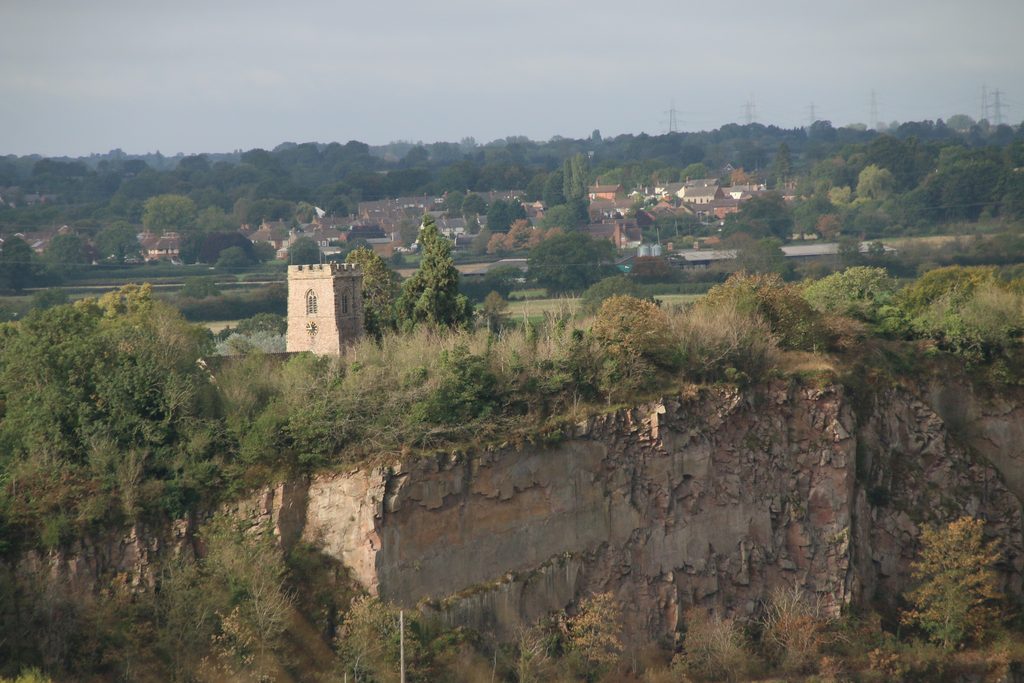
We stop for a chat with the owners of Taffy, a Labradoodle (I think!), who we often meet. The talk amongst the locals is the plans of the quarry, presented at a recent meeting in the village, to import inert waste from London to partially fill the 200m deep “hole”, over the next 9 years, allowing easier access to start quarrying granite on the far side of the excavation. There has been no blasting in the quarry for several years, since the steep sides almost meet at the bottom. Locals have long accepted the occasional dust, depending on the wind, and, until recently, the daily blast – in return we get large areas of public access managed land around and beyond the top of the quarry cliffs. Of more concern now is noise from 24-hour operation of trains and conveyors importing the inert waste. At home we are protected by Croft Hill, but many villagers will be close to the operation. The County Council will be receiving sharp responses to the planning application consultation.
6th September 2026
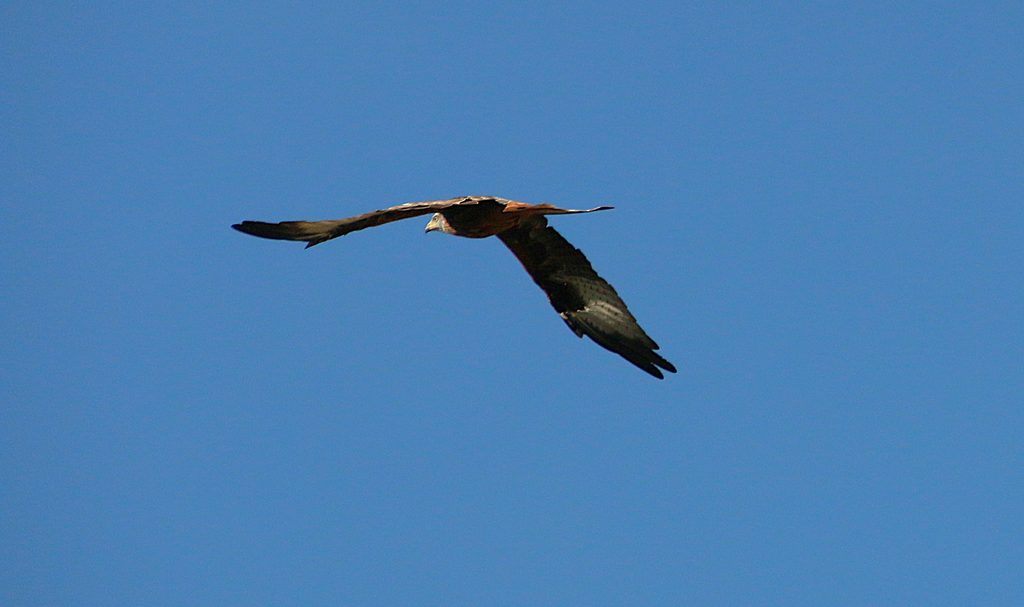
A pair of red kites circles over the stubble fields, the squeaking, almost mewing, calls seeming incongruous from such a large raptor. The calls of buzzards, also common above the fields, is not dissimilar, although somewhat lower-pitched, and almost eery. Buzzards have been the dominant raptor around us for as long as we have lived here, but in recent years red kites have become increasing common, and we often see both during our walks, sometimes flying low above us as they scan the field for prey. Both red kites and buzzards scavenge as much as hunt – it is probably the smaller kestrel that has the highest kill rate, preying on small rodents. We are lucky to see all three species on our walks. The population of kestrels is in decline.
The perimeter of the stubble behind us has been shallow ploughed, just turning over the stubble and breaking up the surface, leaving the almost all of field still in stubble. Once the wheat has been harvested, the grasses and wild plants from the adjacent field edge, left for wildlife and to accommodate the footpath, will have spread into the cultivated part of the field, and shallow ploughing the edges will help control this, as well as break up the surface, compacted by the passage and manoeuvring of farm machinery over the past year. In contrast the lower field has been completely shallow ploughed, in preparation for drill seeds. It maybe that the higher field will be similarly cultivated within the next week or so. Hopefully the stubble will be left over winter, sheltering insects, a source of food for birds in cold weather.
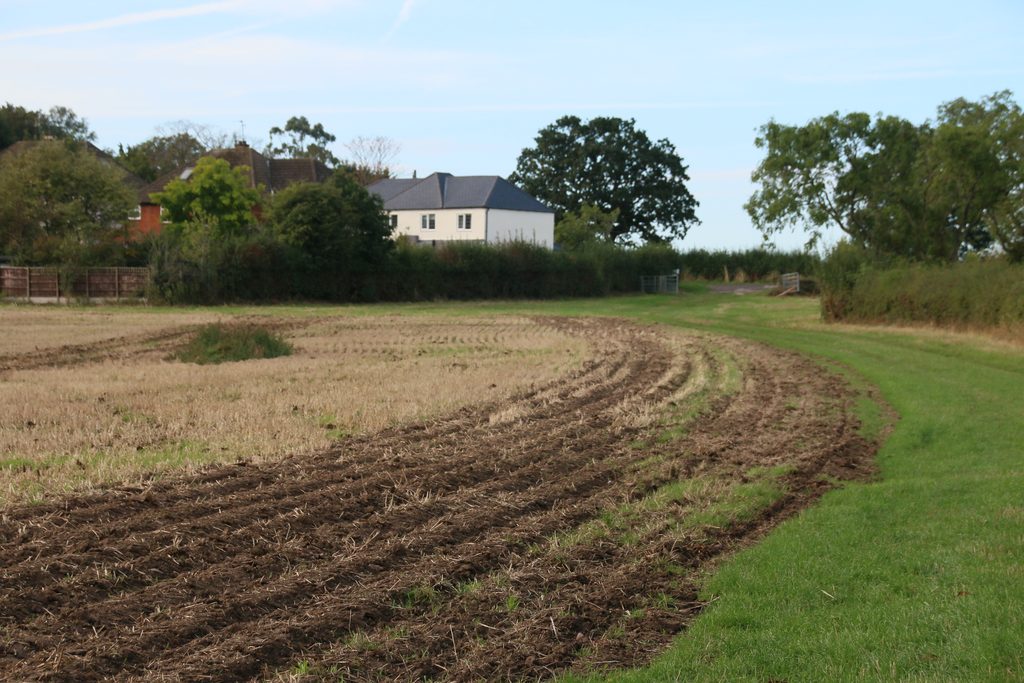
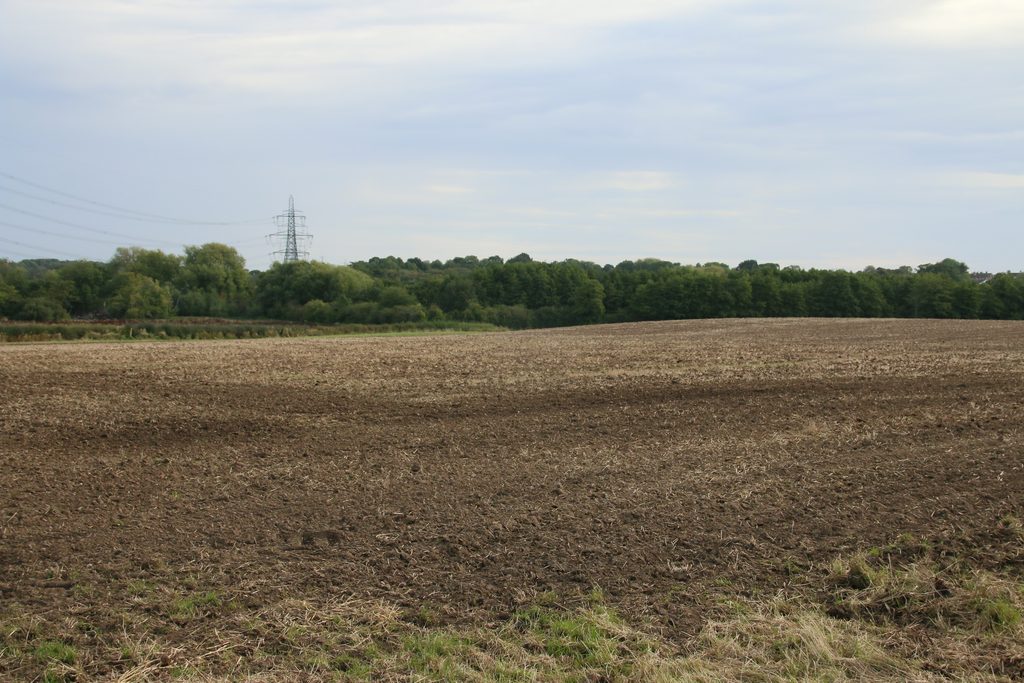
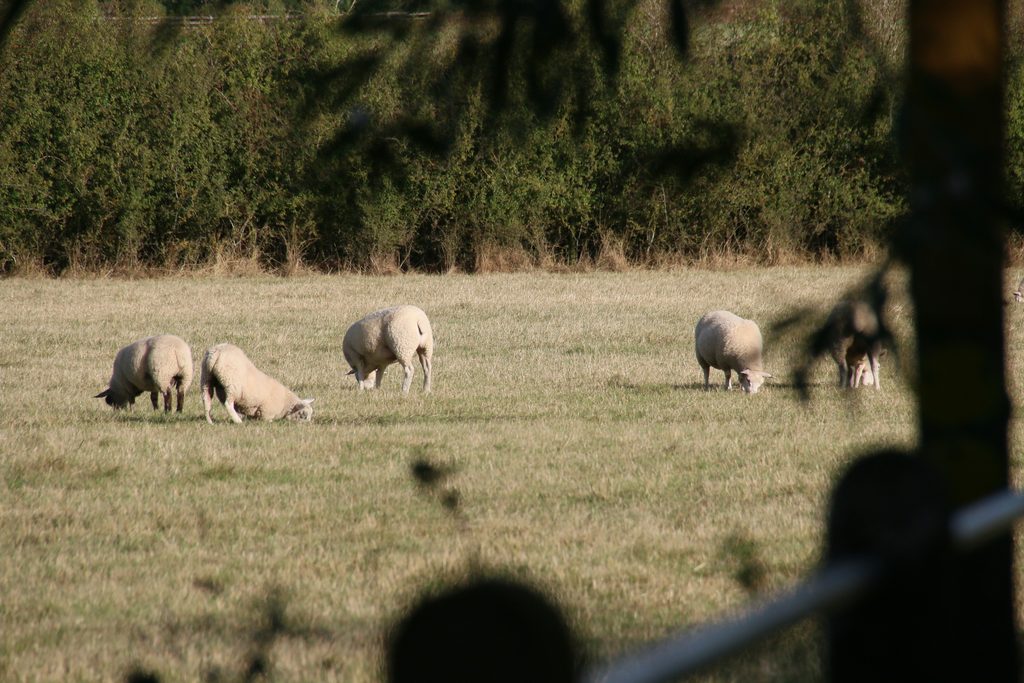
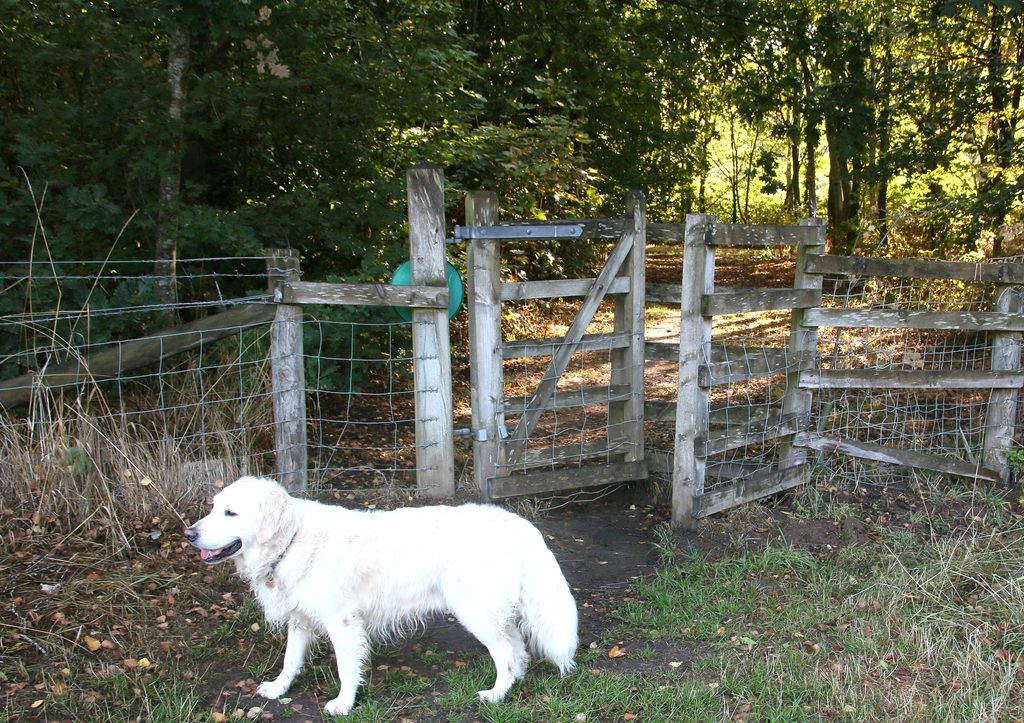
We turn right along the far field edge, and so the dogs can stay off lead. Sheep remain in residence in the meadow at the bottom of the valley, the aptly named, at least by local dog walkers, the “sheep field”, necessitating dogs being on lead if we had chosen to follow the footpath across the fields. Both ignore the sheep, but I am sure that of the sheep started to run, Sam would run after them, although would turn and flee if any sheep turned around. Better that both stay on lead, so that all remains calm. Last week two sheep appeared on the wrong side of the river. I called the farmer who I know has rented the field in the past. This year they are not his sheep. He agreed to tell the farm manager for the land.
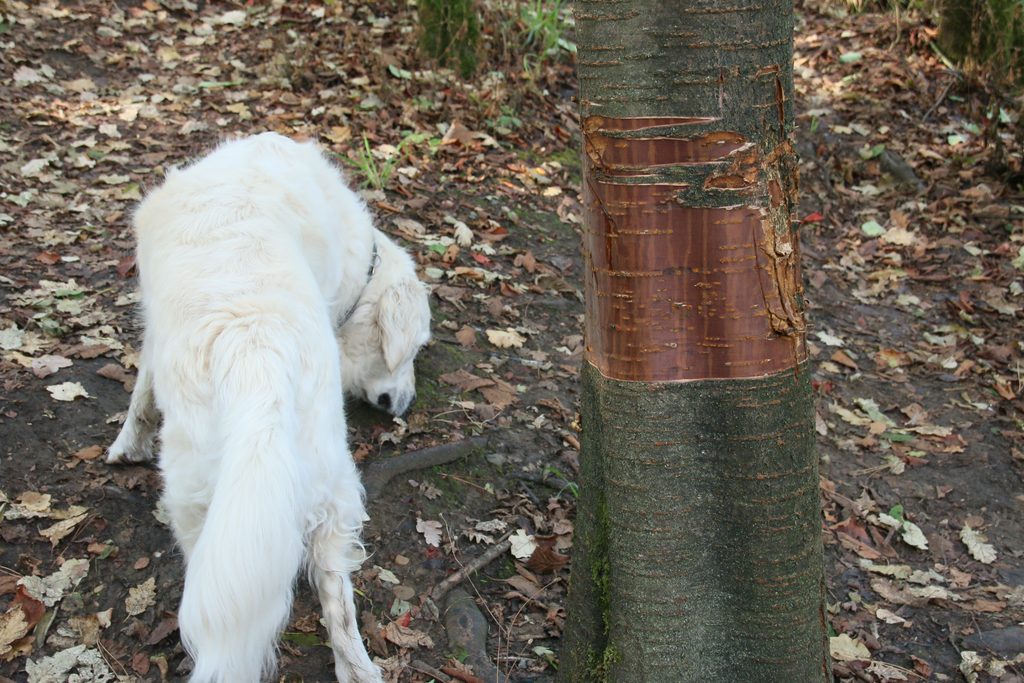
Walking through the woods up to Croft Hill, we come across a birch tree with a wide ring of bark removed. This may be damage caused by deer, but it looks too neat. It is possible that a deer pulling on a strip of birch bark will strip it in this way, but I have a suspicion that humans have been involved. Removing an entire ring of bark will kill a tree, since it removed the phloem and xylem, that “tubes” that carry water and up the tree and circulate the nutrients from photosynthesis around the tree and roots. Hopefully, if this bark has not been stripped too deeply, or enough continuous bark remains to
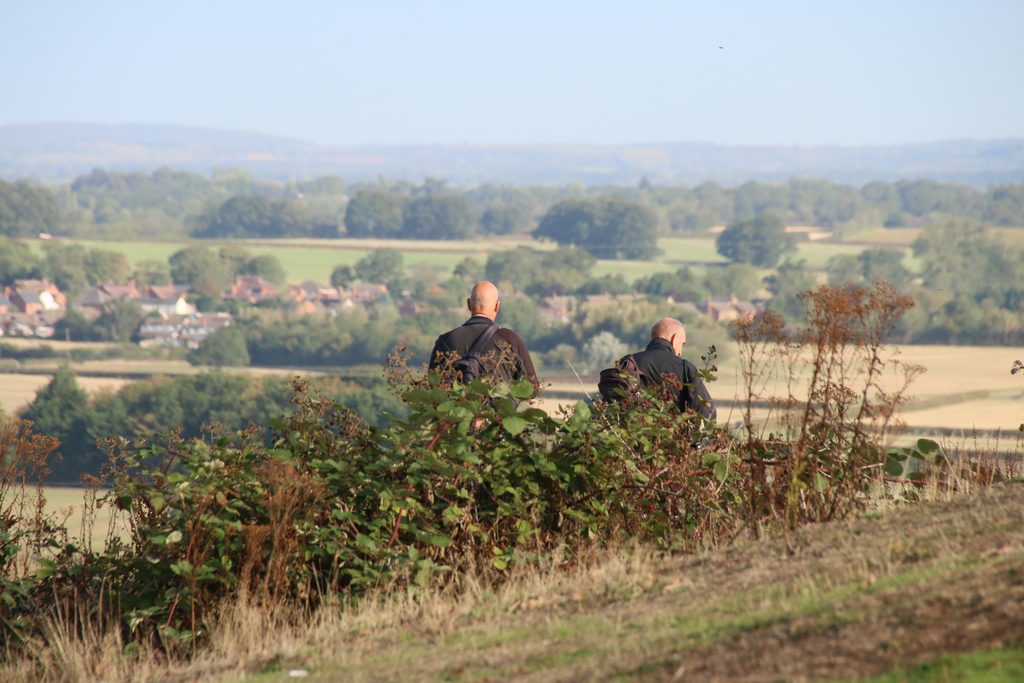
At the top of the Hill, we exchange greetings with a young lady and her poodle, sitting on a rock and enjoying the view, and with two birdwatchers, who are regulars on a Sunday. Unlike me, they have the patience just to stand and watch and observe what is around. Maybe I should do more of just sitting and watching. I’m not sure that the dogs would agree.
31st August 2026
The last day of meteorological summer, and the light has noticeably changed during my morning walk, the sun lower, the shadows longer, the light crisper. Morning walks feel more fresh, and the dogs are more lovely following scents into the trees and grasses, and returning with fur full of seeds, which must be brushed out on our return home.
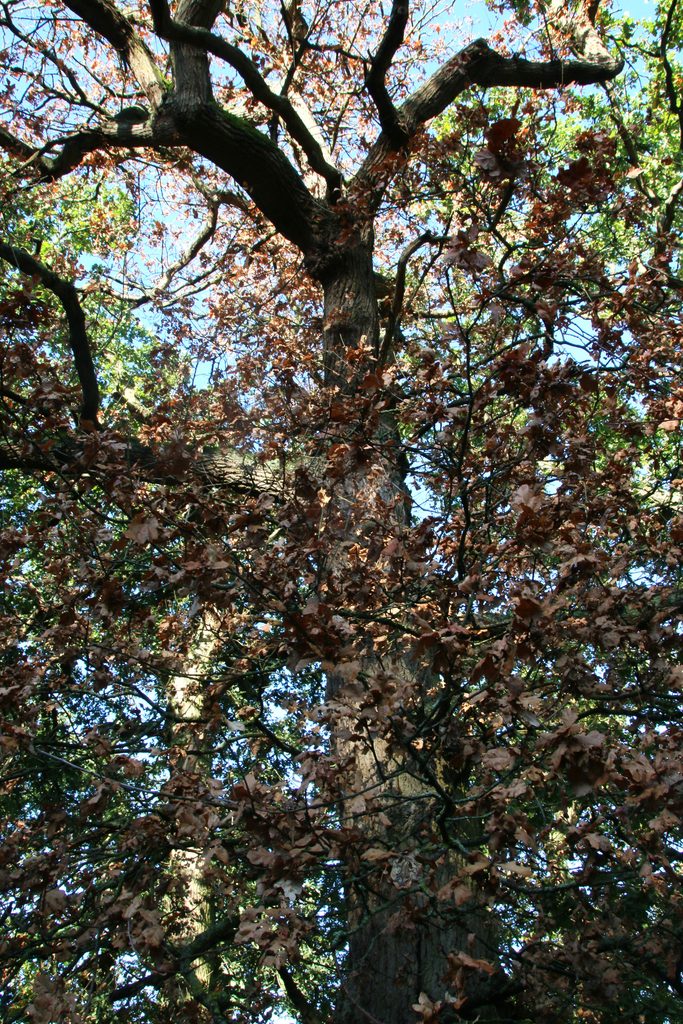
Trees and around the Hill, where relatively shallow soil overlies granite, have suffered during the long, hot dry summer. Even established oaks and elder, both of which tolerate prolonged dry conditions, look dead, leaves hanging limp and brown. Hopefully they have survived and will sprout fresh green leaves next spring, elder one of the earliest plants to come into leaf, and oaks one of the last.
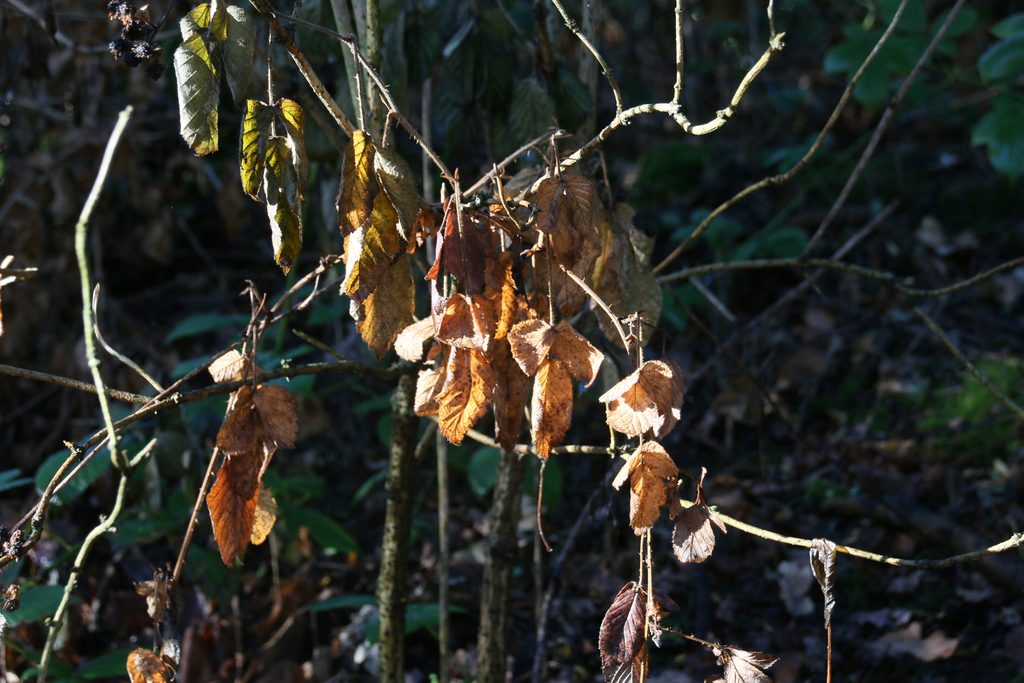
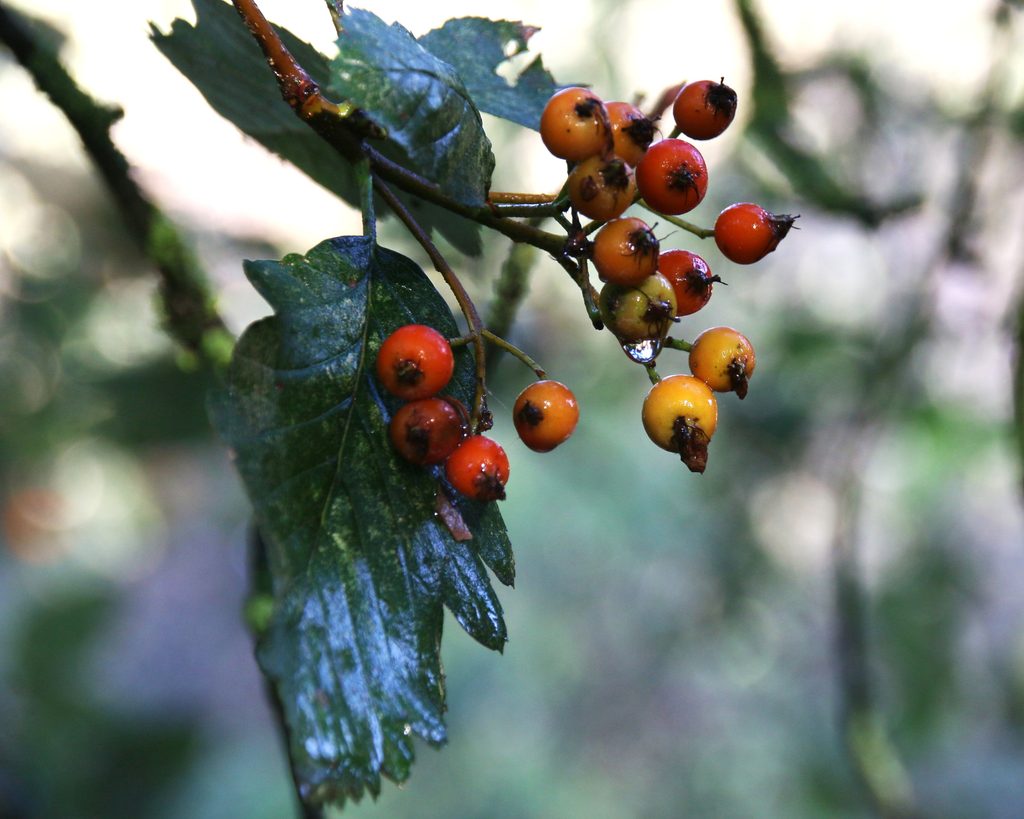
Along the routes around the Hill, whether the drought has stressed individual plants varies considerably, thanks to the variation in soil depth. In most seasons this makes little difference, other than the leaves on some mature trees turning brown a little earlier than others off the same species in the vicinity. It is more obvious this year. Just a short distance from the browns of the elder and oak, we walk down the track from the Hill, moving further from the Hill and quarry, and shrubs are green, with hawthorn bearing healthy red haws, dripping after heavy overnight rain.
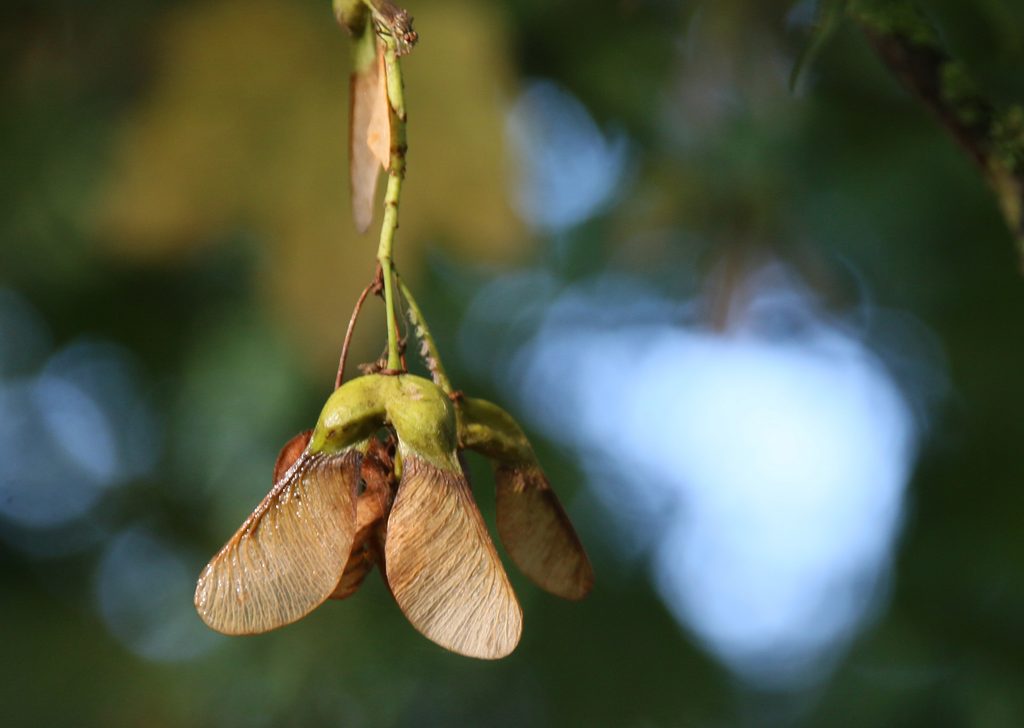
Continuing along the track down to the village a sycamore is thriving and has produced winged seeds, “samara”, commonly called keys, or, to more modern generations of children, “helicopters” since they spin when they free-fall to the ground. Maples have similar seeds, but the two branches are 180 degrees to each other. As with the haws, birds will be grateful for those trees and shrubs still able to provide fruit and seeds despite the drought. The drought has resulted in fewer seeds, berries and insects this year, which may be detrimental to migrating birds who need to sustain themselves for long journeys, and those species who need to be in good condition by the end of autumn to survive a British winter.
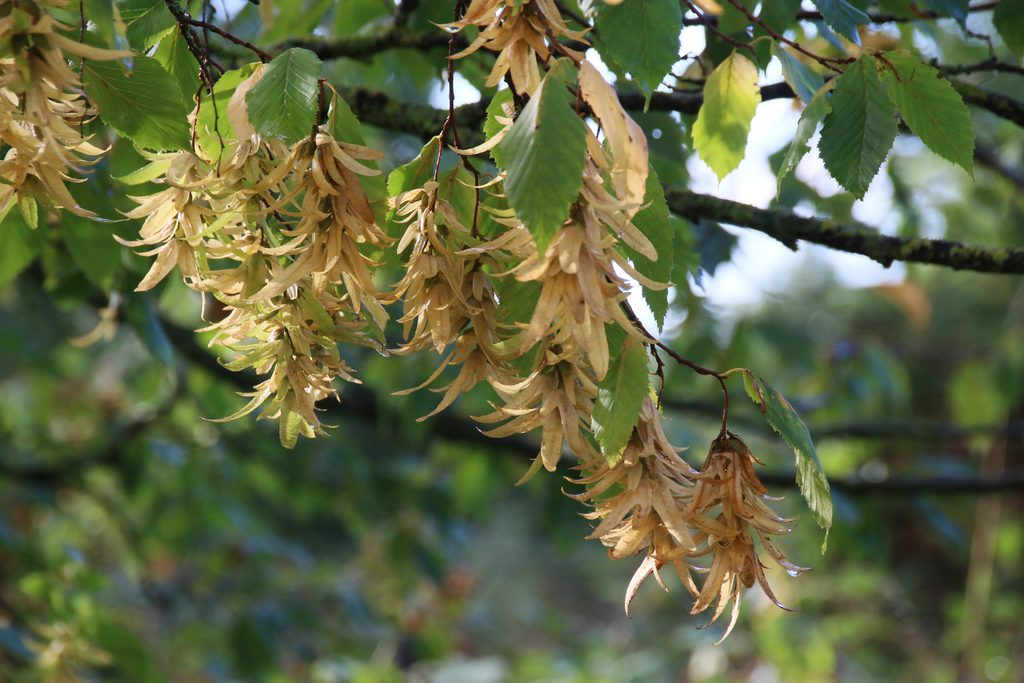
We cross the road and through the gap in the hedge into the Glebe, an area of grassland and trees, where the dogs like to follow the scents of wildlife and other dogs that have visited this popular dog walking route. A mature hornbeam has produced an abundance of papery seeds. “Wild” Hornbeams are more common in the south and east and are an indication of ancient woodland. That is not the case here. This land was once the village cricket field, now located closer to the village, with other sports facilities. This original cricket field was edged with mature trees of different varieties, in particular horse chestnuts, and it is likely that this hornbeam was planted when the cricket field was established in around 1900. The field is now managed by the Woodland Trust, who have planted many more trees between the originals.
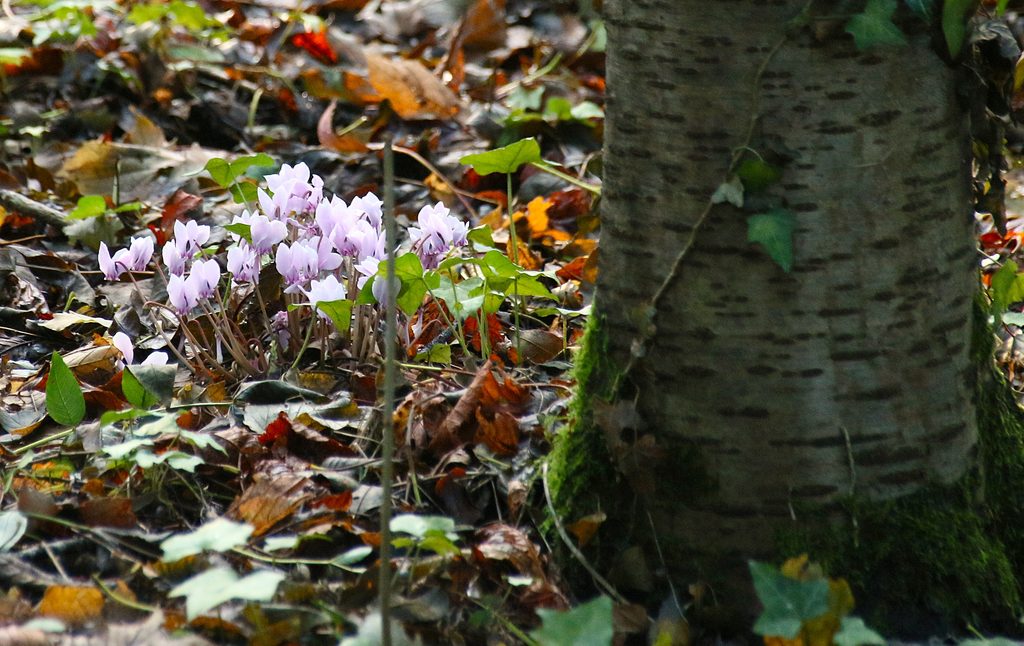
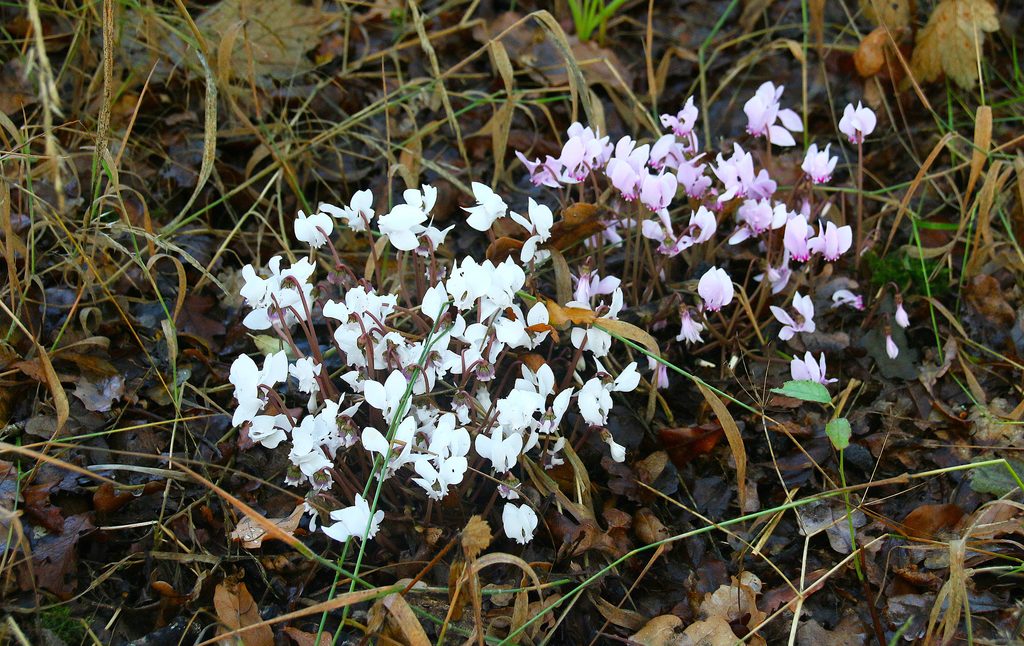
Walking back up the footpath to home, autumn cyclamen is in bloom, both next to the path and in adjacent woodland. It is flowering a little earlier than usual, cheering up the still brown grasses and leaves left from summer flowering plants. Cyclamen spread slowly and the small patch of flowers next to path has not spread much over the years. Regular dogwalkers look out for the blooms as autumn approaches and exchange the news “Have you seen that the cyclamen is in bloom by the footpath?”.
28th August 2026
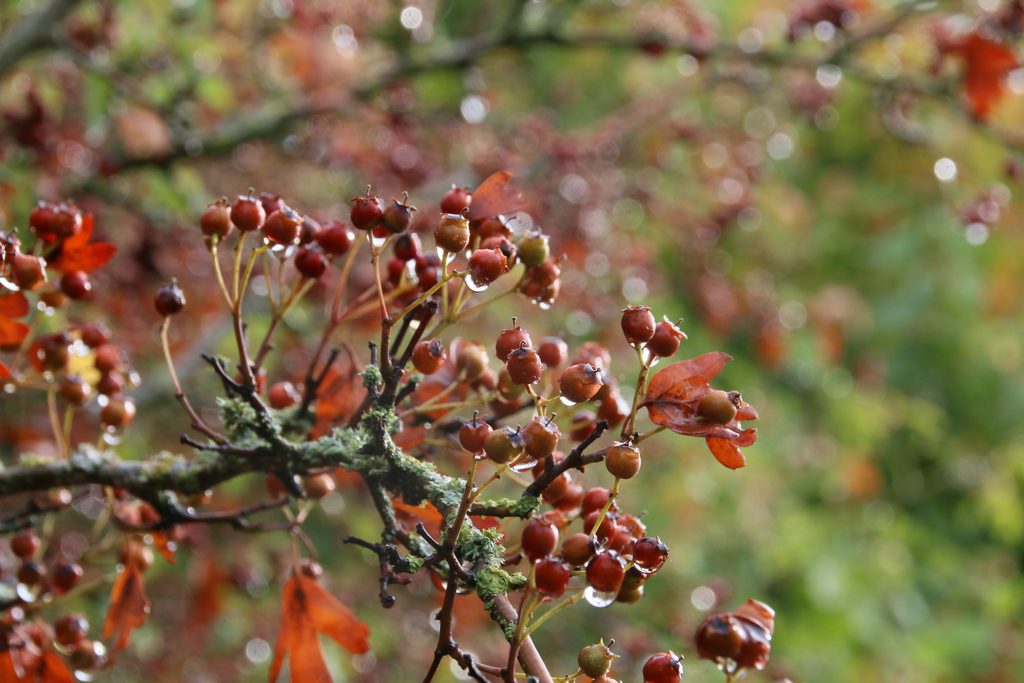
We have had rain. At first a day of heavy showers, and then a day of heavy rain and thunderstorms. Water cascaded down Croft Hill, and down drives along the Lane, overwhelming drains and flooding garages. This morning water-covered haws glisten, and the path beneath is muddy for the first time in months.
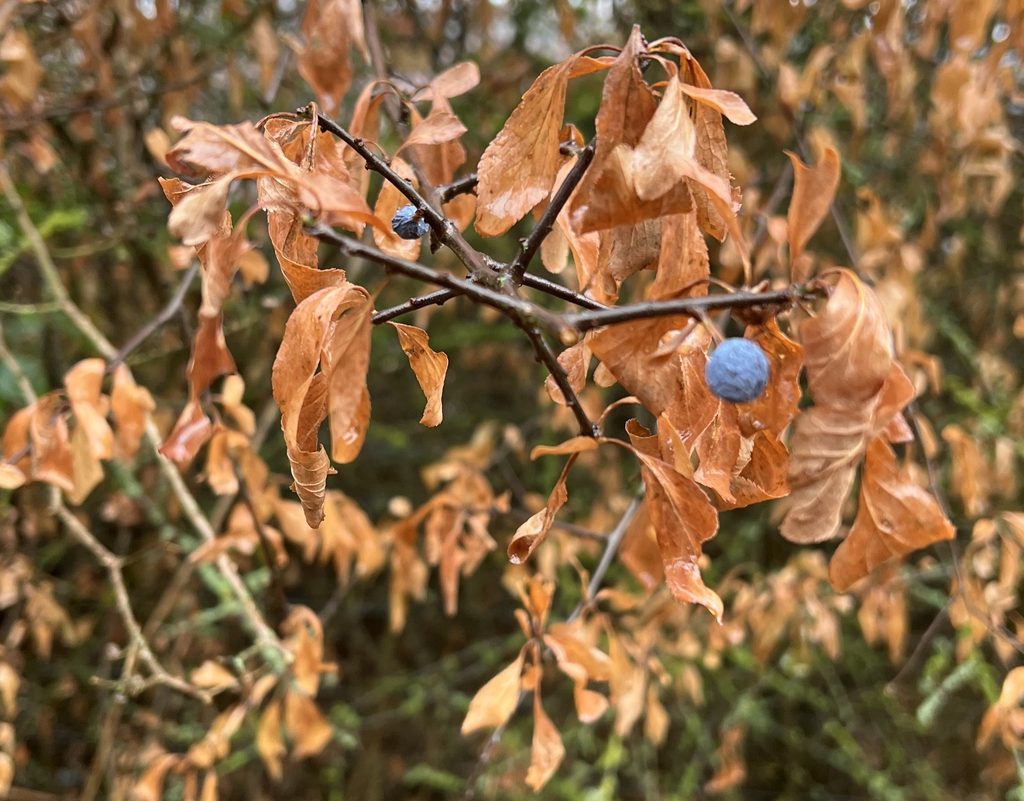
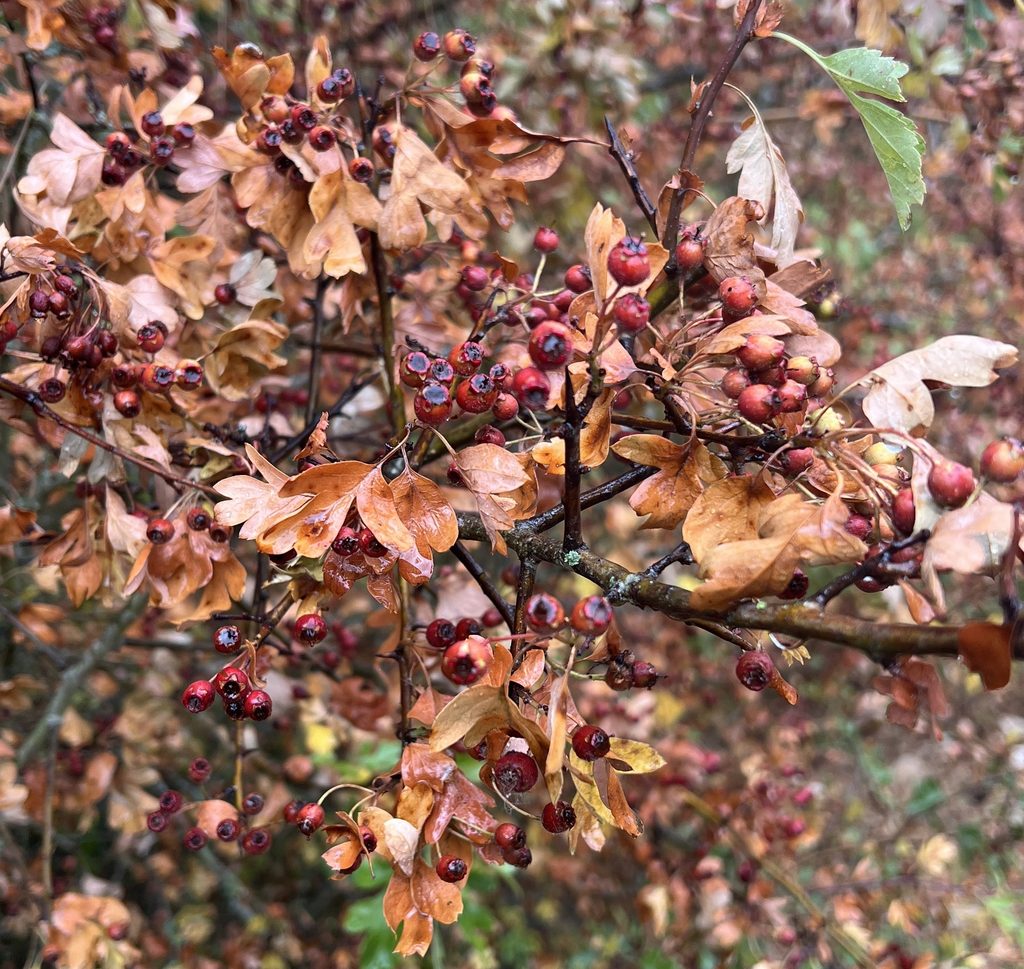
But it may be too late for some shrubs and trees. Around the quarry blackthorn bushes have a sparse crop of purple sloes surrounded by desiccated leaves. Hawthorns have a better crop of red haws, but the hawthorn leaves have died. Brambles have blackberries, but the usually vigorous robust bramble spurs are mostly brown. Rain has been promised in the weather forecast for a week or so, and I thought that the shrubs, although under stress from the drought, would survive long enough to benefit from prolonged rain.
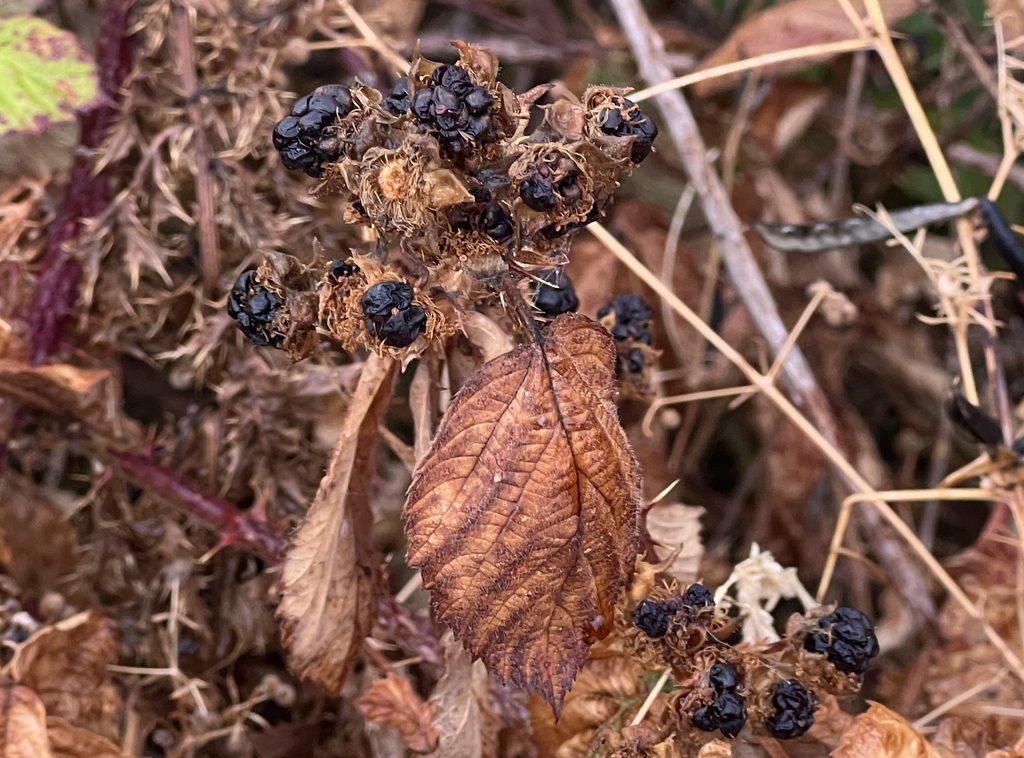
The dry brown leaves are, of course, a survival mechanism. Each apparently dead shrub has given up photosynthesising, sacrificing the production of sugars by green leaves, the energy to grow, in order to conserve water, and hopefully recover next year. We will only know what has survived next spring, when we will see which plants have produced green buds of young leaves.
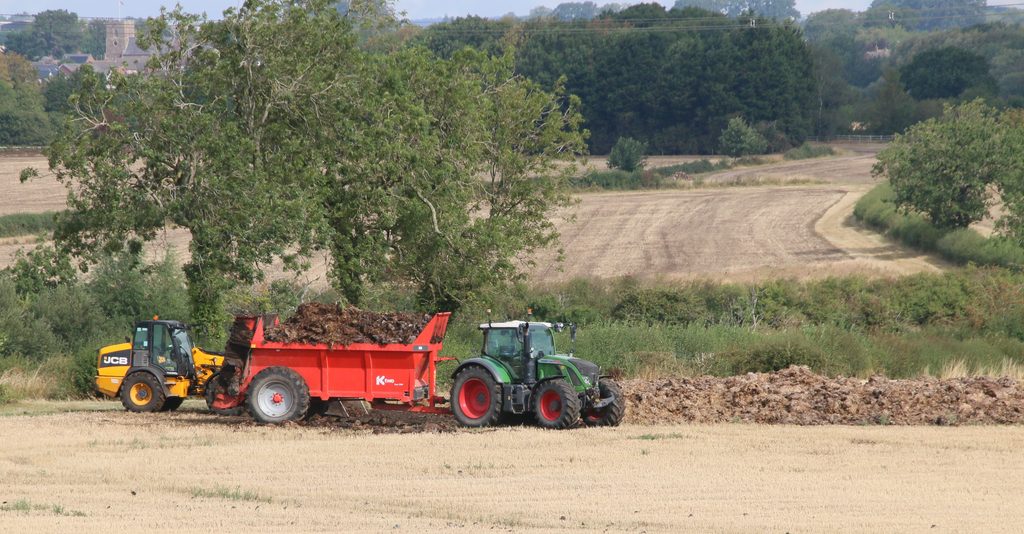
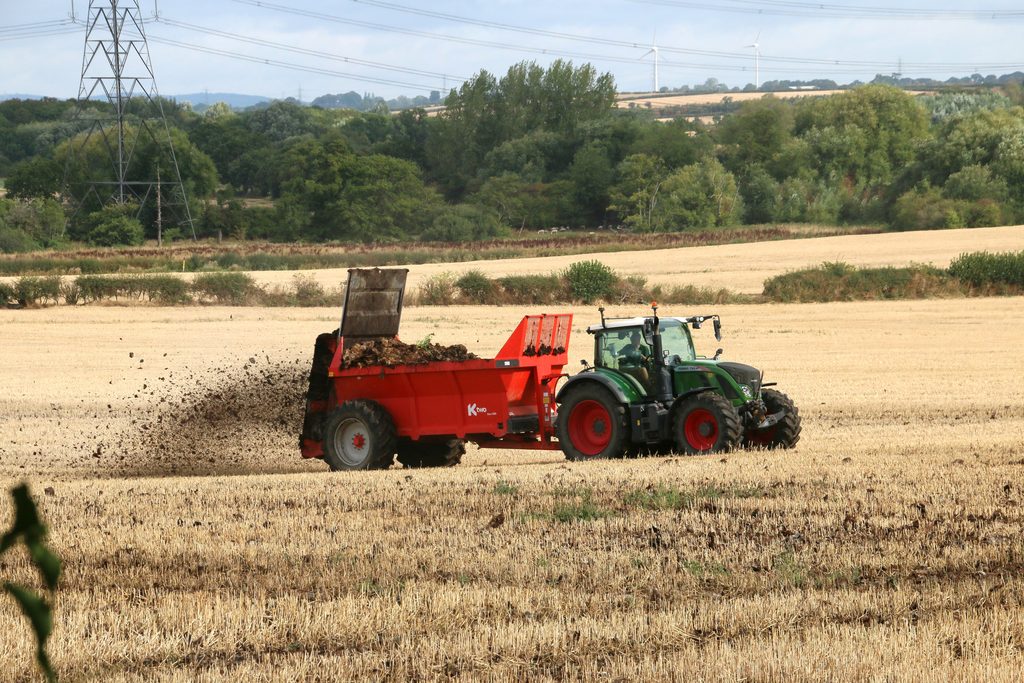
With the change of weather, the manure pile in the fields behind us has been spread across the stubble. Falling rain and wet soil will allow bacteria to break down the mature manure, releasing nutrients for next years crop. Manure spread under the hot dry conditions that have dominated until the last week would have dried out, delaying the process of rotting and absorption into the soil. By leaving it in the heap only the outer few centimetres will have dried to a crust.
19th August 2026
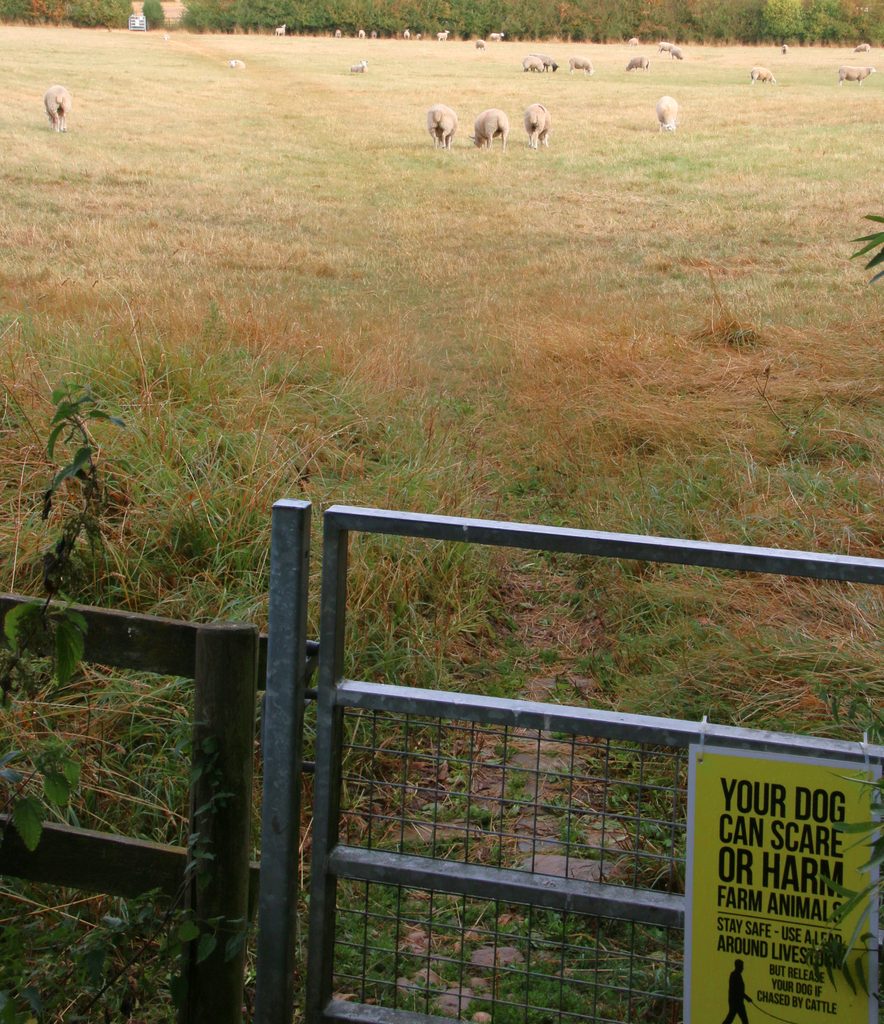
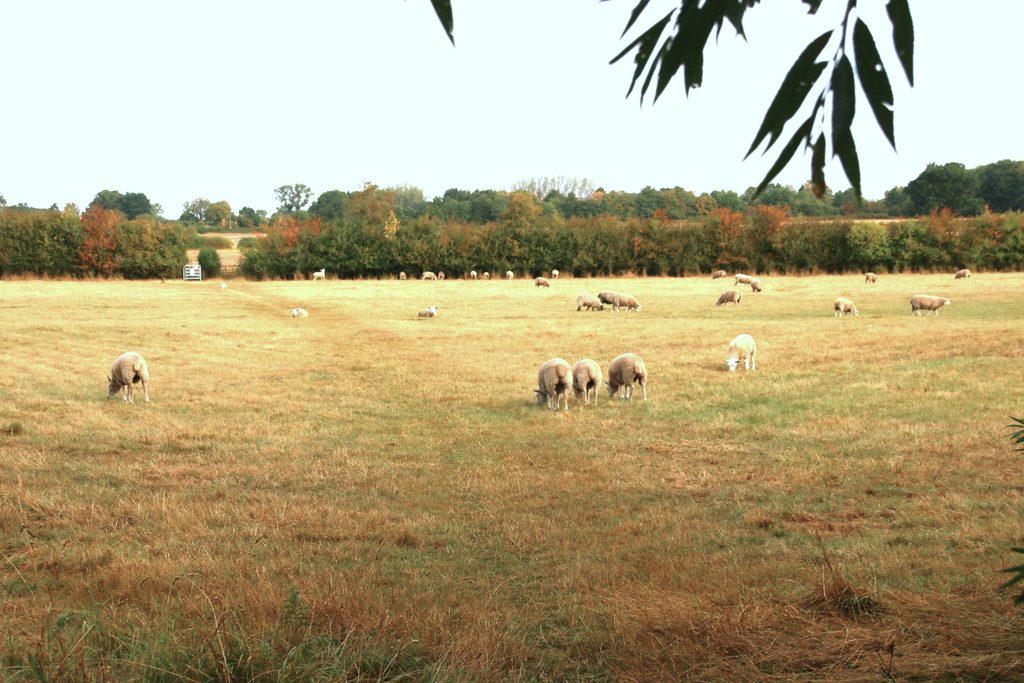
For two weeks the “Sheep Field” has been occupied by just ten rams, who have generally stayed together grazing the far end of the field, easily avoided, and allowing dogs to run free in the rest of the field. Today there are a lot more sheep – a large flock that take up all of the field, especially since the dry grass is poor grazing, and the sheep spread themselves out to make the most of the few patches of green. The farmer will be supplementing the grazing by bringing in feed. We can no longer have dogs off lead – our two would probably not chase sheep, but “probably” is not enough. A footpath crosses the field, and if we take this route leads are attached and detached on either side.
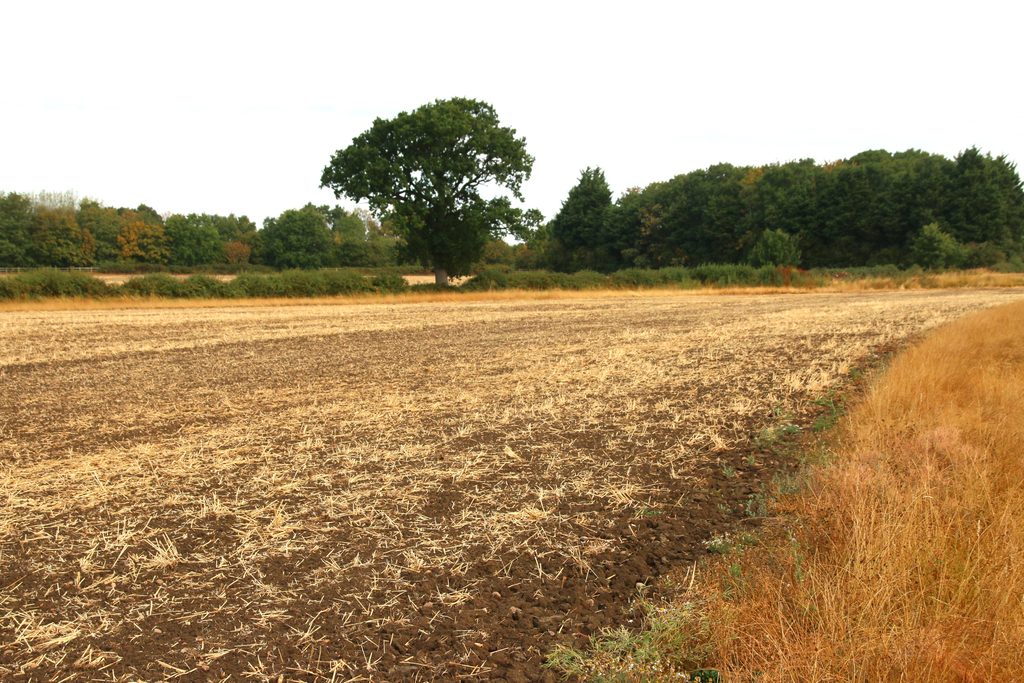
The fields on the far side of the sheep field have been ploughed, the soil now a fine tilth with stalks of stubble mixed with the soil. Presumably these fields will be planted with winter cereal, maybe wheat, cereal drilled (sown) in autumn to begin growing before winter, getting a head start when the soil warms in spring. I have seen no spilled seeds, and so I don’t think that the fields have been drilled yet.
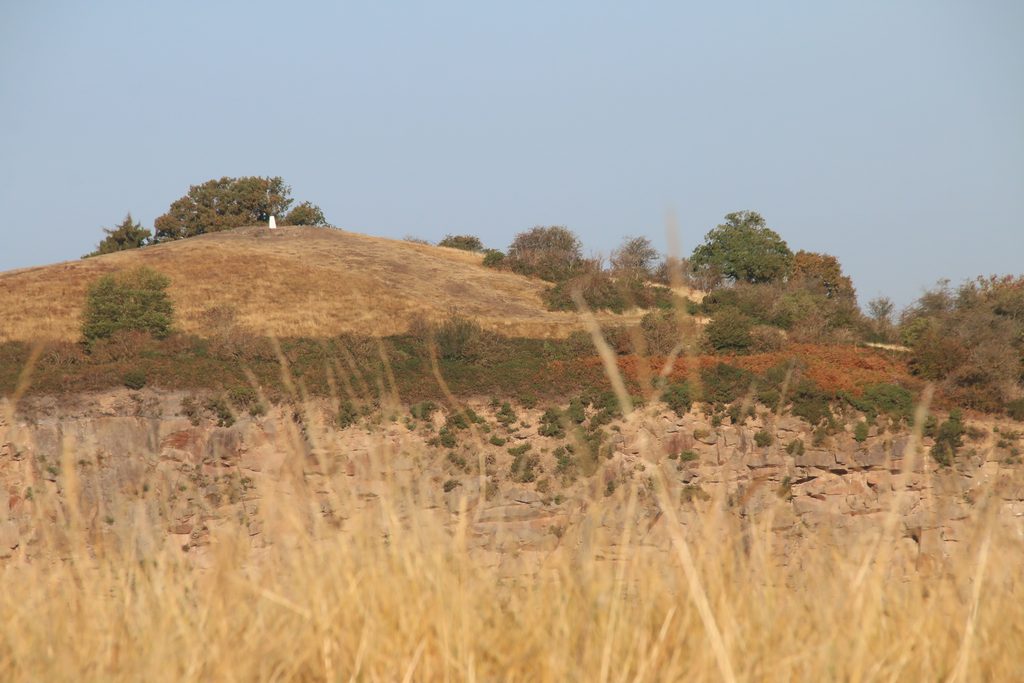
Looking back from the sheep field, Croft Hill rises above the quarry cliff, 50 shades of brown with just trees breaking up the dry beige. The landscape is desperate for rain.
12th August 2026
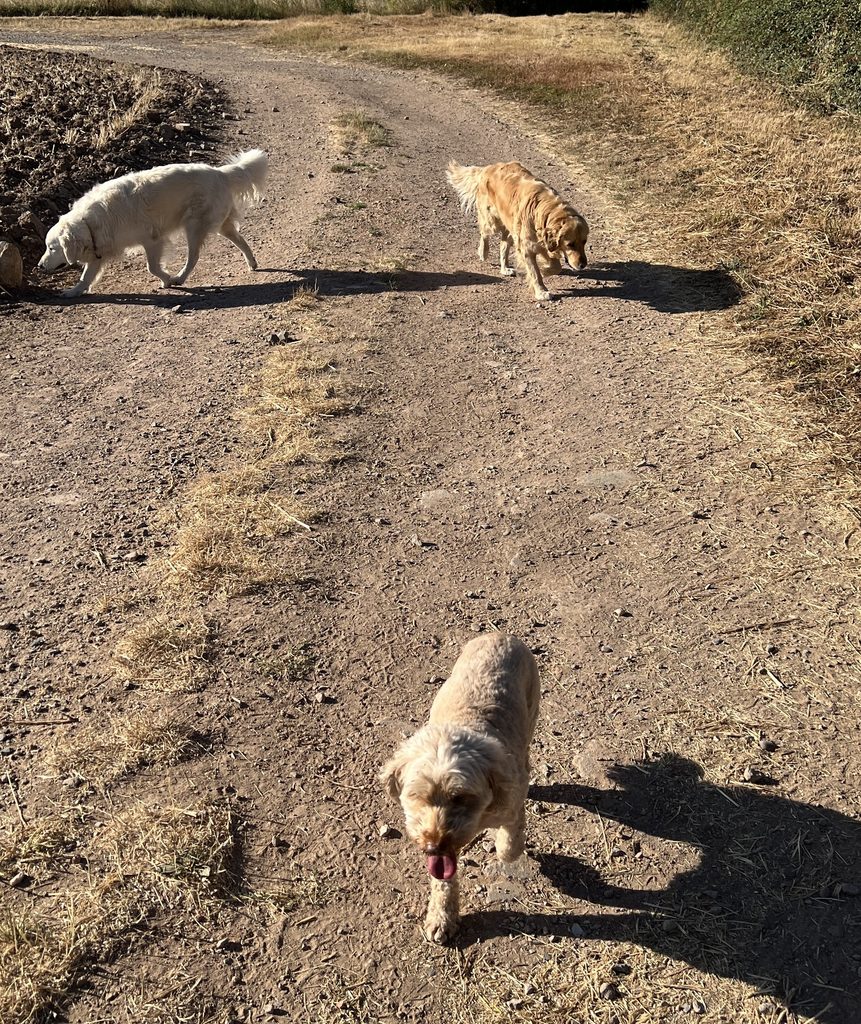
We are dog-sitting for my step-daughter, looking after her Cockapoo Sylvie for a couple of weeks. The tracks along our routes are dry and dusty, the dogs raising clouds of fine dust at anything faster than a slow walk. If they wander off the path into the dry grasses at the edge, our two come home covered in small seeds attached to their fur. Whether it dust or seeds, the Goldies need to be brushed when we get home. The neatly trimmed cockapoo comes home clean.
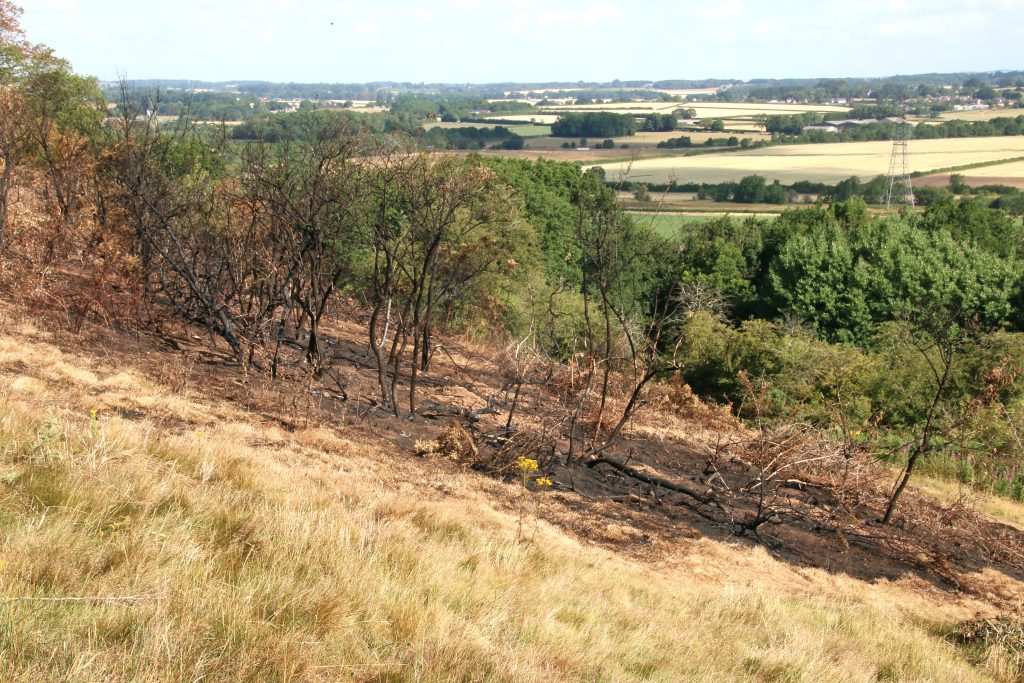
Along a field drainage Common Reeds provide a splash of green between the browns of thistles that have gone to seed, the deep-rooted reeds having found some water below the bottom of the ditch. Higher up on Croft Hill brambles are the only greenery among the dry grasses on the hillside. Wildflowers have affected many parts of the UK, but so far, despite being a popular spot for visitors, there have been no wildfires on Croft Hill, unlike last year when a disposable BBQ set one side of the Hill alight. Charred branches are still visible in one area.
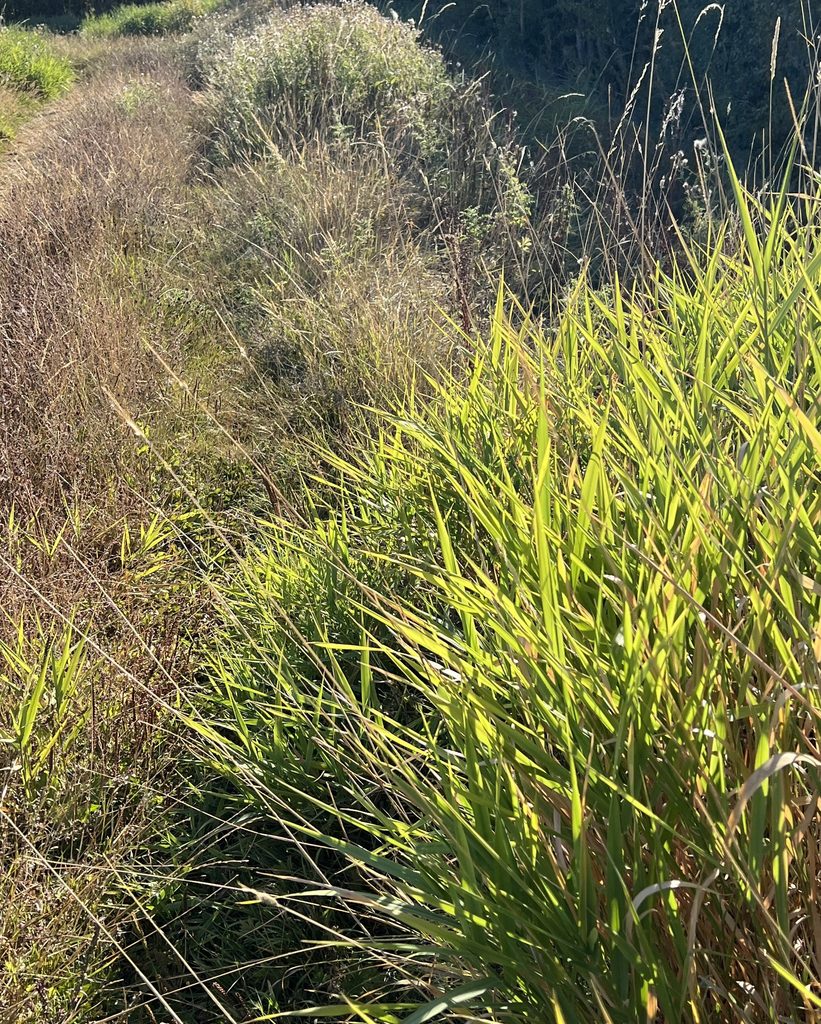
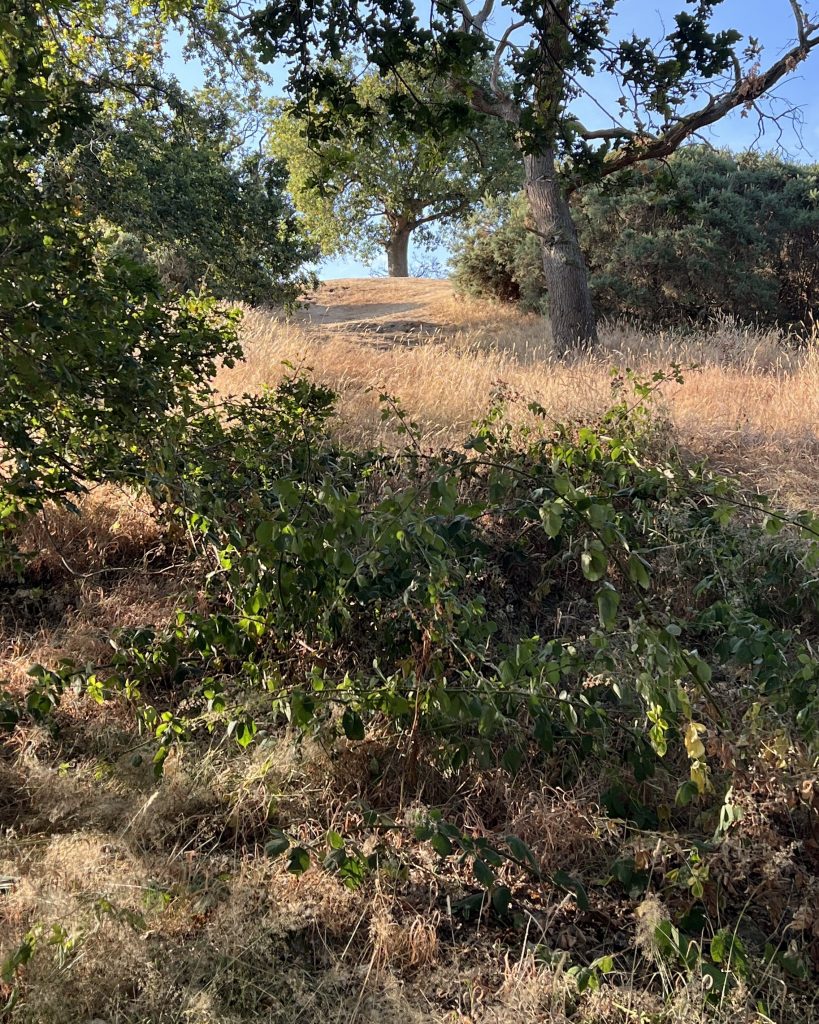
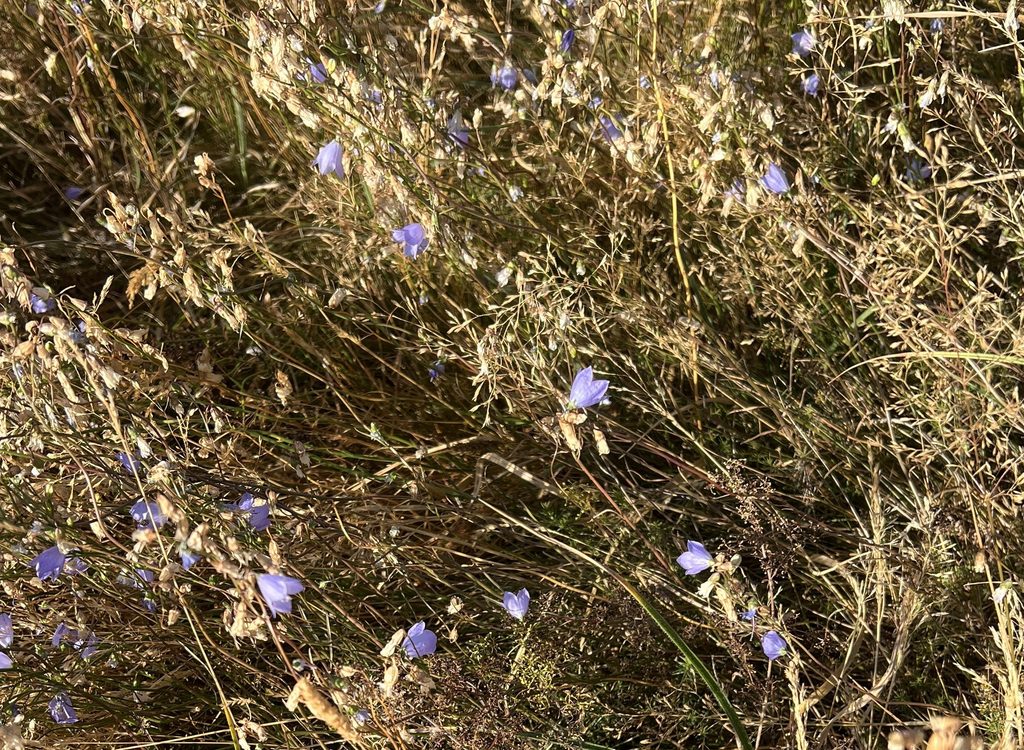
Among the dry grasses near the top of the Hill Harebells are of the few wildflowers still blooming through the drought conditions. Harebells tolerate most conditions, but even these robust wild plants have lost their vibrance in the prolonged dry conditions.
At the “summit” of Croft Hill, the soils is shallow over the underlying granite, that breaks out beside the Trig Point. The stress of the drought to the grasses between the stones has been exacerbated by heavy footfall from visitors to the top of the Hill during the long period of fine weather. Grass will generally recover after the first significant rain, but up here tufts have been worn away, and the exposed soil may well remain until next Spring.
8th August 2026
Still no rain, and most of England is officially declared as being in a drought. In our area, unlike in many other regions, there is no suggestion of a hosepipe ban, maybe because our water company, Severn Trent, has reservoirs in relatively wet Wales.
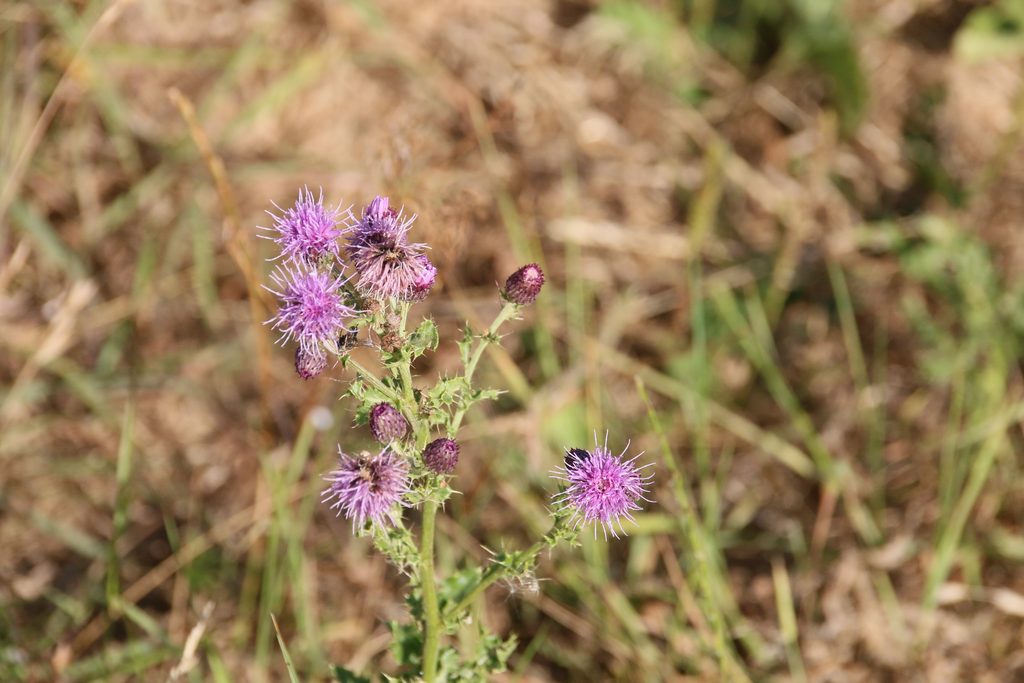
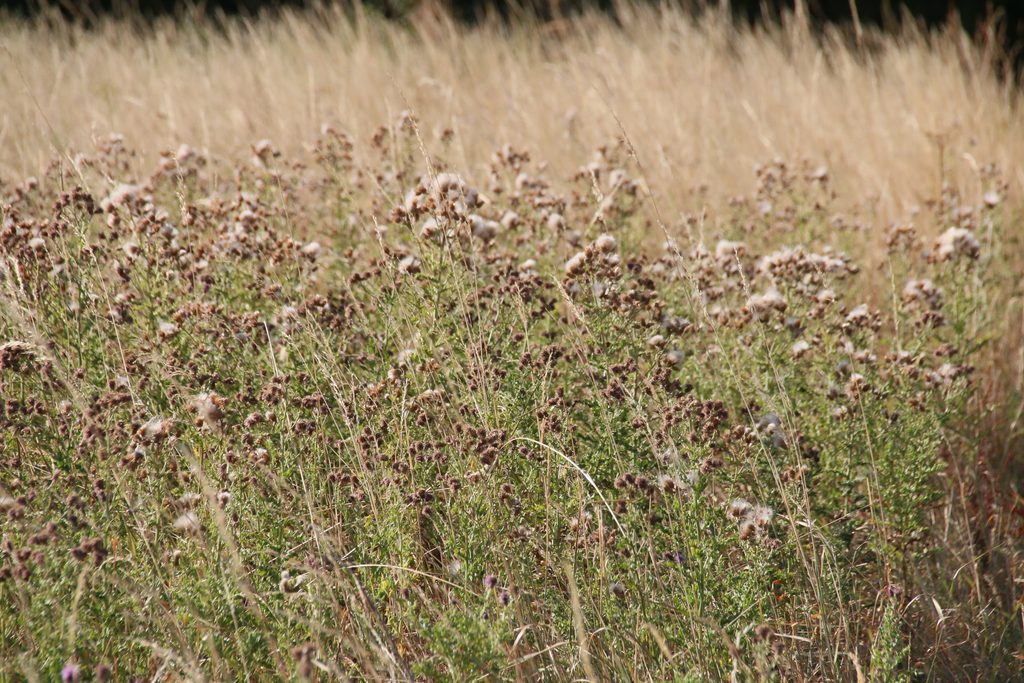
The only splash of colour in the countryside is provided by creeping thistles, which have evolved to cope with dry soil, but even these robust plants have “gone to seed” in most area, the flowers only remaining where deep roots have found some moisture.
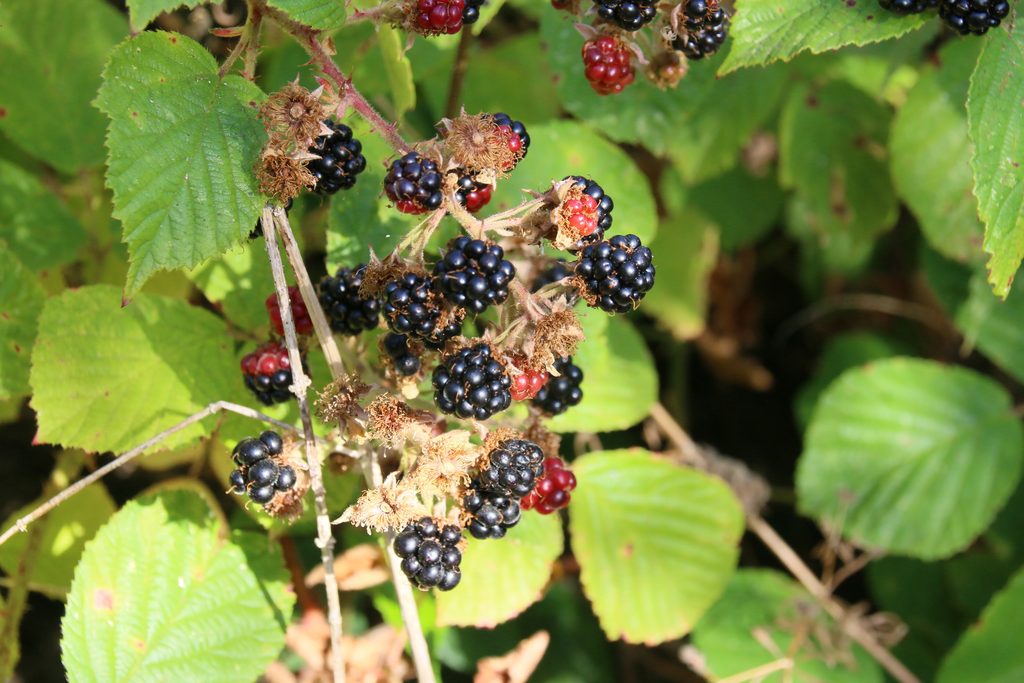
Even the brambles, usually invasive, taking advantage dry weather to out-compete less robust plants, are now wilting, although are still green against the browns and beiges of most of the countryside. There are blackberries on the brambles, and have been for several weeks, but a single cluster displays all stages of the fruit, from green and unripe, through juice purple to brown seed heads. This is not uncommon on individual brambles, but fruits on individual clusters are usually at the same stage.
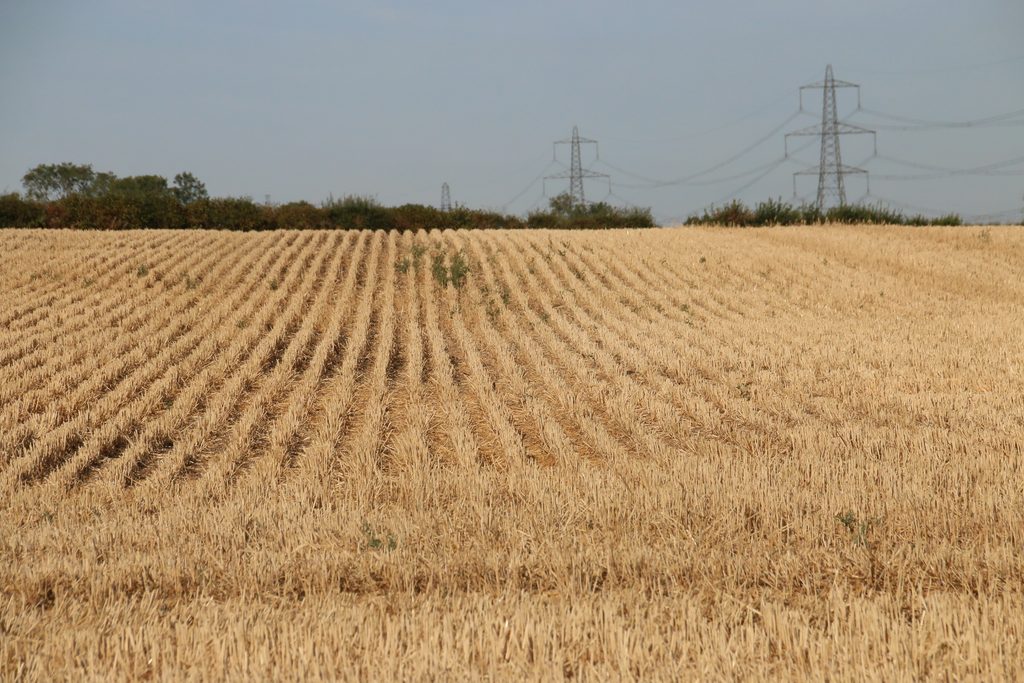
The field behind us has been stubble for several weeks, following the harvest. In a normal season grass seeds in the gaps between the lines of stubble, exposed to light and rain after months of being shaded by tall wheat, would rapidly sprout. This year only isolated weeds are green against the golden stubble.
2nd August 2026
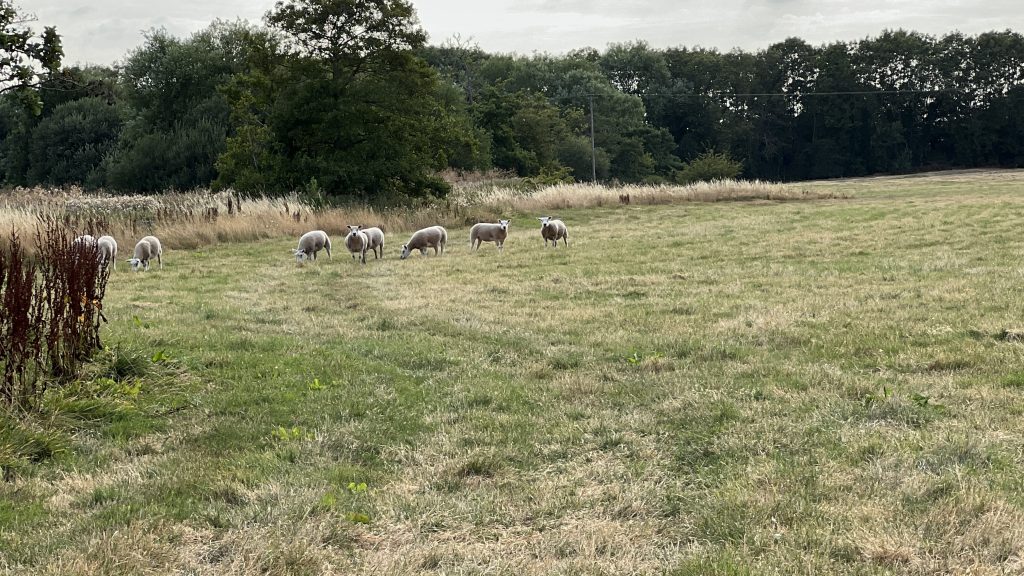
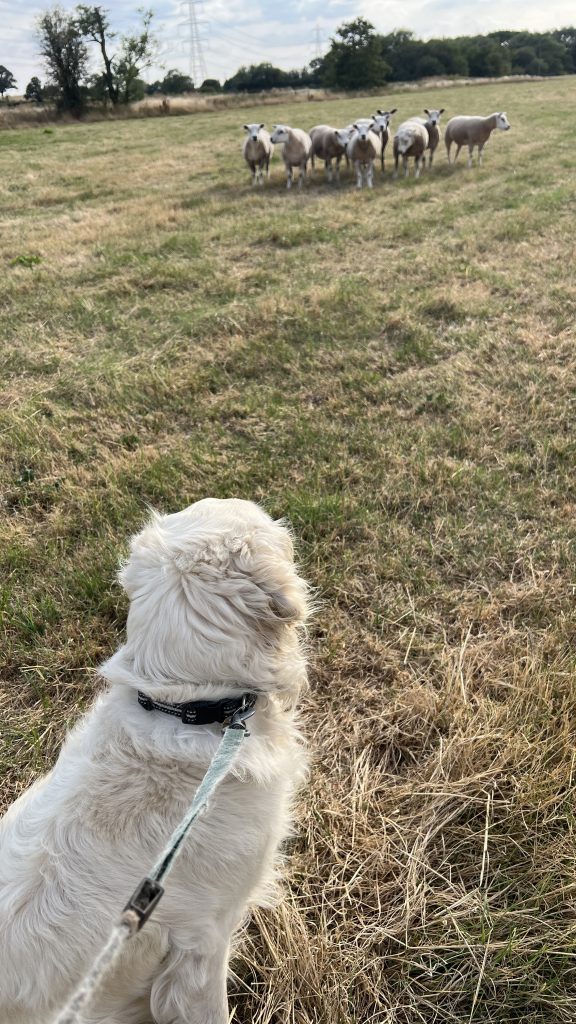
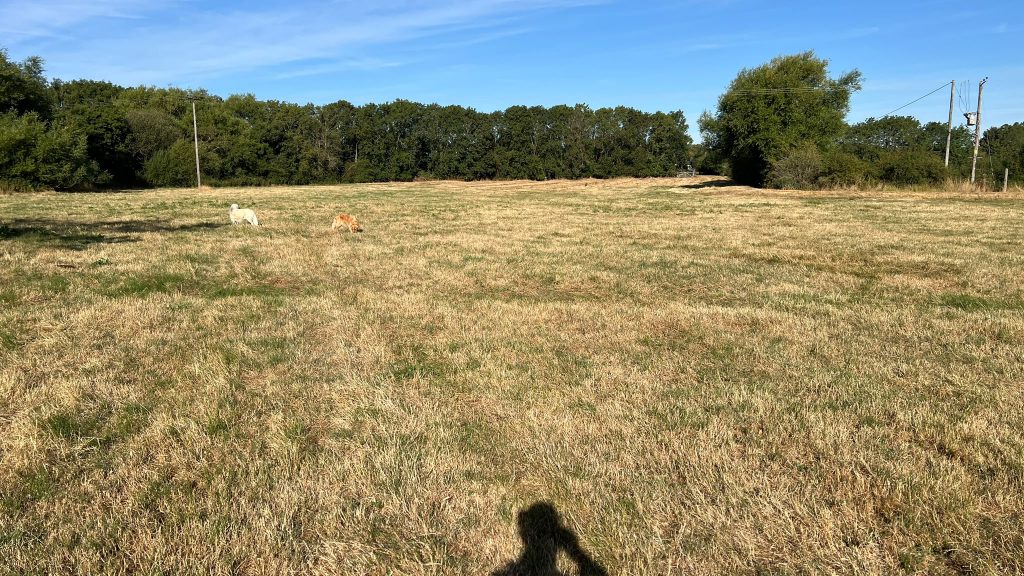
We have been used to the “sheep field” being a convenient dog walking route – a walk down to the field and a full circuit is a couple of miles, and the dogs get to run around and play, and follow scents of the hares that we often see (and they occasionally optimistically chase but never get near), and the muntjac deer that we only rarely see. Normally at this time of the year the grass is knee high, and we must follow well-worn paths, but this year there the greenery is restricted to sparsely patches of tufts, the surrounding grass short and baked-crispy.
It is a surprise when we meet sheep on one of our circuits, chunky rams that are curious and wander over to check us out, by which time the dogs are back on lead. When sheep are introduced into the field there are usually two or three dozen, spread out over the field, but there are just ten rams, presumably because the dry stunted turf will only support a few sheep, with the only greenery being thistles and small patches of field-edge nettles. The farmer has cleared vegetation on the riverbank to allow the sheep to easily access water, in addition to a trough in the field.
In the days following the surprise discovery of the sheep we notice that the rams tend to reside at the furthest end of field, the more shady end, and the end which, in normal years, has the most lush grass. This year there are merely more green thistles and nettles. Generally, by carefully peering into the hidden areas, created by riverside shrubs, to confirm the absence of sheep, the dogs still get a run during the very early and very late walks necessitated by repeated heatwaves.
24th July 2026
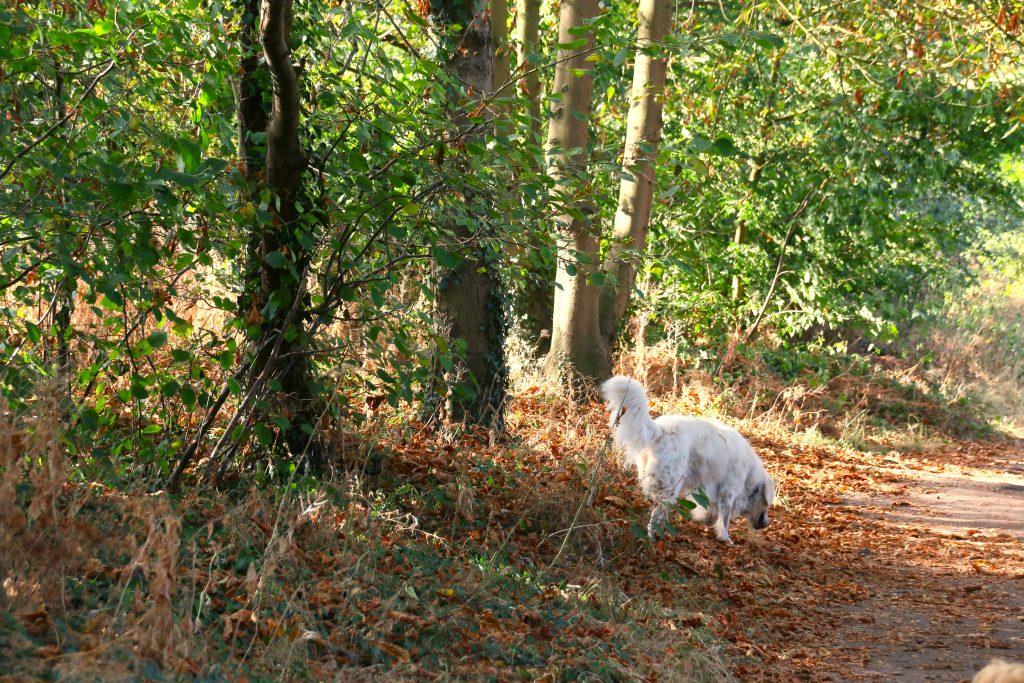
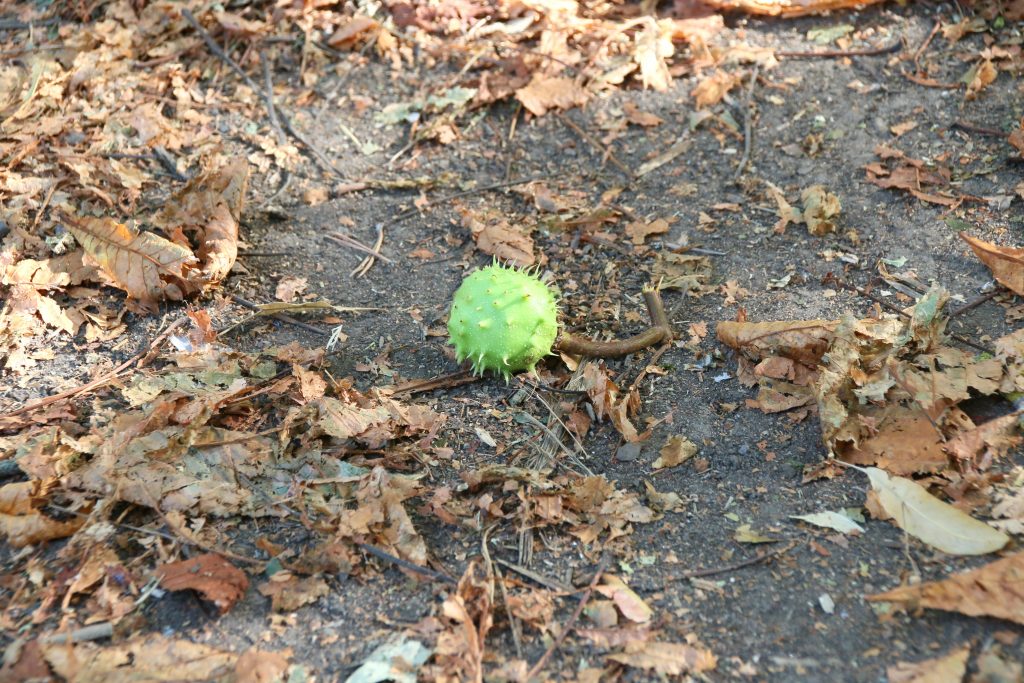
No rain for weeks, and the ground is covered in leaves, an Autumnal carpet, shed by trees in an effort to conserve water. I crunch through the brown crispy drifts of leaves, and, as if to emphasise the Autumnal scene, a conker falls from a horse chestnut, striking me on the shoulder. It is only the warm weather, even early in the morning, that distracts from feeling that it is October. To be honest, the conker skin is a bit too bright and fresh to be fruit from the season of mists and mellow fruitfulness. The leaves of these horse chestnut trees are always tinged with brown by mid-summer, thanks to the thin soil overlying the granite of Croft Hill, and always come back into full leaf the following spring, but the leaf drop this summer is exceptional.
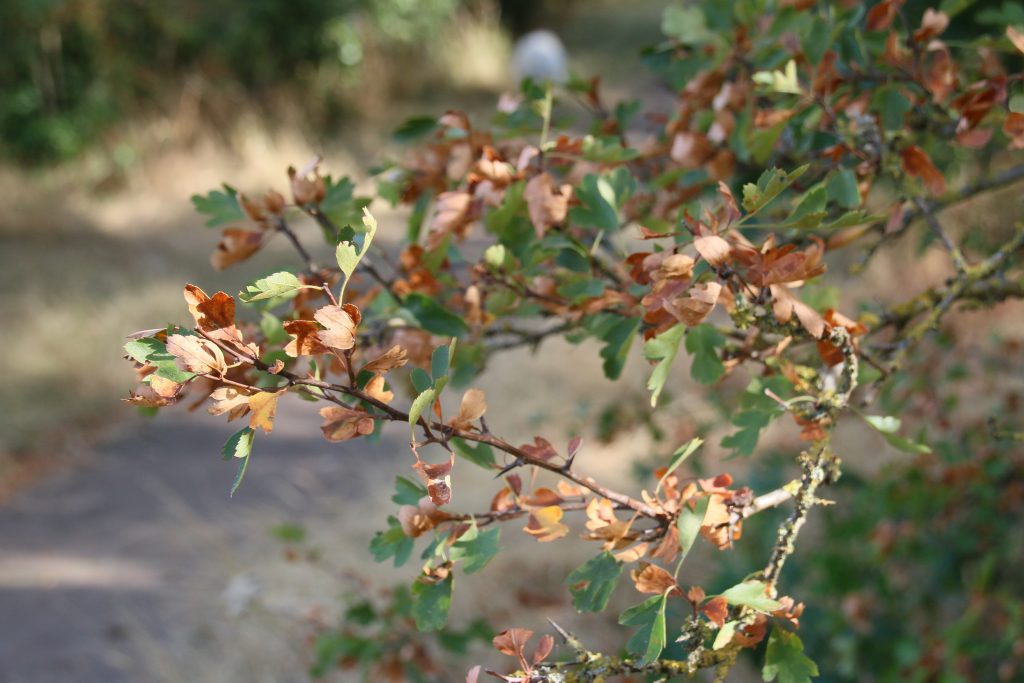
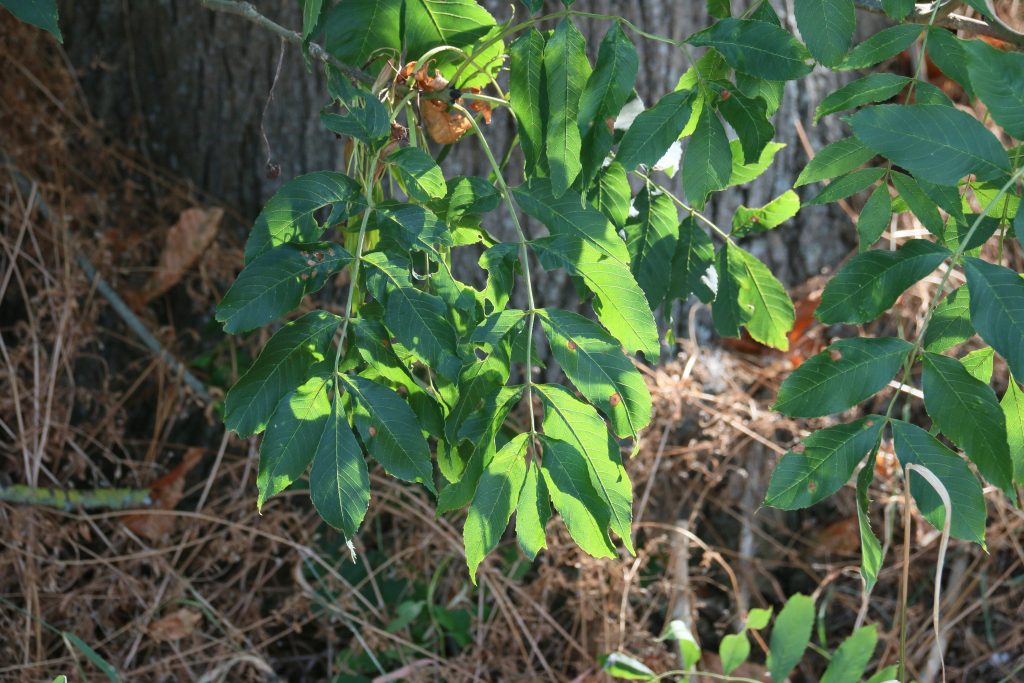
The leaves on smaller shrubs, such as hawthorn, are just crisping around the edges, with no mass “leaf-dump”. The leaves on ash trees are neither being shed, nor “senescing”, turning brown to conserve water, and in consequence the green leaves are hanging limply, dehydrated. I suppose in the event of a period of heavy rain, the ash will recover, whereas horse chestnut trees will not return to full greenery until spring.
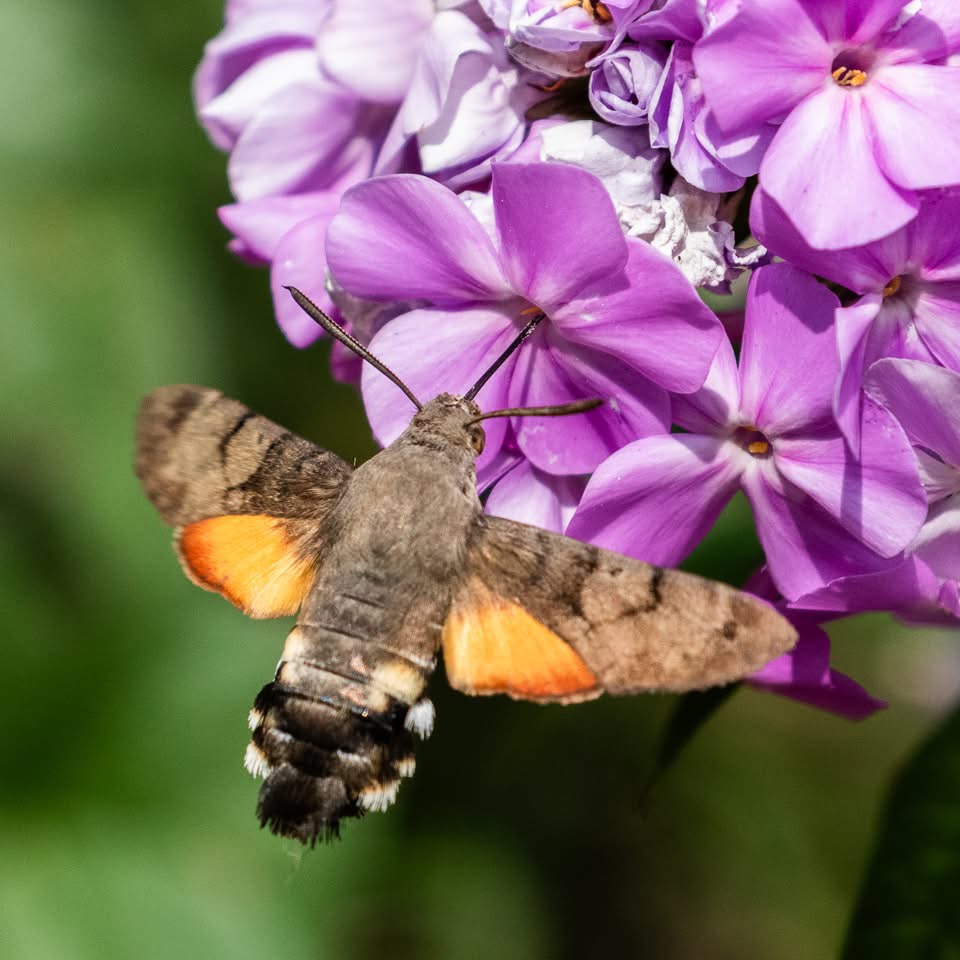
Another sign of the unusually warm weather – we have had a Hummingbird Hawkmoth in the garden, feeding on Buddleia flowers. My sister, in West Yorkshire, has also seen one in her garden. These moths, which hover to feed, just like a tiny hummingbird. The moth migrates from Europe in the summer, but usually only to southern England, and not every year – I have only seen it before in Cornwall. Maybe it will become more common in England and Wales as the summer seasons get warmer. I wasn’t quick enough with my camera – this is my sister’s photograph (Ros Crosland Photography https://www.facebook.com/rosjcrosland).
20th July 2026
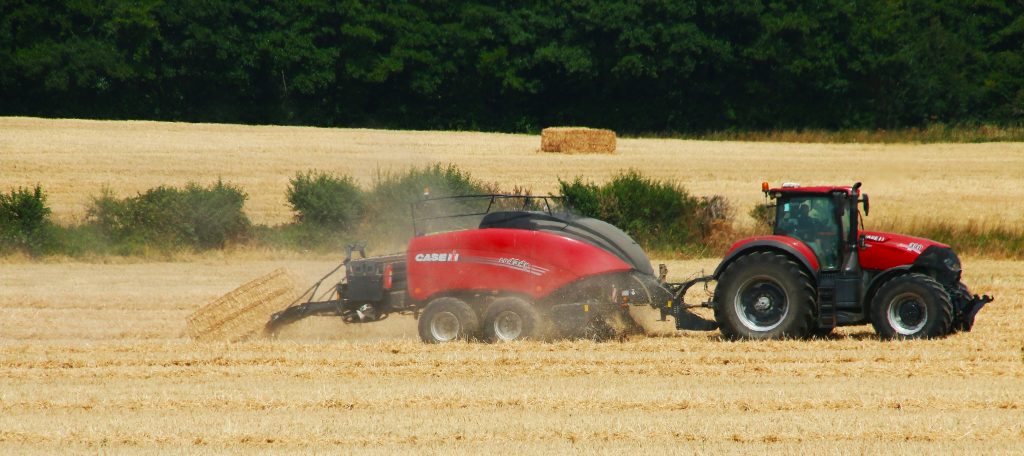
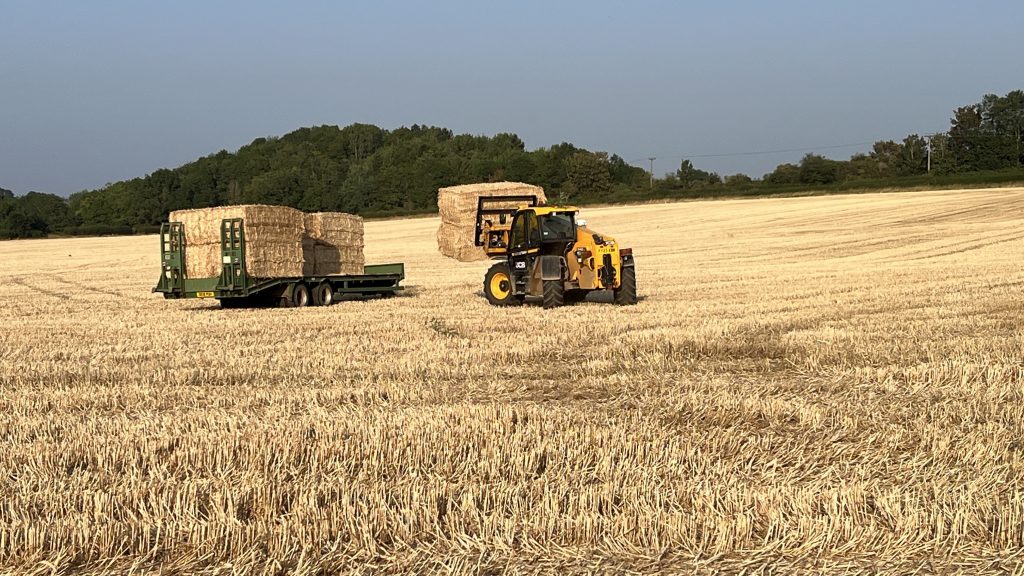
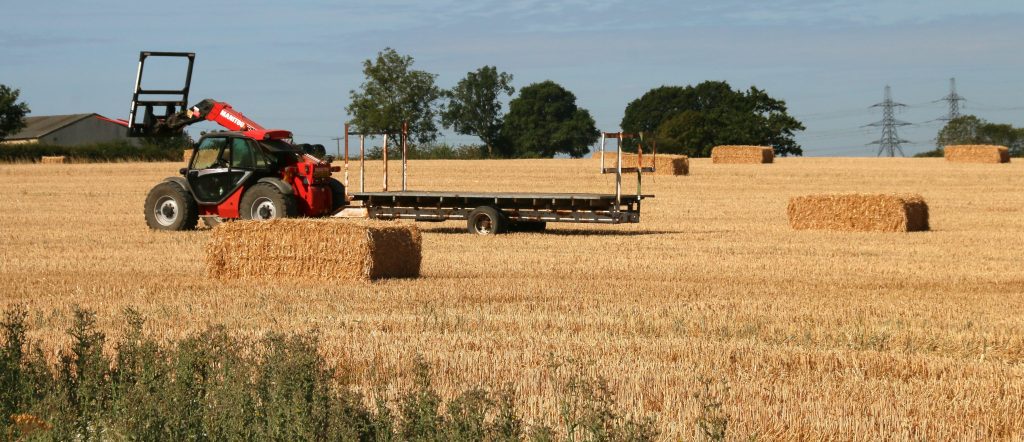
The straw in the fields behind us has been baled, and the bales collected by, I think, two separate people. The straw will probably have been sold in advance of the harvest, possibly at a farm auction, priced per acre of “standing straw”, not baled, the purchaser baling and collecting. The straw will be used for bedding for horses, or for livestock reared indoors over winter. Straw can be ploughed into the ground, providing nutrients, but this hasn’t happened in the fields behind us for several years.
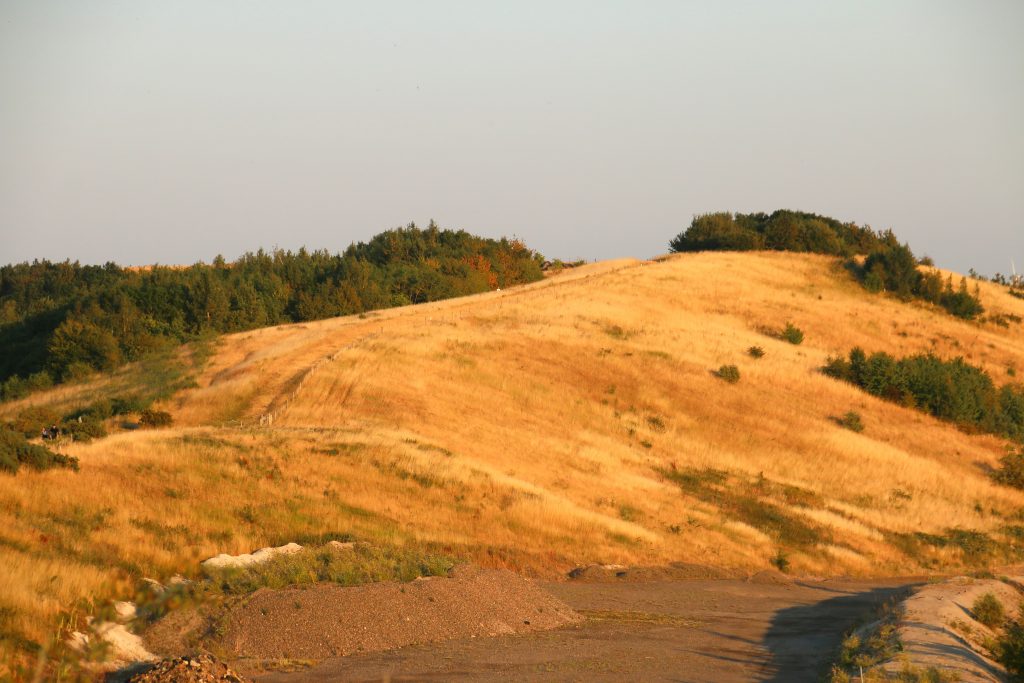
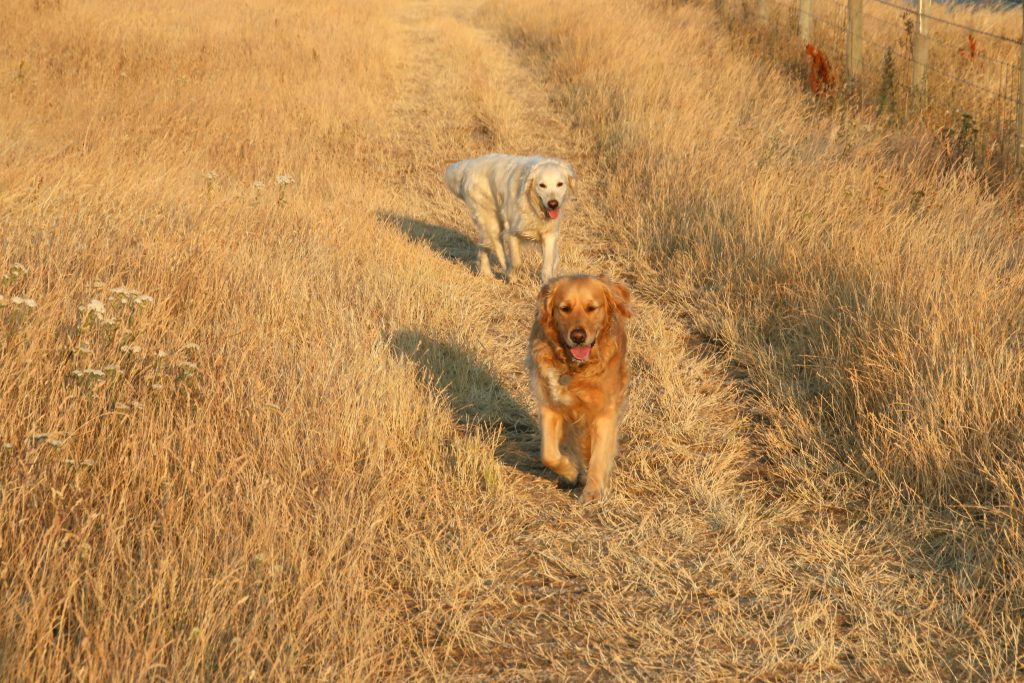
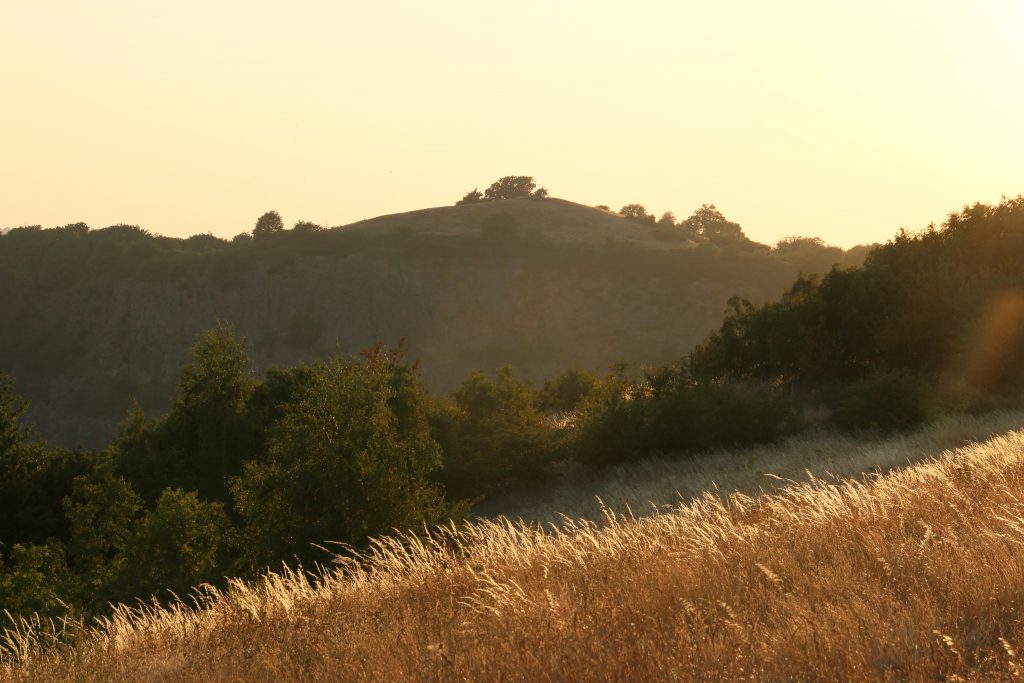
The weather remains very hot, with temperatures above 30C, and very dry, and I walk the dogs early, before 7.30am, or late, sometimes waiting as late as 9.30pm for the temperature to drop. I particularly enjoy the pleasantly warm late evening walks, when the light is golden, the grass along the footpath biscuit-brown, and the taller wild grasses glowing on the evening sunlight. Often, we do not meet anyone else, particularly in this World-Cup-season of evening matches. I prefer to be out with the dogs, enjoying the peace in the gathering dusk.
15th July 2026
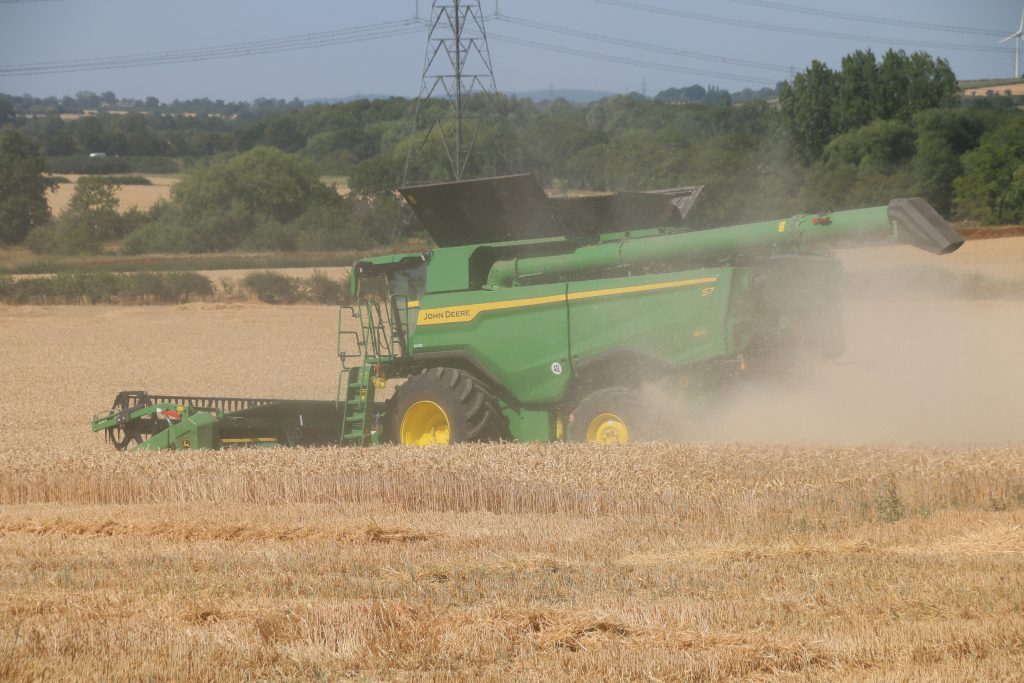
The field behind our home has been harvested. I return from a shopping trip to hear the raw of the combine harvester and see the combine just a few of metres from the fence at the back of the garden. As expected, the combine is creating a lot of dust, together with clouds of chaff, the “husks” from the grain. Unexpectedly, for the first time while we have been resident here, over 20 years, the wind is blowing from the field towards the house, and a blizzard of chaff is falling into our garden and blowing into open doors and windows into our house, settling on every surface. My wife, sitting in a front room, has not noticed, and I rush around closing windows and the patio doors, and fetching in washing, drying just a few feet from the back fence. I then set-to with a cloth and duster on every surface in rooms on the back of the house.
The harvest is two weeks earlier than last year, presumably thanks to prolonged warm dry weather. I hear an interview with a farmer on the radio. In most years farmers have trouble ensuring that grain is sufficiently dry for harvesting – the optimum moisture for combining is 12-14%, and harvesting takes place later in the day when the crop is at it’s driest. This year farmers are harvesting early in the day to ensure that the moisture content of grain is not too low. Dry grain, as well as weighing less, produces drier husks that beak up, which would account for the dusty blizzard in our garden, despite a mid-morning harvest.
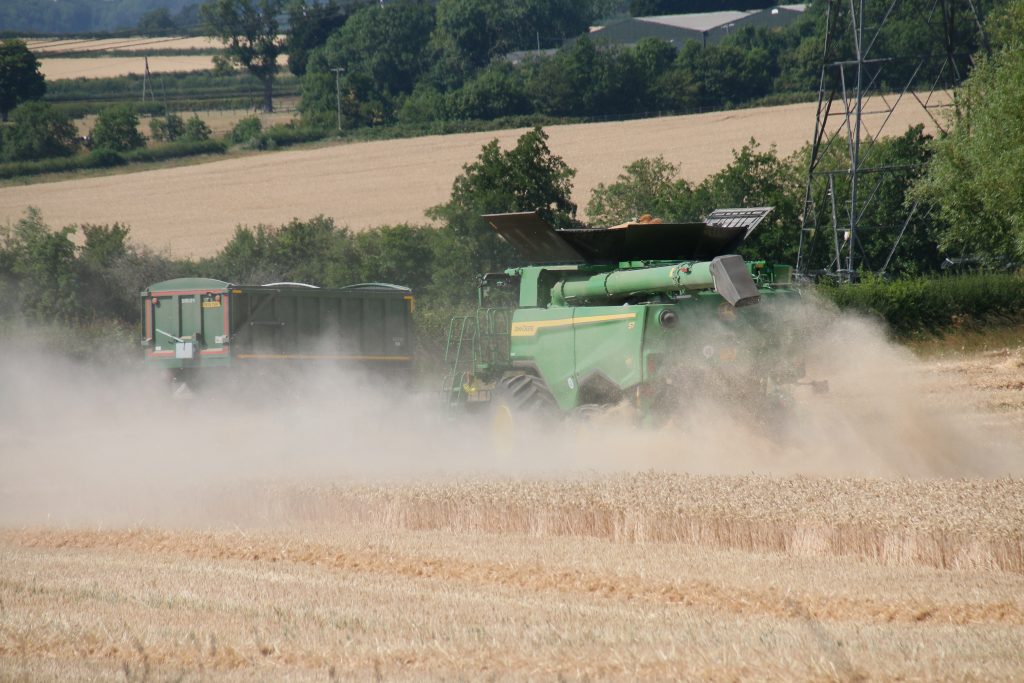
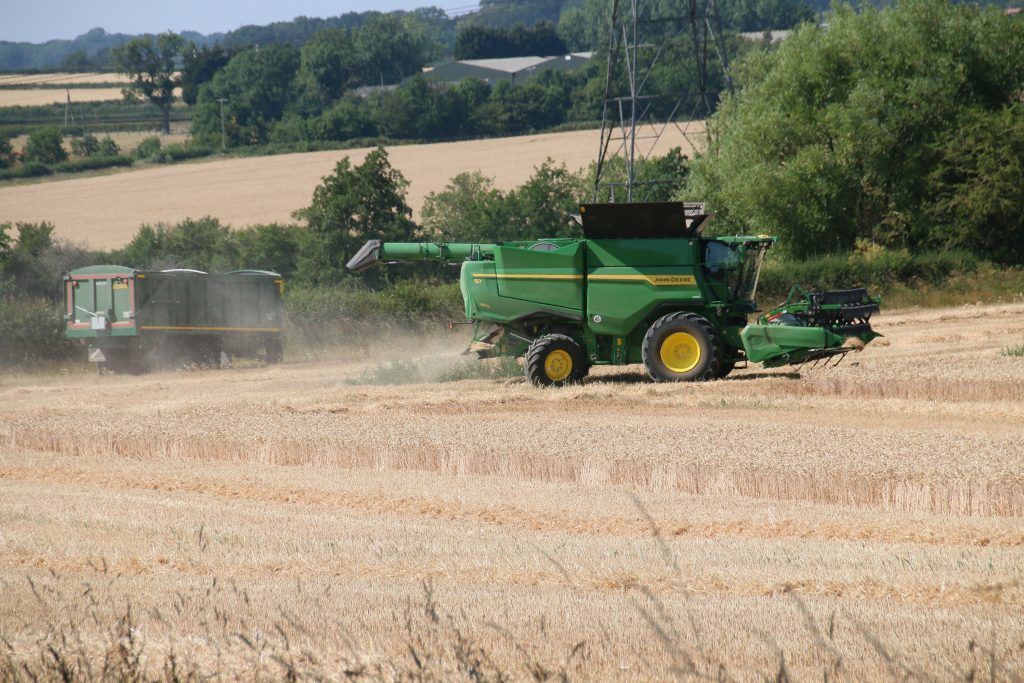
In all previous years, during harvest, the fields behind us have been a hive of busyness, the combine harvester making its stately way around the field, periodically emptying the grain into a trailer, with a constant procession of trailers coming and going, travelling to the farm to deposit the grain. As straw is spewed form the rear of the combine, it is baled, and stacked, and often taken off field on the same day. In fact, all three fields behind us may have standing crops in the morning and be a plain of bare stubble by evening. Not this year – the harvest seems to be a more leisurely affair, and by evening only two of the three fields have been harvested, and lines of straw cross the fields, awaiting baling on another day.
4th July 2026
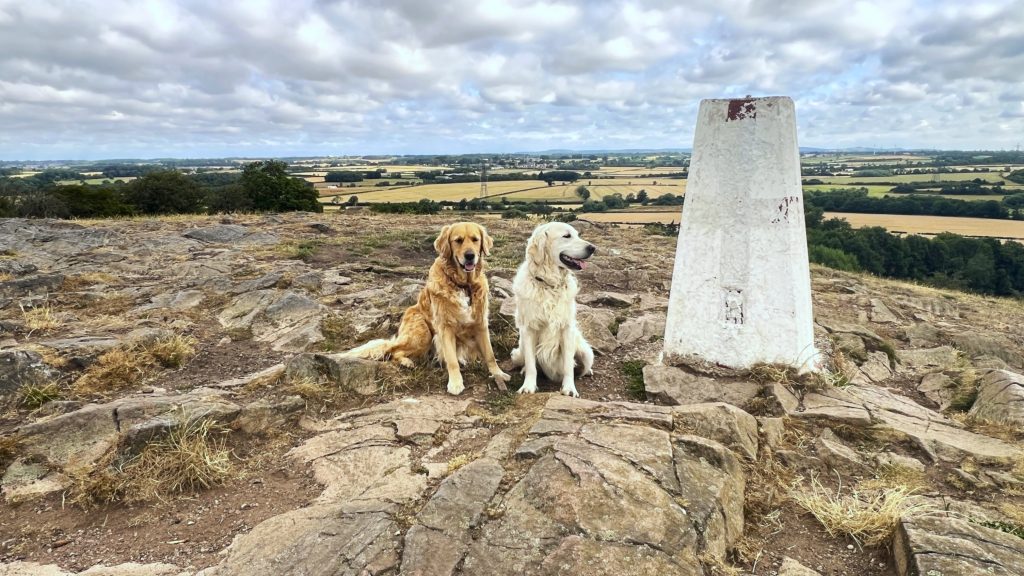
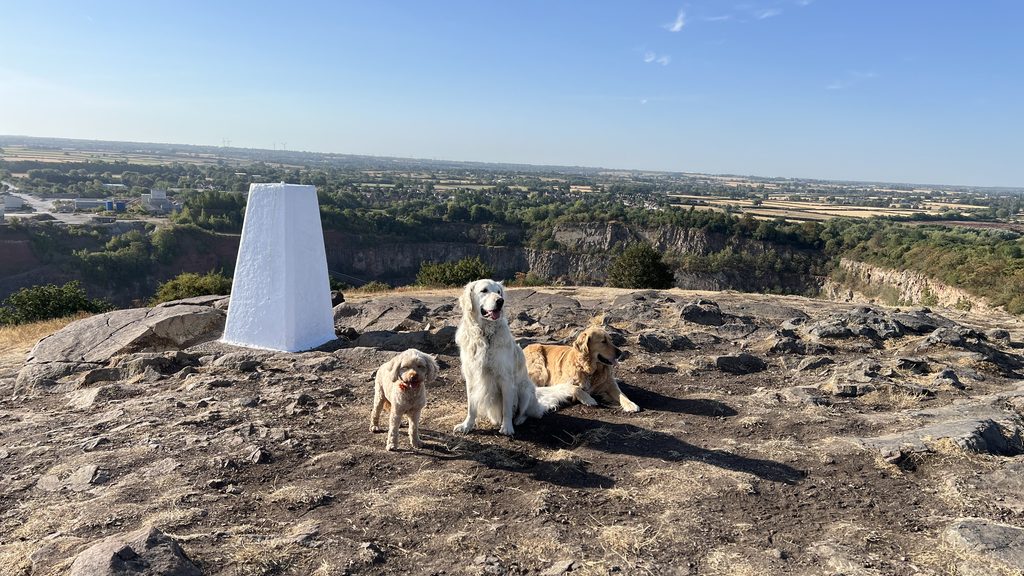
An overcast but warm morning, pleasant in a gentle breeze, better for the dogs than strong sunshine. We climb up the steep side of The Hill, meeting two ladies with their cockapoo on their way down. They were planning the “quarry circuit”, a 3 mile walk from Croft Hill, only partly following the quarry edge, much of which is inaccessible, the route, mostly permissible paths rather than public footpaths, passing the far side of quarry buildings and returning to Croft Hill via the village. At the top of the Hill, I make a point of photographing the dogs by the Trig Point to send to friend – yesterday some wag posted an AI edited photograph on the local Facebook site showing a demolished Trig Point, and I was able to reassure our friend that all is as it should be.

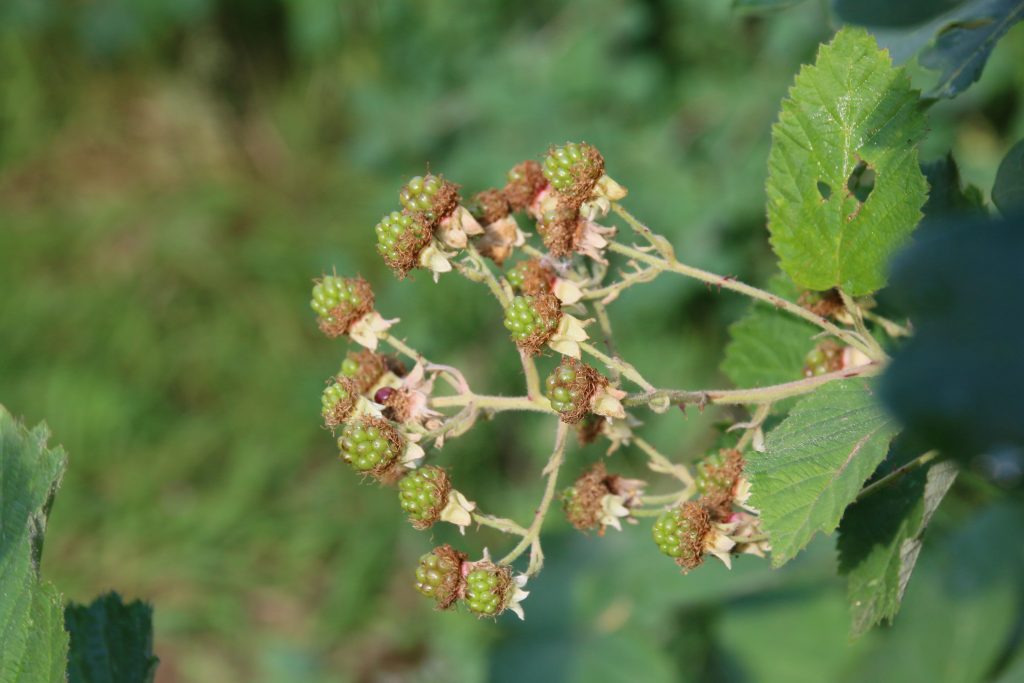
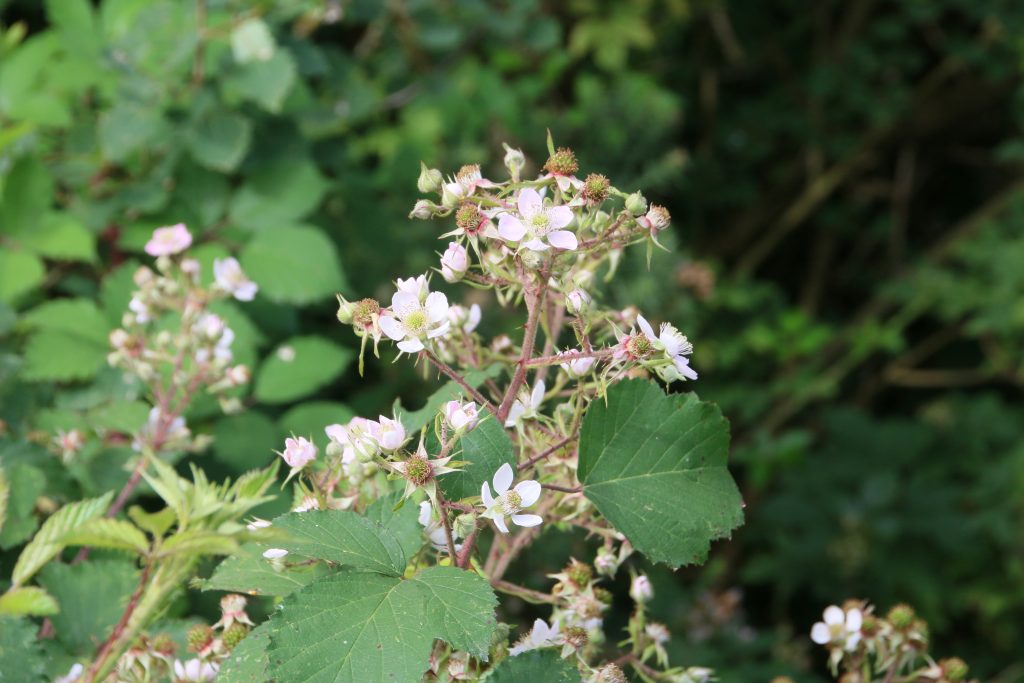
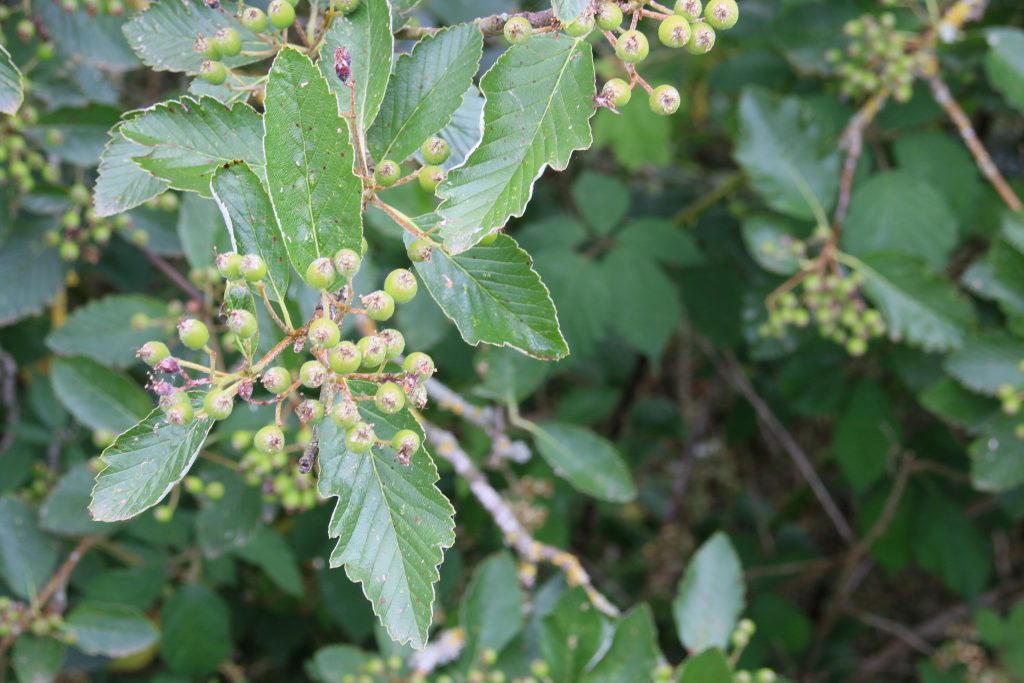
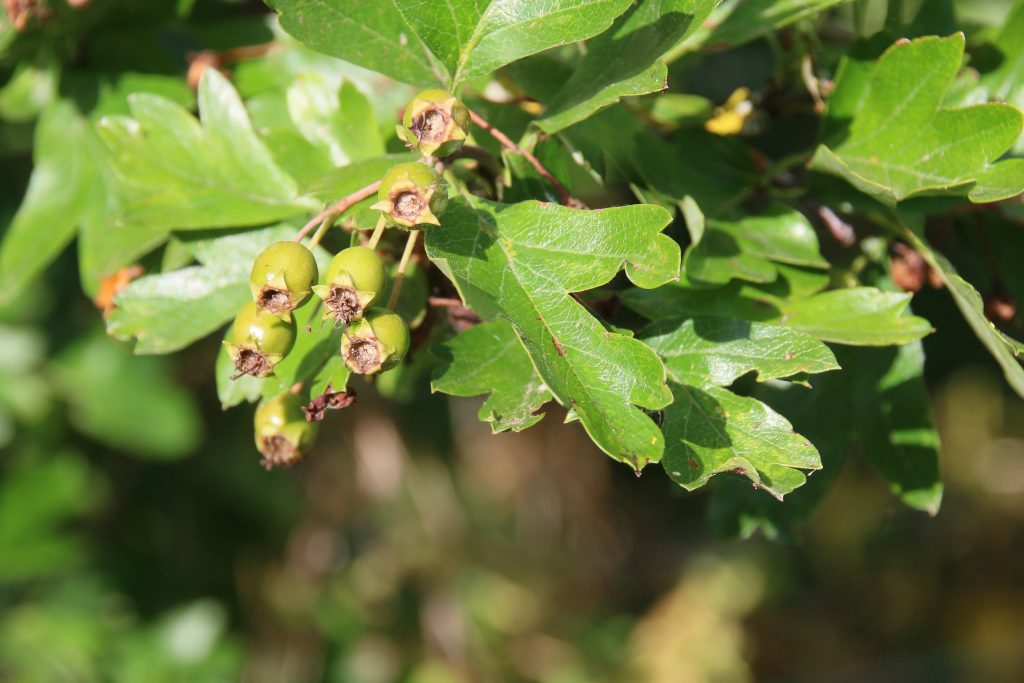
Descending the gentler slope, we meet a regular walker, and discuss his recent knee operation, which as allowed him out and about again after a few months. We agree that, with or without fully operational knees, care must be taken when descending, since loose soil on worn paths can be as slippery as ice. At the bottom of the Hill blackberries are already beginning to ripen, with just a hint of purple on some bunches of fruit, while others remain green, and some branches are still in blossom, albeit looking a bit tatty. Tight bunches of green elder berries and individual rosehips on dog roses have also appeared, as we move from mid-summer into late summer, with a glimpse of Autumn just visible on the horizon.
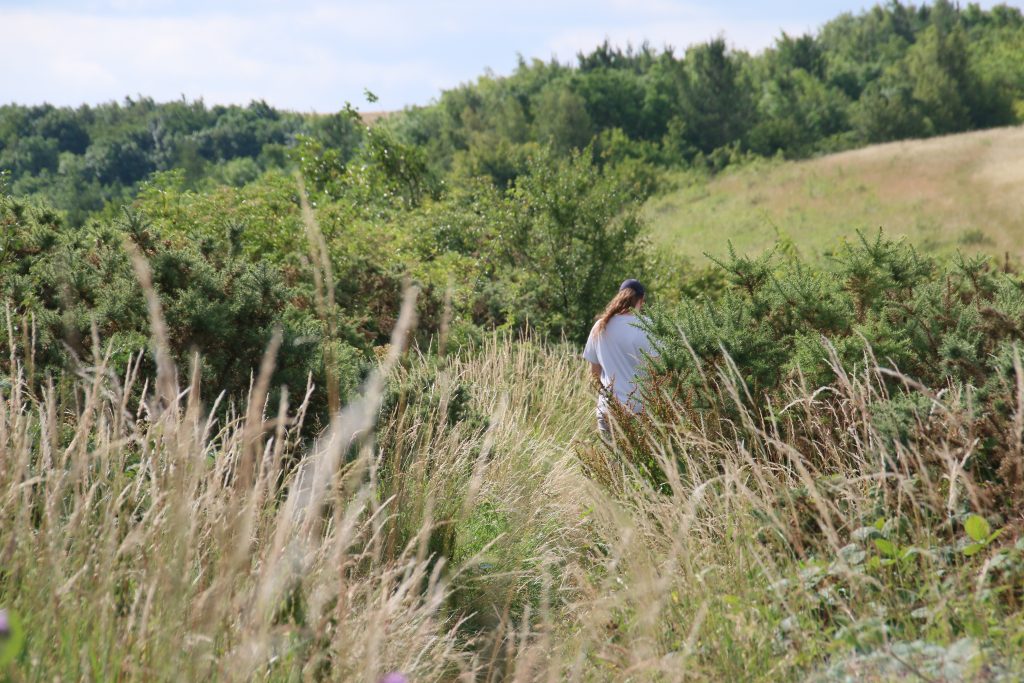
As usual we meet some of the regular dog walkers, and it while chatting to one of them that Sam decided that it was time to go home, and trotted, oblivious to call or whistles, disappearing over the brow of the hill. I know he will wait for me, and sure enough he comes into sight, waiting patiently while being fussed by a rambler without a dog, who assured me that he hadn’t moved, despite the attention that she was giving him. She moved on along the overgrown path, brushing past long grasses, overgrown brambles, and gorse before walking up onto the open hillside.
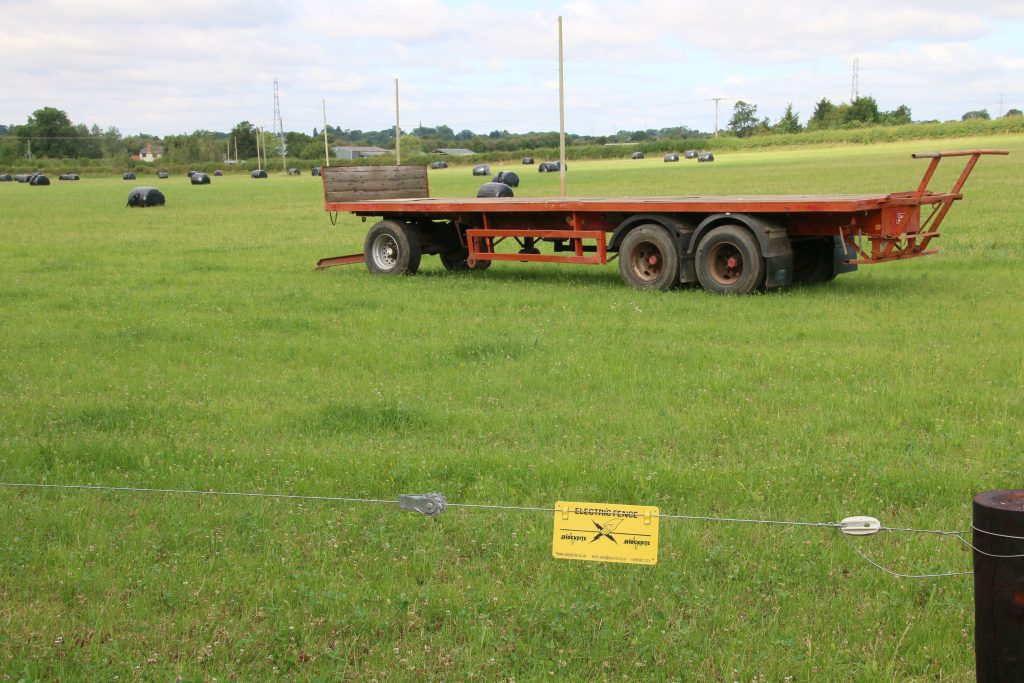
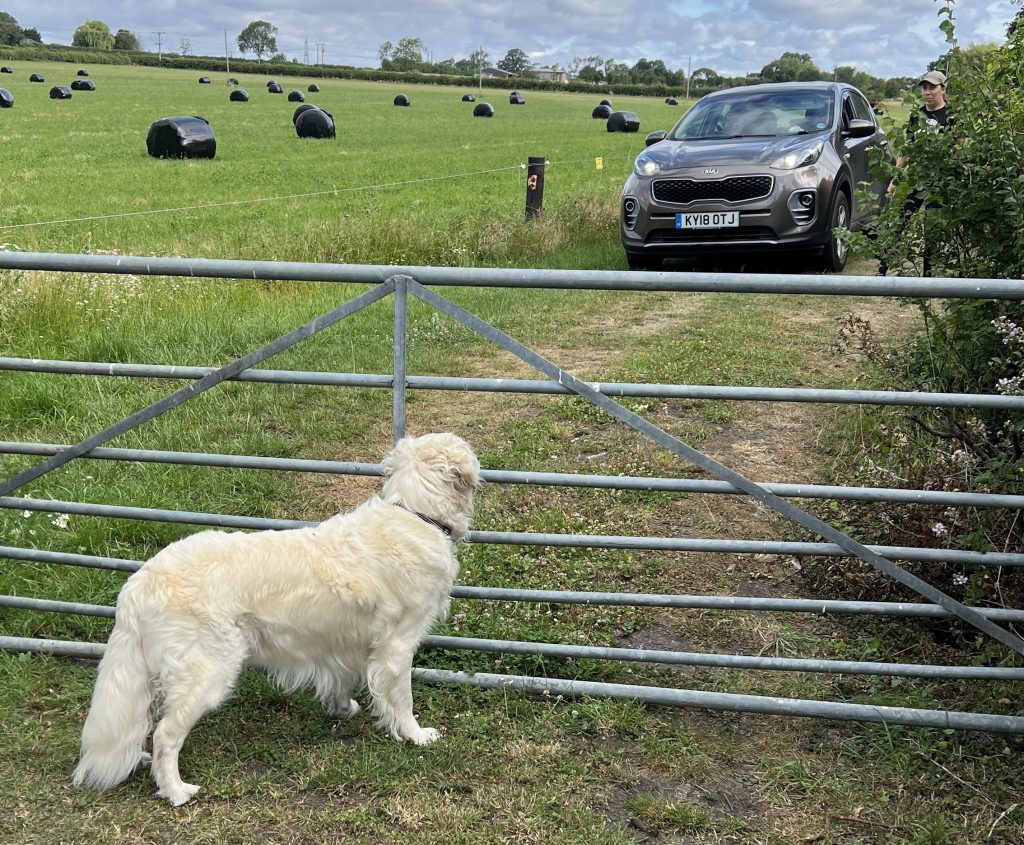
We continue following the path down to the village, briefly meeting a couple and their rather lively rescue labrador, before we cross the road to walk down to the track at the back of the Glebe. The track borders a field that has been used for grazing a dairy herd, which is moved in rotation around several similar fields, and since only an electric fence, which the dogs can run under, separates the path from the cows, we have avoided this route for a while. The field has been ungrazed for a few weeks, and a crop of sileage has been mown and baled into polythene-wrapped cylinders. With no cows, and with the electric fence presumably turned off, since there are gaps in the for tractors and trailers, we can once again follow this path. I receive a text from a friend, on holiday abroad, and am so busy on my phone that I am taken by surprise by car approaching from behind, along the grassy track. It is the owner of horses in nearby paddocks, who, with her father, take sacks of food for them. In wet weather the dad parks on the nearest lane, and she transports the feed for the last stretch using a wheelbarrow, involving several return journeys to the car.
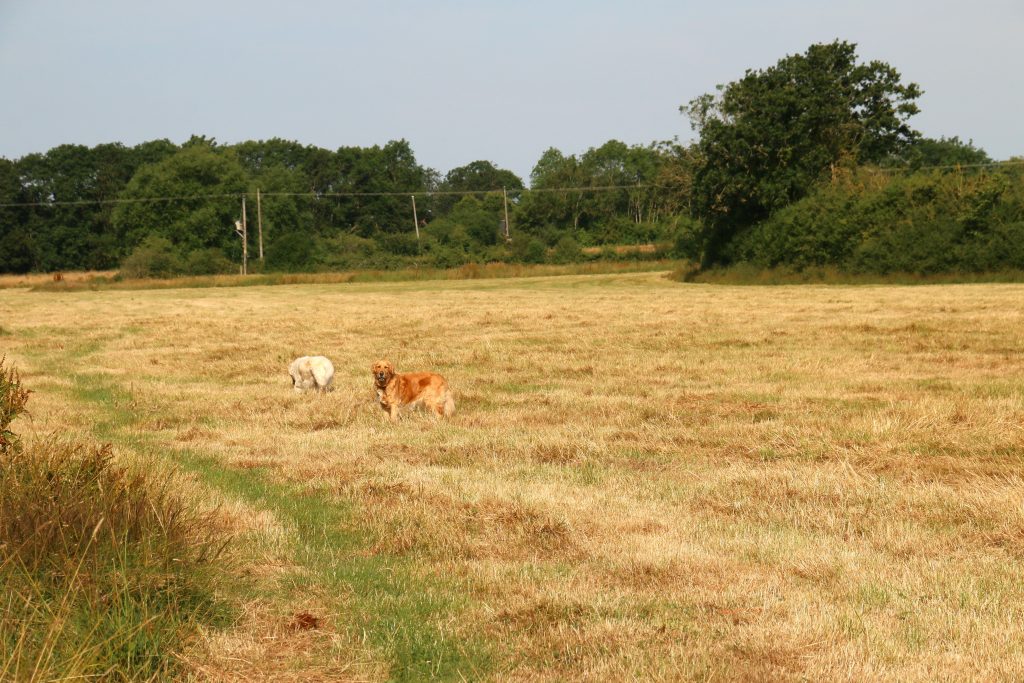
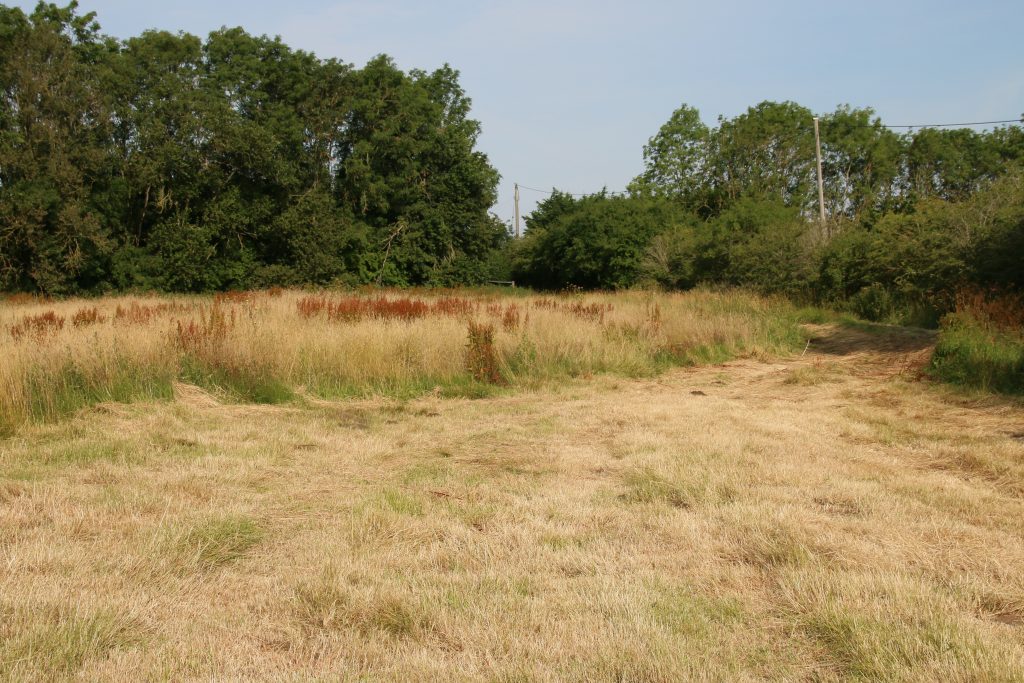
Behind our home, at the bottom of the field track, the bales have been removed from the hay-mown “Sheep Field”, leaving acres of short grass for the dogs to enjoy, running in circles across the open grassland. A large area at the end of the field has been left wild, with grasses and wildflowers, to the benefit of insects and birds, leaving just mowed strip, access to the field gate. We now wait to see if the grass is allowed to grow for a second hay, or sileage, crop, or whether sheep will be grazing. In the meantime, we are cautious when letting the dogs off lead, just in case there are sheep just around the corner.
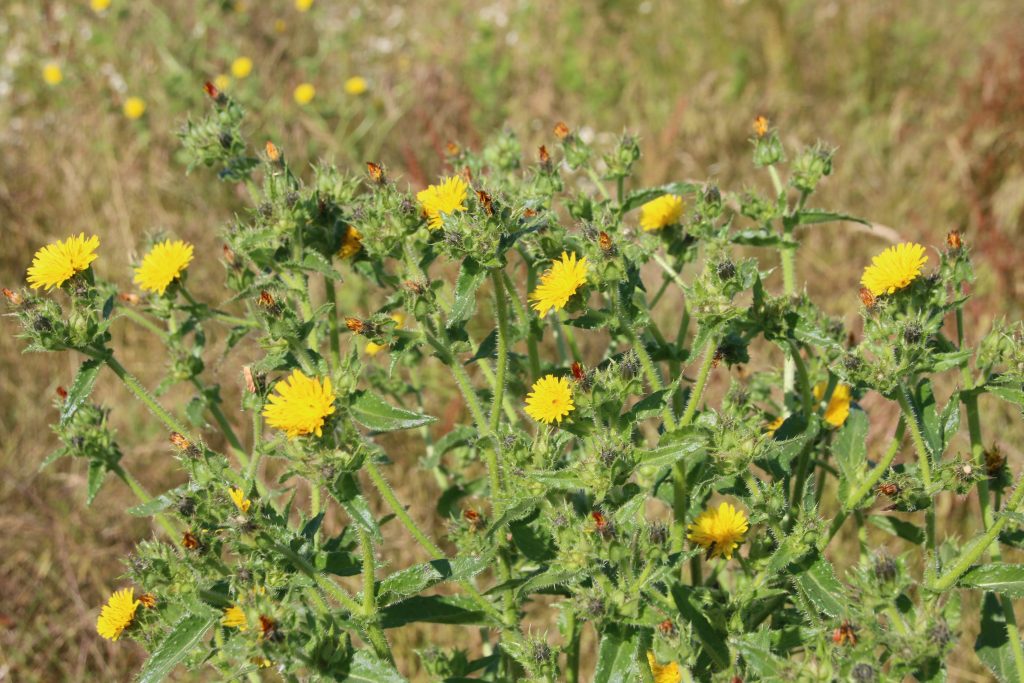
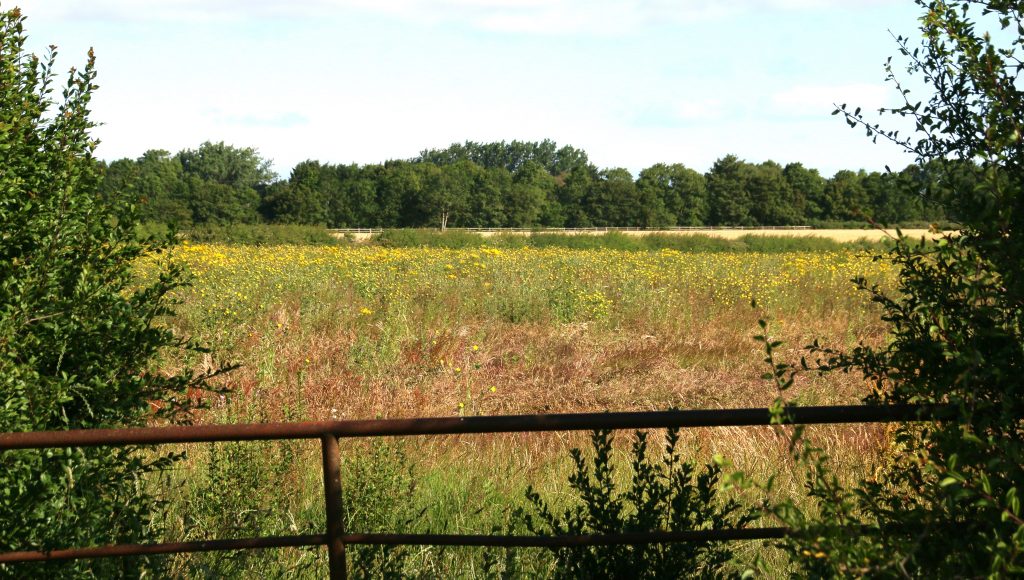
Crossing the sheep field in the valley behind our home, the naturalised area of the field behind is sprinkled with yellow, Bristly Oxtongue, a taller relative of dandelions. This is a bit of a thug of a plant, spreading vigorously if it gets an opportunity. The neighbouring arable part of the field will have been sprayed with herbicides to control spread from the adjacent “wild” area. Insects will appreciate that this corner of the field has been left “rough”, with such nectar rich flowers. To be honest, it isn’t a great loss to the farmer – the corner sometime floods, to the detriment of crops, although recent ditch-clearing has helped reduce the number of periods
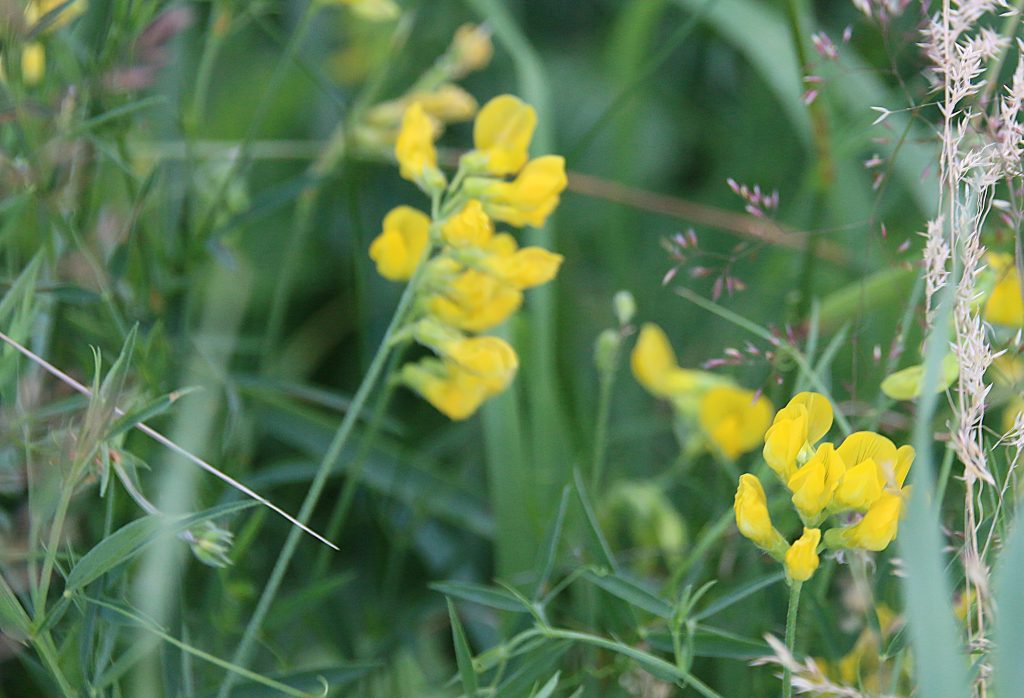
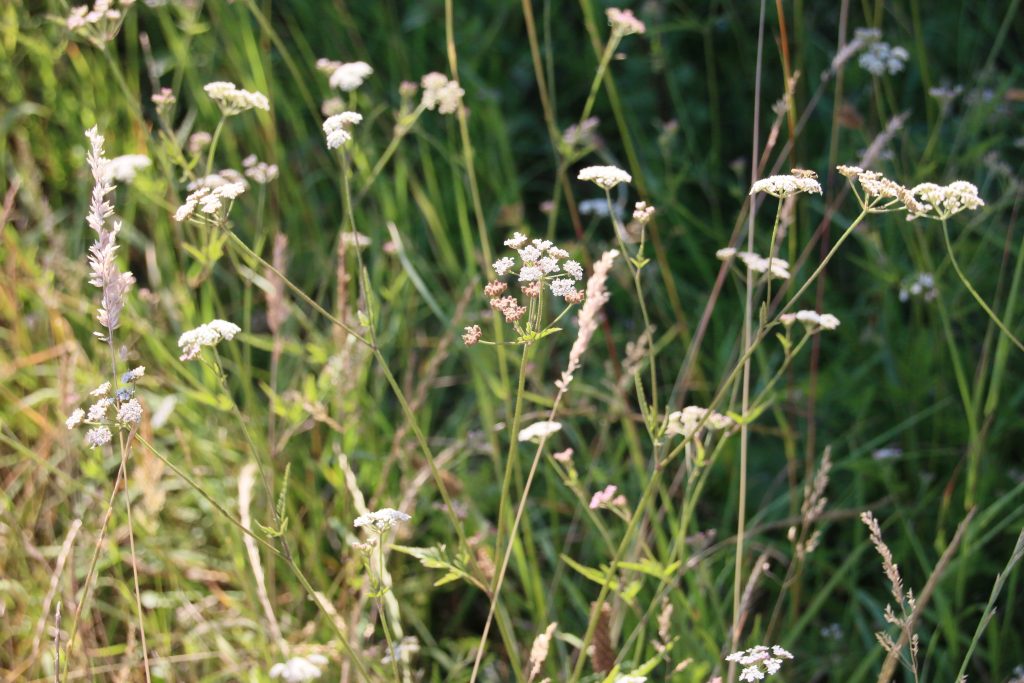
The yellow flowered Meadow vetchling grows between grasses and hedgerow, the grass providing support. Like Purple vetch, with similar leaves, Meadow vetchling is a member of the pea family, and is sometimes called “Meadow Pea”, and the flowers will be followed by small black pods, containing the tiny black seeds. Next to the Meadow vetchling taller Upright Hedge Parsley spreads along the verge beside the field track, the white flowers blooming where a month a ago the taller and more dense Cow Parsley dominated. As the season moves on, wild plants that prefer drier conditions take over from those preferring the damp soil of spring and early summer. In Spring Butterbur produced purple flowers, and the large heart shaped leaves in early summer. Now the Butterbur leaves beside the Glebe-side lane have wilted and will soon die back.
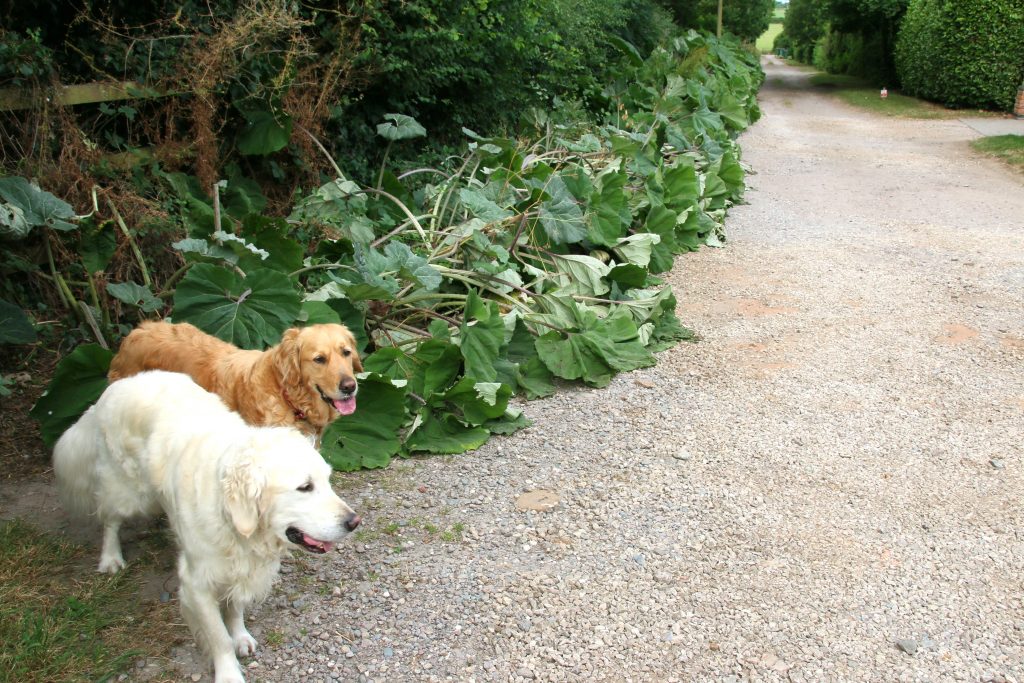
29th June 2026
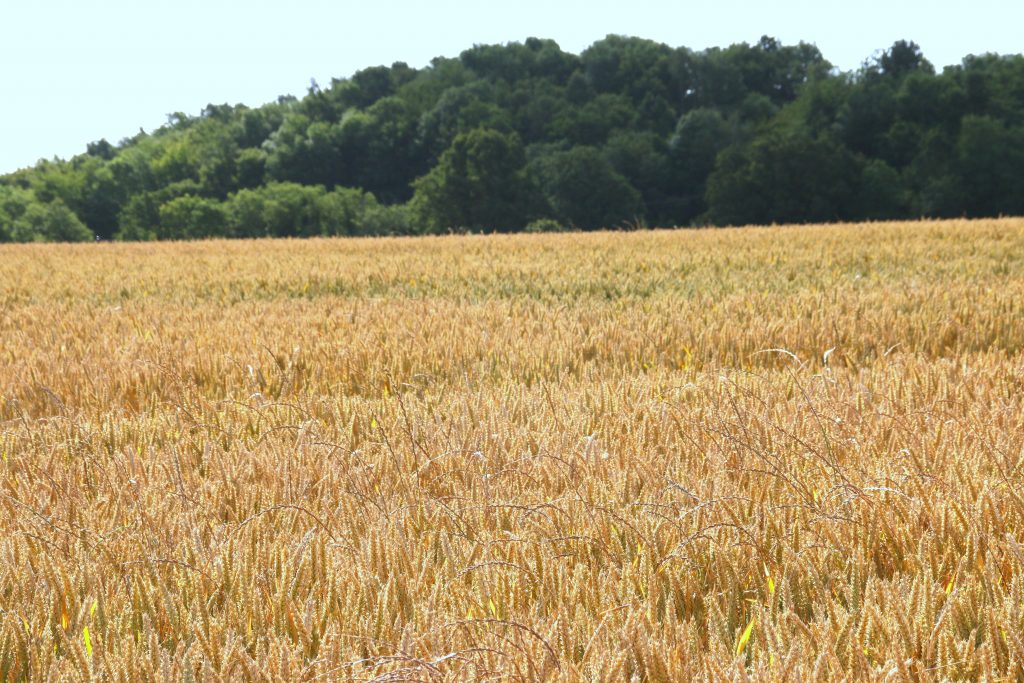
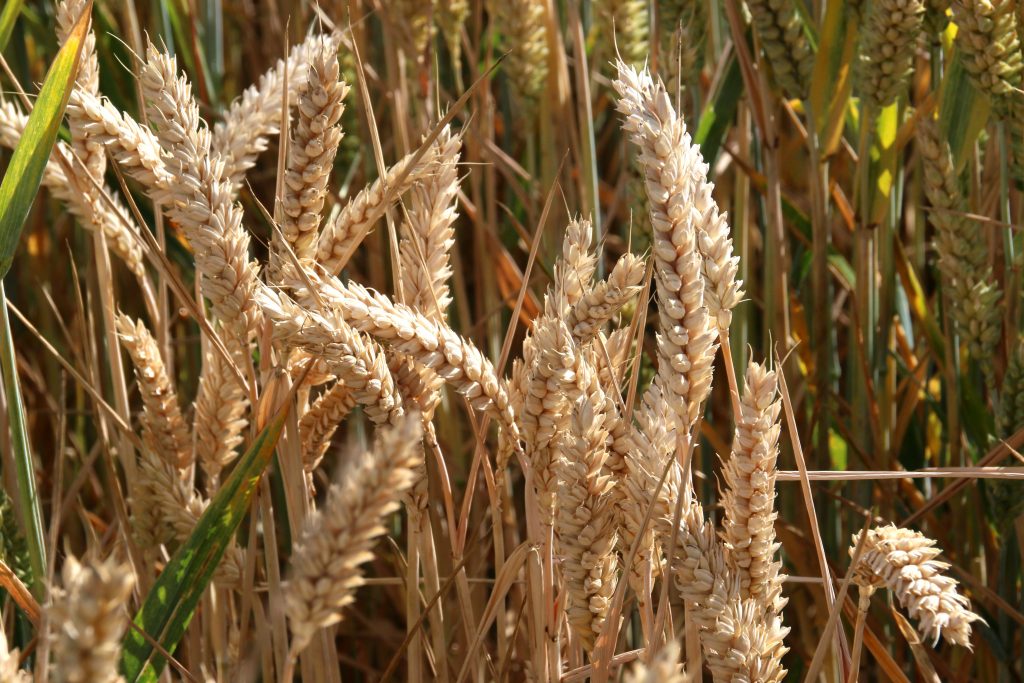
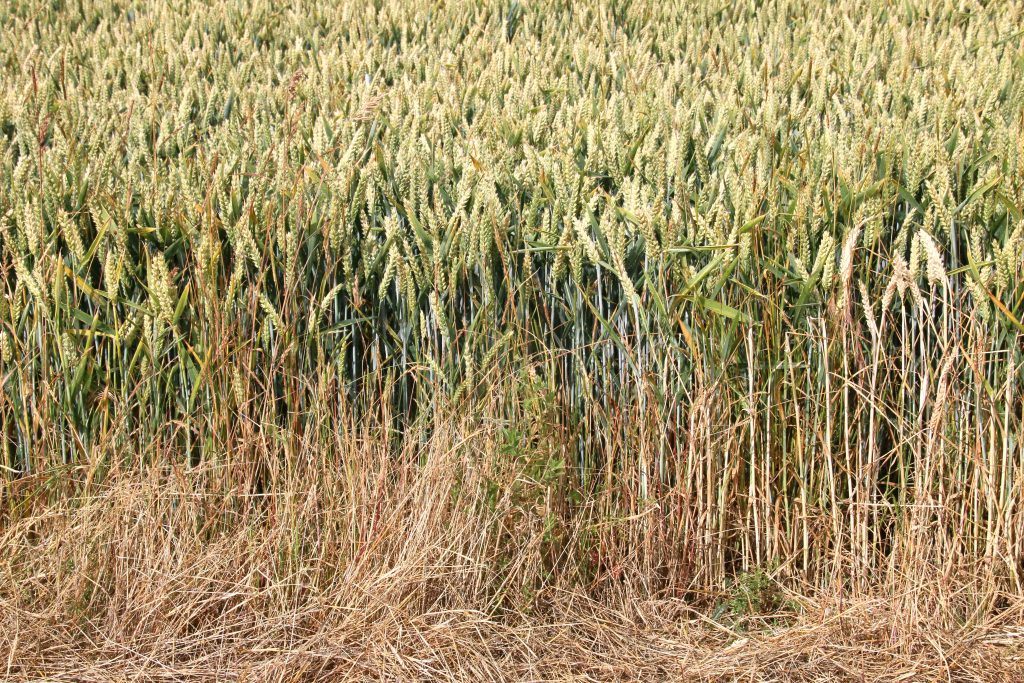
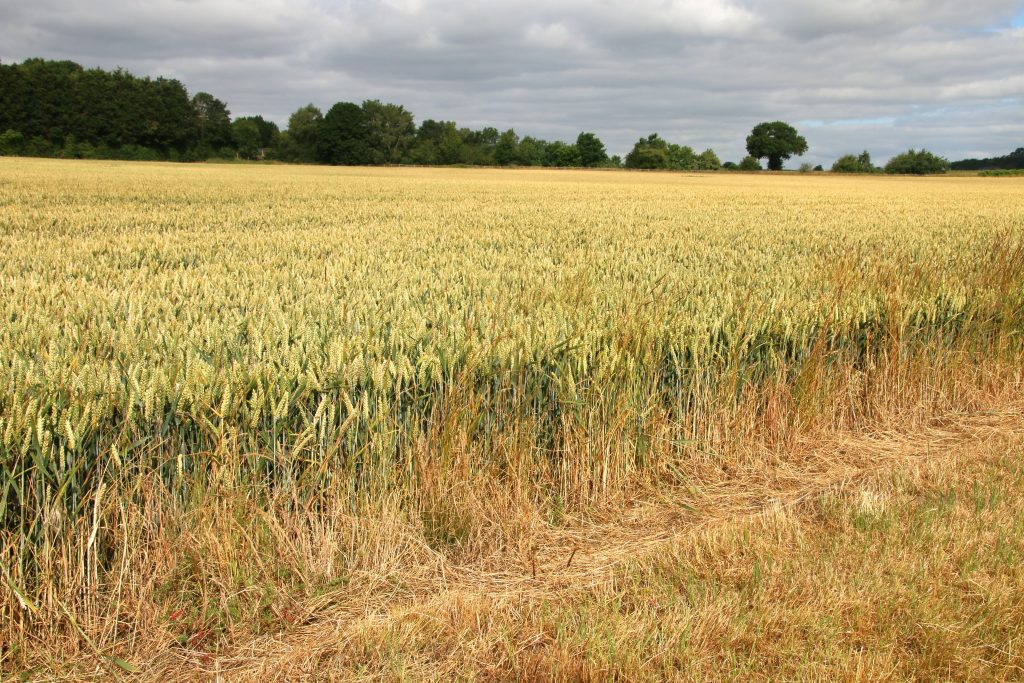
Last week’s heatwave has subsided, to the relief of us all. Our youngest dog, Sam, woke us each night, barking to be let outside – he just wanted to lie outside in slightly cooler air. The heatwave has ripened the wheat crop behind our home, which is now the colour of biscuits. I pluck off an ear and bite into a grain. It is hard, with the flour inside solid rather than floury. It will be a while before the combine harvester will be on the fields, although we may get an early harvest, maybe before the end of July, depending on the weather. On the far side of the valley the wheat still has a slight greenish tinge.
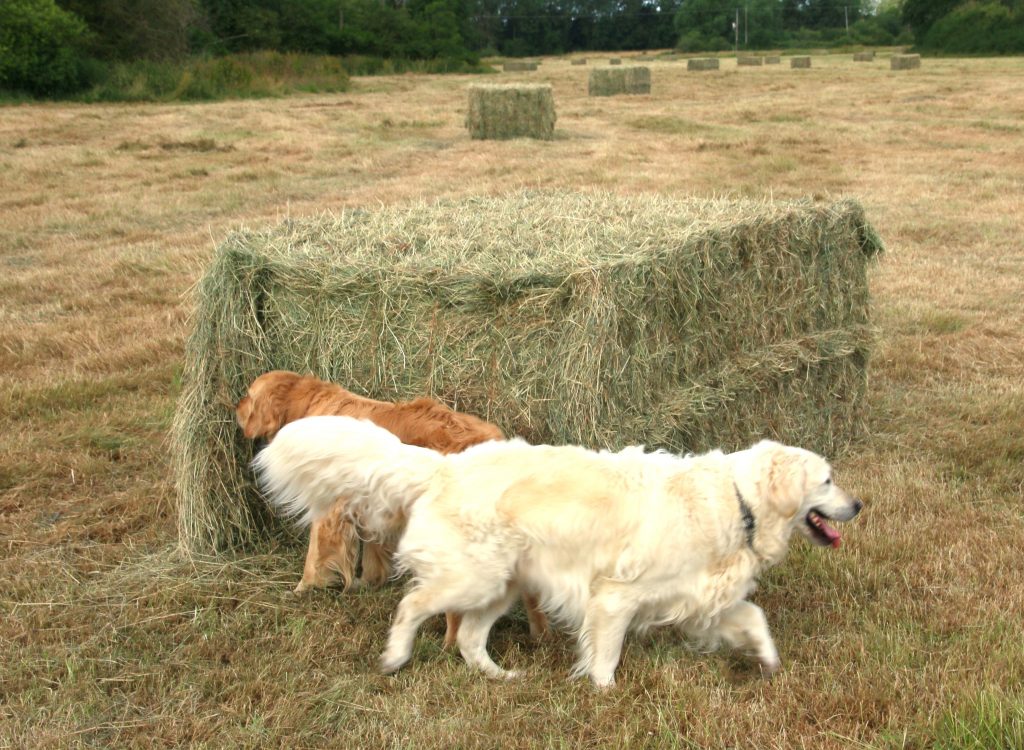
The lying hay in the “sheep field”, mowed a few days ago in this riverside meadow at the bottom of the valley, has been baled, not round bales this year, but large square ones. This may depend on what they are destined for. Stables, or farms with smaller herds of cattle over winter, prefer the smaller square bales, stored neatly and accessibly under the cover of a barn or similar, rather the along the edge of fields or yard, as round bakes often are. For the time being they remain on the field, awaiting collection.
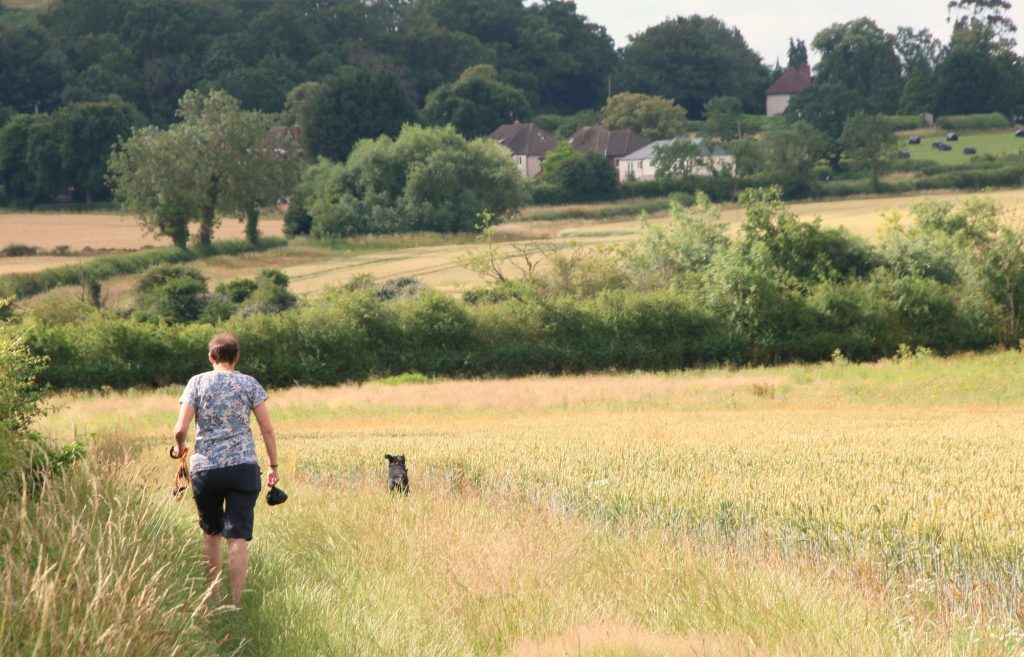
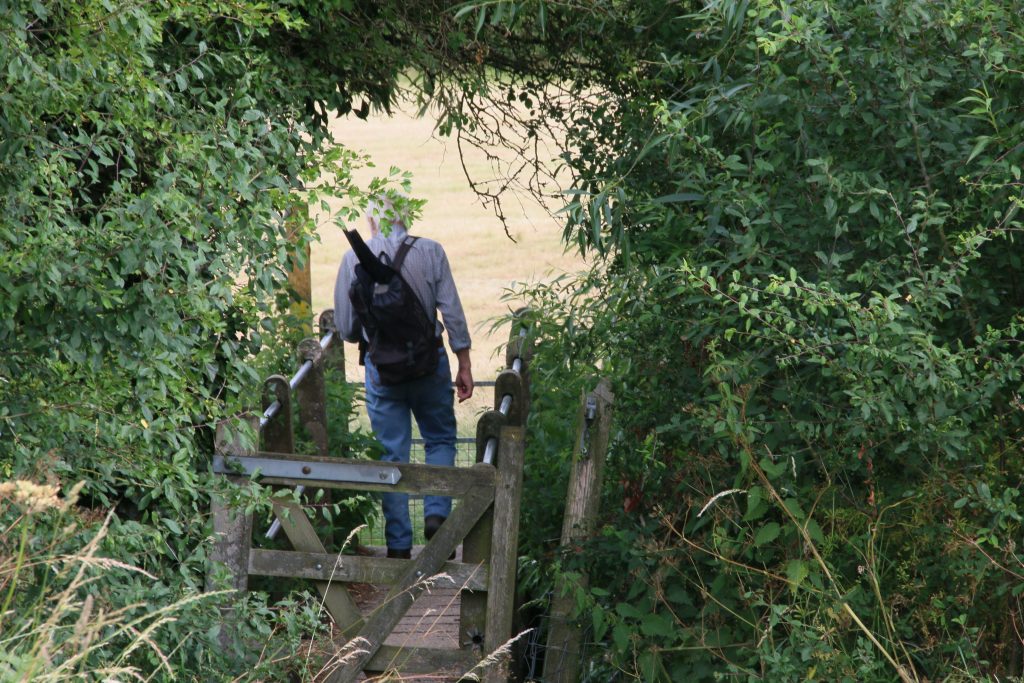
We walk up the far side of the valley, meeting some of the regular dog walkers, discussing last week’s heat wave with the owners of collie Bryn, who were camping in Cumbria, leaving the site only for short walks a couple of times daily, to the nearest river to cool off. A black labrador bounds towards us, followed by a lady we usually meet on the routes around the quarry. We compare notes on cruises – we have recently cruised among Croation islands, and she has cruised among Scottish islands. I think that her cruise may have the more interesting, even if she was on a bigger boat than ours. Later, as we cross the river bridge on our way home, we meet a rambler, who assured me that he likes dogs, before I let ours go to greet him, before we each go our own way.
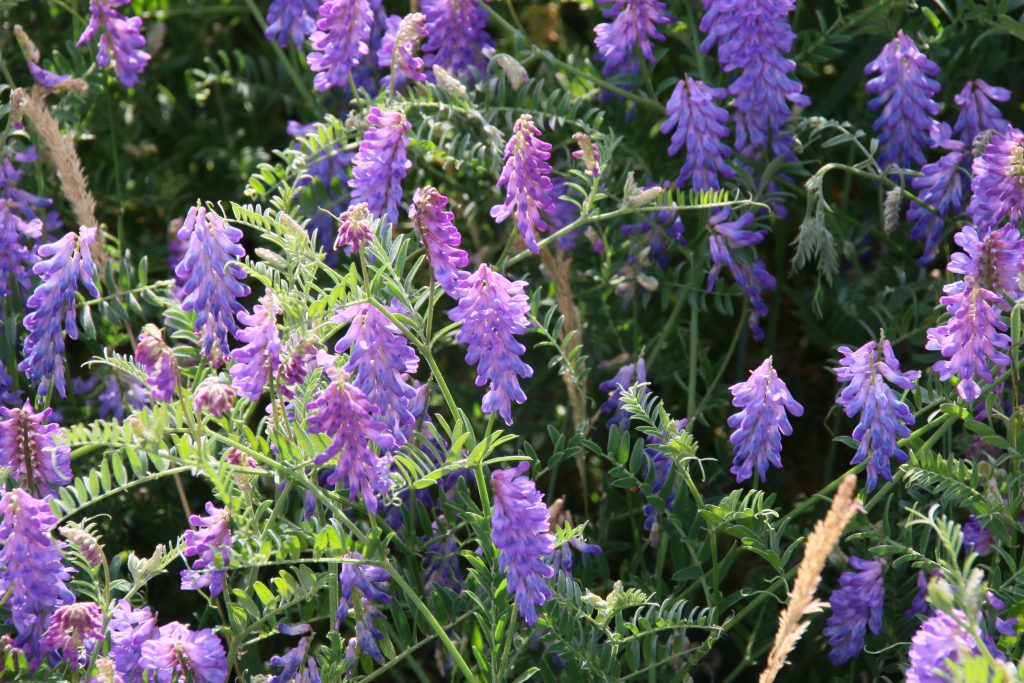
The field edges and track verges are colourful with summer wildflowers. Purple Vetch, a member of the pea family, reaches up amongst the tall grasses in field gateways. Like peas, Vetch will produce pods later in the summer, small black pods enclosing the seeds. Nodules on the plant roots contain beneficial bacteria which introduce nitrogen into the soil, to the benefit of the Vetch and the grasses growing around it. Vetch thrives when grazed, although in this location it can only provide a brief snack-on-the-go for any sheep passing on their way through the gateway.
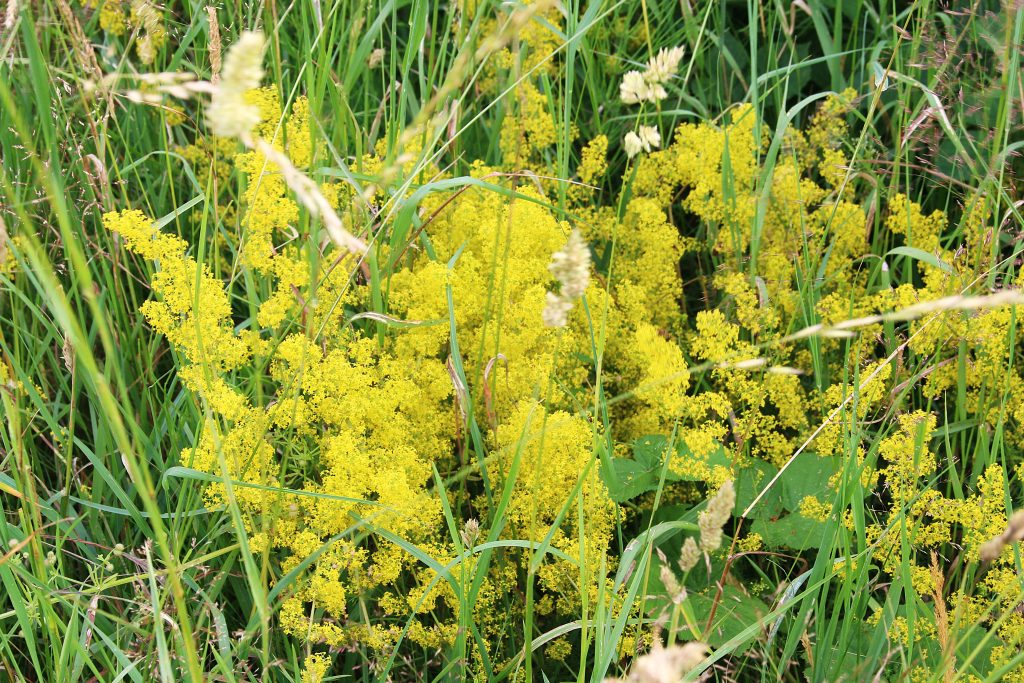
The scented yellow blooms of Lady’s Bedstraw decorate the edge of the field track, partly outcompeted by grasses. In a drier location the Bedstraw would have won out, favouring drier areas which would inhibit grass growth. Traditionally, as the name suggests, Lady’s Bedstraw was used to stuff mattresses, an alternative to hay, the sweet smell repelling fleas. There is a legend that Mary used Lady’s Bedstraw to line the manger where Jesus was laid after he was born.
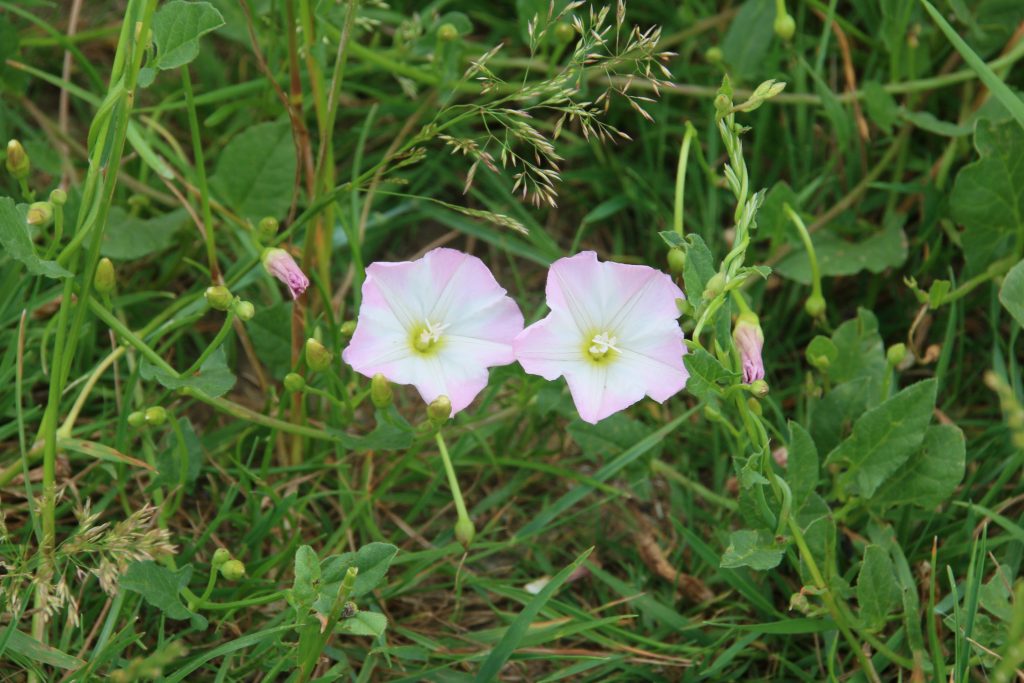
The flowers of Field Bindweed look delicate, but this flower is no shrinking violet. It will vigorously climb any shrub, hedge or fence, climbing up to 2m high, although the specimen that I spot has chosen a poor location for upward mobility – it will have to creep along the ground for a metre or so before reaching the adjacent hedgerow.
Hay bales are already being collected from a meadow on the far side of the valley, and I keep the dogs close as a trailer-load of bales passes long the farm track in front of us, fortunately before we’ve actually reached the track. We are less lucky on our homeward journey, walking back along the track, when a tractor and empty trailer drive towards us, leaving us in a cloud of dust as it passes.

25th June 2026
It is hot, the temperature peaking at 32C for the last two days, and still in the low 20s each evening, and dog walks must be early and late, before 7.30am and after 9.30pm. It is not just the air temperature that affects the dogs, but also the ground surface. By the end of a hot day, hard surfaces are hot enough to burn paws.
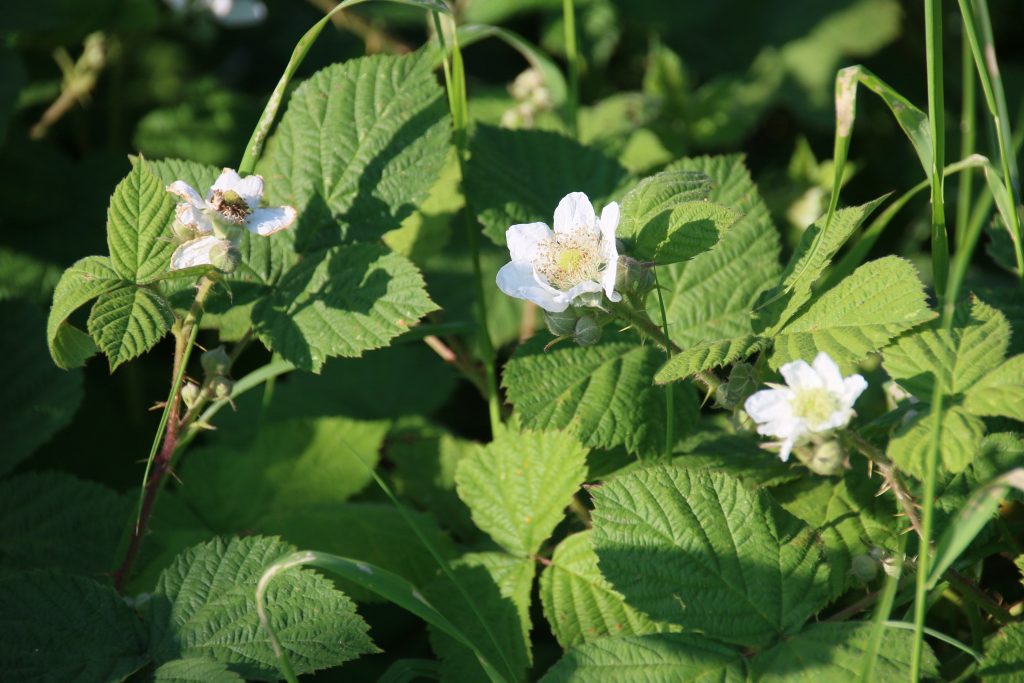
Although exceptionally hot, the heat wave and drought have not been prolonged. It is less than two weeks since the last rain, and so although the countryside is dry, it is not parched, not yet brown. A summer with periods of rain interspersed with brief heat waves is ideal for a bountiful fruit harvest, but it is too early to predict whether this will come to pass. For the time being a healthy display of blackberry, or bramble, blossom suggests that the shrubs may bear a lot of fruit, but a continuing dry summer may mean smaller fruit.
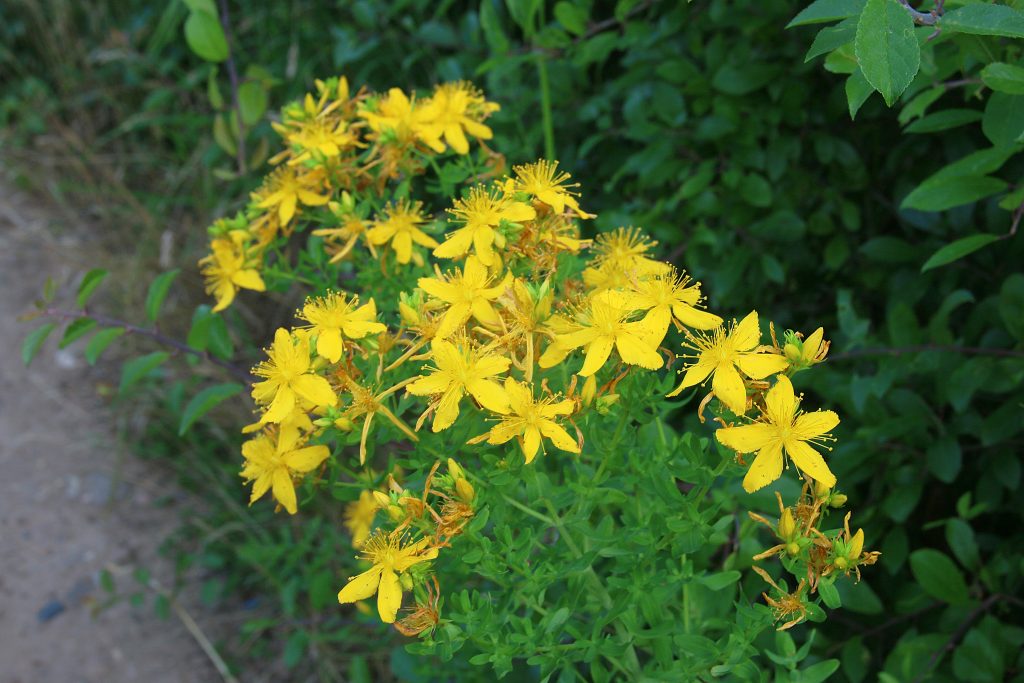
The yellow St Johns Wort is flowering beside the path. “Wort” indicates that the plant has medicinal qualities, and extract of the Wort is readily available from herbal pharmacies, a treatment for mild depression. Four days ago, we were awoken at 4.20am by a group of young people parking on the Lane before setting off up Croft Hill to see the sun rise on the longest day, the Summer Solstice. Traditionally St Johns Wort is at it’s most efficacious if picked on the Summer Solstice. The plant is named as such as it starts to flower just before the Feast of St John on 24th June, yesterday.
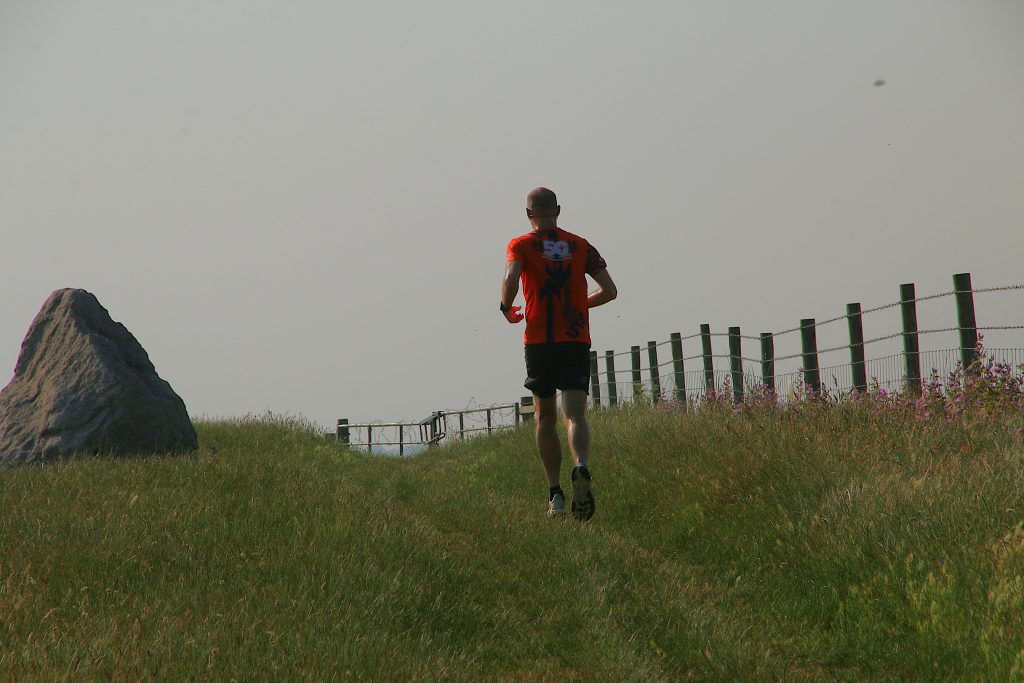
We are not the only ones avoiding the heat by exercising early. A runner passes, thanks me for keeping the dogs out of his way, shouting, as he passes, that he must complete is route before it gets hot. At the top of Croft Hill another runner arrives at the Trig Point, before turning to run back down. A mountain-biker has also ascended the Hill but stops for a rest and a chat before descending. He has another 7 miles to cycle before he gets home. On a more sedate note, a lady walks slowly up the slope, commenting on the warmth of the early sunshine, and back at the bottom of the Hill we meet a dog-walking friend with her two labradors. Despite living in the village, she has driven part-way so that most of her walk is in the shade.
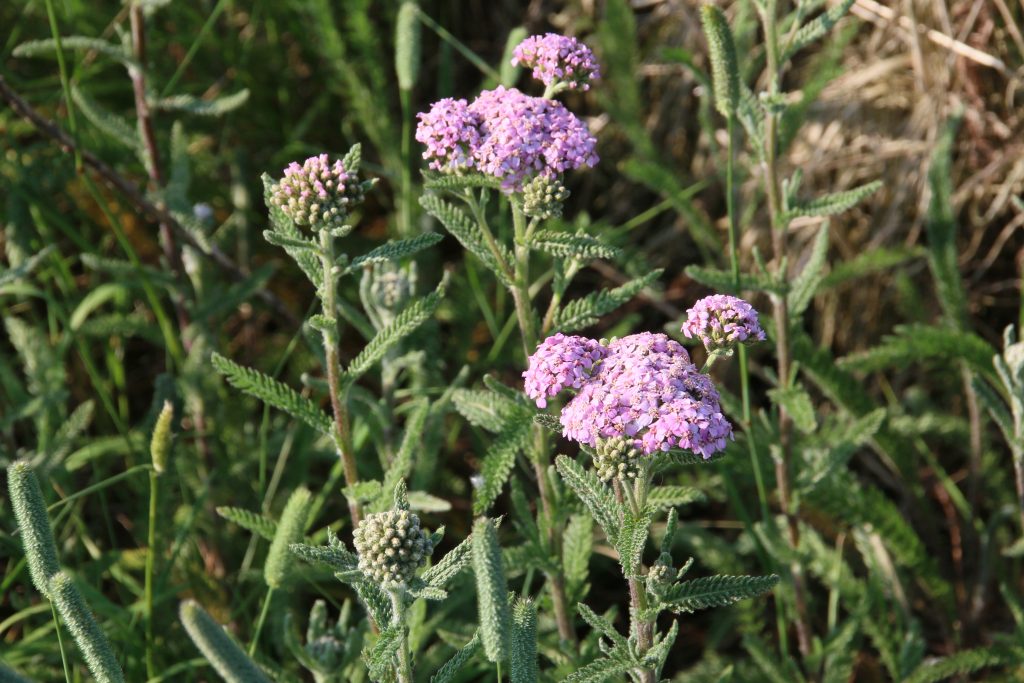
We spot another summer flowering plant with, traditionally, medicinal properties, Yarrow, said to inhibit bleeding. The leaves are used as nesting material by some birds – the leaves may discourage parasite infestations, although I suspect that birds do not appreciate this. The soft feathery leaves can be woven in with other nesting materials or used to line nests.


In the fields around us, the cereal crops are beginning to ripen, beginning to pale to a golden brown, although it will be several weeks before the wheat crops around us is harvested. Mowing grass meadows for sileage began a couple of weeks ago, and this week it was the turn of the meadow opposite our home. Earlier in the season this was grazed by dairy cattle, the milk destined for the Long Clawson stilton cheese dairy, but for weeks the grass has been allowed to grow. It has now has been cut for sileage, the round grass bales “packaged” into black polythene, the bale rotated behind the tractor as it is wrapped in strips of black plastic. The bales have, for the time being, been left on the field. When they are taken away to be stored in readiness for winter fodder, we will know doubt see the cows back in the field.
During a late evening dog walk, with the temperature still 25C at 9.30pm, we take the field path to the “Sheep Field”, another grass meadow at this time of the year. To our relief this too has been mown, in this case for hay, left on the ground in windrows, lines of cut hay, to dry. These will be turned over, using a tedder behind a tractor, for more drying, before baling.

5th June 2026
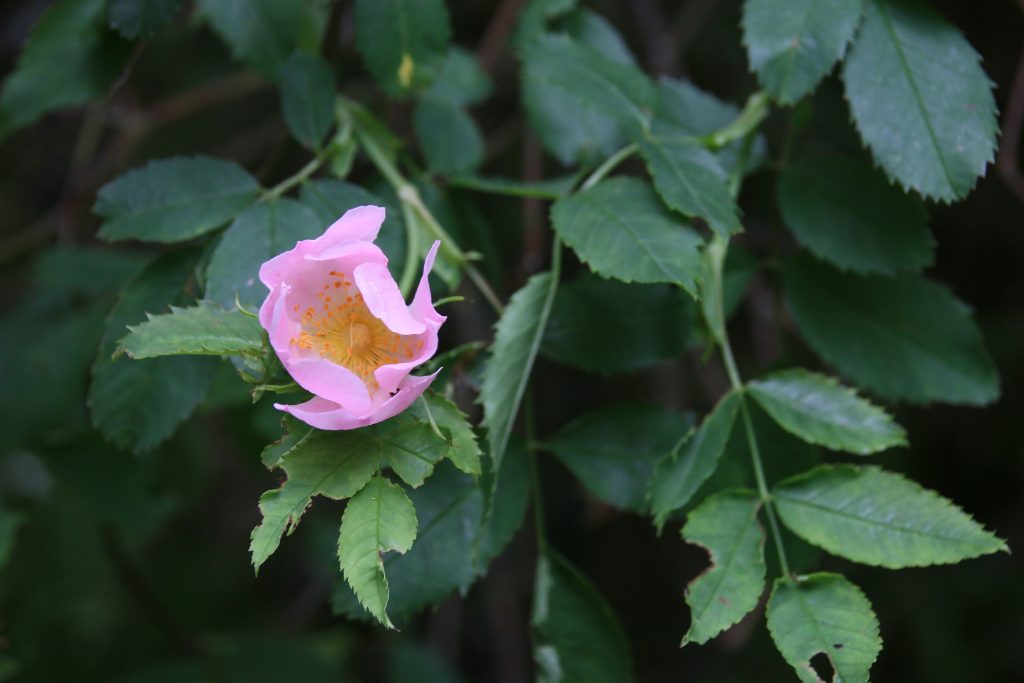
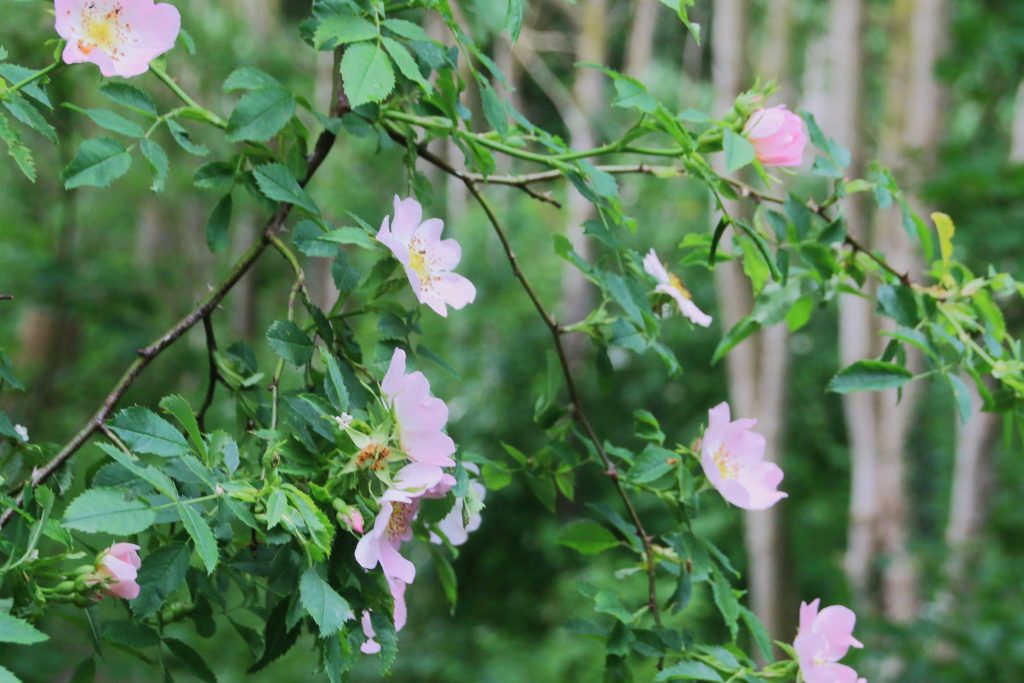
After a dry April, May turned wet before the month ended, but with ground dry for several cm the paths are more “slick” than muddy, wet patches barely enough to muddy dogs’ paws. Today is dry, but grey, with a cool breeze rustling the birch trees at the bottom of Croft Hill. The rain has resulted in a flush of greenery and flowering in the countryside around us. Dog roses are in full bloom, in some places arching over the footpath, to be passed with care or thorns will snag clothing. Even “dog-walking” attire will be expensive to replace. Dog walkers, out twice daily in all weathers, wear quality walking clothing, even if it does look scruffy after a season of walks.
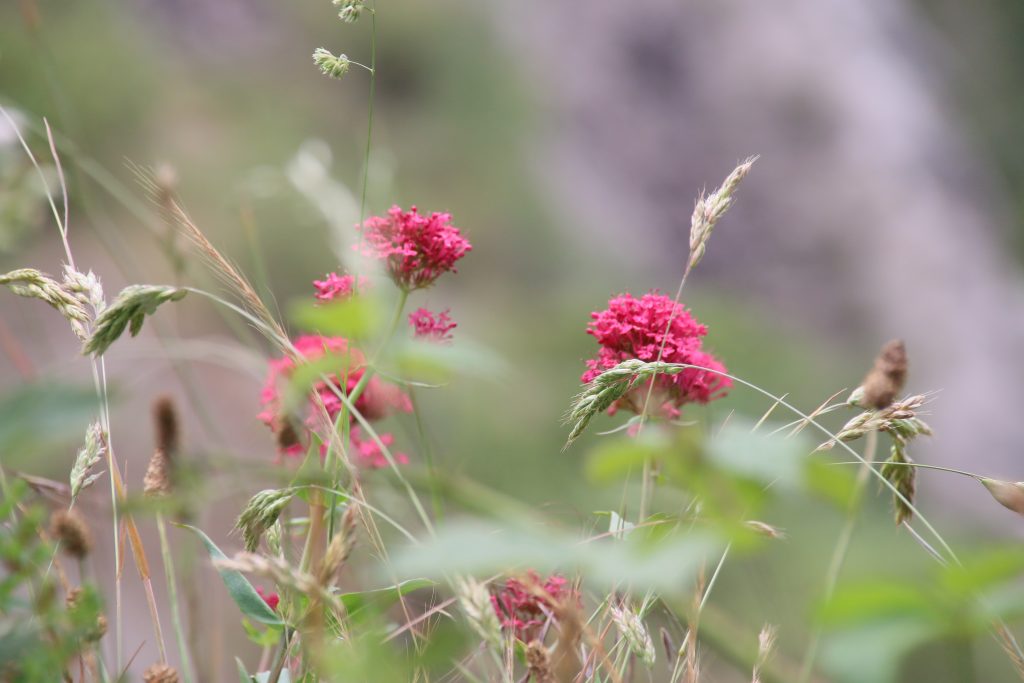
Looking over the quarry, I notice a splash of red on the cliff edge, behind grasses and inaccessible behind the quarry fencing. This is Red Valerian, unusual in the midlands, but more common in this area thanks to centuries of quarrying creating artificial but established cliff faces of broken stone, favoured by the plant.
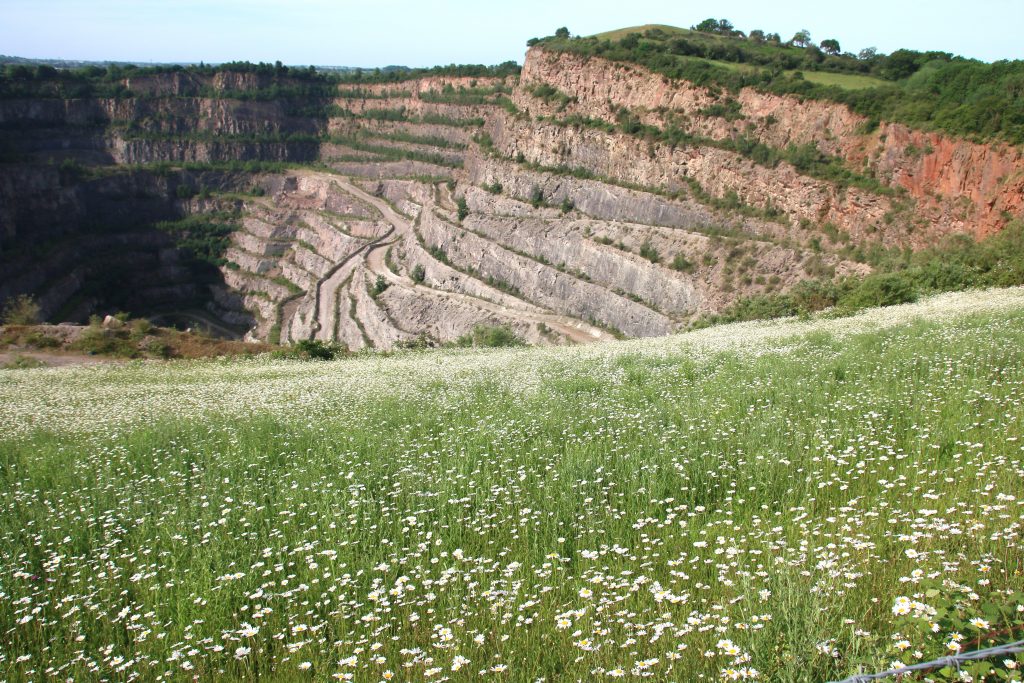
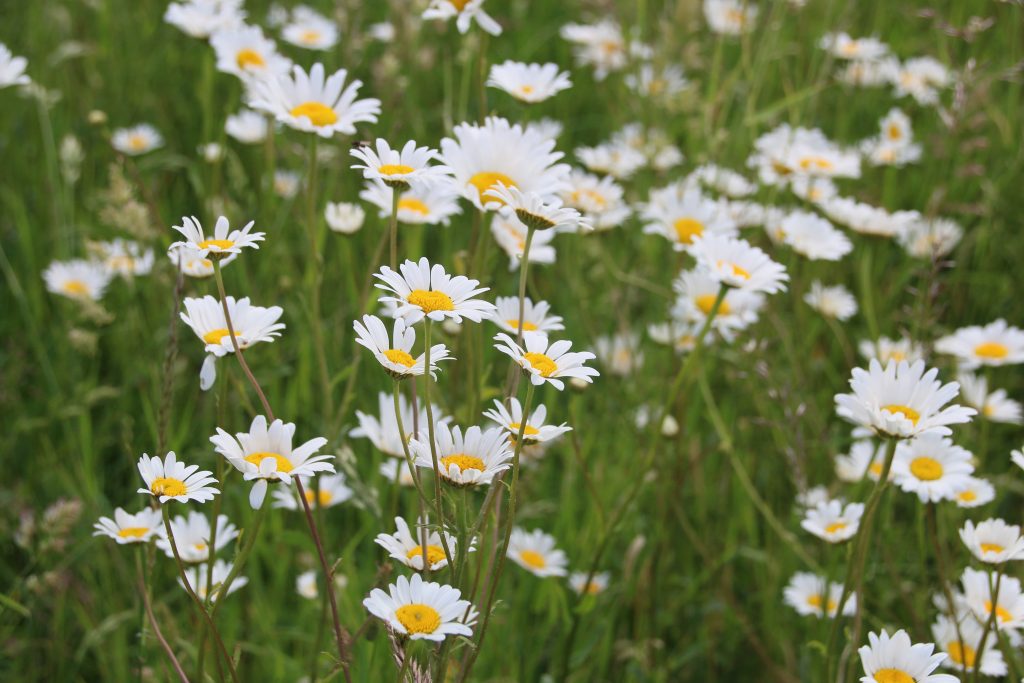
Further on, a grassy bank slopes gently down to the cliff edge, so orientated that it received full sun for most of the day. This is covered with a carpet of ox-eye daisies, cascading from the edge of the path and over the slope. In early summer these wildflowers dominate this slope, thanks to the fertile soil, to the exclusion of other wildflowers, which are shaded out by the tall daisies and surrounding grasses.
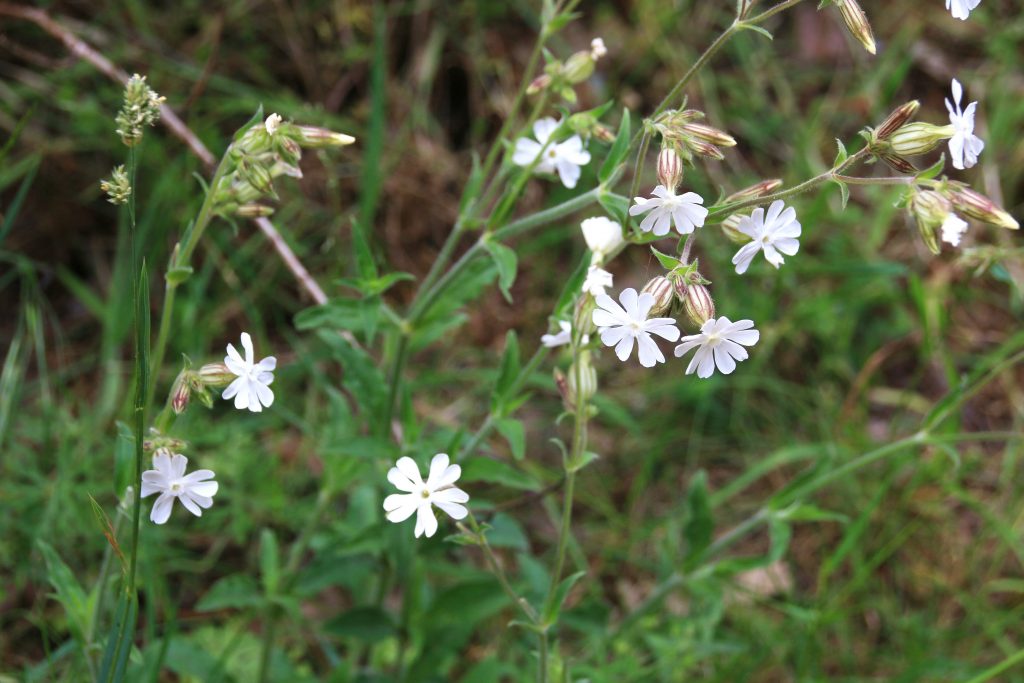
Red Campion has been common in hedgerows for a month or two. These are now accompanied by its “cousin”, white campion, a different species of the same family. The two can hybridise, the result being, as you might expect, pink flowers, but I have not seen pink campion around here. White campion has a noticeable scent, particularly at night when a combination of the white bloom and the scent attract a wide variety of moths to feed.
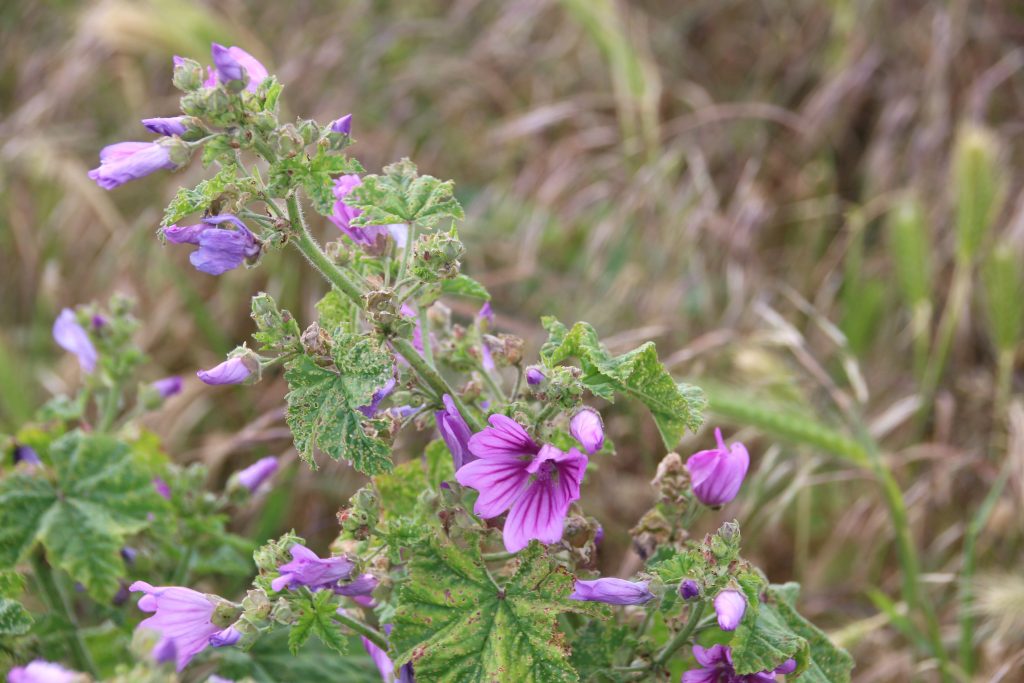
Further along the path, higher up and more open, a lone kestrel hovers in the updraft blowing up the cliff face of the quarry. As I move towards it, it flutters sideways along the side of the quarry, and I am never close enough to photograph it. Common Mallow is now in bloom along the bottom of the fence that runs along the quarry edge. Apparently, parts of the plant can be used top relieve pain, and has been as such since Roman times, but personally I’ll just stick to observing and photographing it.
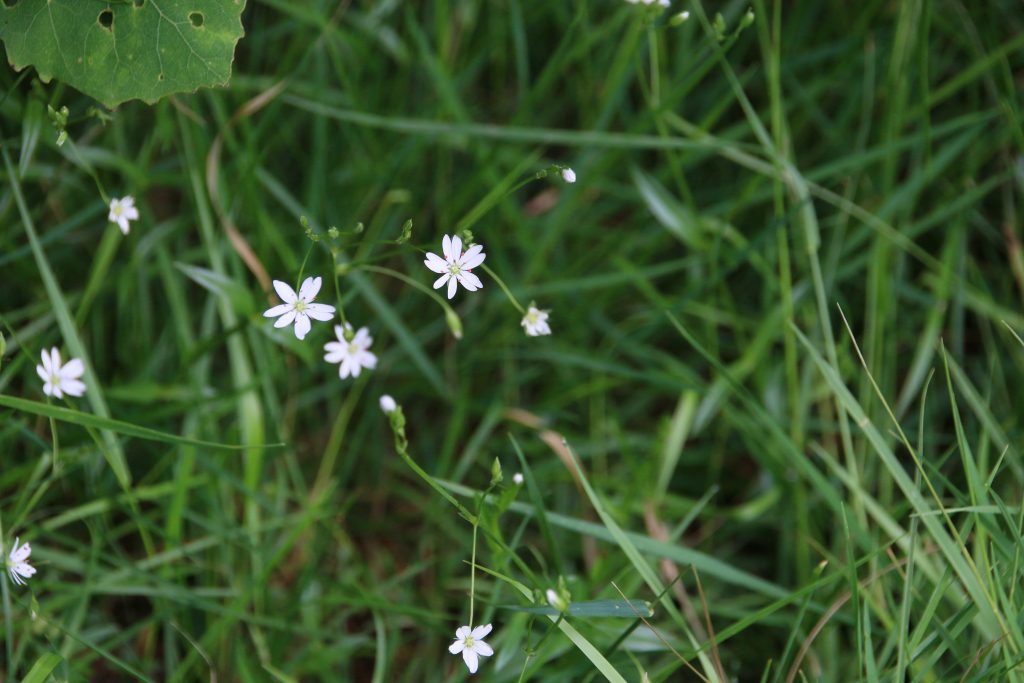
Also hugging the fenceline, growing amongst the clumps of grass, is Lesser Stitchwort. Like White Campion the Lesser Stitchwort is a source of nectar and pollen for insects, including bees, moths and butterflies. In fact the plant does not need insects to spread, since it can self-pollinate, although will happily cross-pollinate if visited by insects who move from plant to plant.
Away from the fenceline, in open grassland, Dove Foot Cranesbill is spreading. This tough spreading plant is a wild variety of geranium, and tolerating being trodden on, and surviving prolonged dry weather. Up here it is a wildflower which enhancers the landscape, but when it appears in a manicured lawn it becomes a weed, spreading unless controlled. We don’t have a “lawn”. We have areas of grass, mowed but not manicured, and with patches left for grasses and wildflowers to grow, to the benefit of insect life.
Dropping back down the slope to the bottom of Croft Hill we meet an elderly couple out for a walk. I keep the dogs close, to prevent them running over to give an enthusiastic greeting. After a brief chat we move on, and come across another walker, and we comment how a cold grey start has turned into warm sunshine, and we are both overdressed. At least I am coming to the end of my walk, and decide not to shed layers until we get home.
26th May 2026
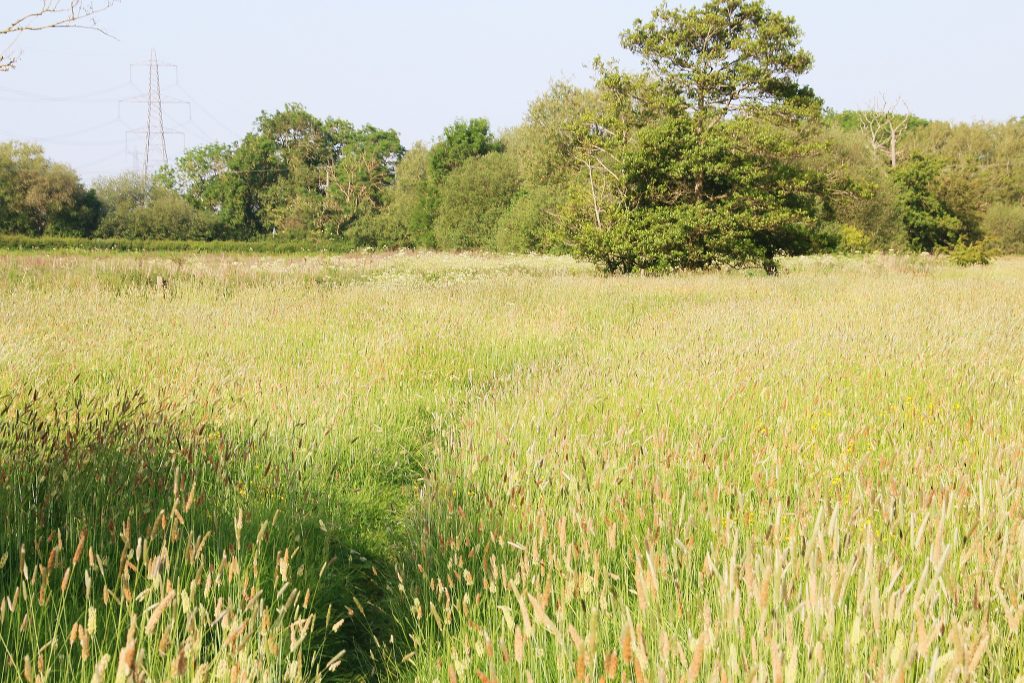
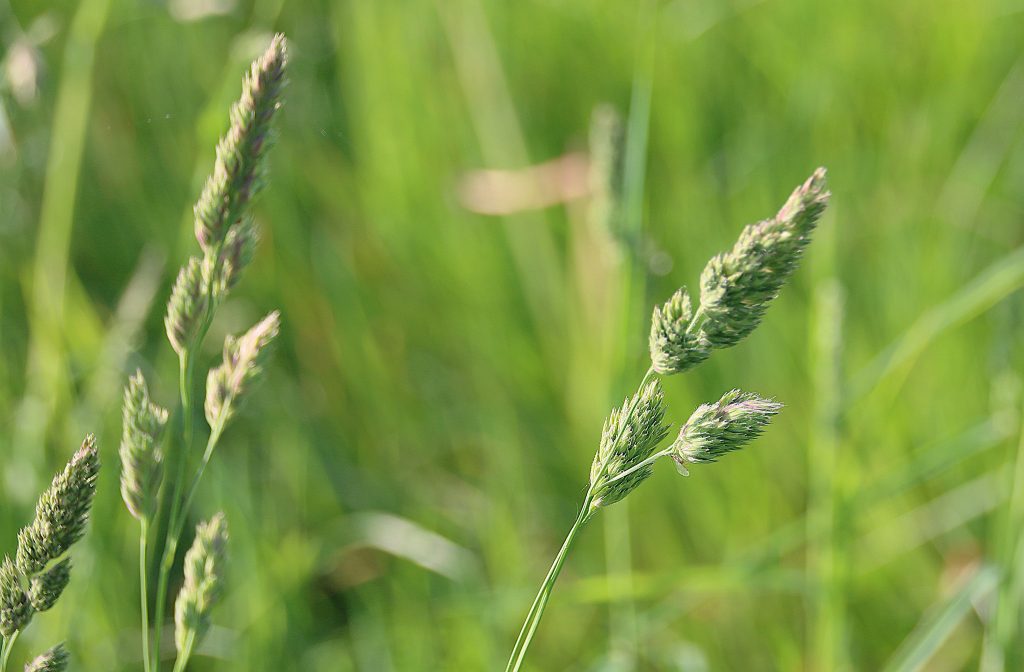
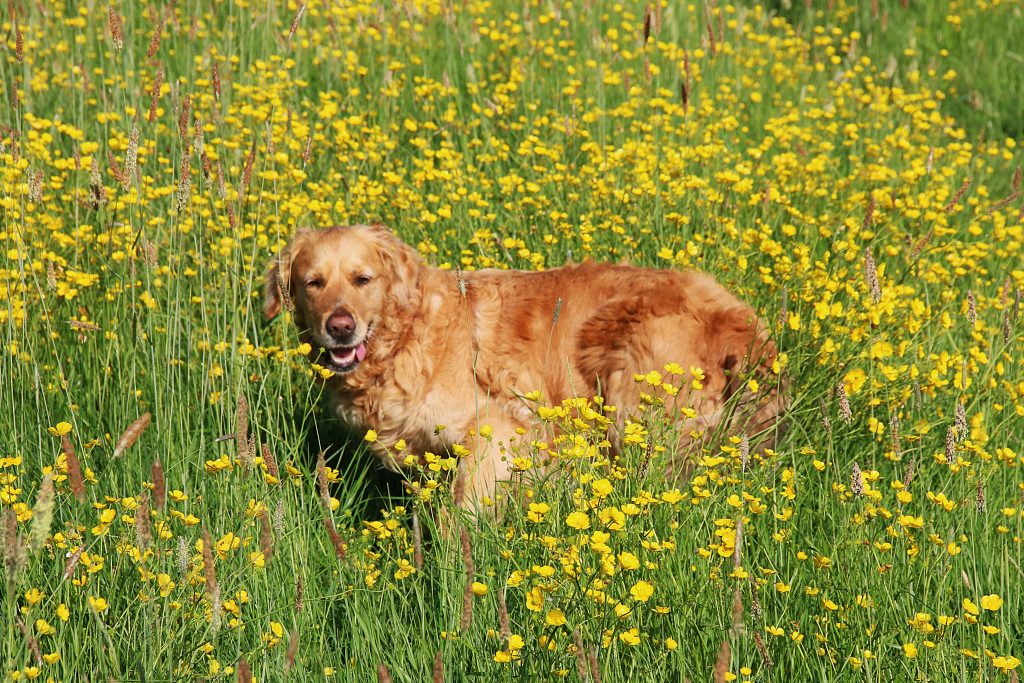
As anyone with hay fever will know, this is the season of the grasses, with long grass of all varieties along field tracks, and in meadows. With a hot day forecast we are out early, walking the dogs in the cool of the early(ish) morning, following the field track behind our home, to walk around the “Sheep Field”. At the moment it is definitely not a Sheep Field. The grass is long, sprinkled with yellow meadow buttercups, and before long it will be harvested, mown for hay. After that the grass may be left to grow for another hay-crop, or sheep will be introduced to graze.
The footpath goes through the middle of the field, although you wouldn’t know it without a map. Despite being a popular dog walking route, there is little sign of a path though the knee-high grasses and meadow buttercups. The dogs are not small, but even they disappear if they follow a scent through the grass. On a wet or dewy morning, I avoid the field, since without wellies and waterproof over-trousers the drops from wet grass will soak my trousers. On the other hand, on a warm dry day it is a preferred route, since the dogs enjoy the cool shade as they run through the dense grasses and flowers.
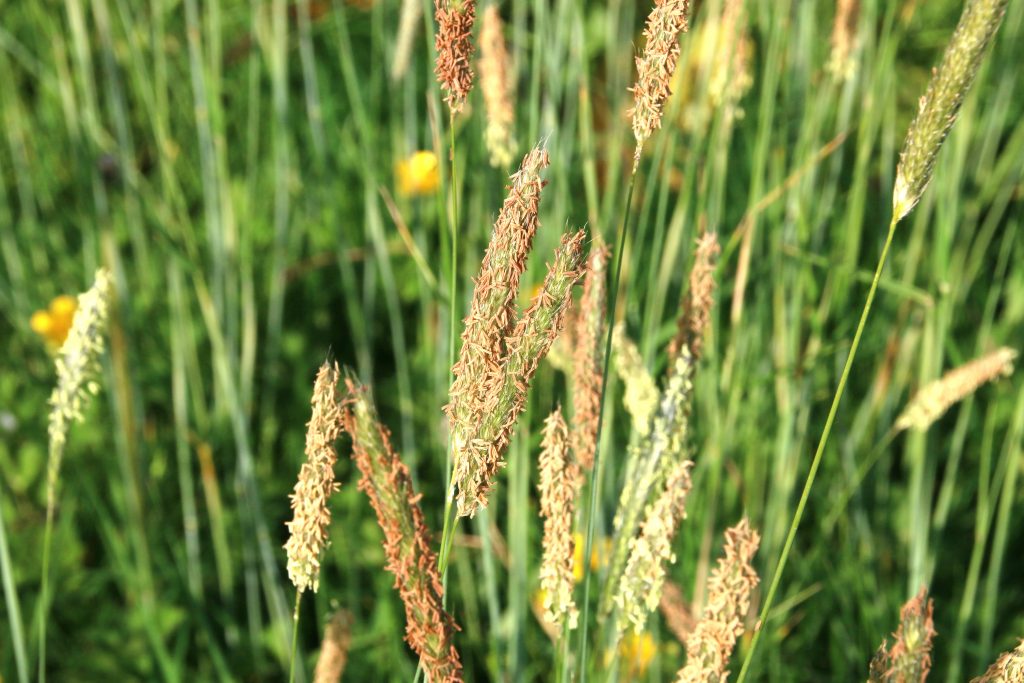
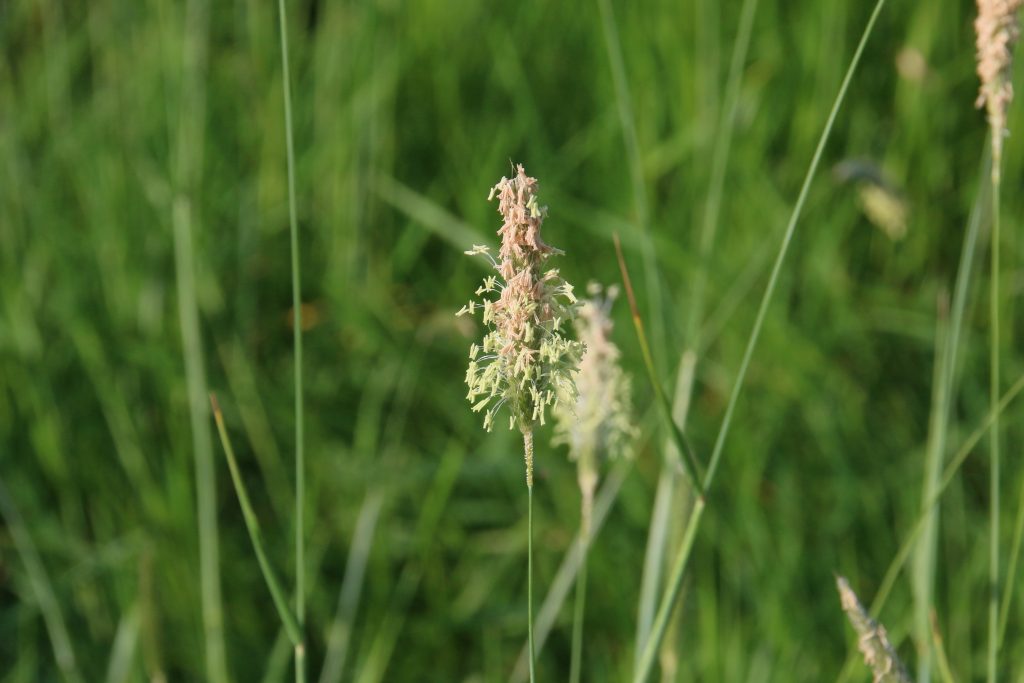
Internet searches suggest that true hay meadows are not common, many being replaced by fields used for sileage. Hay is not artificially fertilised, mown in June or July, and maybe again later in the season, the grass and flower stems drying in the field before being baled, nowadays mostly in large round bales. This results in a wider variety of grasses and wildflowers. Sileage fields are also mostly grasses but may have fertiliser applied resulting is denser grass growth, which is harvested using a forage harvester which chops the stems up. The sileage is also stored in round bales, but these are bagged in plastic without drying, subsequently fermenting. Both hay and sileage are used for winter feed for stock – sileage has a higher energy content and is better for dairy cattle or cattle being fattened for market.
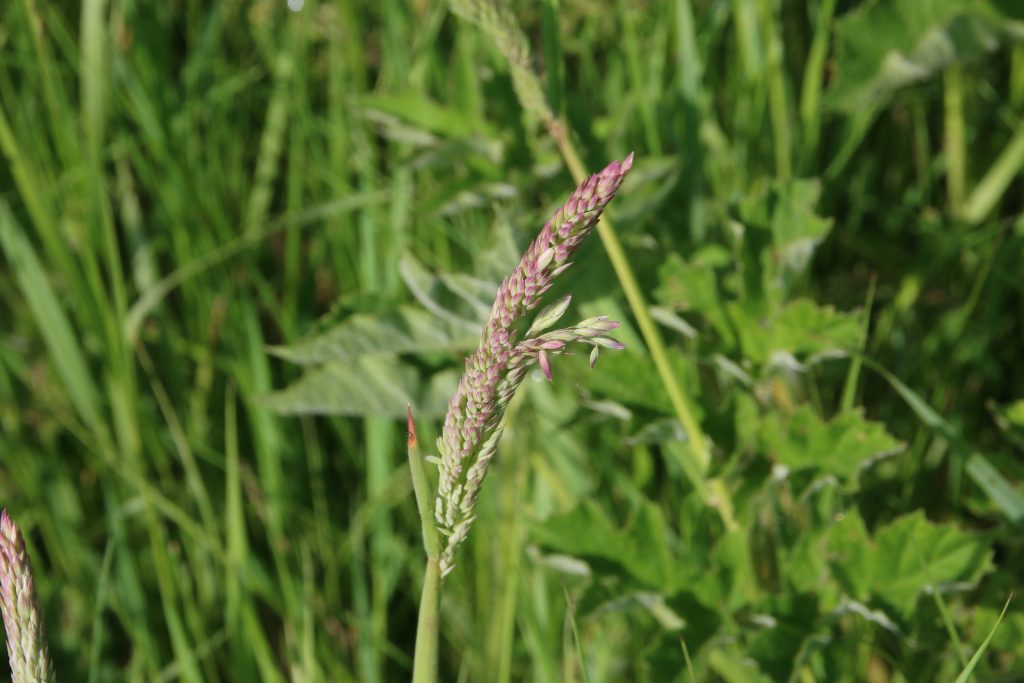
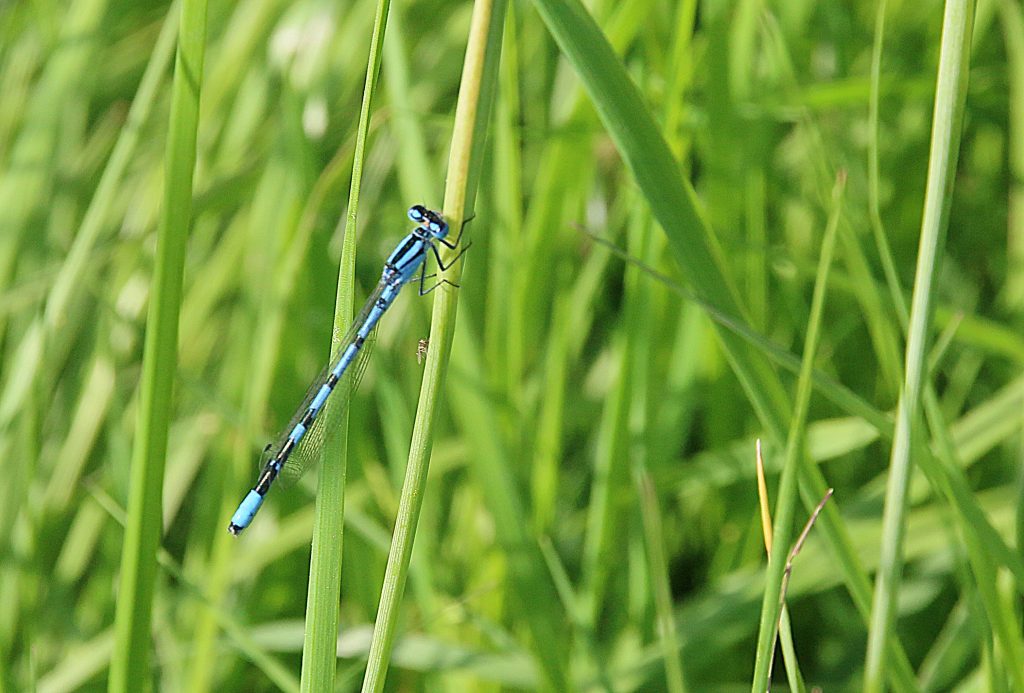
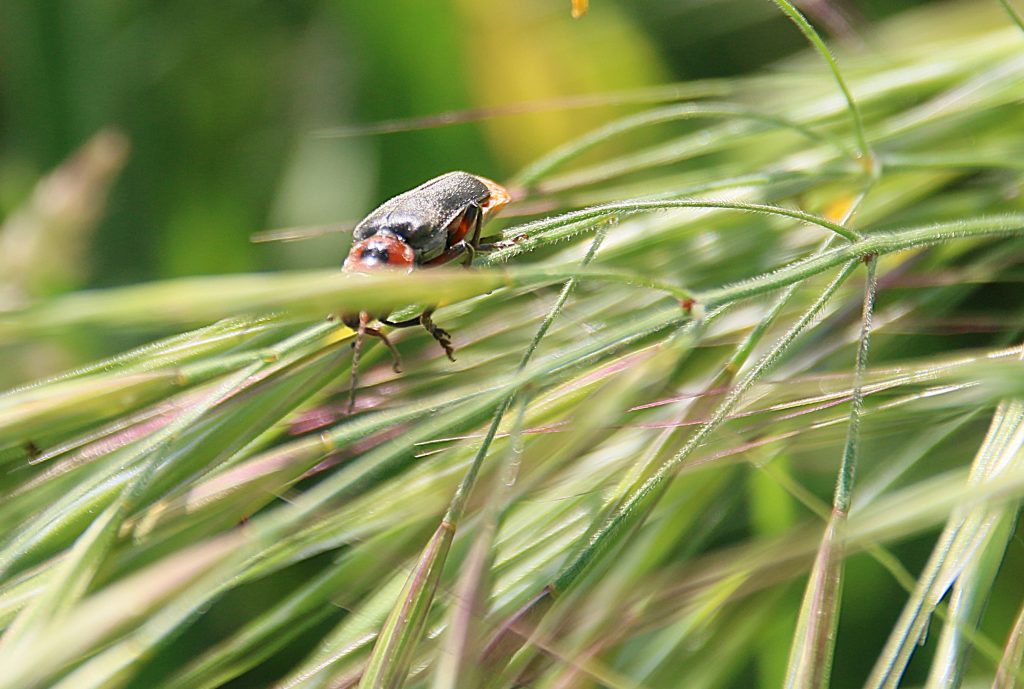
Grasses for either sileage or hay host a variety of insects, and I spot a couple in my lens as I photograph the grasses. The vivid iridescent blue of a Common Blue Damselfly is easily spotted, although less easily photographed as it flits from stalk to stalk. A Soldier Beetle is a slow mover but prefers to keep his head down amongst the leaves and stalks of the meadow grasses.
At the lower end of the field, the end that always floods first and where the soil is more moist,, Meadow Buttercups still decorate the greens of the meadow, although less profuse that a couple of weeks ago. As I walk through the meadow, I raise clouds of pollen from. The dogs will be covered in pollen, mostly invisible, which will need to be removed by a good brushing when we get home. The bright yellow pollen from the buttercups is more easily seen, particularly on Sam’s white fur, and he leaves the field with a stained face. Fortunately, none of us suffer from hay fever.
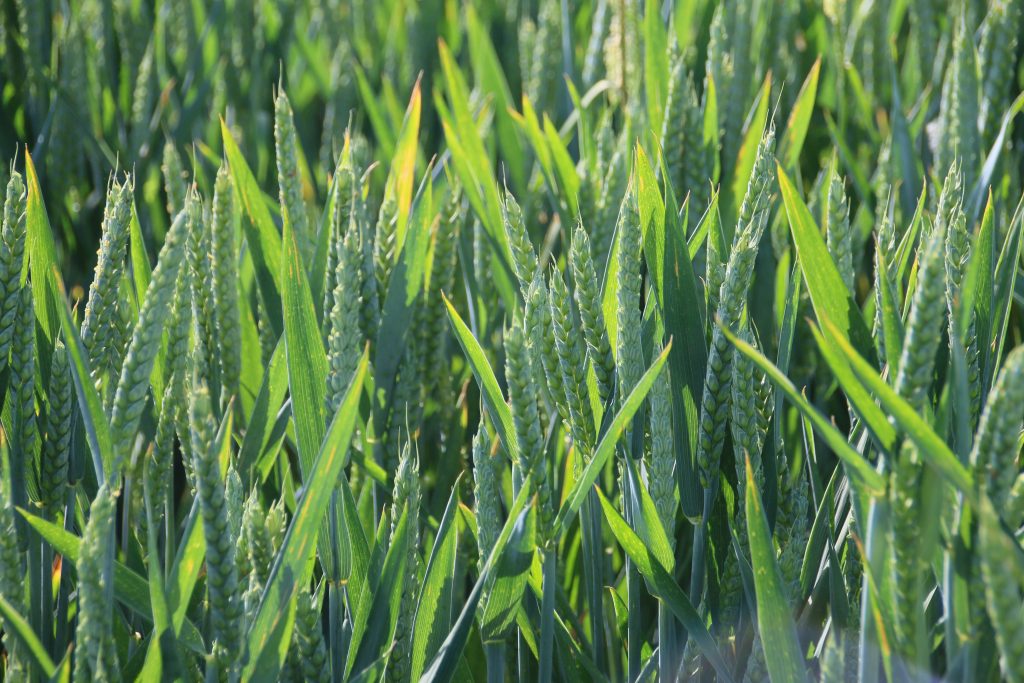
Walking back home along the field track I note that the wheat, which after all is just a cultivated grass, has also produced seed heads, although these are still green, several weeks away from ripening.
15th May 2026
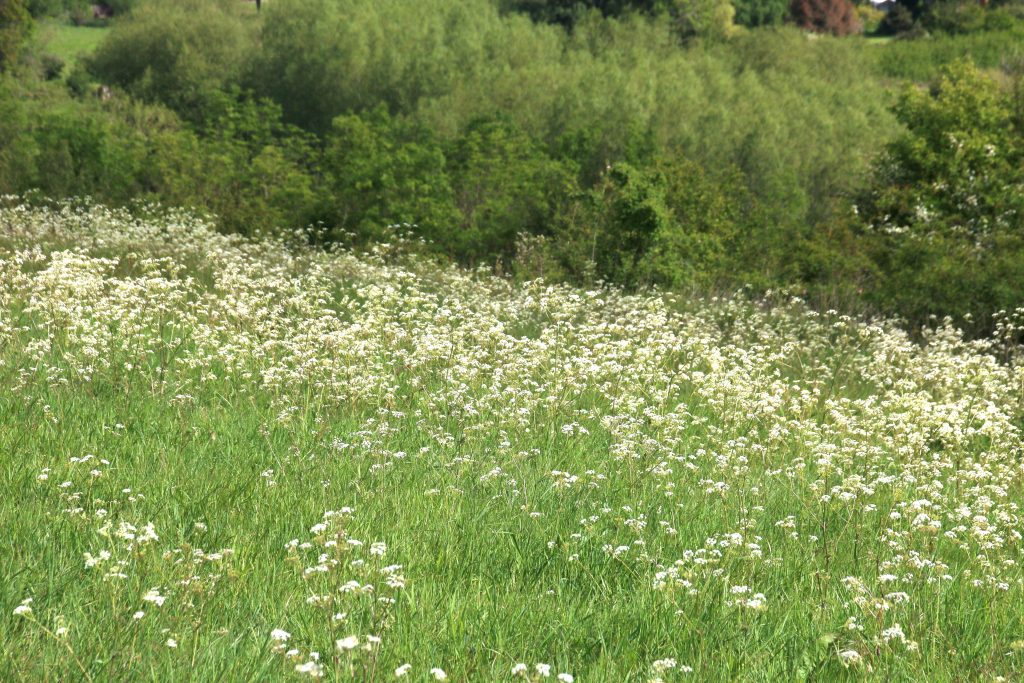
Where only a month ago primroses decorated the grassy slopes around the quarry, now pignut grows through the long grasses. At first glance pignut could be mistaken for Cow Parsley, but is shorter, with smaller flowers, and found on meadows and grassland, or maybe more open woodland, rather than ditches verges, and damp woodland. The plant is called “pignut” because it has a nutty edible root
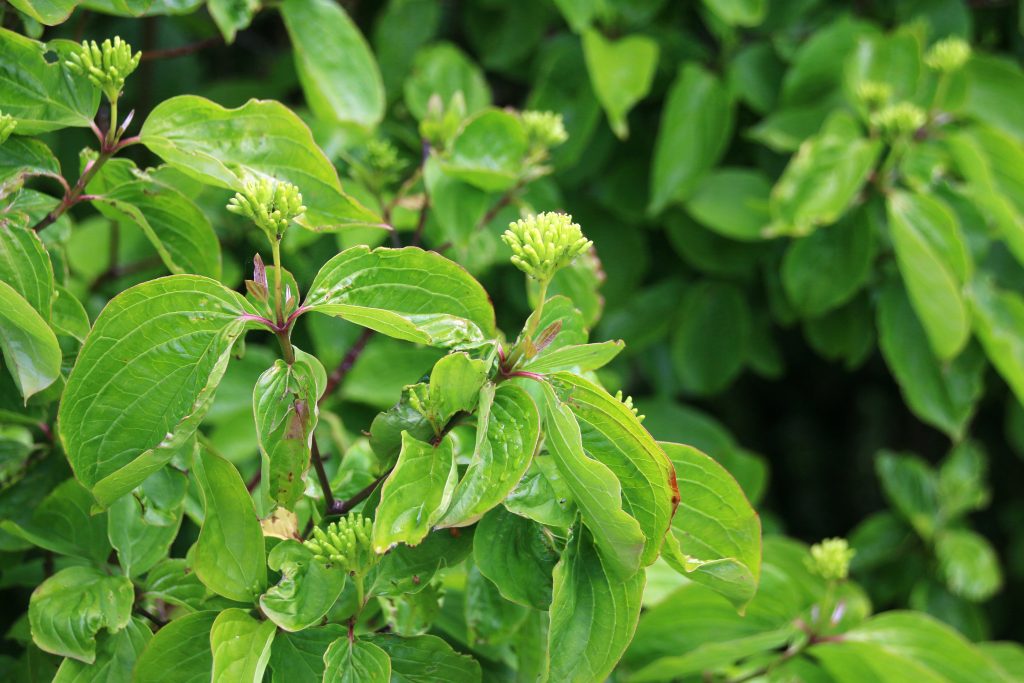
Where the path narrows, shrubs crowd in from either side. The overgrowing blackthorn has been trimmed back, probably by a dogwalker who has remembered to bring secateurs for the purpose. Further on we pass dogwood, the blossom not yet open, leaves still damp from an earlier shower. Dogwood is a native of southern England, rather than the English Midlands, where we live. It has been planted here as part of a planting scheme to “naturalise” the artificial hill along the quarry edge.
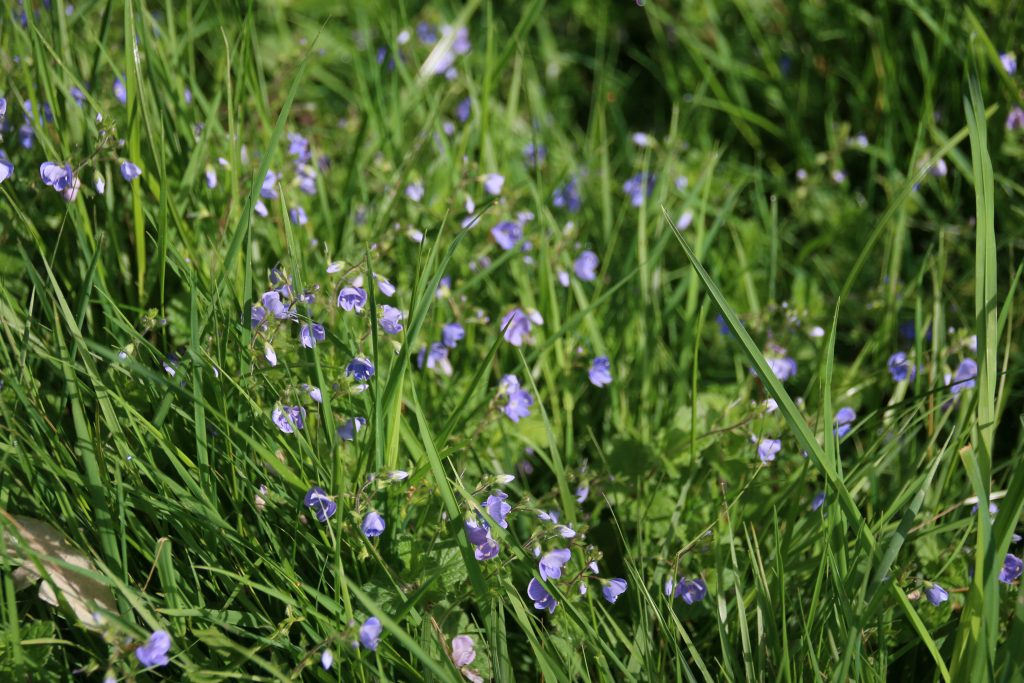
Germander Speedwell is spreading in the short grass at the open highest point of the hill, where there are almost uninterrupted views across South Leicestershire and beyond. Speedwell flowers in to Autumn, and is said to bring good luck to travellers, ensuring that they “speed well” on their journey. It is a source of nectar particularly favoured by solitary bees and is common. I leave areas of my lawn unmown, and Speedwell grows among the long grasses and dandelions, and I often see bees visiting.
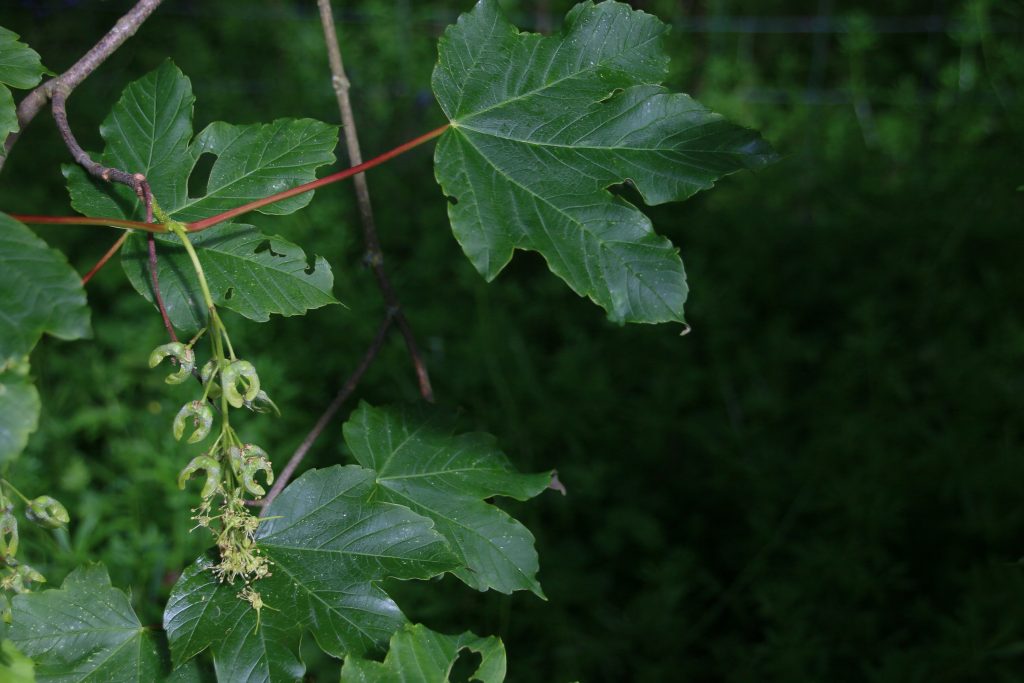
We walk down the slope of the “New Hill”, through a copse and onto Croft Hill, the “Old Hill”. The Hill itself is granite, and near to the top the rabbit-cropped turf is thin, just a couple of centimetres lying over the bedrock, but around the base a corridor of woodland, mature trees and shrubs, separates the hill from the footpath and lane that connect Croft and Huncote. A sycamore has produced seeds, small green wings that have developed from the blossom earlier in the season. The seeds can be used to distinguish sycamore from maple, which has similar leaves. The two wings of the maple are 180 degrees to each other, a straight line, whereas sycamore seeds form an angle of 90 degrees.
2nd May 2026
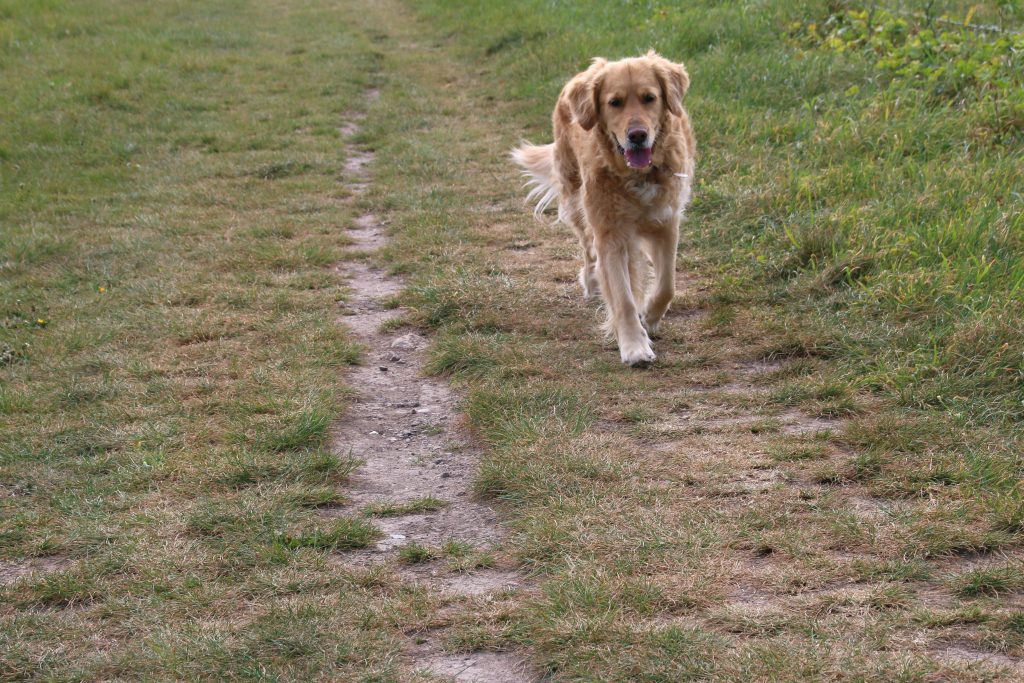
After six dry weeks the ground is hard beneath our feet and paws – just four paws today, because Sam has been limping and is on short walks. Along well-trodden paths the grass already worn away, and even in the lush grass of the sheep field the route around the field used by dog walkers is a clear path between the knee-high meadow grass.
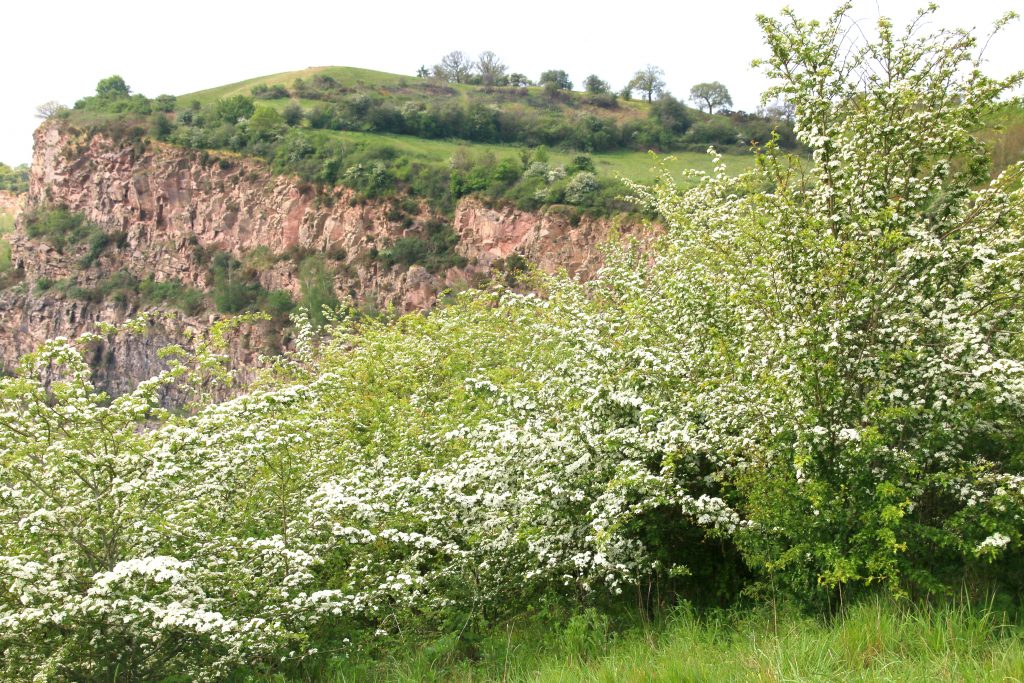
The blackthorn blossom of early Spring has now completely surrendered to hawthorn; the hawthorn hedgerows and shrubs are frothy with the blossom. Hawthorn is also known as May, or the May Tree, and the proverb “Ne’er cast a clout till May is out”, keep wearing layers until the May is out, is probably based on the May, or Hawthorn blossom. By the time that Hawthorn is flowering, the worst of cold weather is behind us, as each day the midday sun climbs higher into the sky, and sunlight becomes stronger and warmer.
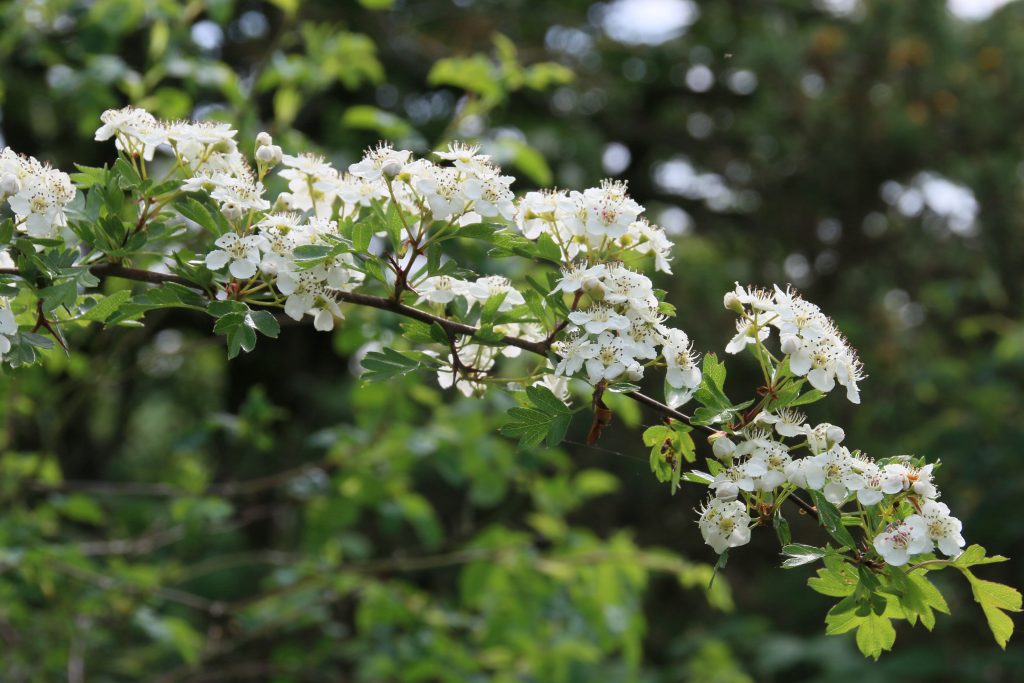
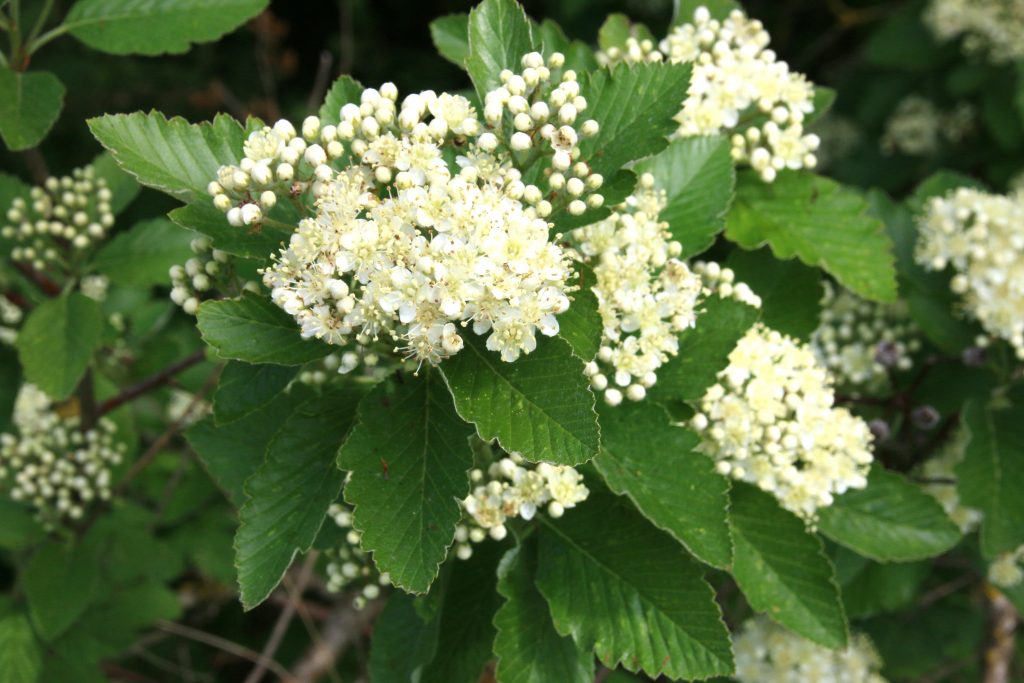
Hawthorn may be the dominant blossom in the countryside around us, but other shrubs are also in bloom. Whitebeam blossom looks similar to Hawthorn, but the leaves are very different, toothed or serrated, rather than the lobed leaves of Hawthorn. Whitebeam is more common in limestone areas. The specimens that we pass today will have been planted as part of a landscaping and planting scheme around the quarry.
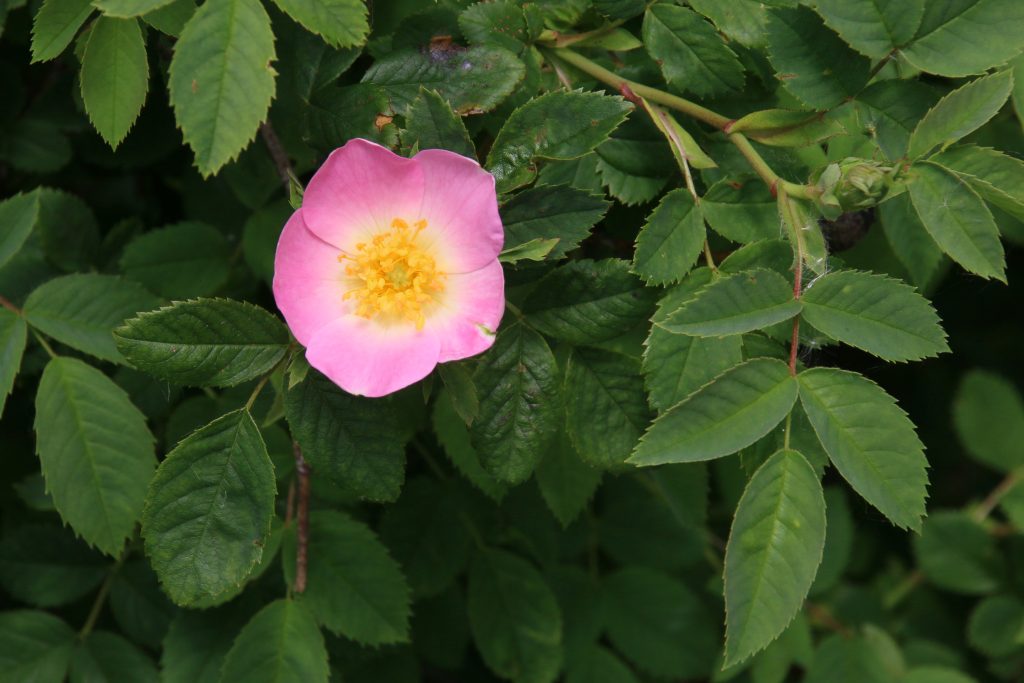
Wild roses, or Dog Roses, are just coming into flower, just isolated blooms and a little earlier than usual, possibly thanks to recent warm, almost summery, weather. A small blue/purple butterfly or moth flies up from the rose bloom, disappearing before I can identify it.
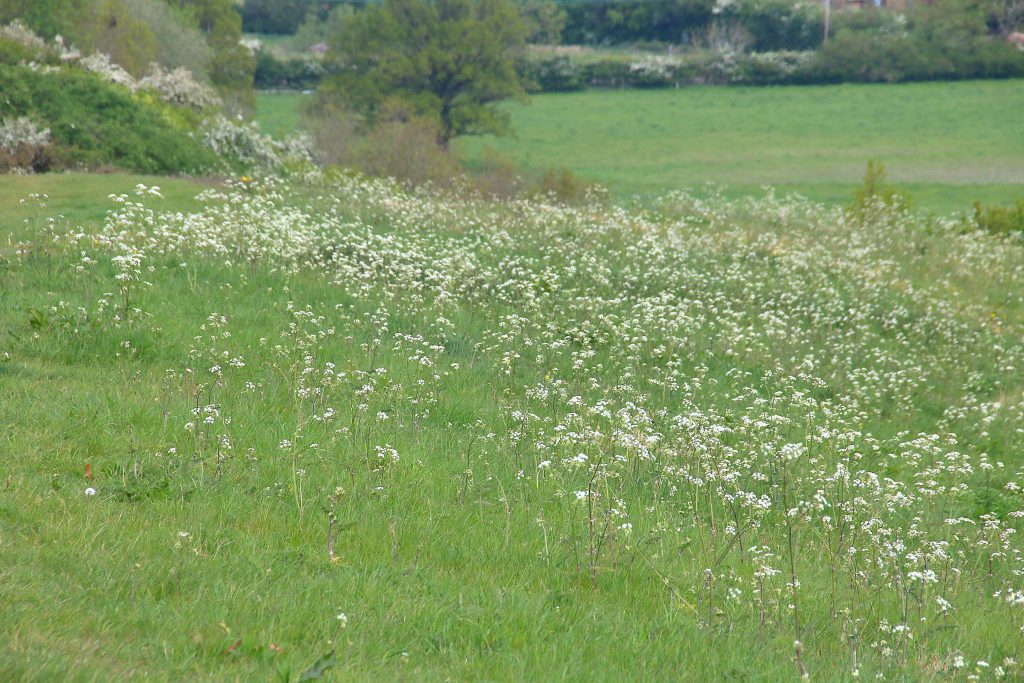
Pignut has now emerged on the grassy slopes where cowslips flowered in profusion just a few weeks ago. These delicate, white-flowered plants resemble small Cow Parsley, but are only a foot or so tall, and more likely to be found in open areas, whereas Cow Parsley is usually found in damper hedgerows and grass verges.
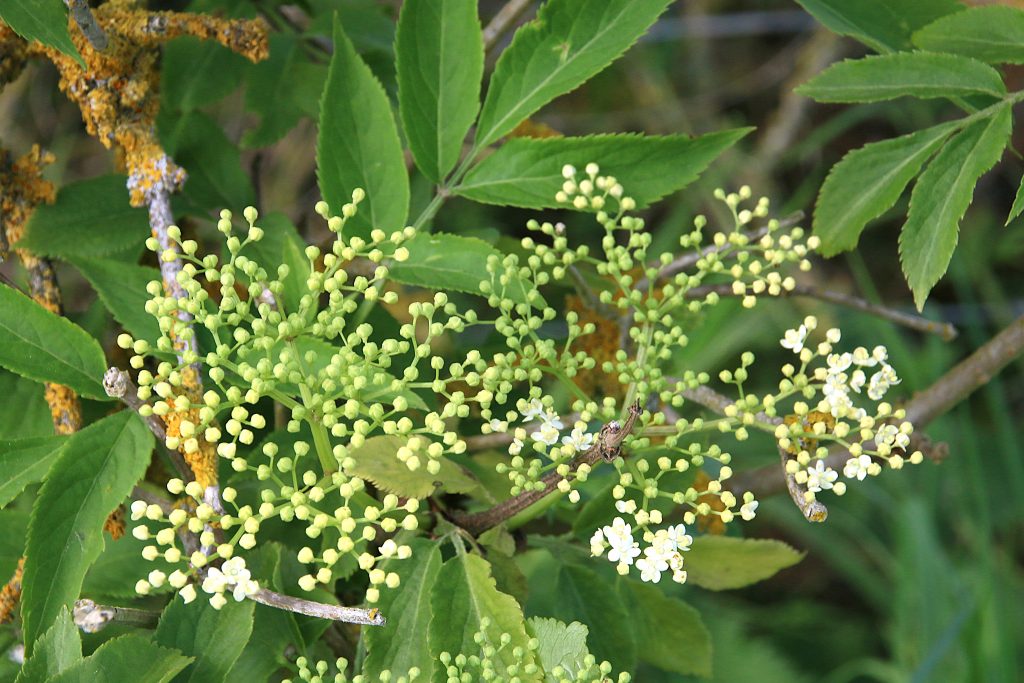
Elderflowers are just starting to bloom. Elderflowers can be used for Elderflower cordial and Elderflower wine, or even a tea-like infusion, but will not be gathered until later in the season when the shrubs are in full flower. Elder is very common, spreading rapidly, almost invasively, where there is plenty of sunshine and where soil has been disturbed by man or animals.
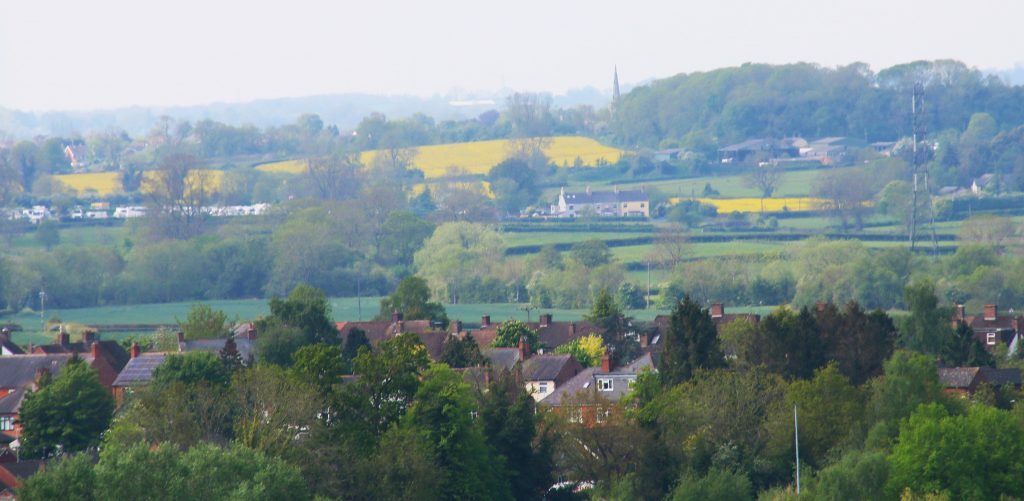
White is not the only colour in the countryside. In the distance the bright yellow of fields of oil seed rape are visible around the village of Broughton Astley, two or three miles away. No rape around us this year. The crop is strikingly pretty at this time of the year, with a strong fragrance, but those with hay fever or allergies curse the pollen-laden flowers. As the crop grows it blocks footpaths, impenetrable unless the farmer cuts it back.
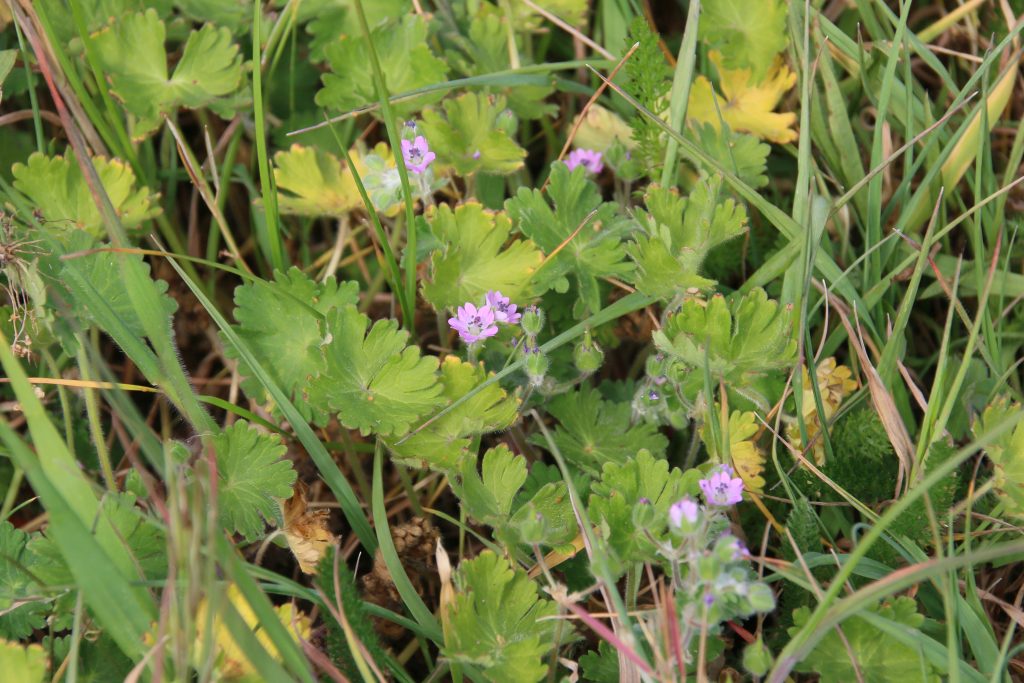
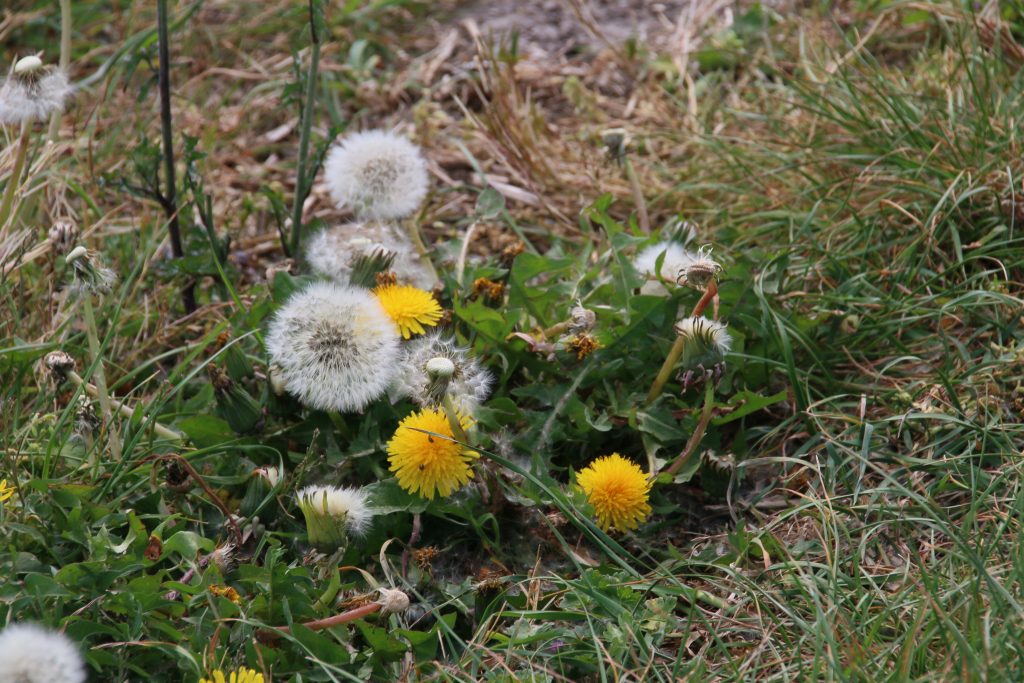
On the ground Doves-Foot Cranesbill is almost unnoticed under foot, a low creeping plant among the grasses around the quarry edge, although it will grow taller over the next few months. A very common plant, a useful source of food for caterpillars of various moths and butterflies. Dandelions have been in flower for some time, but now “dandelion clocks” are emerging, the seedhead that grows after the flower has closed and the petals fallen off. The yellow flowers and downy seedheads will be around for many months.
21st April 2026
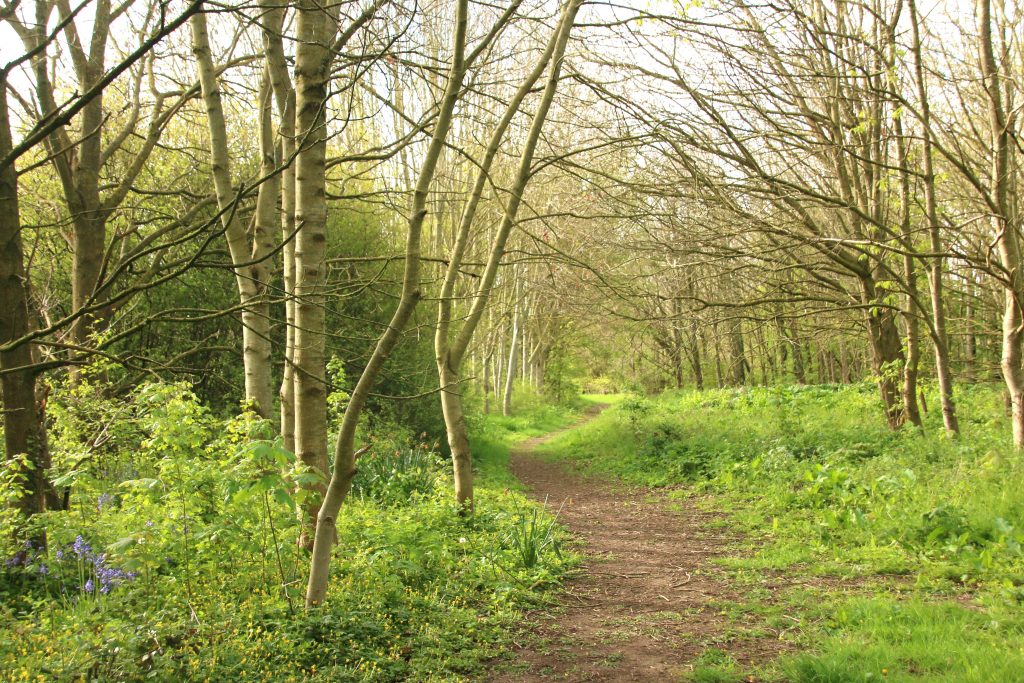
It is a mild morning, with warm spring sunshine and a gentle breeze, a perfect morning for a longer walk, but I notice that Sam is limping, probably arthritis, although he is only four years old, a legacy of an elbow dysplasia operation when he was 7 months old. This will be a shortish walk, with anti-inflammatory Metacam dispended when we return.
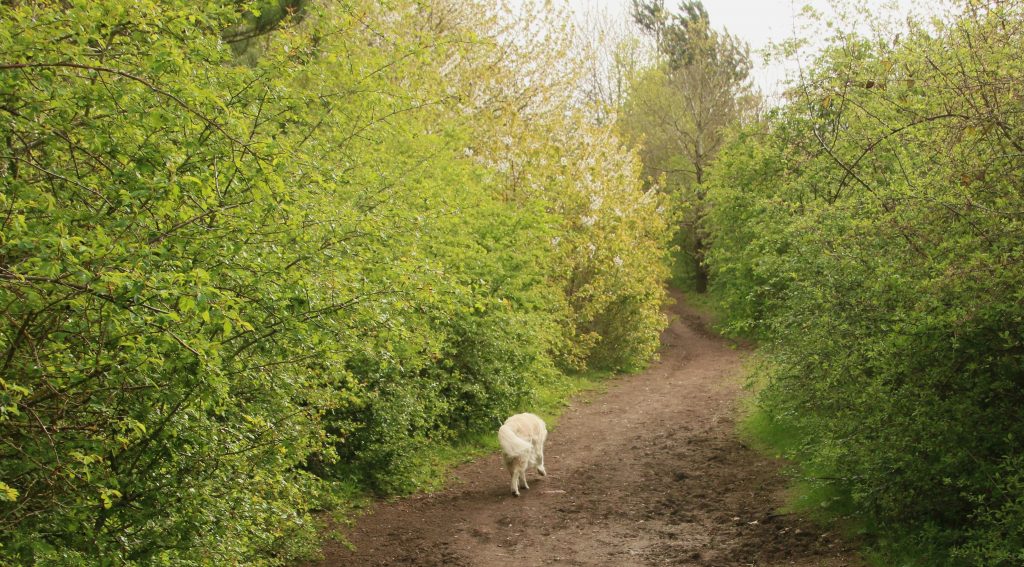
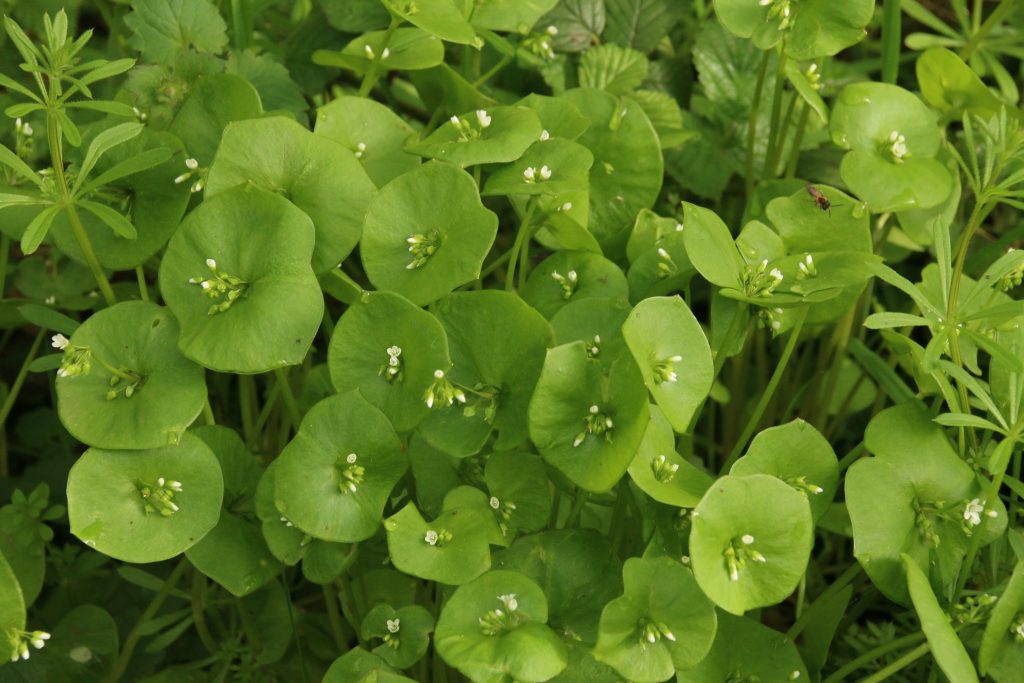
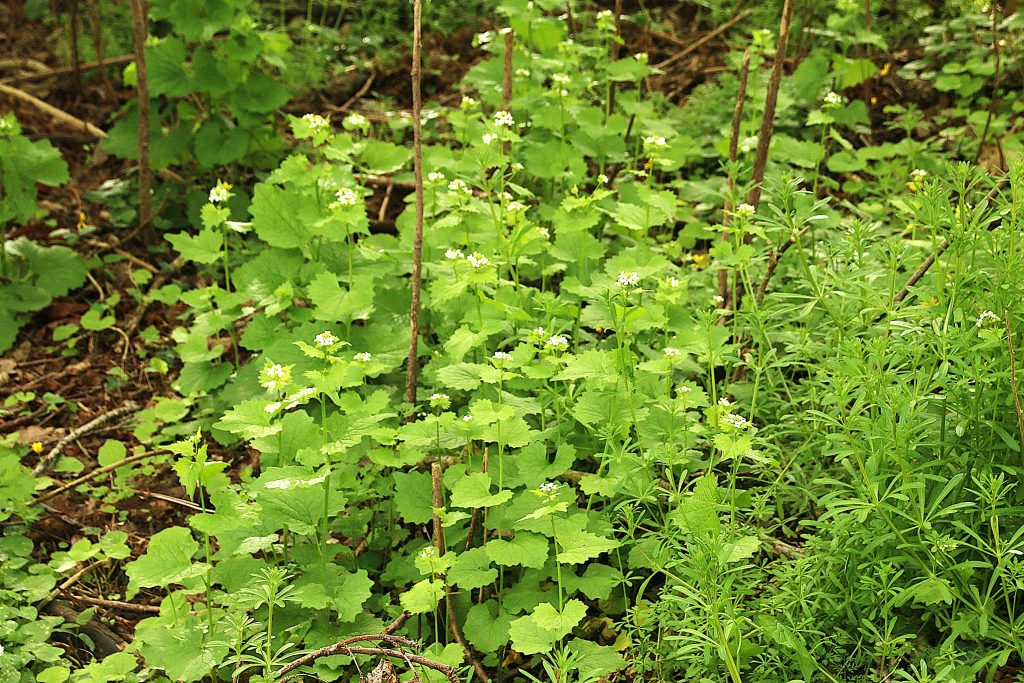
Although most trees are not yet in full leaf, or, in the case of oaks, no sign of leaves yet, the countryside is a verdant green. The tiny white flowers of Miners Lettuce is abundant along the edges of path, and the taller Garlic Mustard is spreading among the sticky tendrils of Cleavers, the wild plant favoured by children who pull up long strands to surreptitiously attach it to the back of unsuspecting adults. Both Garlic Mustard, also known as “Jack-by-the-hedge”, and Miners Lettuce are favoured by the orange tip butterfly, quite common, but none are around today.
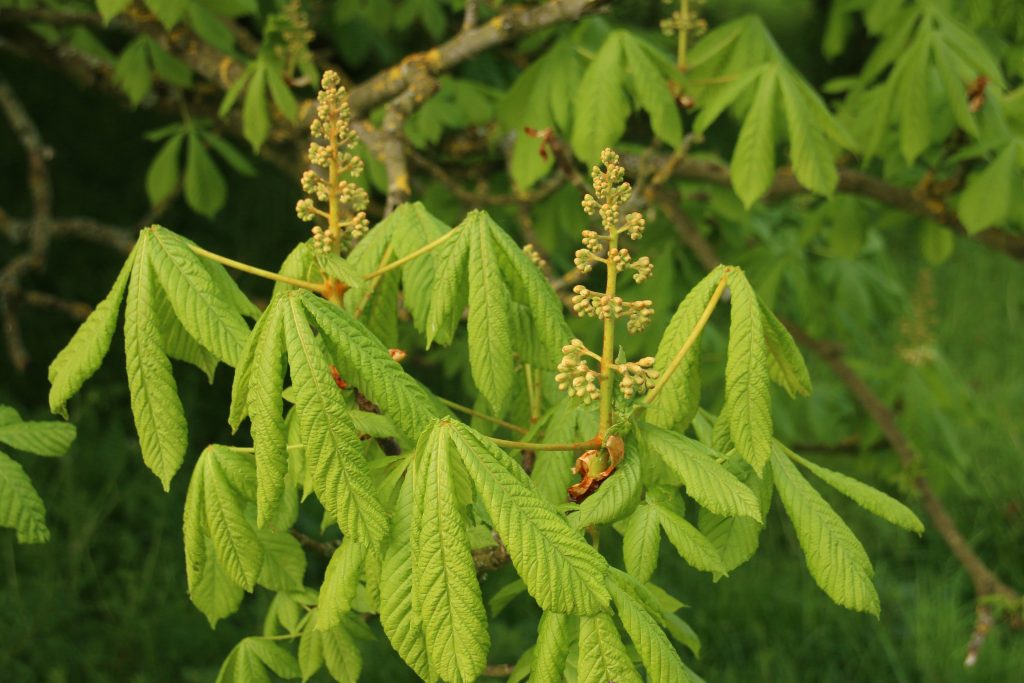
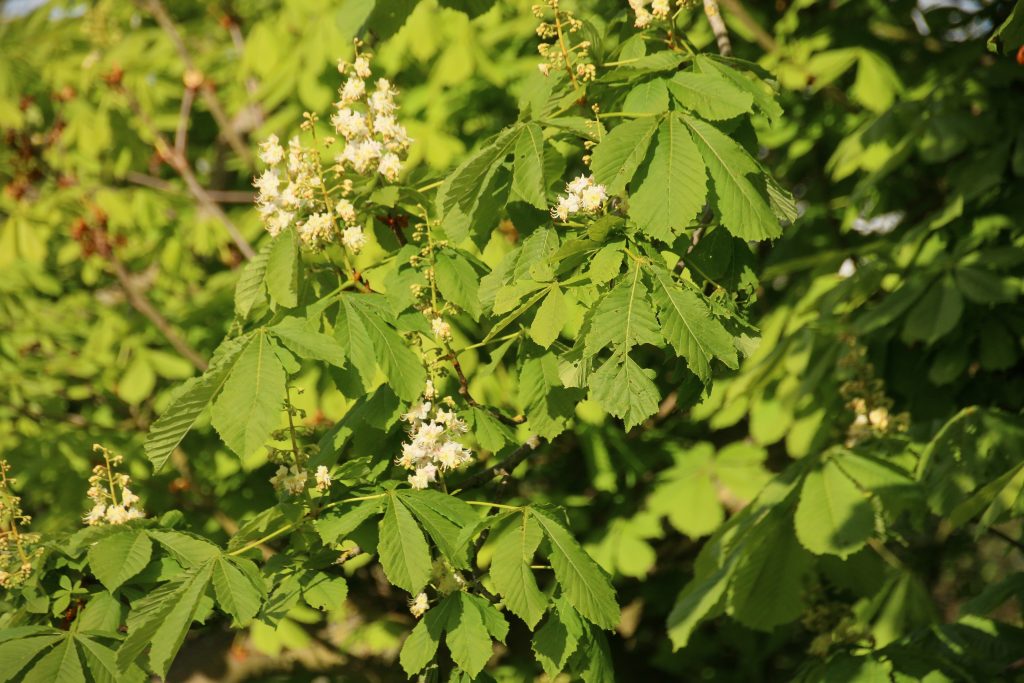
Horse Chestnut trees are coming into flower, tall blooms atop the light green of recently emerged leaves. When fully open these flowers remind me of candles standing proud from the surrounding leaves. Horse Chestnut trees are not native to the UK, but have been a presence in parks, gardens and the countryside for over three hundred years, originating in Eastern Europe.
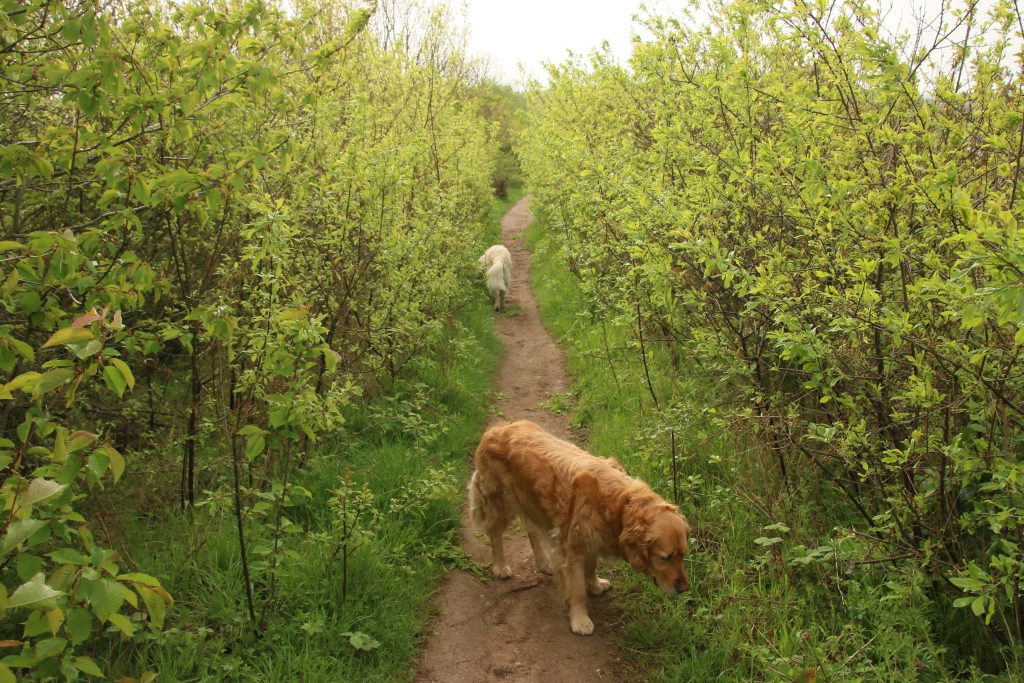
The Blackthorne, having shed the blossom, is now in full leaf, and growing vigorously across the path. Someone has clearly brought secateurs on a walk, and small twigs and leaves litter the path where obstructing slender branches have been pruned.
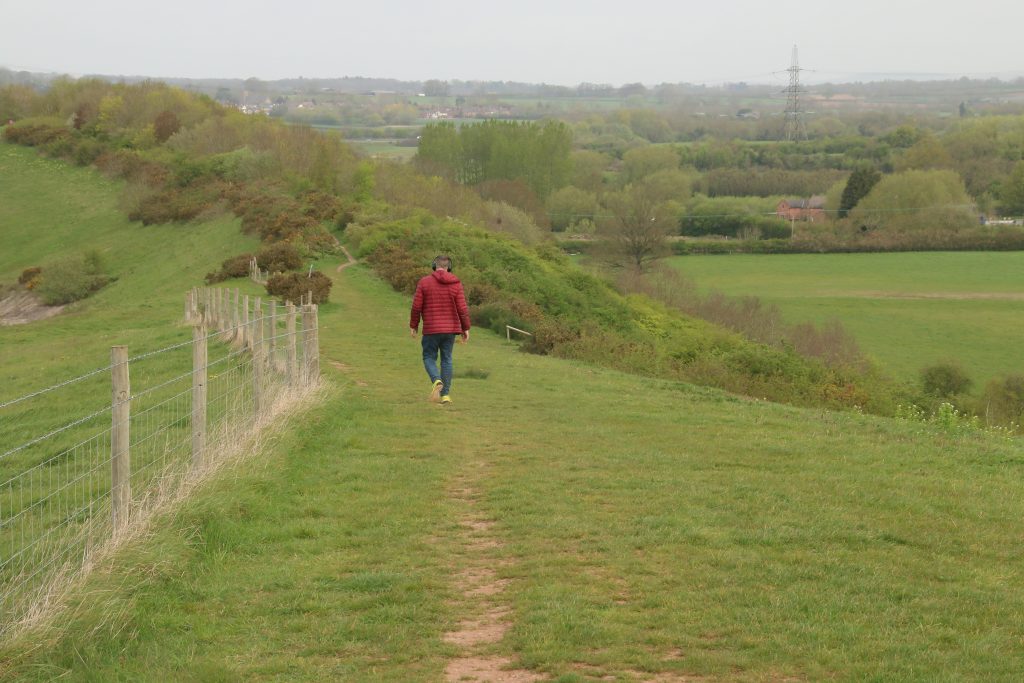
We meet a young man who we have met before, and we discussed the pros and cons of dog ownership. There is a bit of a split in his family over whether to have a dog. I point out that a dog is certainly a tie, restricting some activities, and as any responsible dog owner will tell you, life tends to revolve around your dog, with dog walks, training and making sure that the dog is not left alone for long periods. The wind is cool at this point, out of the shelter of Croft Hill, and so we both move on. Another dogless walker passes, headphones clamped to his head, but he gives us a cheery Good Morning. We meet a regular, someone who lost his dog several years ago, and never felt able to have another, another downside of dog ownership. We chat for a few minutes, exchanging notes of which muddy routes are, at last, drying out.
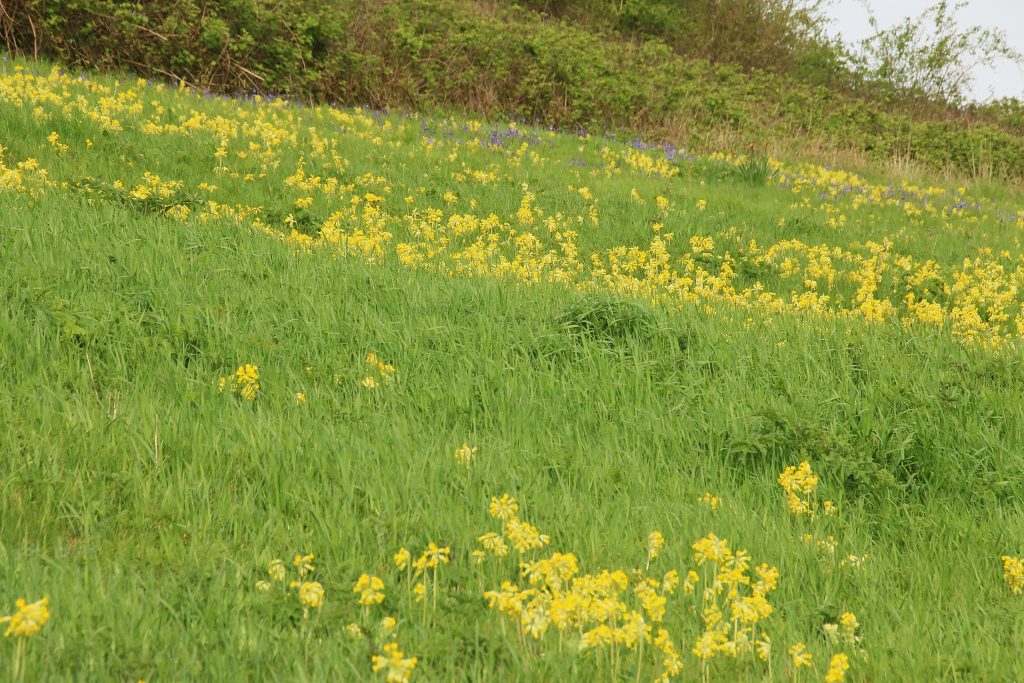
We descend through the woods, the dogs running off following scents, probably muntjac deer, common these parts, but rarely seen. We emerge onto the grassy slope that descends to the wildlife pond, at this time of the year covered in cowslips, and fringed with bluebells beneath the brambles at the top of the slope. A couple of years ago we met someone harvesting the flowers to make herbal tea, probably technically illegal, but the plants have remained abundant on this north facing damp grassland.
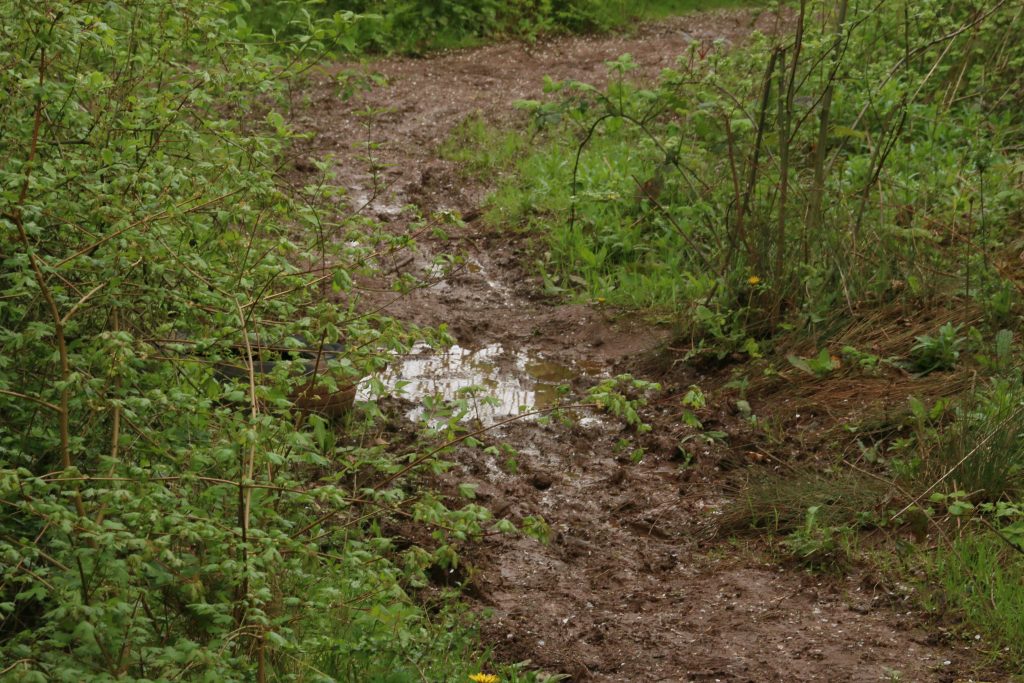
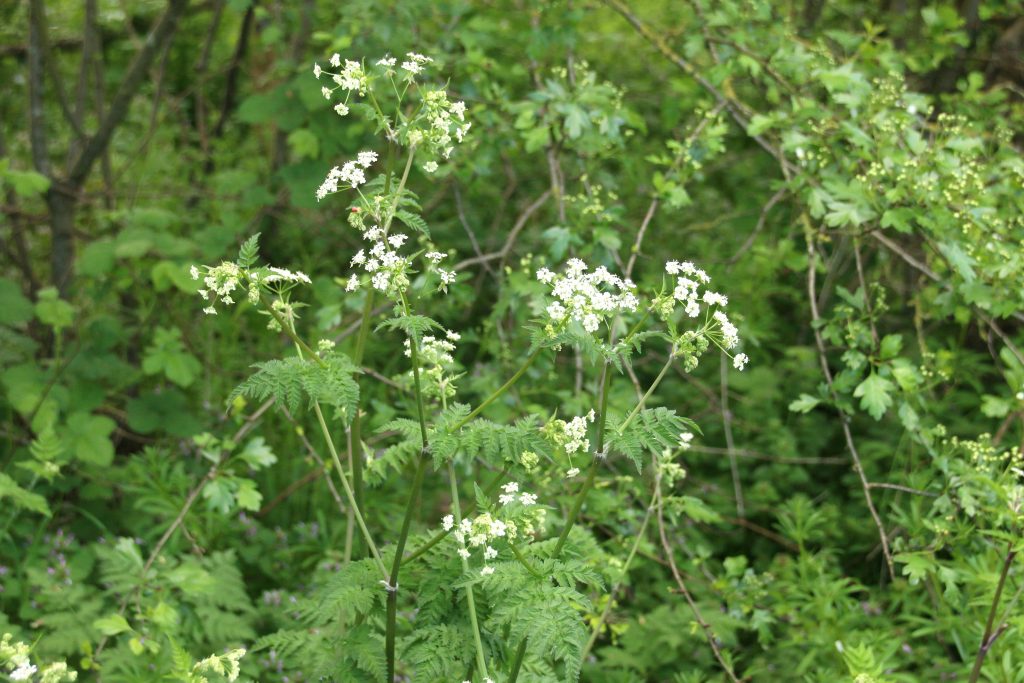
We return via one of the muddy routes discussed earlier, which has indeed dried out somewhat, but still with wet mud and puddles to negotiate. The dogs manage to circumnavigate the worst of the mud, and it will only be paws that need to be washed when we get home. Hopefully the days of hosing down muddy fur are behind us, at least until Autumn. I notice an isolated cow parsley, or “Keck” as it is known in the East Midlands, beginning to flower, in front of tight budded hawthorn blossom. For me, Cow Parsley flowers are a sign that late spring and early summer is on the way, by which time the verges and hedgerows will be frothy with “Keck” flowers.
14th April 2026
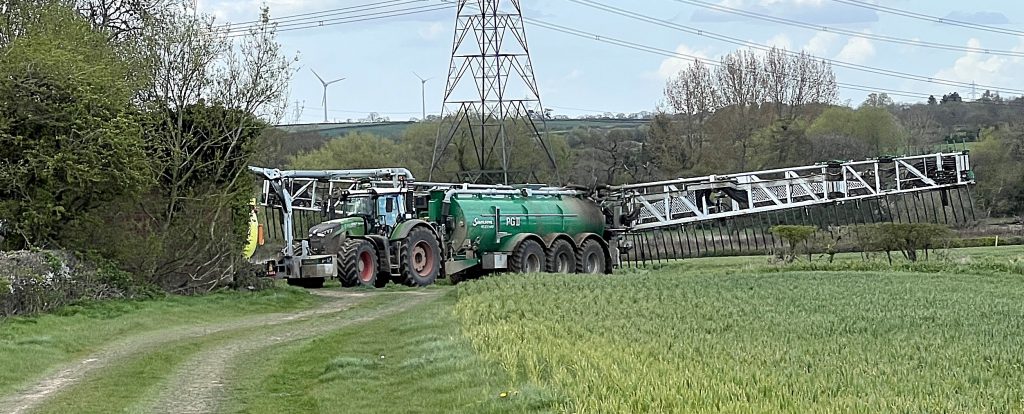
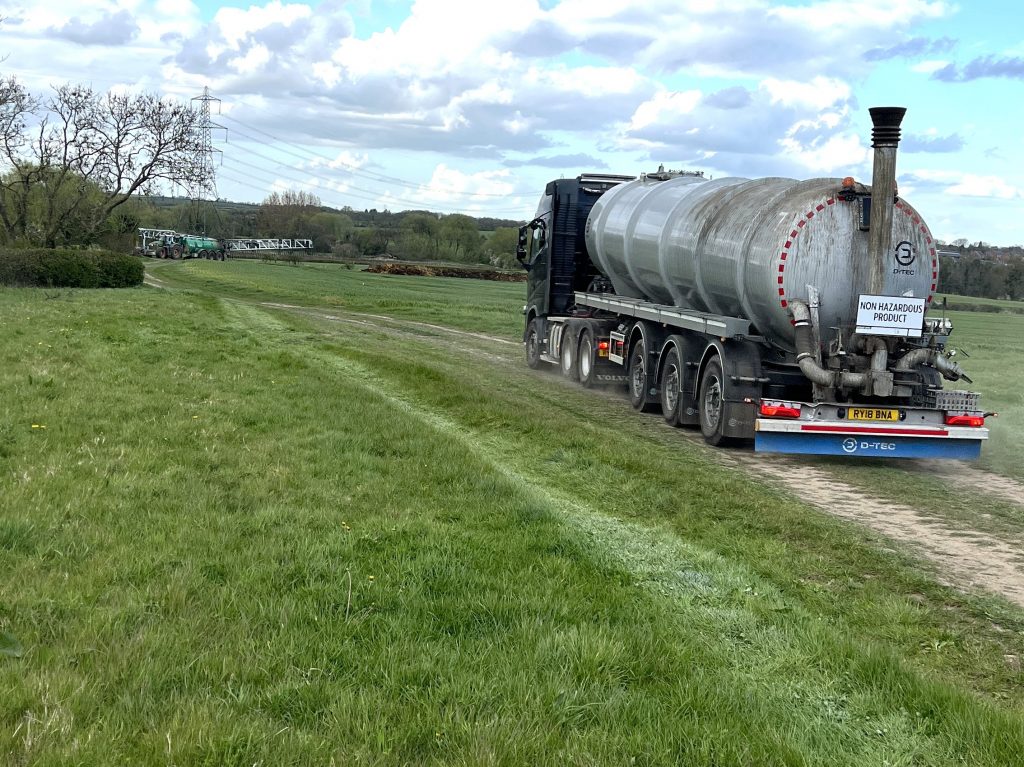
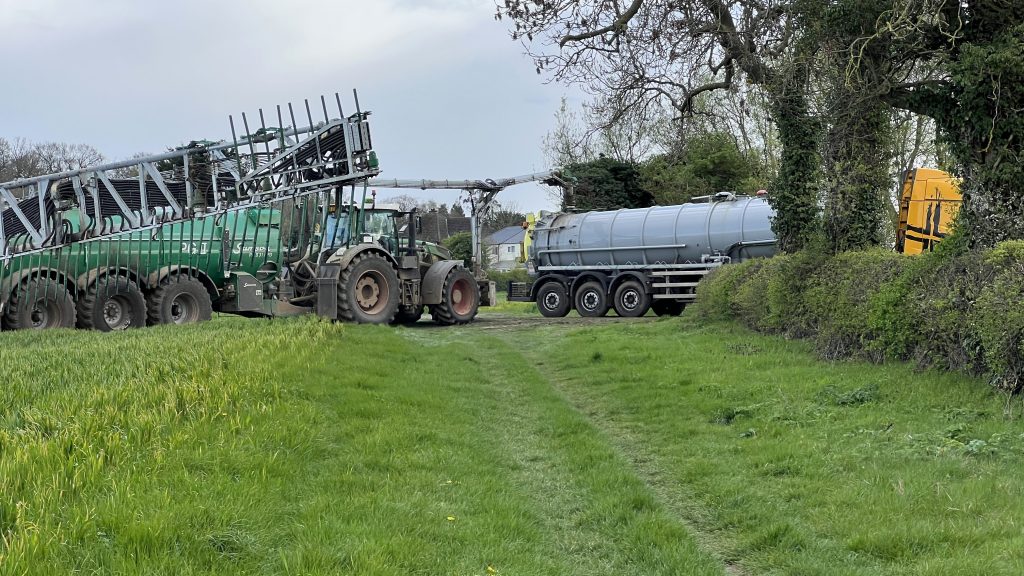
After the open moorland, grassy cropped fields, and fragrant woodland walks of West Yorkshire, we are home to the delights of arable farming. Slurry. We take the dogs for a walk down the field track behind our home, to see a tractor spraying slurry across the cereal crop. I have no idea of the source of this strongly odiferous thick liquid, but probably animal based rather than treated human sewage, but the experience is not pleasant. An articulated lorry towing a tanker, to top up the tanker behind the tractor, appears behind us, the driver politely waiting and waving a thank-you as we call the dogs and put them on lead. The field will smell, and we must avoid small pools of spilt slurry on the track, until the next substantial rainfall, which is fortunately forecast in the next few days, possibly why slurry is being spread today.
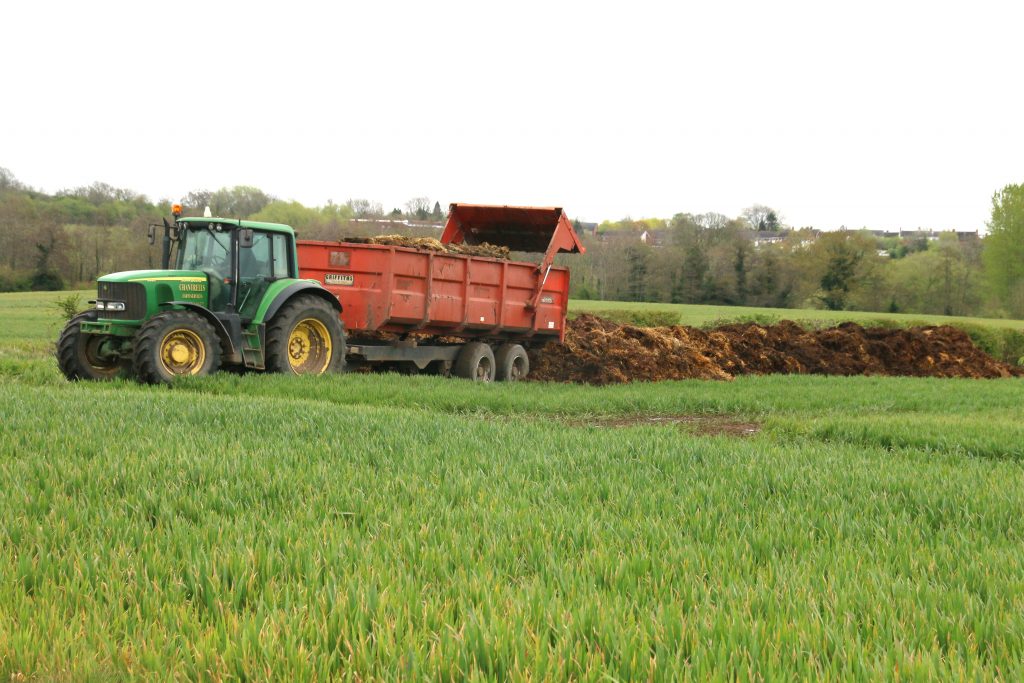
After the slurry, the real thing. Trailer loads of manure, cattle manure, tipped into a heap at the field edge, a few metres from the track. This will probably sit here until after the harvest in August and be spread on the field in Autumn or Winter. At least the small from the heap is not strong, is not particularly unpleasant, and doesn’t dissipate far from the dung. Many dogs find fresh cow-poo irresistible, and will either be kept close if owners prefer them not to have a mid-walk snack as they pass. Our two, fortunately have different tastes, and are unlikely to go “off piste” in search of a natural supplement to their twice-daily bowl of kibble. If we happen to pass horse poo, on the other hand….
13th April 2026
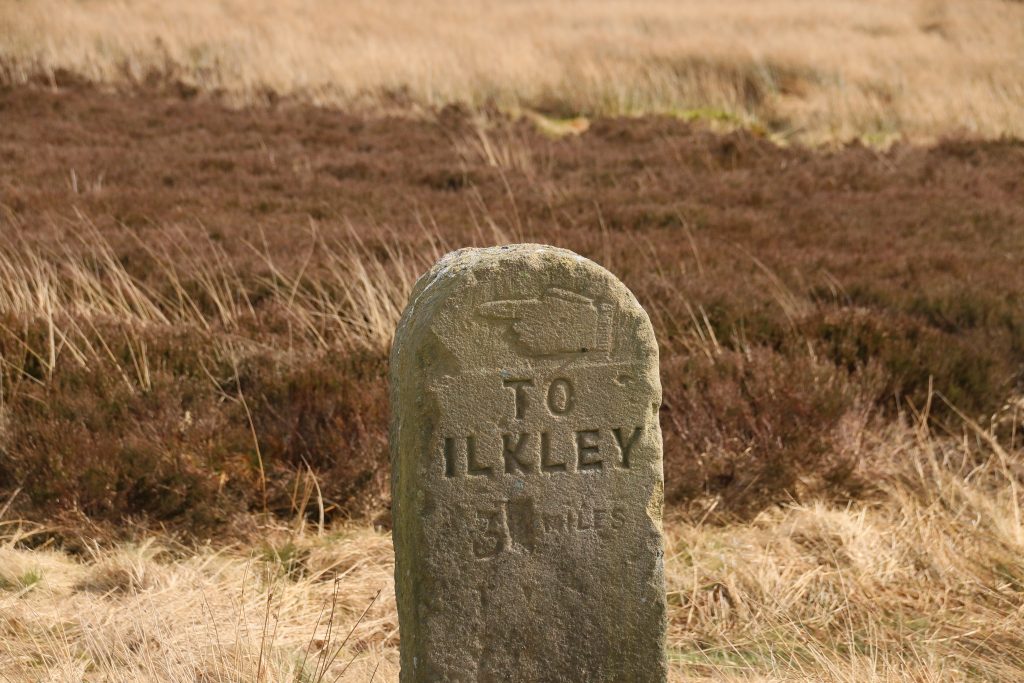
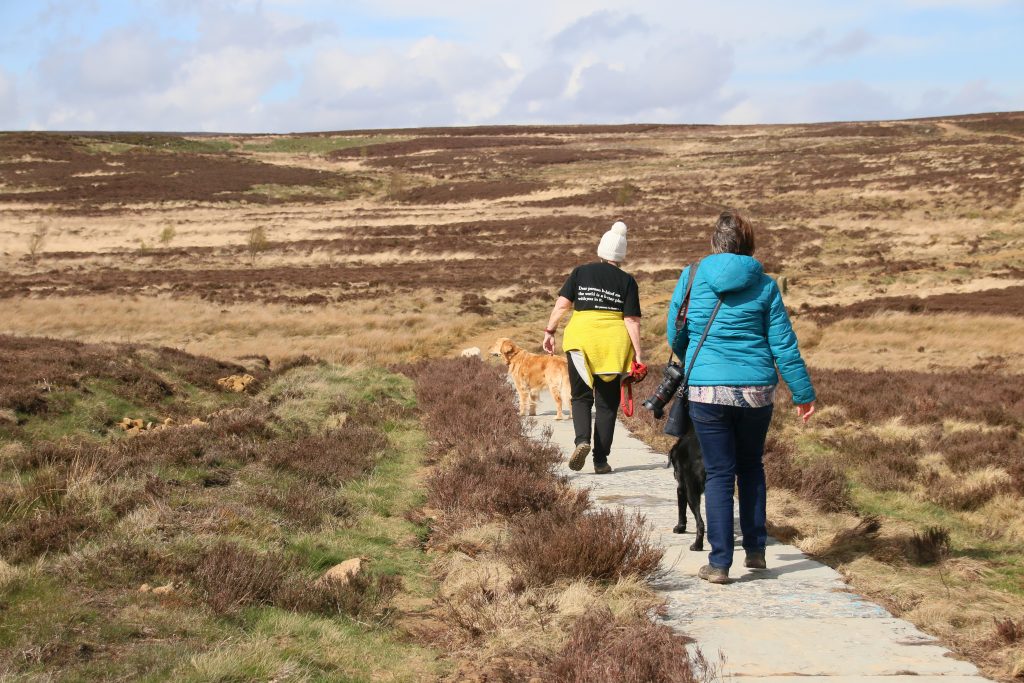
A couple of days in West Yorkshire, not far from Ilkley, staying with my sister and her black labrador. With three dogs and lovely countryside on the doorstep, it is inevitable that the visit will be centred around dog walks. We visit Dick Hudson’s pub, across the moors from Ilkley, for Sunday Lunch, and I persuade the others to walk off at least some of the calories by a walk on the moor. The track crosses the moor eventually descending onto Ilkley Moor after 3 miles, but, with a cold wind and rain threatening, the Ladies opt for a shorter return walk. The path is undergoing work to prevent erosion, stone slabs laid along the path for the first mile or so – from the prepared surface I imagine that the surfaced path will continue all the way onto Ilkley moor, and maybe the descent into the town.
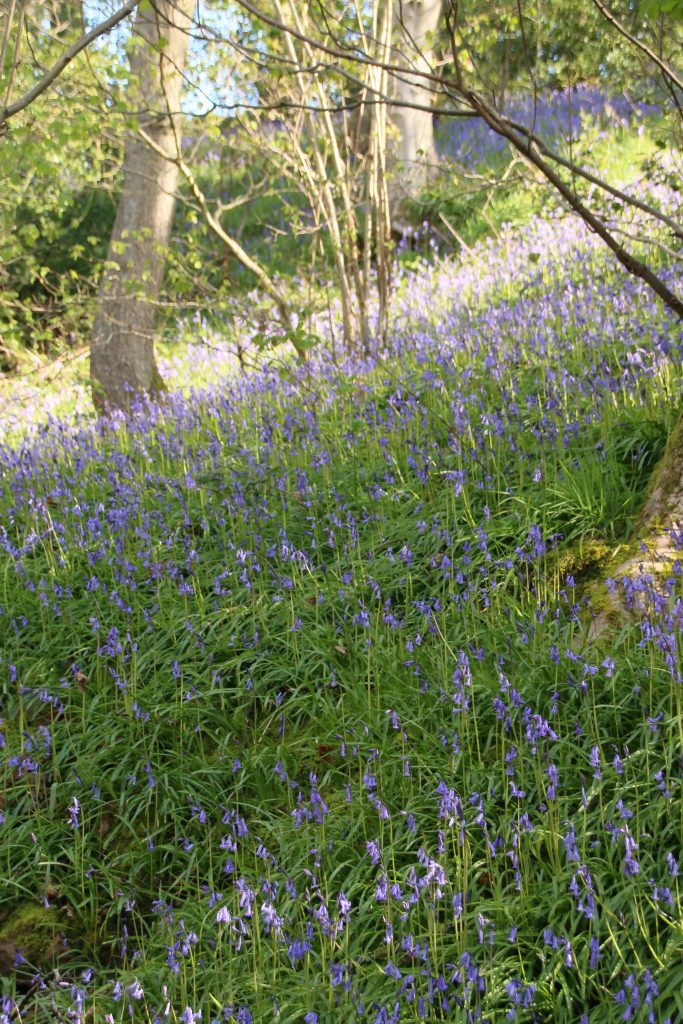
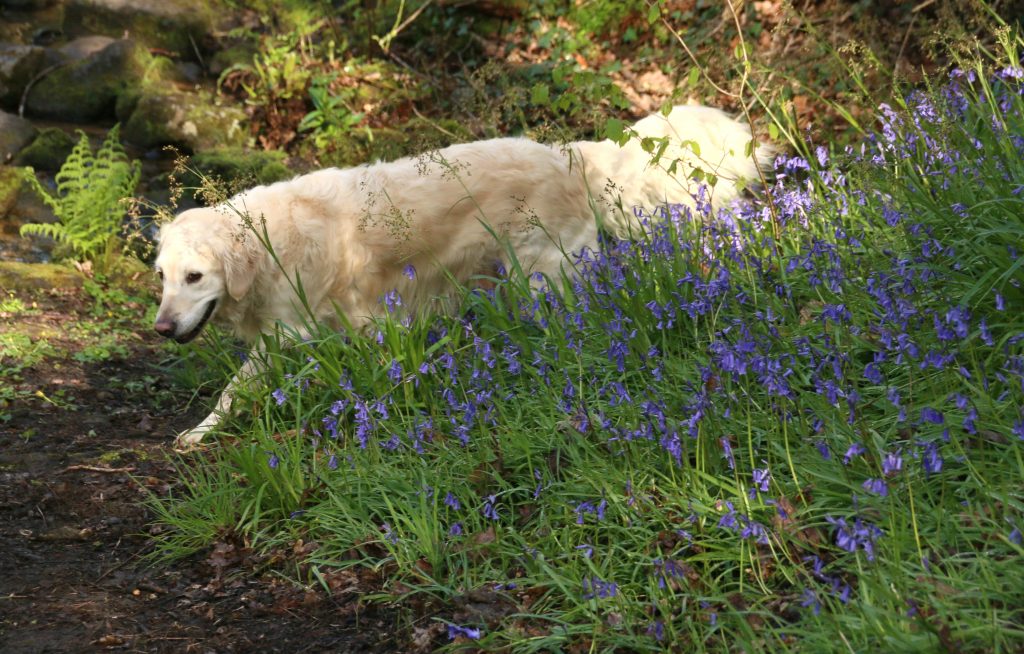
The following day walk in local woodland, the grassy banks blue-purple with bluebells. The expanse of bluebells indicates that this is a well-established woodland, probably undisturbed for hundreds of years or more, and these are British bluebells, different to the more upright Spanish Bluebells in my garden. I suspect that the isolated patches of bluebells in the verge along our Lane are hybrids of the two. Generally, bluebells spread slowly, their seeds not travelling far from the parent. The bluebell bulb gradually pulls itself deeper into the ground over the years, which explains why the Spanish variety in my garden are so difficult to dig up and eliminate.
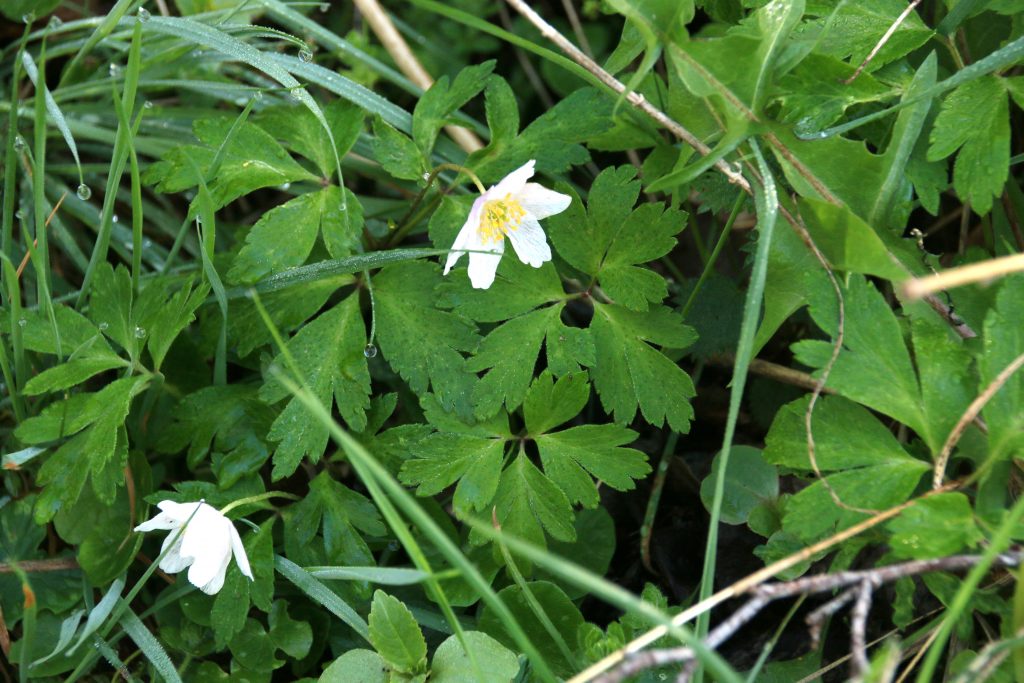
In lower damp areas of the woodland, we pass purple and white Wood Anemones close to the river. These also spread slowly, another sign that this woodland, only a short distance from the commuter towns surrounding Bradford, minutes from a housing estate, is old, possibly an “ancient woodland”, in existence since the 17th century.
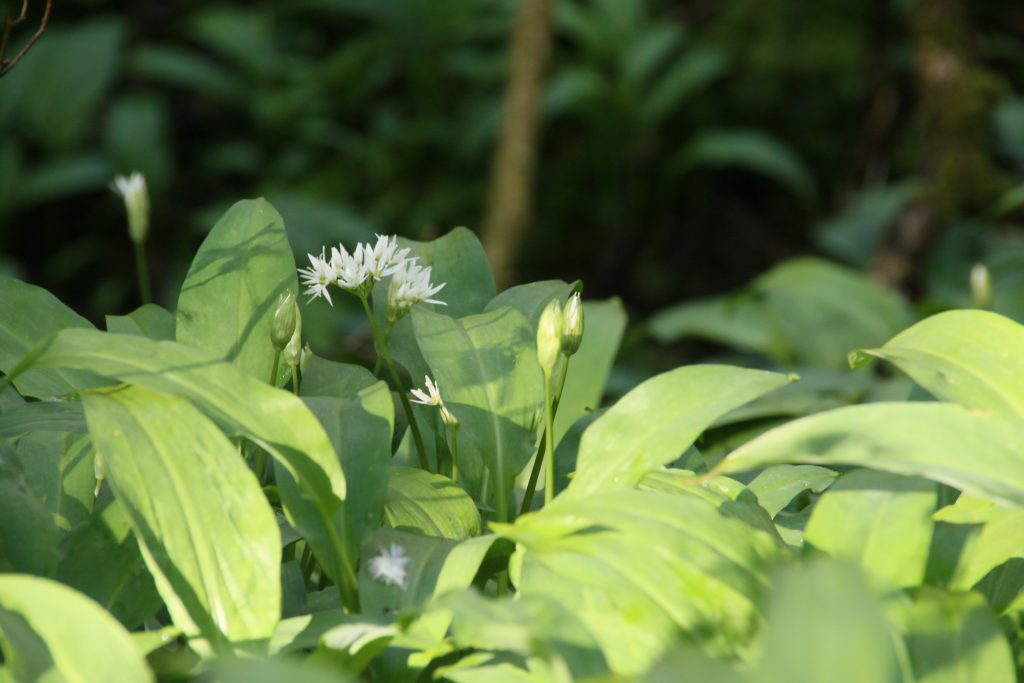
Patches of Wild Garlic is starting to bloom, again close to the river running through the wood, although this early in the season only isolated plants and in flower. Crushing the long leaves between fingers releases the characteristic smell of Garlic. In a couple of weeks, when areas of the wood will be carpeted in the white flowers emerging from the waxy leaves, the smell of garlic will dominate the lower paths.
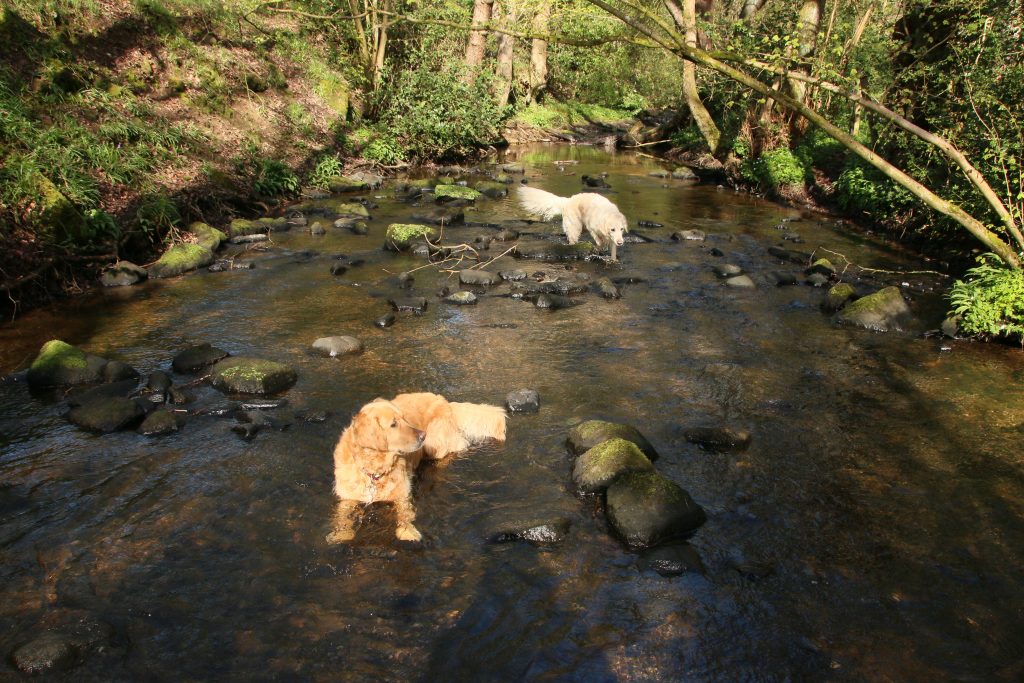
Before we ascend the steep slope back to the horse-grazed fields above the wood, after locating my sister’s black lab who has gone exploring, we give the dogs an opportunity to cool off in the river, which we cross using stepping stones, one or two not very stable after being moved by the high water levels in winter.
10th April 2026
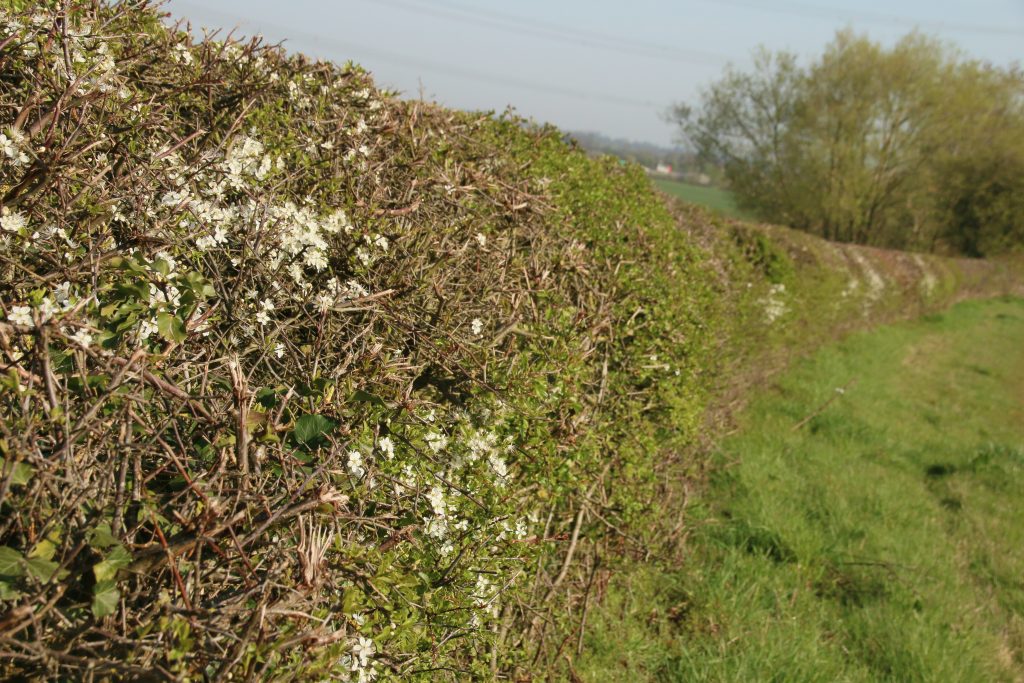
The field track from the gate onto our gate down to the Sheep Field is bordered on one side by the open arable field with a young cereal crop, and on the other by a blackthorn hedge, kept low and dense by the farmer, the hedge being flailed annually, the top and sides essentially shredded by spinning blades mounted on a tractor. This is an agricultural task for winter, when there will be no birds nesting within the spiny hardwood branches. At this time of the year the hedge becomes striated, as the white blossom fades and gives way to green foliage. The hedge may be impregnable to livestock, but the dogs occasionally find a route through the lowest branches to chase, but never catch, a pheasant that struts along the grassy strip on the far side.
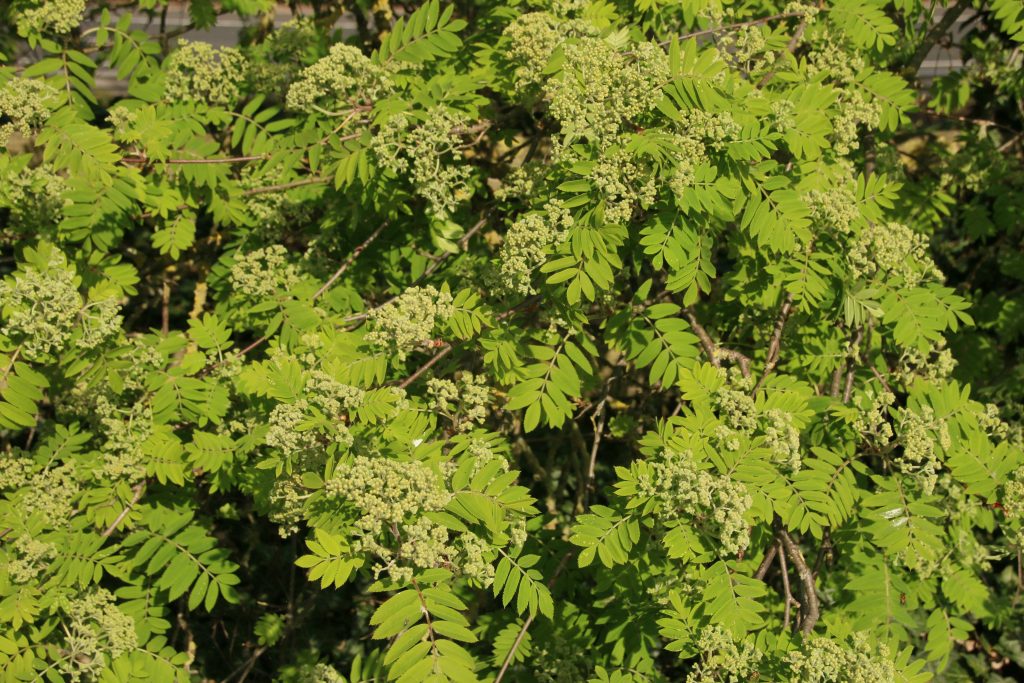
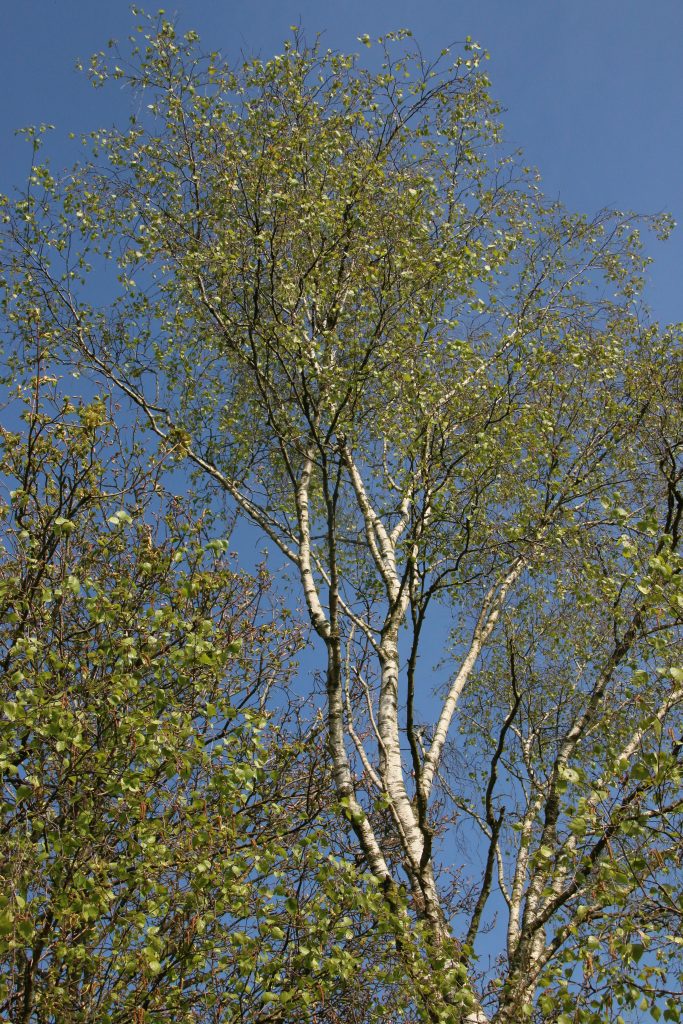
Further on a Rowan tree, or Mountain Ash, is on the verge of bursting into bloom, the clusters of white flowers still a tight bunch of light green against the slightly darker young leaves. Next to it a silver birch dapples the blue sky above. Both trees grow beside the fencing separating the footpath from the adjacent M69 motorway, and I suspect that they were planted as part of the landscaping when the motorway was built in the 1970s.
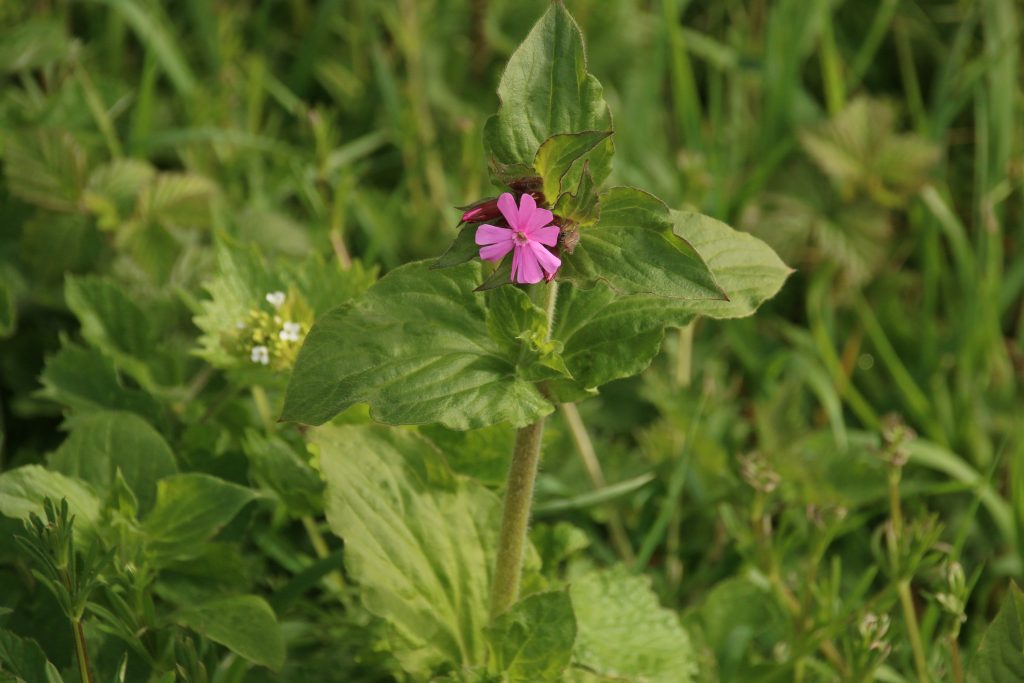
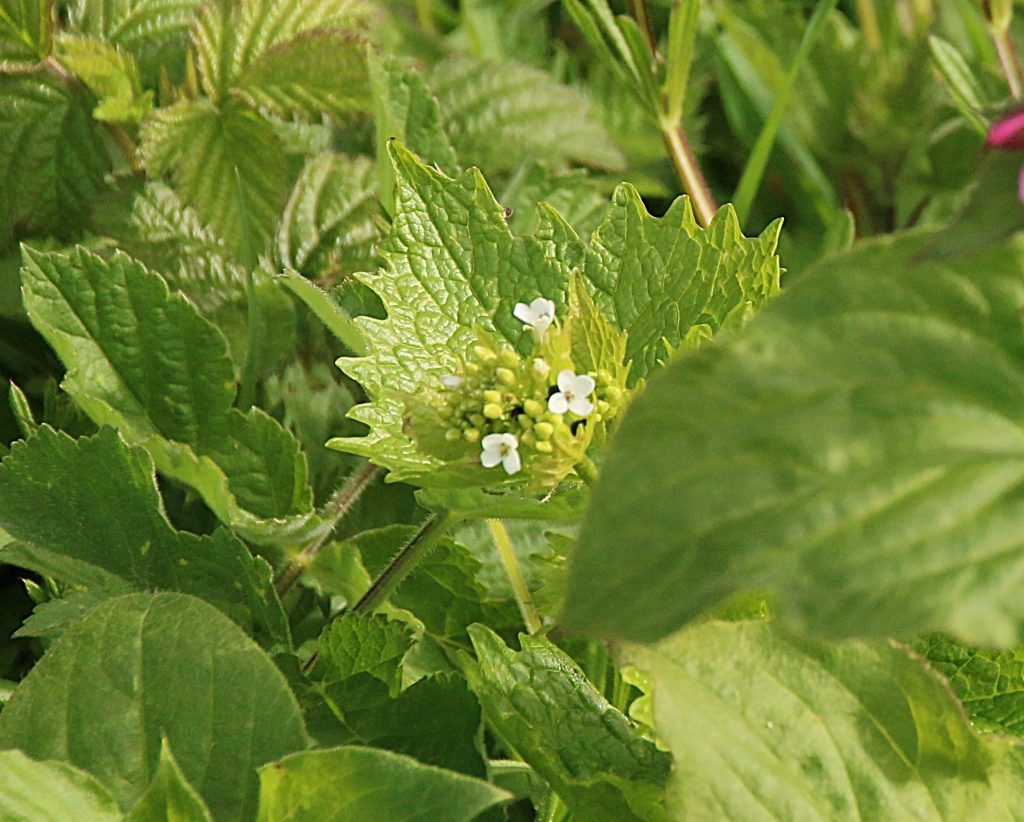
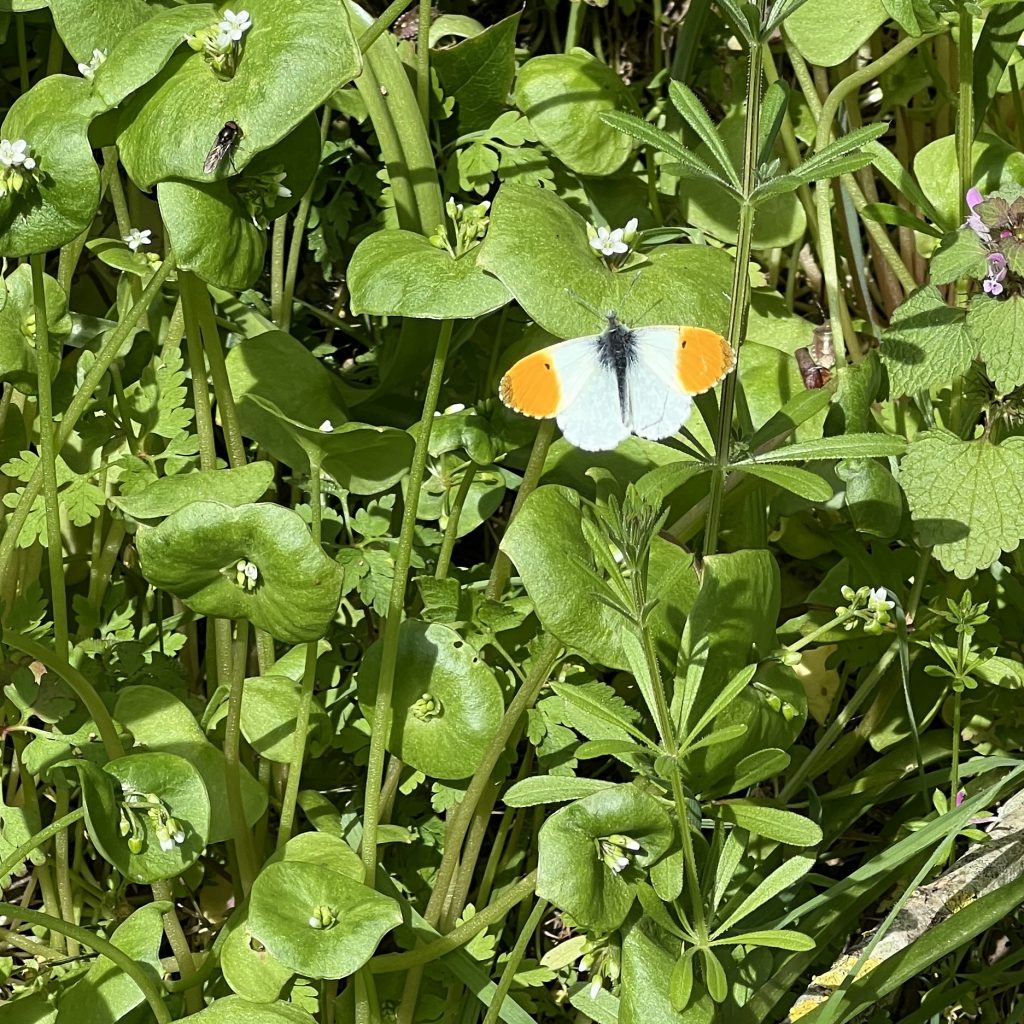
Leaving the motorway behind the path skirts rough grassland, occasionally enclosed with electric fencing so that a small flock of sheep can graze, but at the moment vacant, and still boggy in places after the wet winter. Red Campion is growing along the field edge, but maybe of more interest is the much smaller plant and white flowers of Garlic Mustard, almost missed as it nestles behind the Campion. Garlic Mustard, along with other wild brassicas, is favoured by the orange tipped butterfly, which times its emergence from the chrysalis to coincide with the flowering of Garlic Mustard and the other plants on which the butterfly feeds. Later in the day, walking along the footpath to the village, we see an orange tip butterfly feeding on Miners Lettuce, its wings spread in the warm spring sunshine.
2nd April 2026
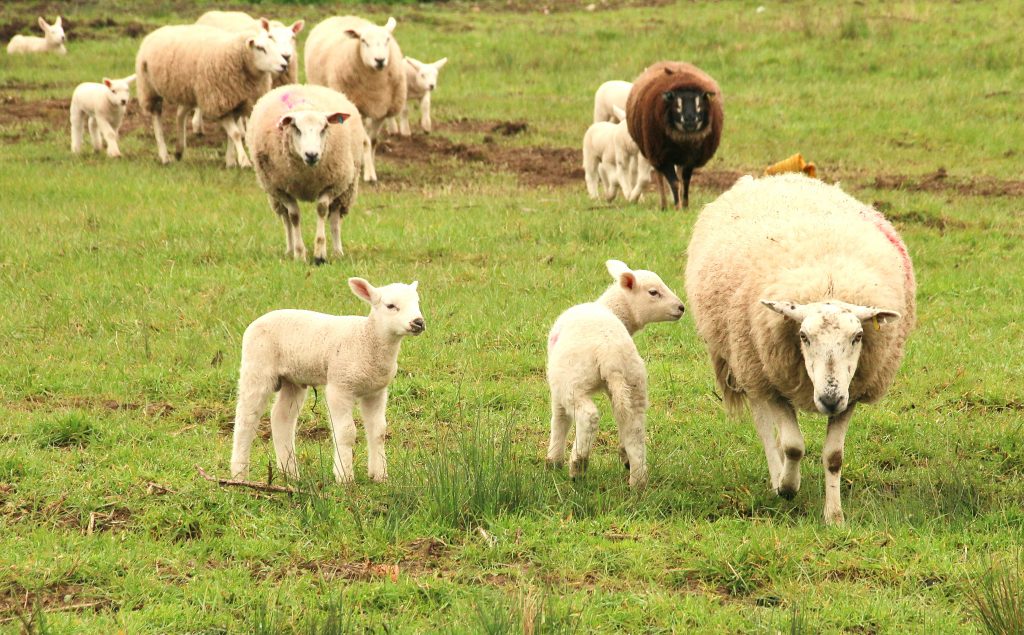
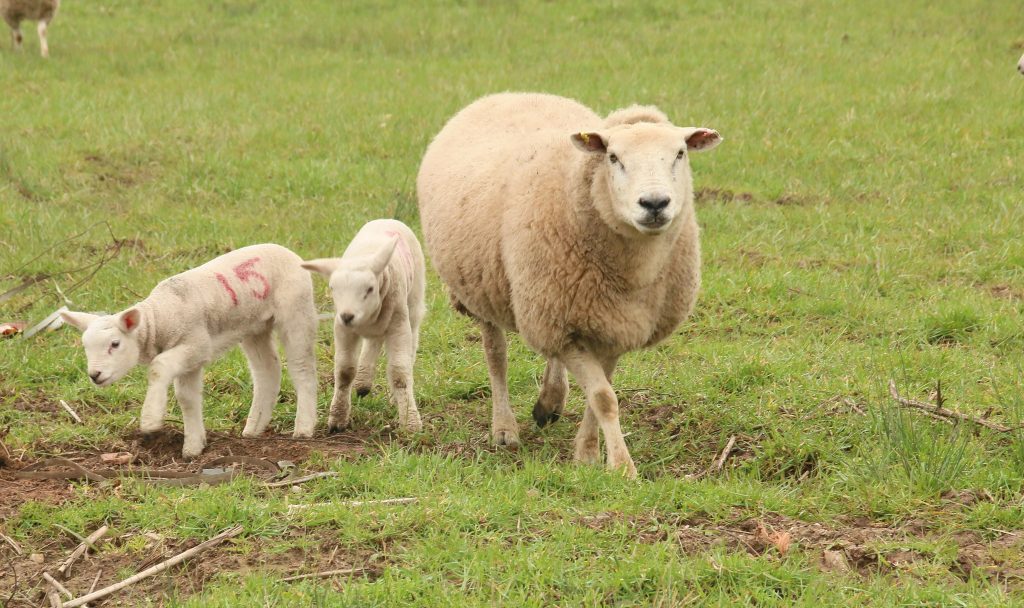
It has been “lambing time” for several weeks, although around us it is only in the last two or three weeks that lambs have appeared in fields, and even then, not near routes that we regularly walk. Yesterday ewes and lambs had been moved onto a field on the far side of the valley behind our home, bordering a track that we regularly use. The dogs sat patiently while I leaned over the gate to take a photograph, and the sheep obligingly strolled over to come and see me, followed by their lambs. Presumably this gate is where food arrives daily, a supplement to the grass. This afternoon we visited the sheep again, this time with my family in tow. Town dwellers, they spent some time admiring the ovine families, evening attempting some conversation with them, until they remembered that a leg of lamb was in the oven, in readiness for a roast dinner, and they guiltily continued on our walk.
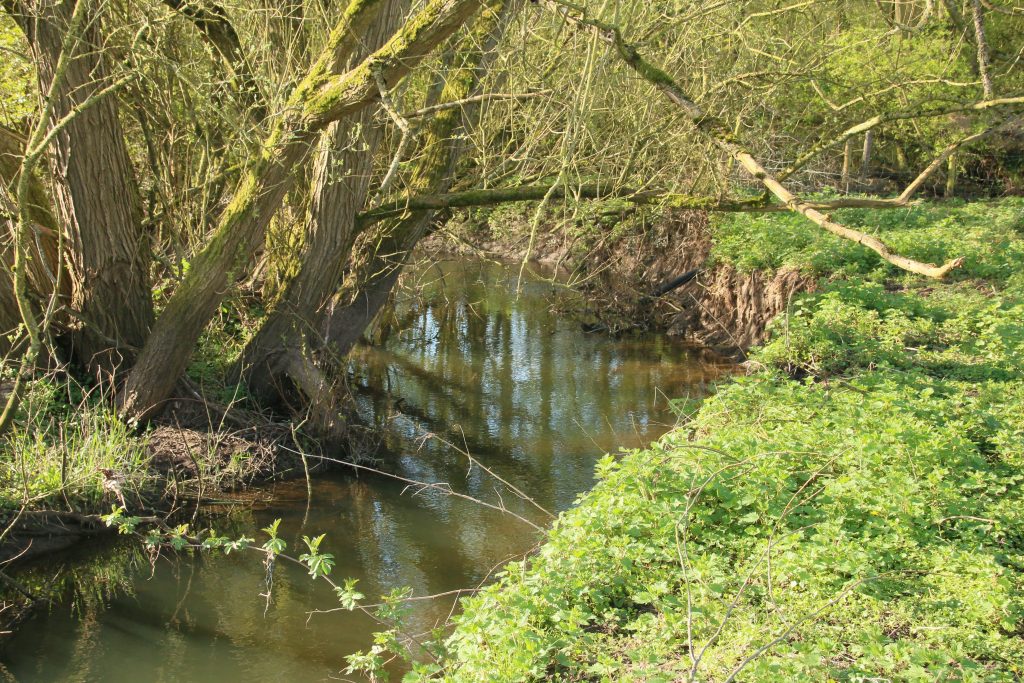
After two weeks without significant rain, the river is at its lowest level for months, and the field no longer has wet areas to be avoided. Most footpaths are dry, with just a few areas of soft mud which can easily be by-passed, carefully following the drier edges. Our network of walking routes is beginning to expand, as routes that are impassable in winter, at least without wellies and the consequence of very muddy dogs. Having taken account of dry paths around the field behind us, we attempt a route that includes one notoriously muddy stretch. This proved to be a mistake, with several metres of deep liquid mud that reached the top of my walking boots, but too far around the circuit to be worth turning back. On our return home some time was spent hosing dogs and cleaning boots.

Along the tree-lined footpath down to the village purple Dog Violet is blooming among the dense growth of the fragile stems and leaves of Cleavers and other low growing plants. The “dog” of dog-violet refers to the fact that the flower is not scented, rather than the canine pet, distinguishing the dog-violet from the similar but scented Sweet Violet. This is the only meaning of “dog” referring to scentless that I have come across!
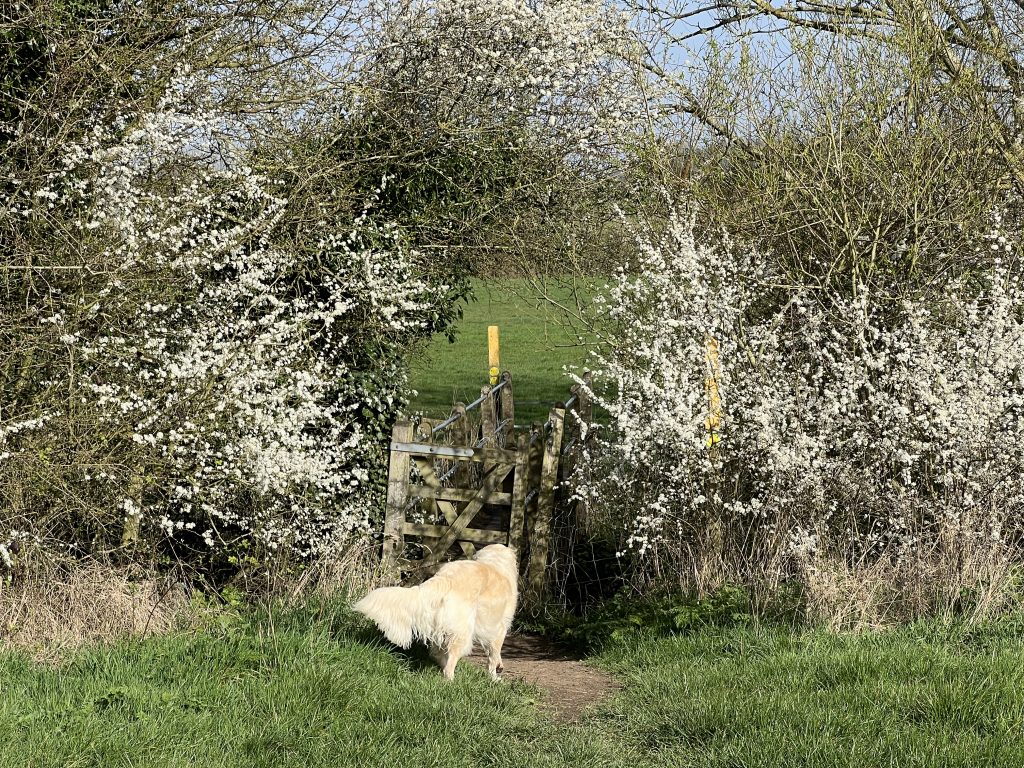
Green Alkanet is flowering under hedgerows around more open field edges. Traditionally the blue flowers would have been used to make dyes, presumably requiring a lot of this quite small plant, although the plant will continue to increase in size as we progress towards summer, eventually reaching up to a meter in height. The wildflowers beneath our feet are a sign of late spring and early summer, but the white snowdrifts of blackthorn blossom still dominate the wild hedges that have not been cut back over winter, although becoming more patchy as flowers fade and leaves, which for Blackthorn emerge after flowering, sprout from woody branches.

25th March 2026
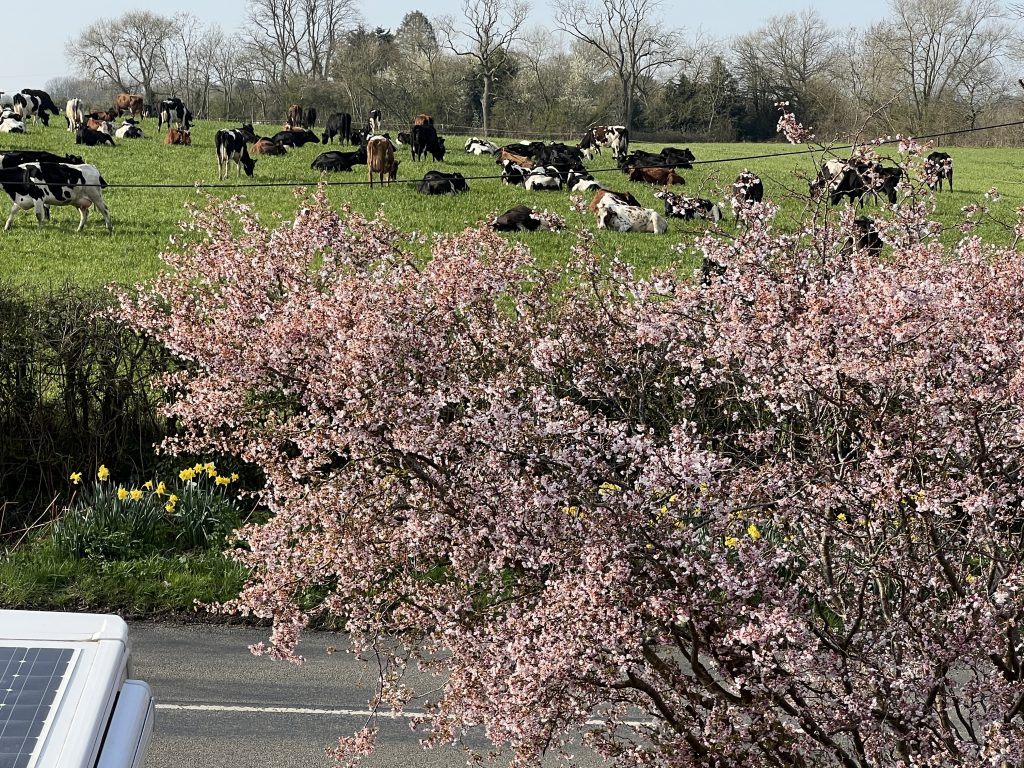
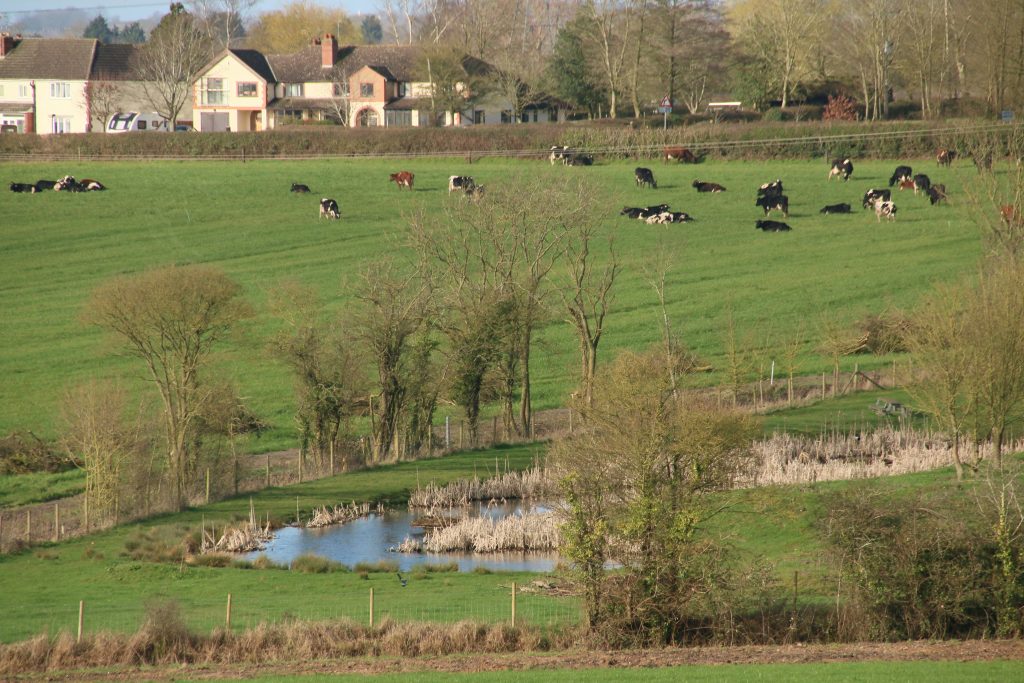
We have new neighbours on our Lane. We have a field opposite our home that has always been arable, at least long as the 24 years that we have lived here, and I suspect for decades before that, mostly growing cereal crops, but also occasionally oil seed rape and maize. We were somewhat surprised several weeks ago when we noticed fence posts being installed around the field, soon followed by electric fencing. Crops do not need fencing in. As we suspected would happen, cows have now arrived in the field, the dairy herd that we have seen, complete with a mobile milking parlour, on fields between our Lane and Croft village. The milking parlour hasn’t made it onto the field, and is still located in the next field, necessitating the herd crossing another country lane for milking.
The cows have a large area to graze, although are restricted to a part of each field before being moved on every couple of days or so. From my OS map app I reckon they have 100 acres to graze, and since I estimate the herd to be 50 cows, that is 2 acres per cow. A quick online search found a “Farmers Weekly” item that stated that 1 acre will feed 40 cows for 24 hours, suggesting that “our” herd will only need to revisit a grazing patch every couple of months. Some of the grazing land is not yet well established, and may need to be less intensively grazed . It will be interesting to see, after the cows move on from the far side of the Lane, how long it will be before they return. Incidentally the Farmers Weekly article also said that farmers are turning from arable to grazing because of increasing costs, and that was in 2018, before the Ukraine and Iran conflicts that so dramatically increased the cost of diesel and fertilizer.
18th March 2026
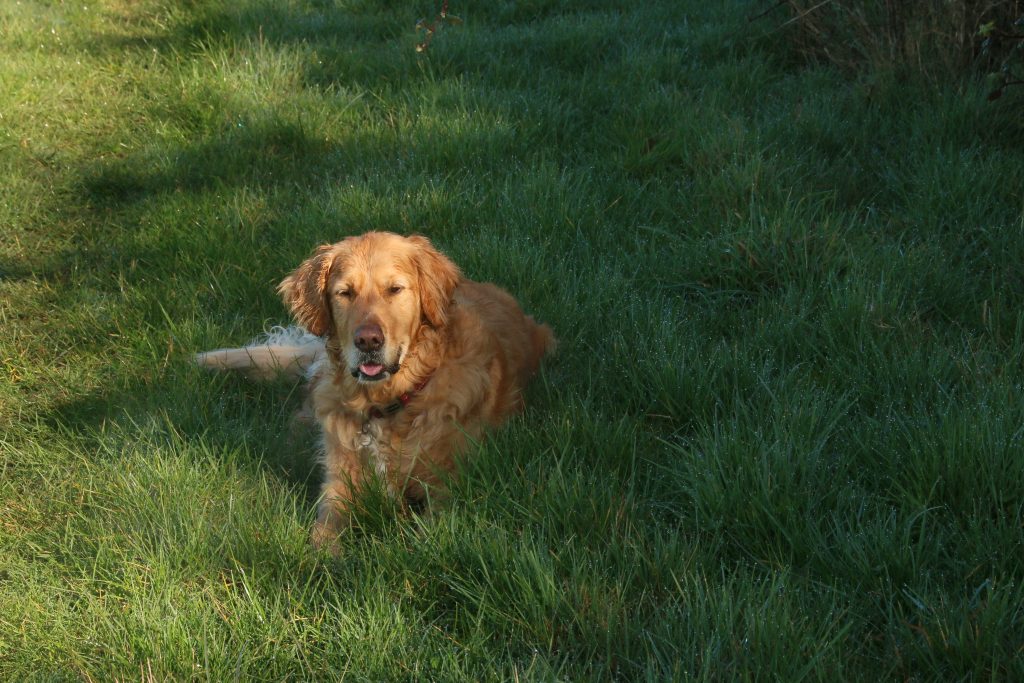
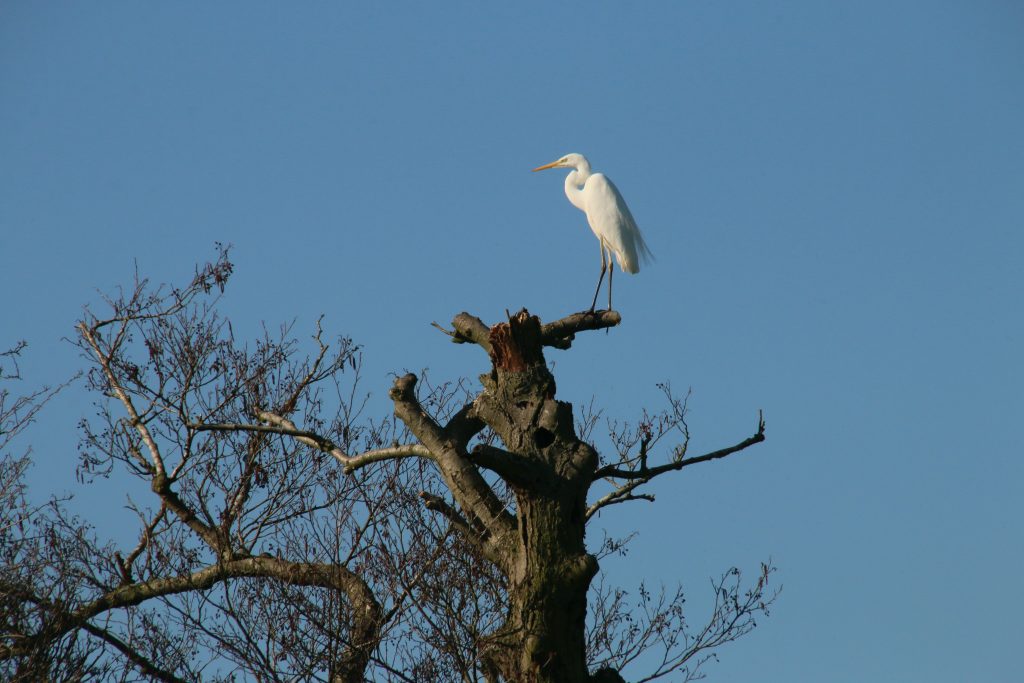
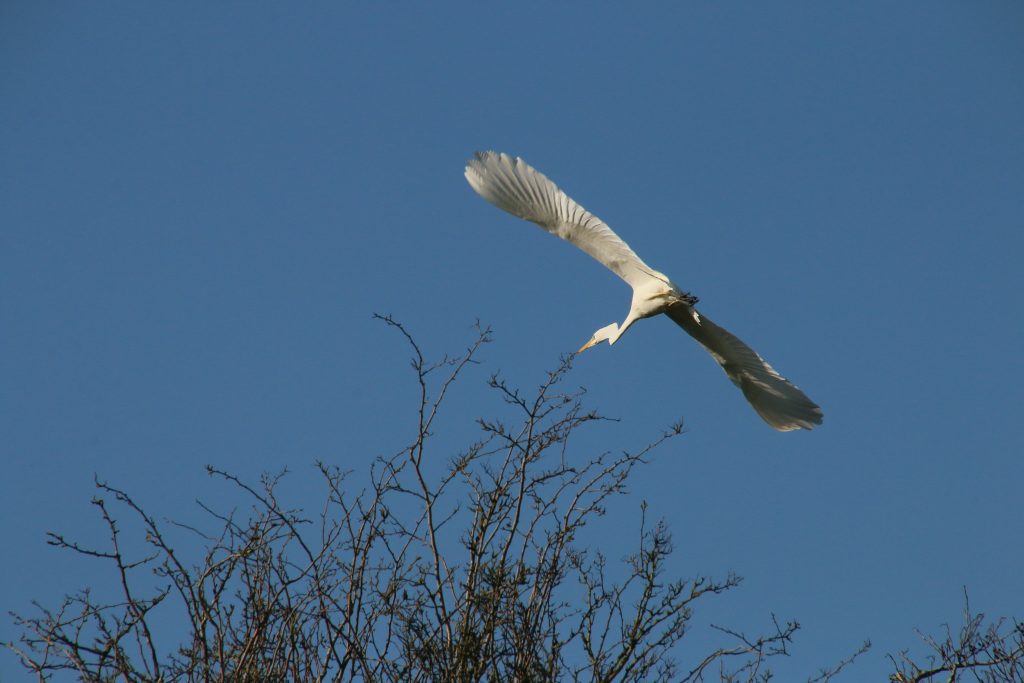
A cool start to what turned out to be the warmest day of the year so far. The grass is dew-wet under my boots, and the dogs’ paws leave trails through the sheep field. I see a Great Egret perched atop the trunk of a dead tree by the riverbank, and I deviate from my route across the field to get a closer look. The Egret ignores us all, despite the dogs running and rolling in the grass, only taking off when we get close to the bottom of the tree, flapping off to the riverside area of rough grassland on the far bank, and we rejoin our originally planned route up to the track at the top of the shallow valley.
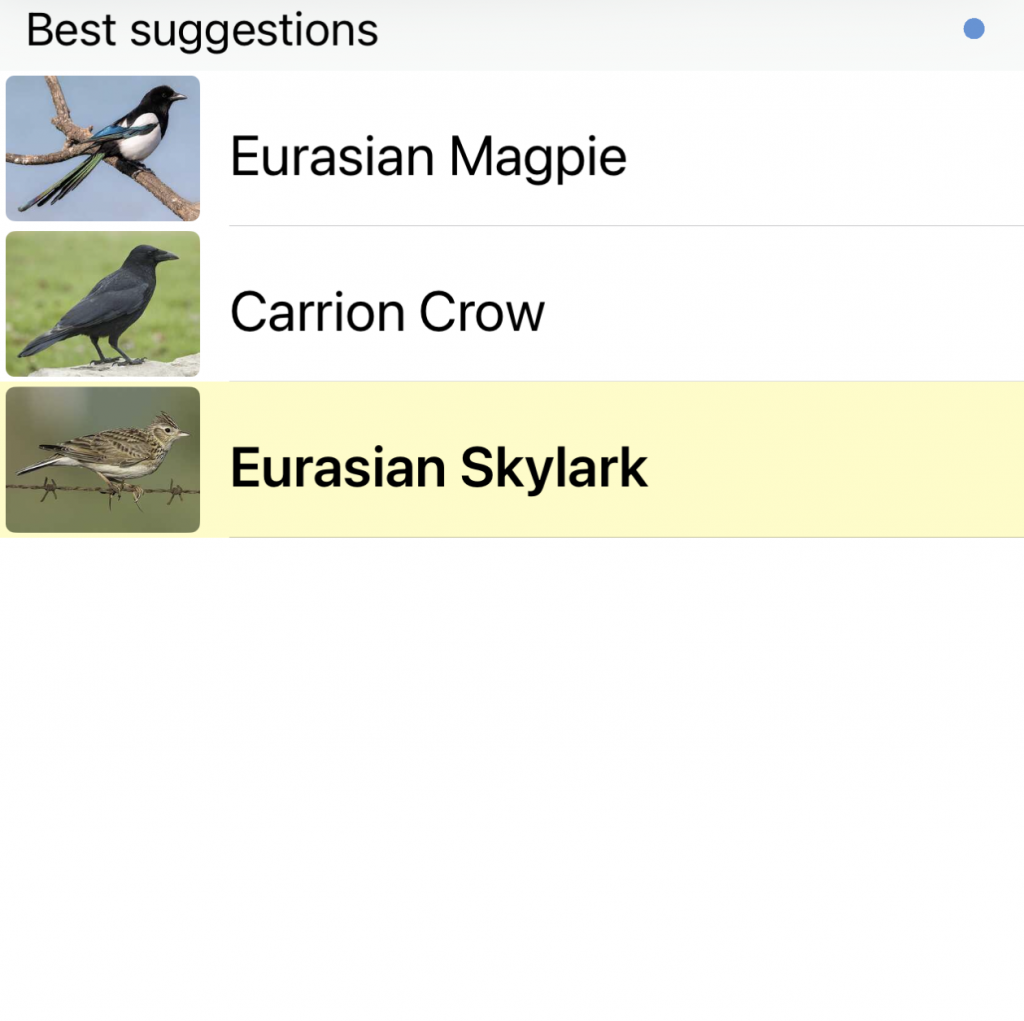
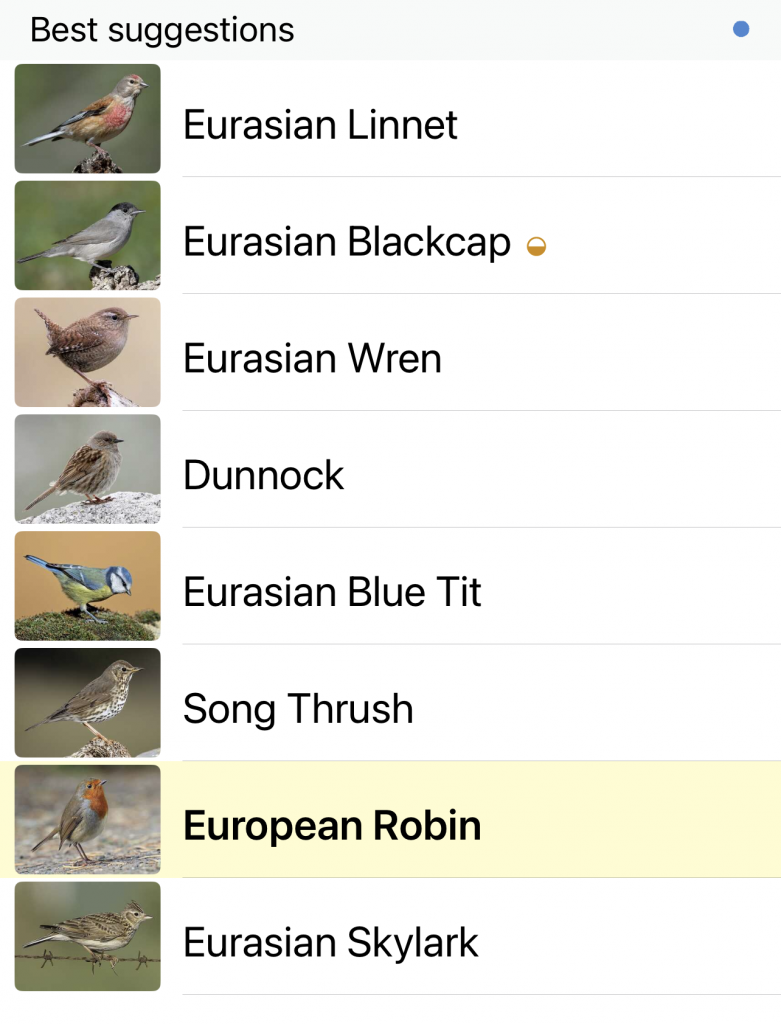
The soundscape is dominated by the constant song of a skylark, high above us, as we walk through several fields. I have no idea whether this is all from a single bird, or more than one. I listen for other birds and use my “Merlin” app on my phone as I walk back down from the track, recording a crow and magpie in addition to the skylark in the few seconds before I stop recording to tackle the stile and unstable wood bridge into the Sheep Field. I turned on the app again on the track back up to our lane and recorded eight more species.
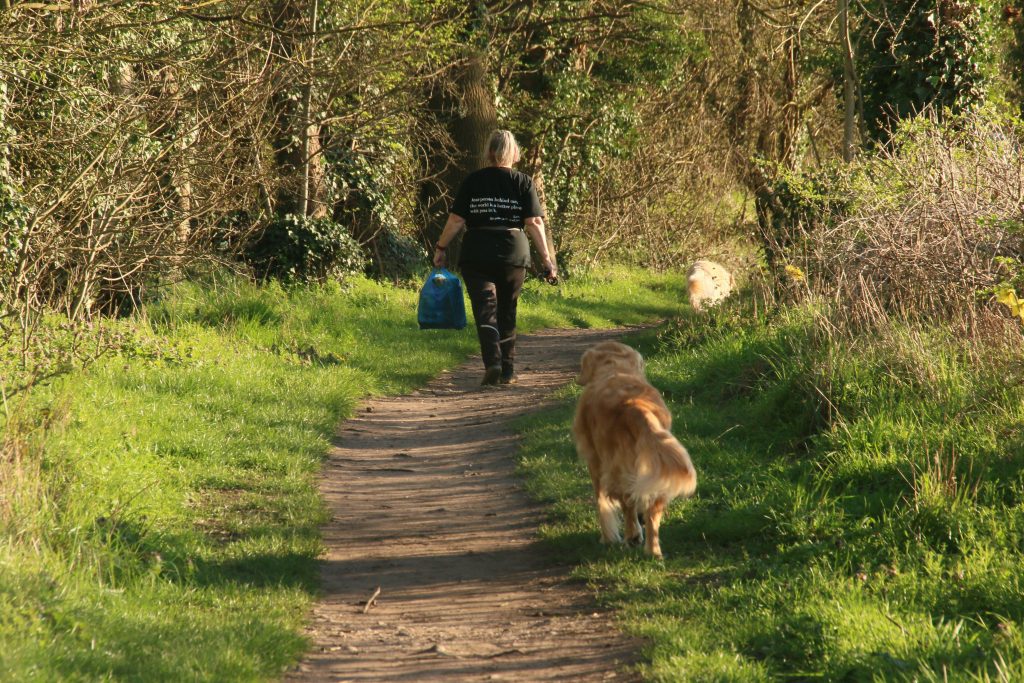
This afternoon, we walk down to the Glebe, my wife carrying a bag full of empty eggboxes, which we will exchange for fresh eggs from our friend who walks her spaniels with us, and who keeps hens. I think we get the better of the deal. We would never get eggs this fresh from a supermarket.
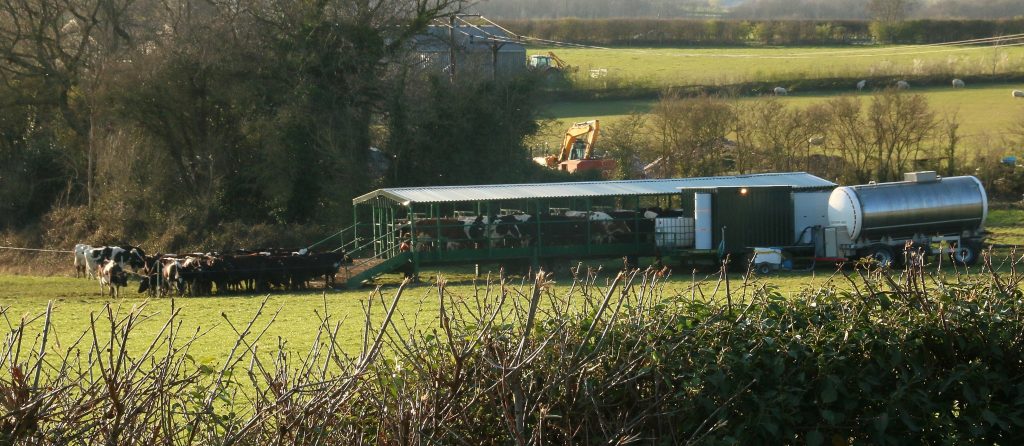
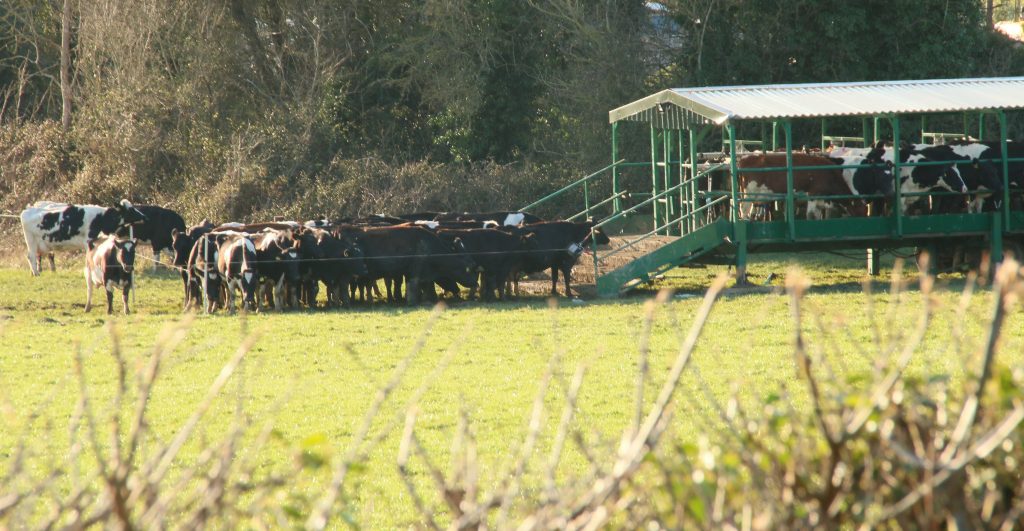
I note the “mobile milking parlour” in the field across the road. The cows are restricted, using electric fencing, to an enclosed area for grazing, the herd moved around to fresh grass every few days. The milking parlour follows them. The cows know when to queue at, and eventually enter, the parlour at the appropriate time, rewarded by food. The farmer has a contract with Long Clawson dairy, one of the six dairies where Stilton Cheese is made.
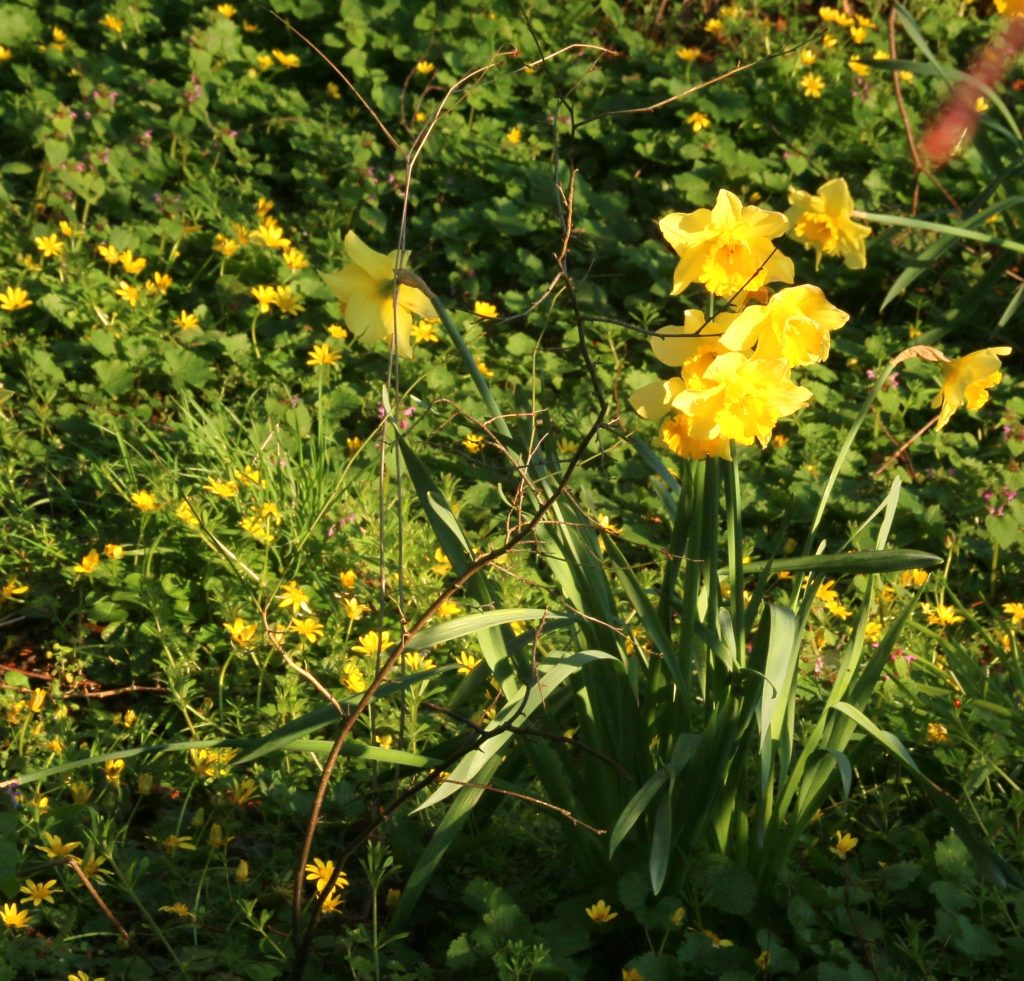
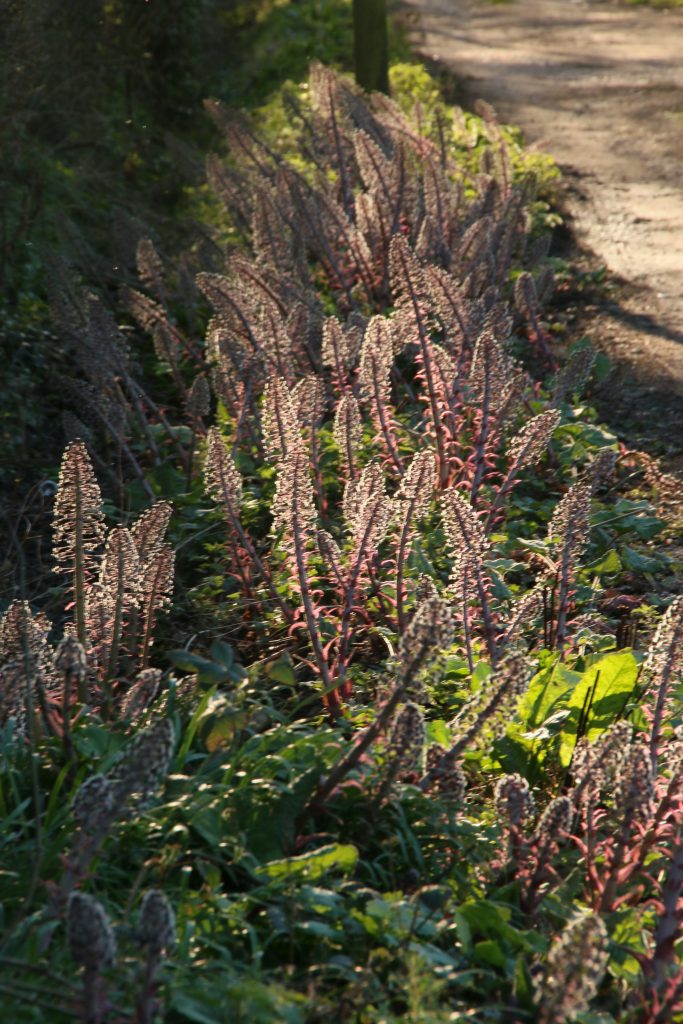
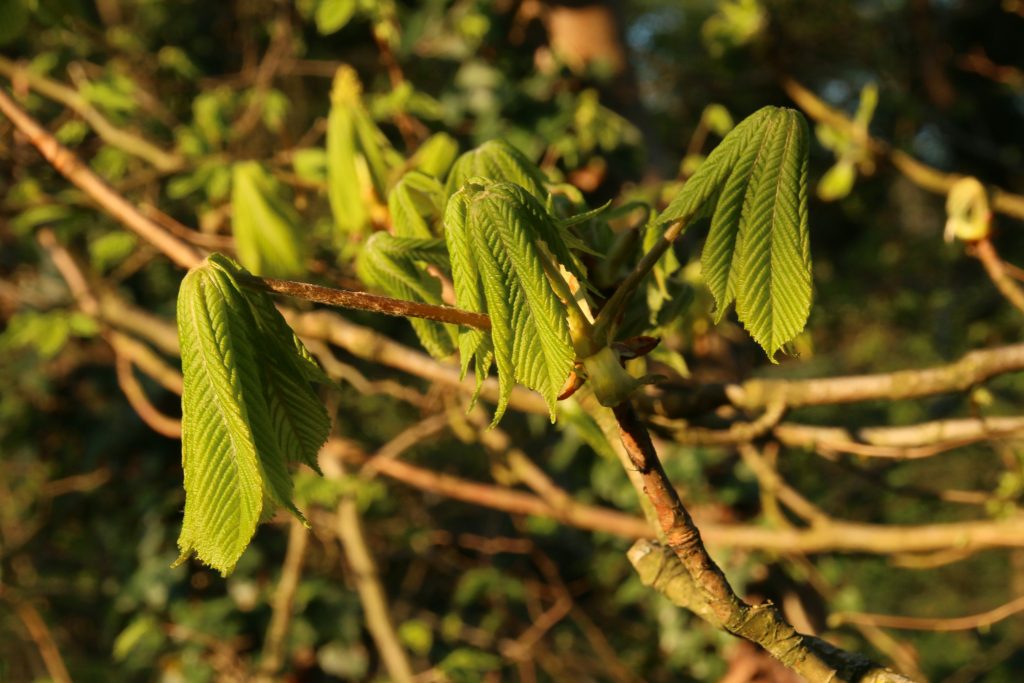
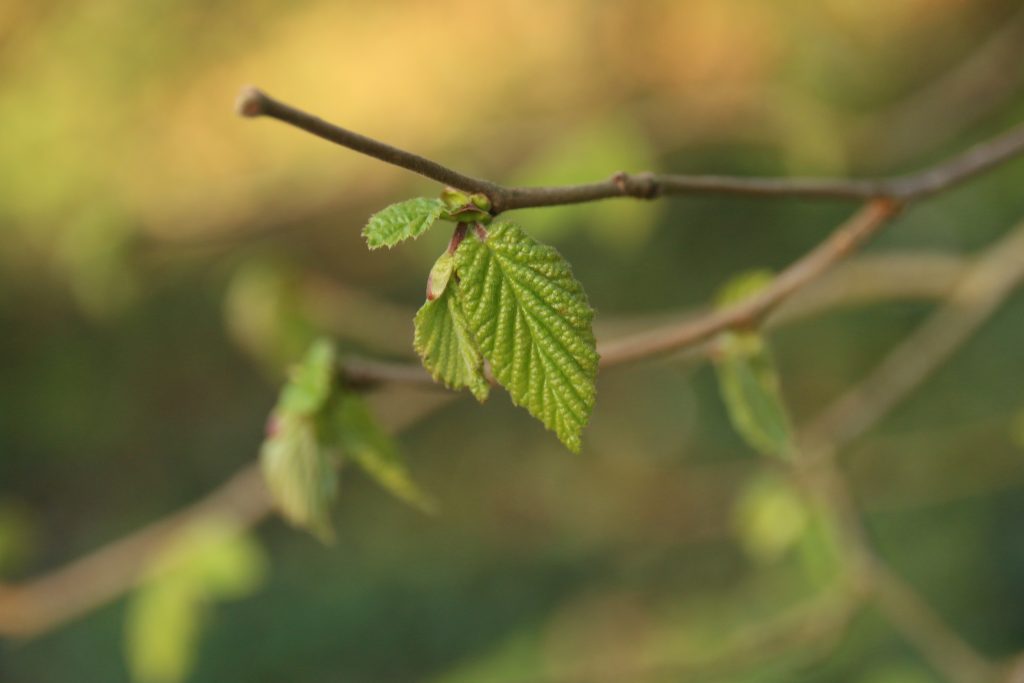
Along the path down to the Glebe daffodils bloom among the lesser celandines, and the afternoon sun illuminates the purple Butterbur flowers that grow beside the ditch by the entrance to the Glebe. The sticky buds on some Horse chestnut trees have sprouted young leaves, looking like multilobed flannels hung out to dry, and young hazel leaves have emerged from the low shrubs among the trees beside the track
12th March 2026
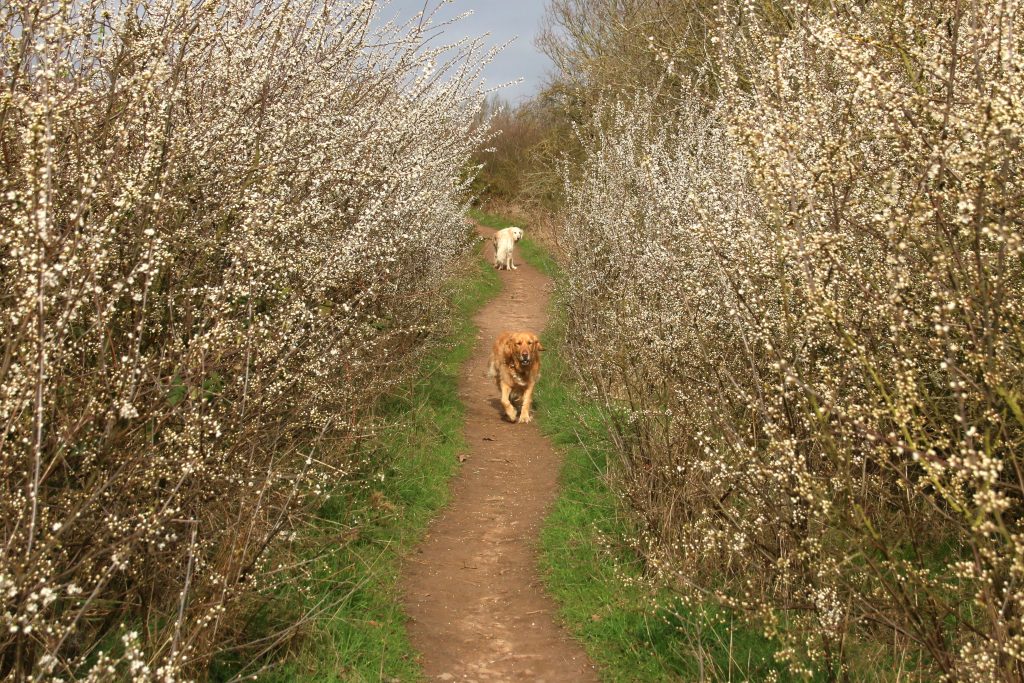
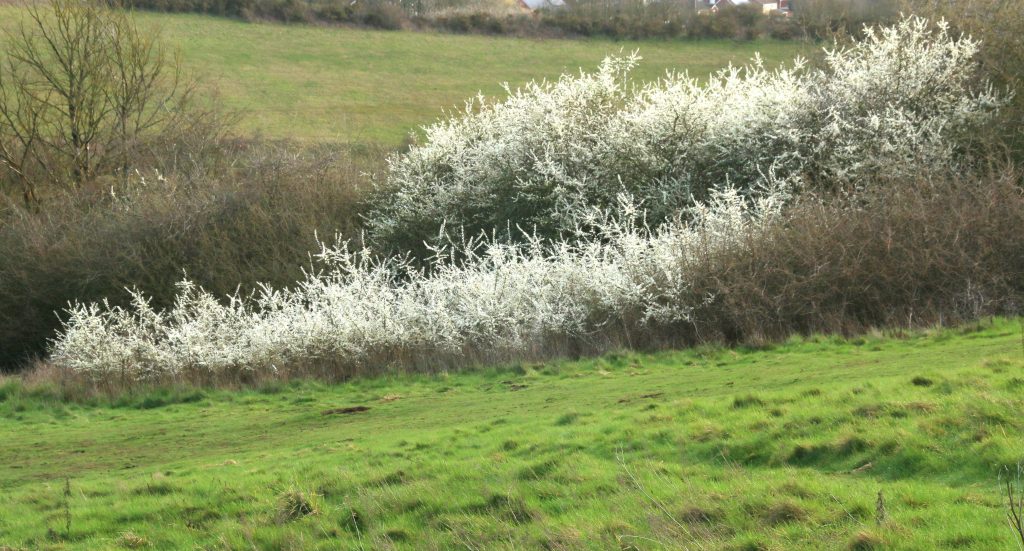
A wet and windy night, but by this morning the sun is shining, although the wind has not abated. We walk up the “New Hill” by the quarry. The ascent, which has been drying nicely, is once again slippery with ankle deep mud in places. At the top the path passes through flowering blackthorn shrubs which, just a few days ago, were tight buds. Now the flowers have opened, enclosing the path like a church aisle draped in white for a wedding, but is will be few more days before the bushes are covered in white floral froth, as are those at the bottom of Croft Hill.
As we climb further up, I look behind while waiting for Sam to sniff every blade of grass, checking out which dogs have passed this way over the last couple of days. I see one of the regular walkers in the distance, with his two fox hounds on lead. If he gave them their freedom, they would be off, following the first scent of foxes or deer and would run a long way before stopping. As a result, their owner walks a lot of miles to give them the exercise that they need. As we get higher we leave the shelter of Croft Hill, on the far side of the quarry, and wind is strong on the exposed ridge.
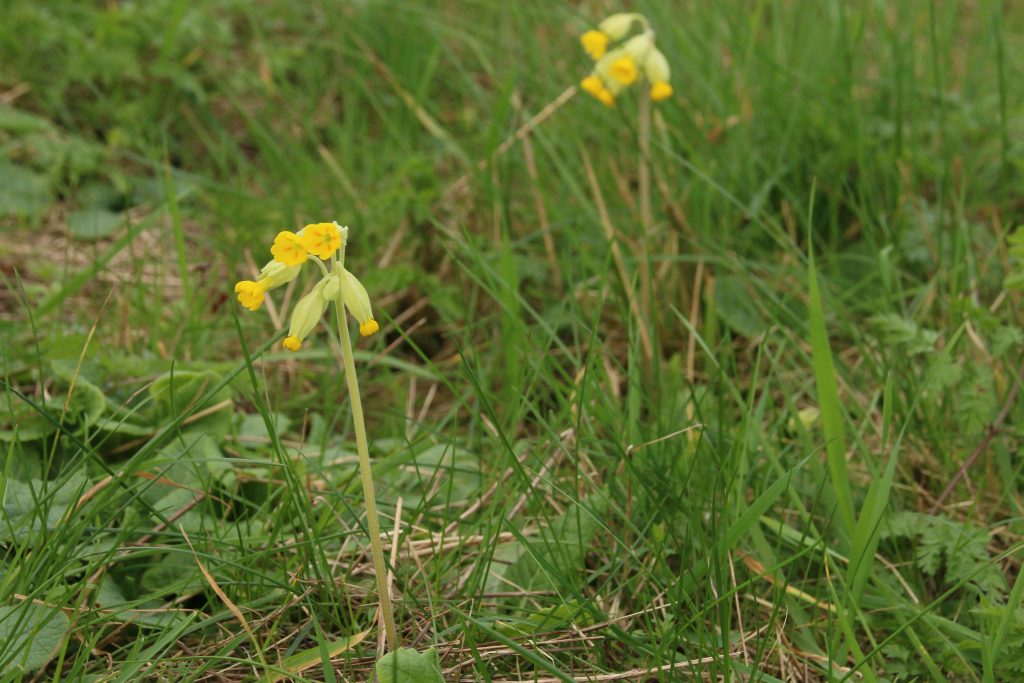
We drop down to the leeward side of the ridge, walking through the lush grass which has benefitted from the warmer weather as well as the moisture in the ground from a wet winter. Cowslips have emerged, scattered thinly across the grassland rather than in groups. The flowers provide an early source of nectar for bees and insects, although none were visiting the blooms on this windy morning.
We walk back around the quarry and up Croft Hill. The blackthorn is almost in full blossom on some of the shrubs on the side of the Hill, but on immediately adjacent branches the buds have barely opened. The flowering season seems to be extended this year, rather than the full-on overwhelming blanket of white in the hedgerows across the landscape, that usually seems to appear over only a few days.
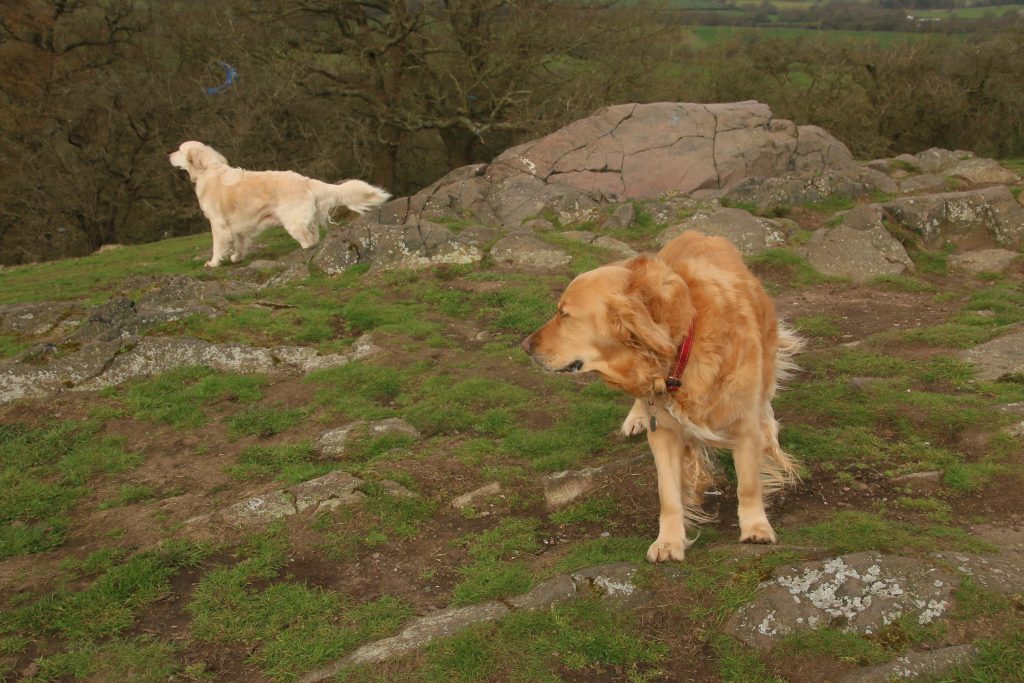
As expected, the wind at top of the Hill, open in all directions, is strong and gusty. I can almost lean into the wind. The dogs face into the wind, sniffing the scents from the landscape around us. Today the scents are collected from the countryside by the westerly breeze and delivered to the appreciative dogs in a concentrated serving.
10th March 2026
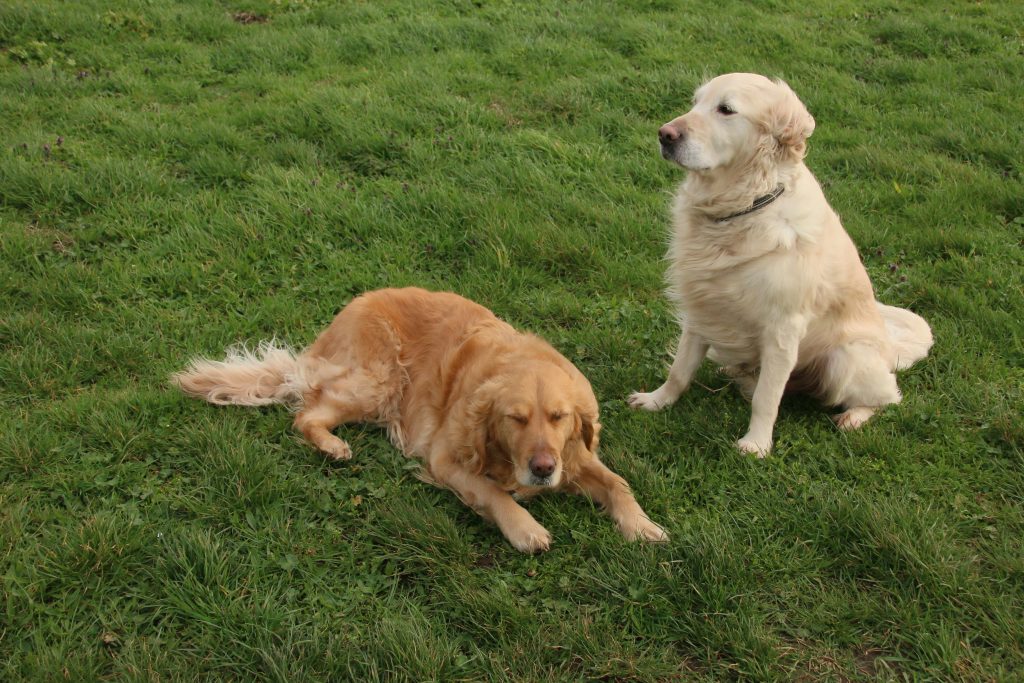
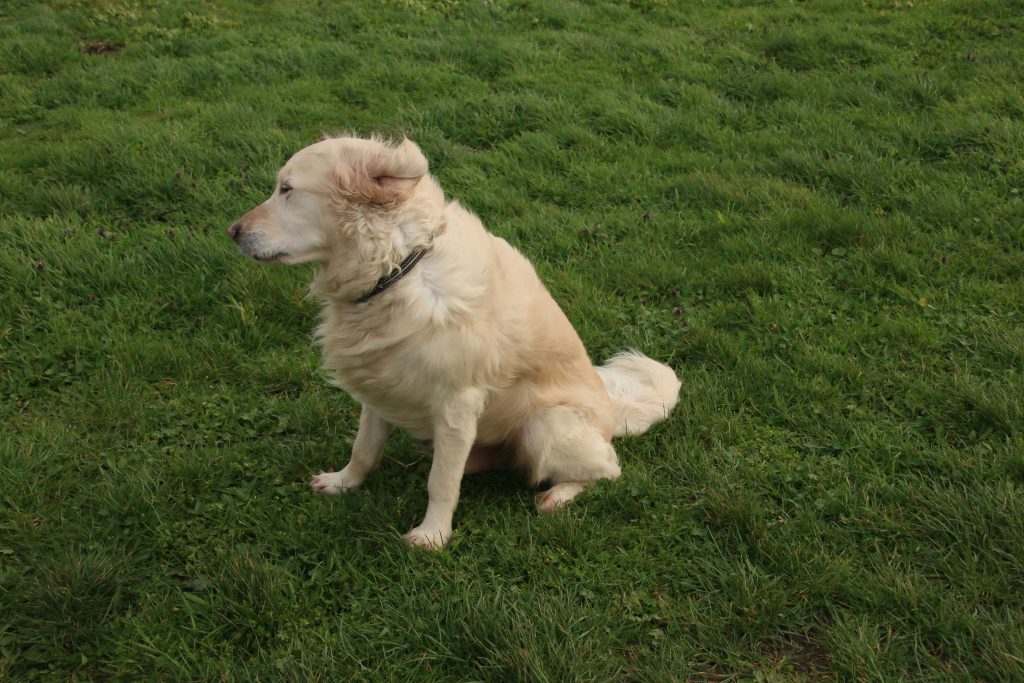
Back to typical early spring weather, bright, cool, blustery, the wind blowing the dogs fur, their ears flapping as they squint into the wind. The first part of our walk becomes a meet-a-spaniel event, in fact three of them in the first few minutes. The first is a regular, and we owners stop for a natter while the three dogs play. A runner passes us just as we are all going on our separate ways. Sam and Ellie ignore runners – they are always timing themselves, far too occupied to stop and fuss dogs, and in any case, they never carry dog treats.
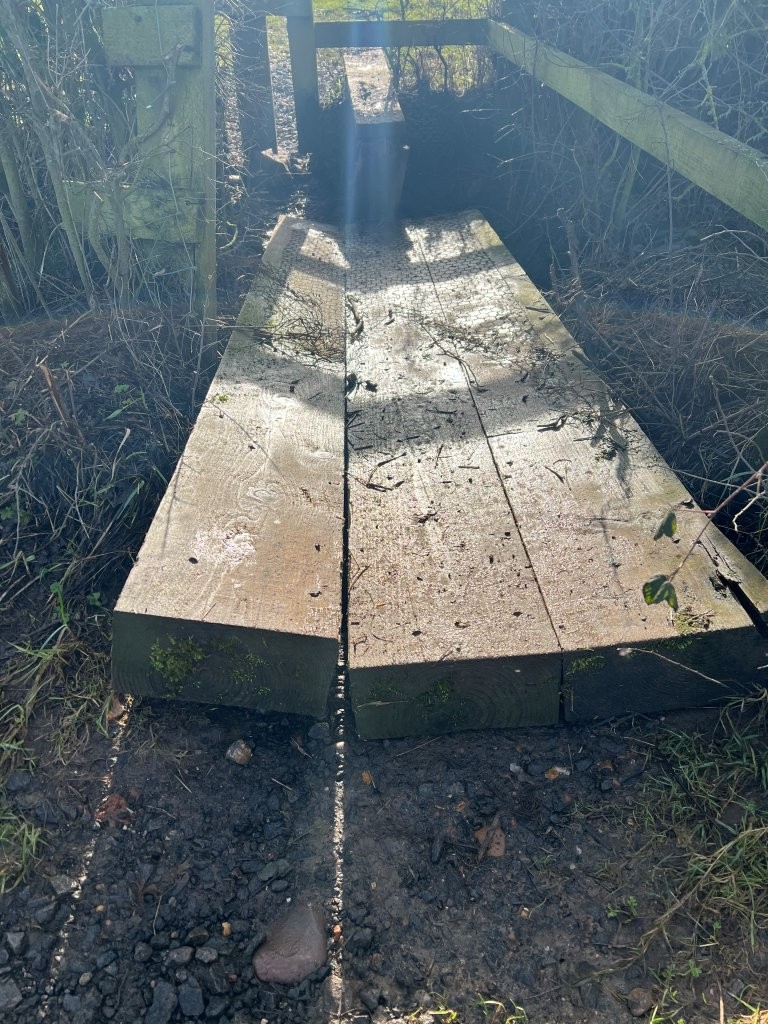
The runner pauses briefly on the river bridge in front of us, before disappearing ahead, and when we get to the bridge we see why – another spaniel is doing circuits, the owner a short distance away. Since the spaniel is off lead, I let our two through onto the field, and the spaniel promptly heads at speed towards the far end of the field. The owner explains that his dog is nervous of other dogs, and so I put ours on lead as we head for the stile on the other side. It is a month since I reported the stile as being somewhat dodgy, with regular flooding dislodging the footbridge to which the stile is attached. The stile and bridge must still be crossed with care. Maybe the County Council is saving funds for a more substantial bridge.
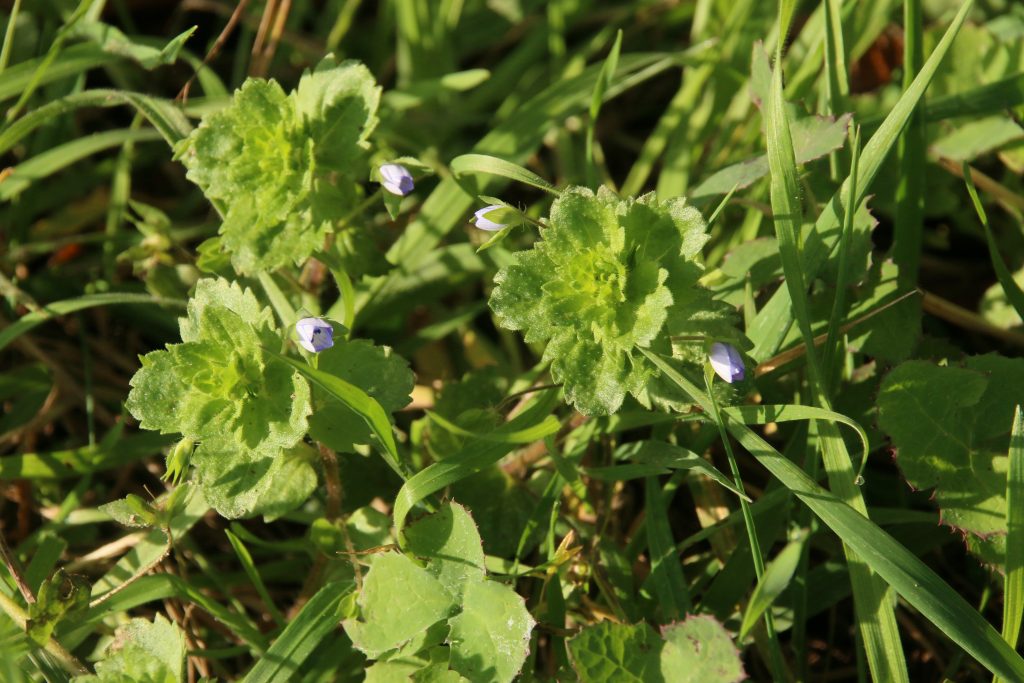
Walking the up the field beyond, and we see out third spaniel, the dog and owner walking up the far hedgerow, some distance from is, unusual since there is no path there, and certainly no right of way. Maybe this is another nervous spaniel. I planned turn back at the top of the field, since Sam is limping slightly, possibly arthritis, but instead we walk a little further along the track at the top of the field, allowing spaniel and owner to head in the opposite direction towards Huncote. We are rewarded by the first Speedwell, Birds Eye Speedwell, nestling in the grass beside the track. The flower is common and may be considered a weed if it appears on a carefully manicured lawn. Here, in its natural habitat, it is another welcome sign of the season.
7th March 2026
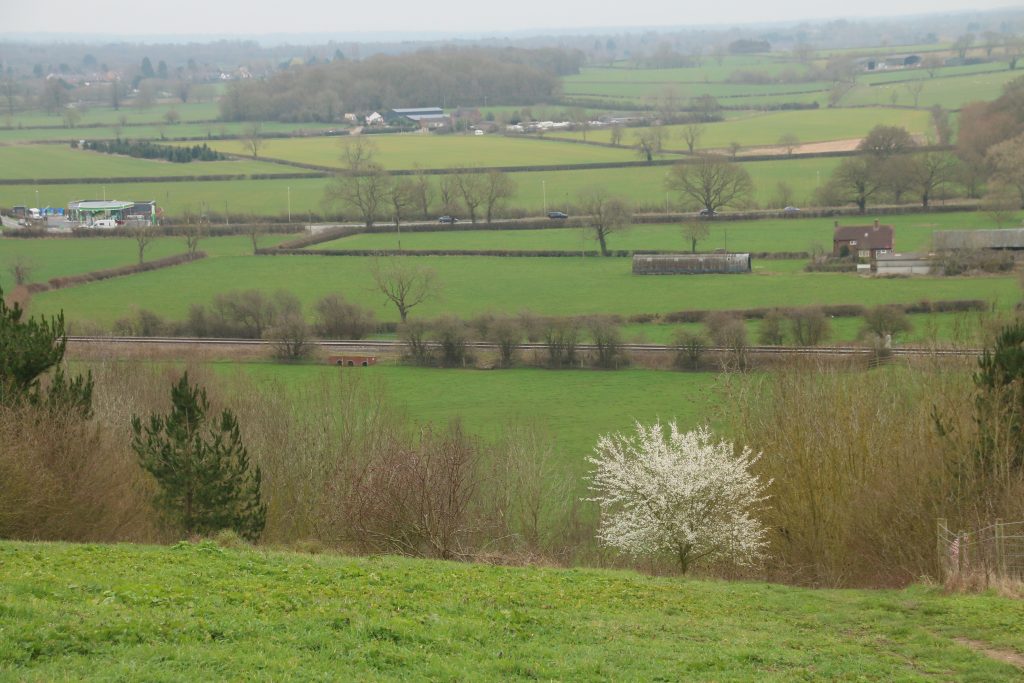
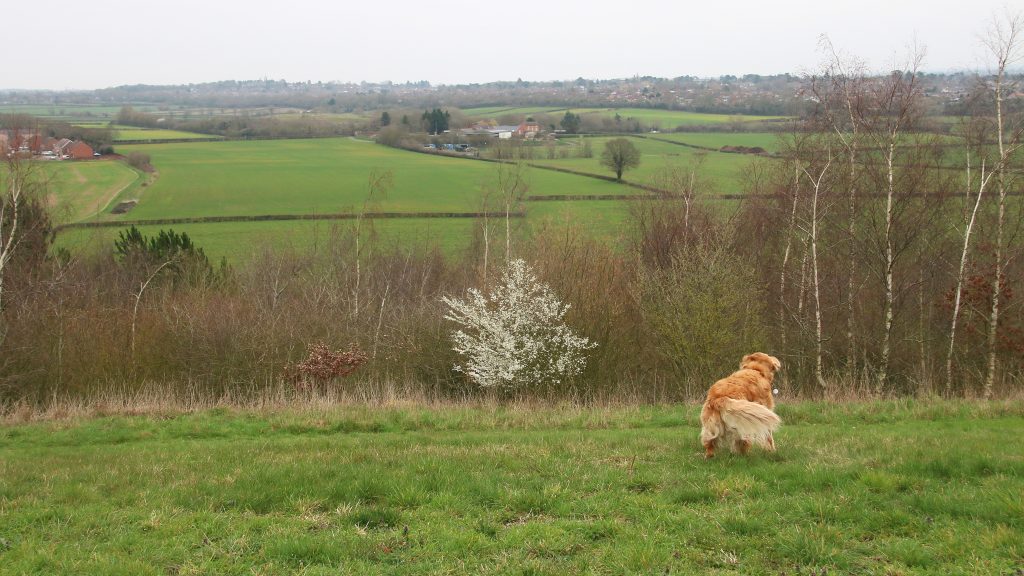
After the warm springtime weather of only a couple of days ago, the weather is once again cold, the landscape grey, and once again with more of a Winter than Spring appearance. Only the splashes of white from wild cherry shrubs dotted among the greys and browns of bare hedgerows remind me that we are on the cusp of an explosion of new life and colour, when Spring finally overcomes Winter.
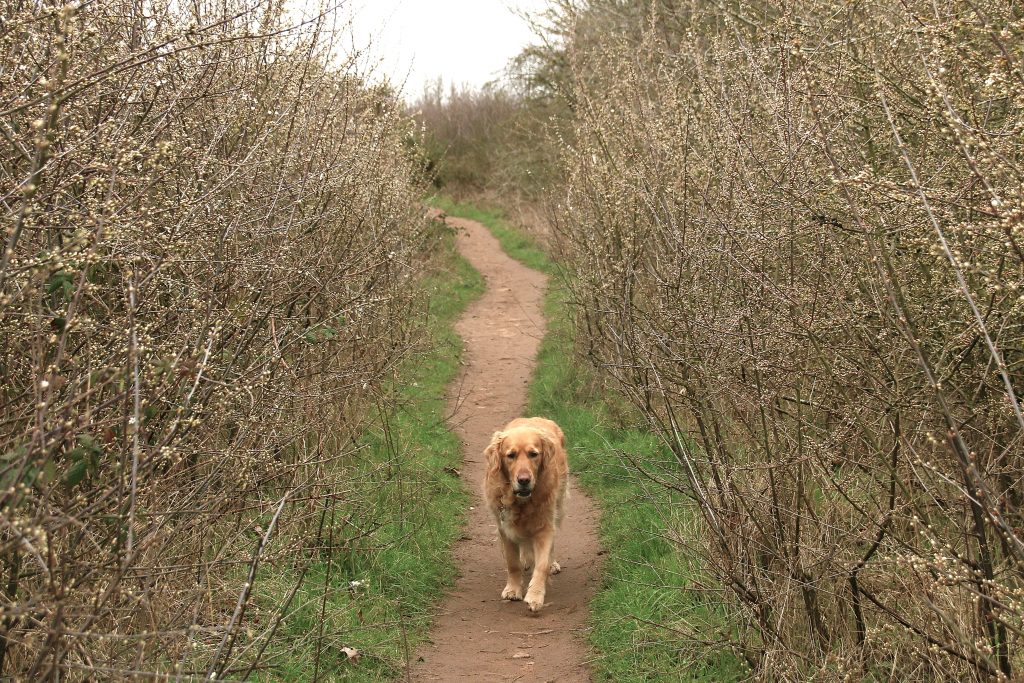
But looking away from the landscape to my immediate surroundings and I see more signs of Spring. I always look forward to the full bloom of Blackthorn, exuberant frothy white blossom in hedges and tall shrubs that dominate Croft Hill and the surrounding walks. Today, around the bottom of the Hill, I see the first open blossom among white buds. Only a few minutes away, further up on the more exposed quarry edge, the Blackthorn buds remain tightly closed, although the bushes lining the footpath give a hint of the forthcoming frothy display. By Autumn this blossom will develop into sloes, ready for flavouring Sloe Gin
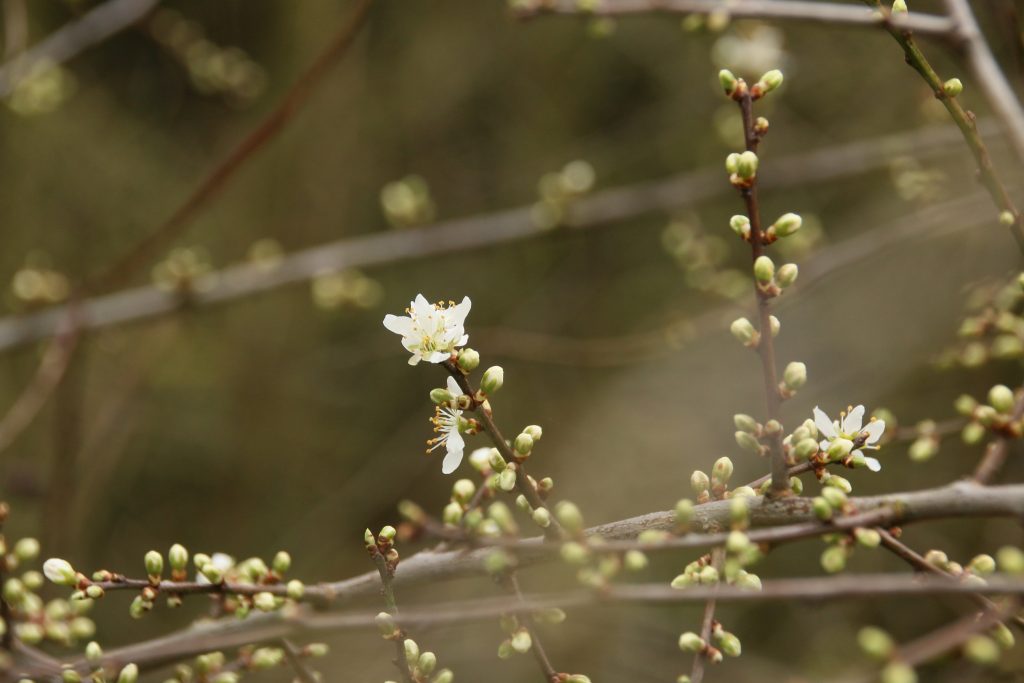
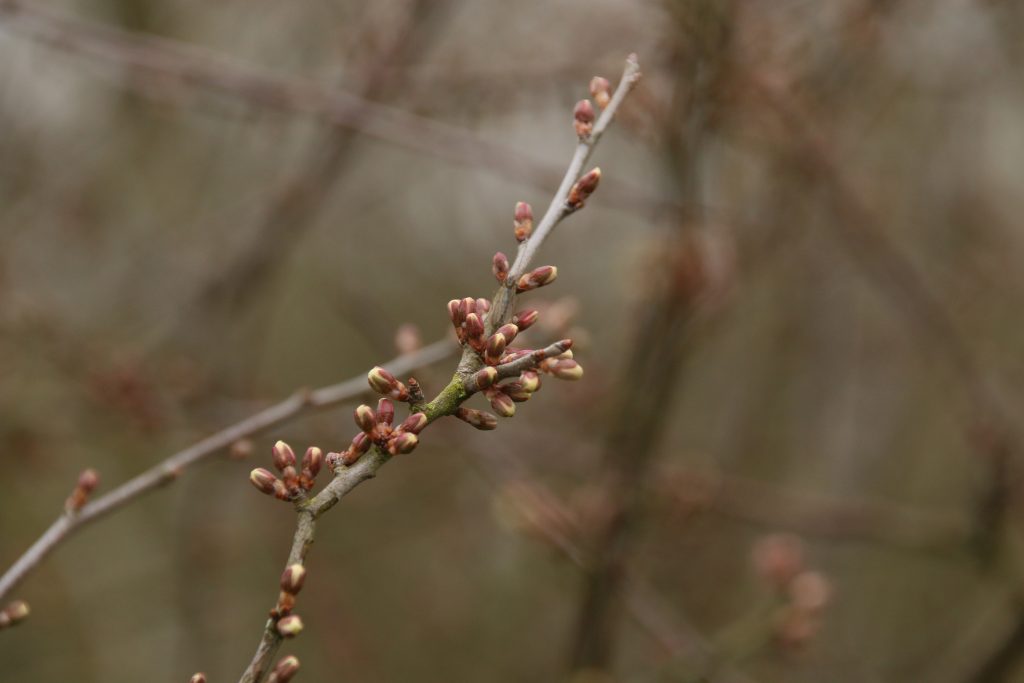
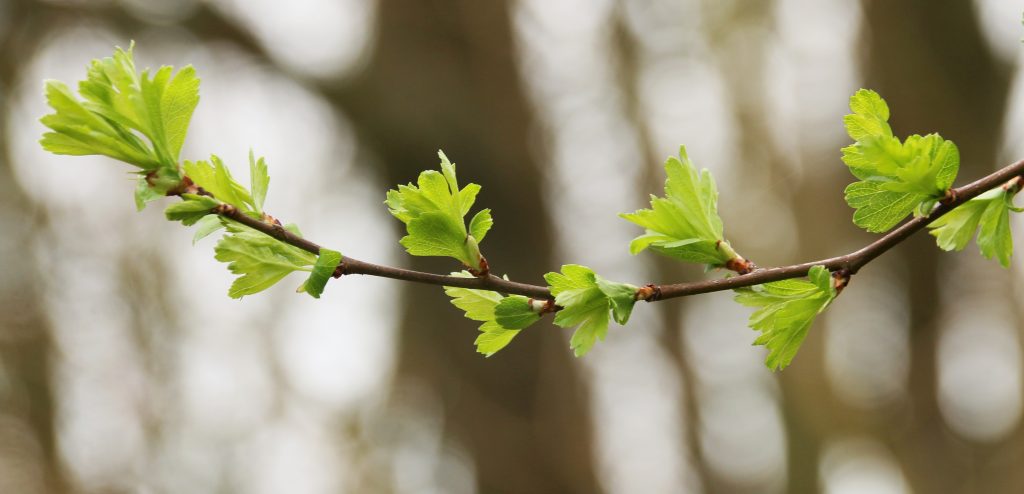
Blackthorn blossom emerges before the leaves, whereas Hawthorn comes into leaf before the branches produce white blossom in most of the hedgerows around us. Today I see the first Hawthorn leaves emerging, but it will be May, with summer on the horizon, before the white Hawthorn blossom lines local highways and byways.
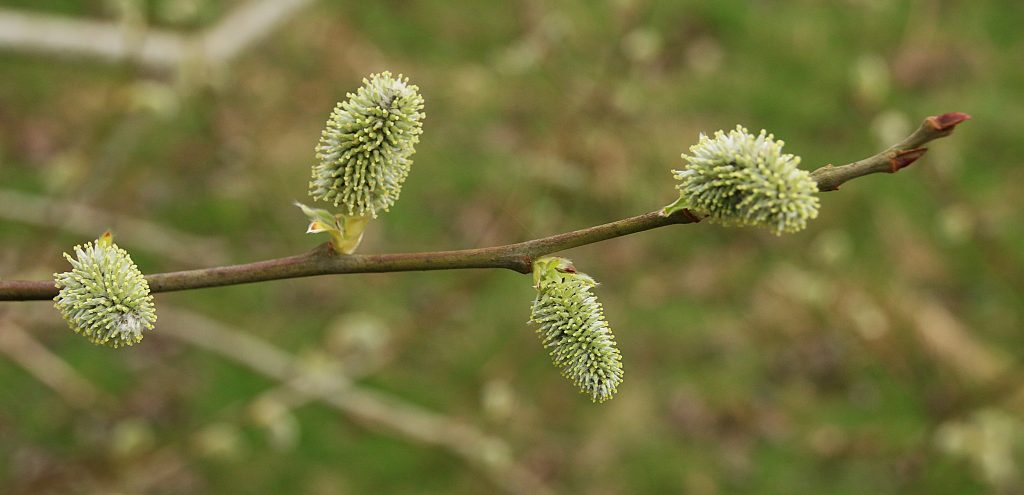
Beyond the Hawthorn Goat Willow catkins have appeared, in this case the female catkins. Young male catkins are furry, hence the name “Pussy Willow”. While photographing the catkins I hear a bark behind me and a black Labrador appears, followed by two ladies who I don’t recognise – at weekends visitors from nearby towns travel to walk around the quarry, and local dog walkers have a different routine. My two and the labrador bound up to greet each other but unfortunately, I hadn’t noticed a nervous Border Terrier behind the ladies. The Terrier flees beneath a gate but is quickly retrieved by his owner before reaching the road. We let all four of them carry on before us.
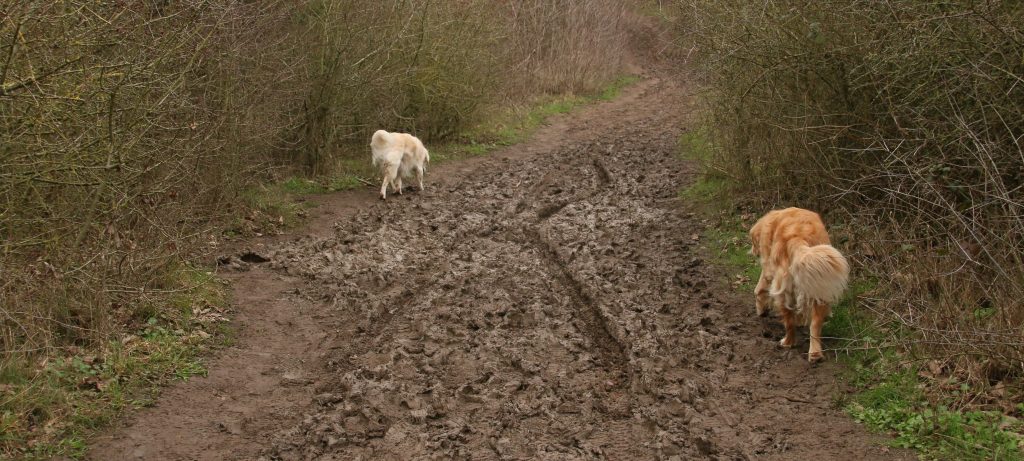
The ground is drier in places, but the slope up to the quarry edge remains wet and muddy, albeit the areas of mud have shrunk a little to allow narrow tracks of less liquid mud at the edges. I am pleased to note that Sam and Ellie carefully stay out of the worst of the quagmire.
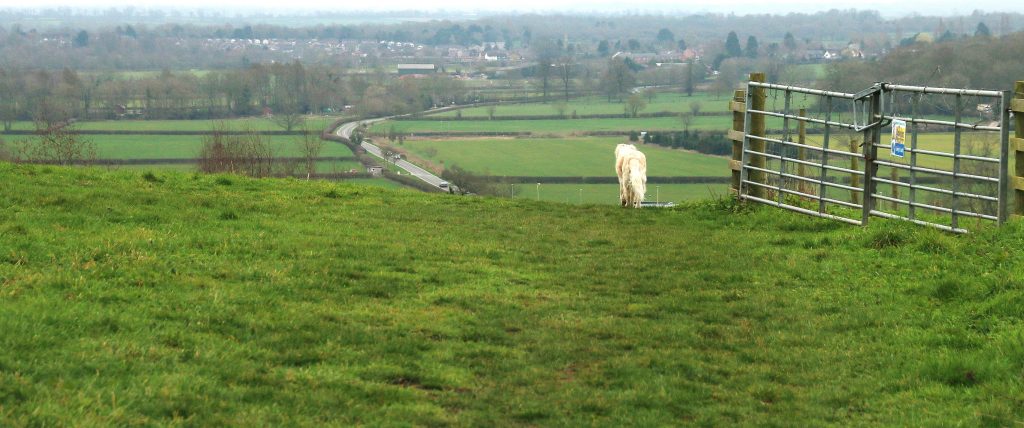
We continue along the grassy ridge above the quarry to end of the ridge, with views overlooking the south Leicestershire countryside, where the ground descends to steps that lead down to the river, and paths along the bottom of the Hill. These will be very wet and muddy, and so we follow the upper fringe of the woodland on the slope above the river, before climbing back to the top of the ridge.
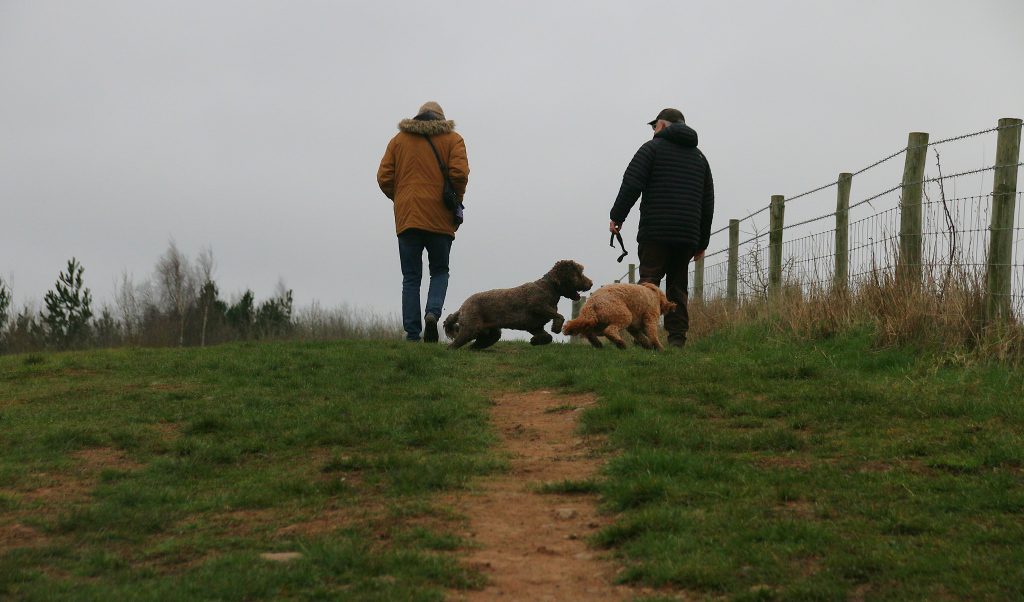
We meet a Cockapoo and owner, and the owner and I stop for a chat. We are of an age when, after traditional comments on the weather, the conversation turns to health matters, before we joined by a second Cockapoo, and I leave Cockapoos and owners to continue together along the path that we have just followed.
From the top of the steps leading down to the wildlife ponds I see how wet the lower paths are. Our decision to stay higher up was a sensible one, and the dogs return home relatively clean.
5th March 2026
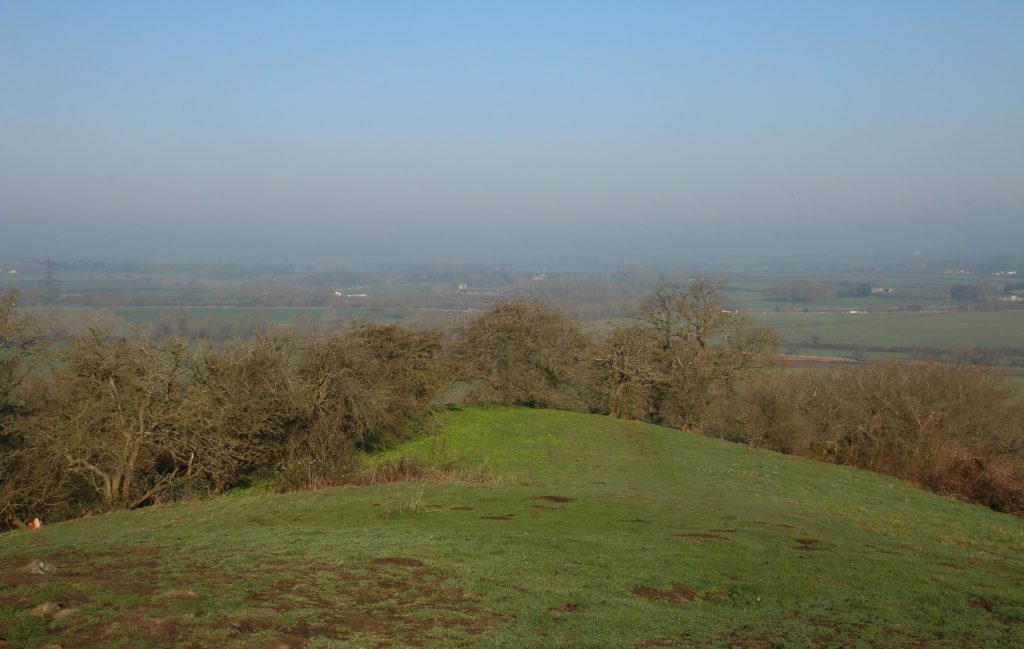
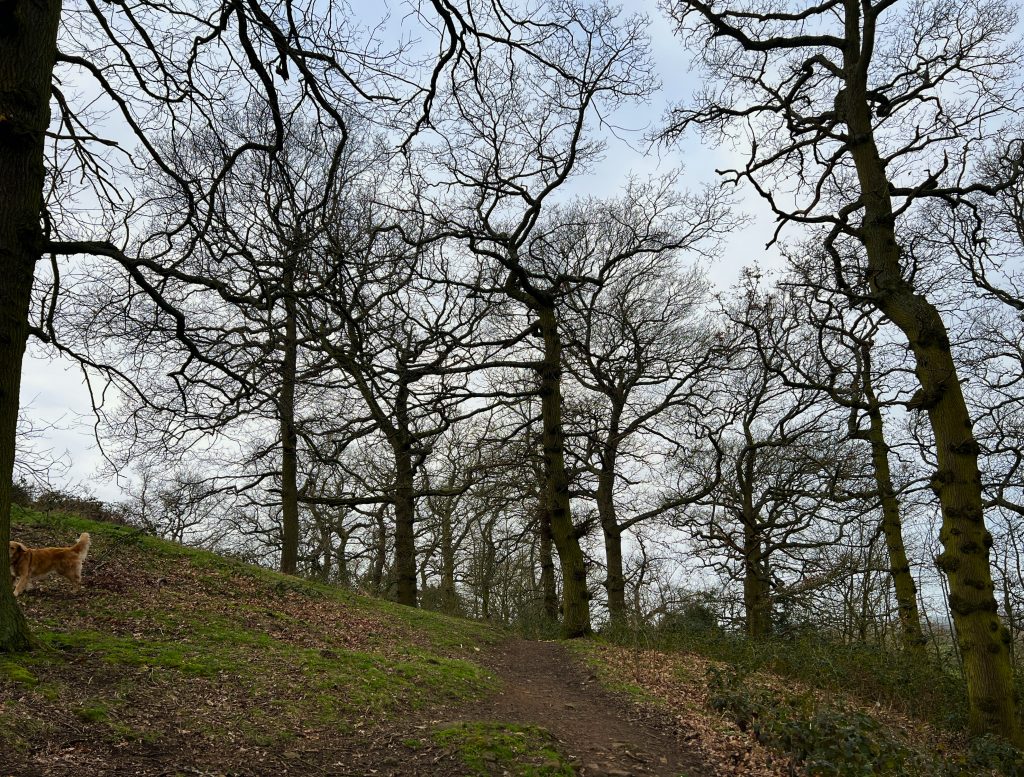
A glorious morning, with a hint of mist over dew-soaked grass. Among the bare branches of the trees around the bottom of Croft Hill a woodpecker drums against a trunk, probably a Greater Spotted Woodpecker, the variety that we see and hear in our garden which is not far from the Hill. The woodpecker maybe excavating into the bark for grubs, or, at this time of the year, drumming to establish a territory and attract a mate. Woodpeckers may drum on a variety of objects to attract a mate, not just trees. A year or so ago a persistent male repeatedly drummed our rooftop TV ariel, the metallic vibration reverberating around our home, often waking us at first light. Further on during today’s walk I hear the laughing call of the Green Woodpecker, as it swooped through trees on the edge of The Glebe.
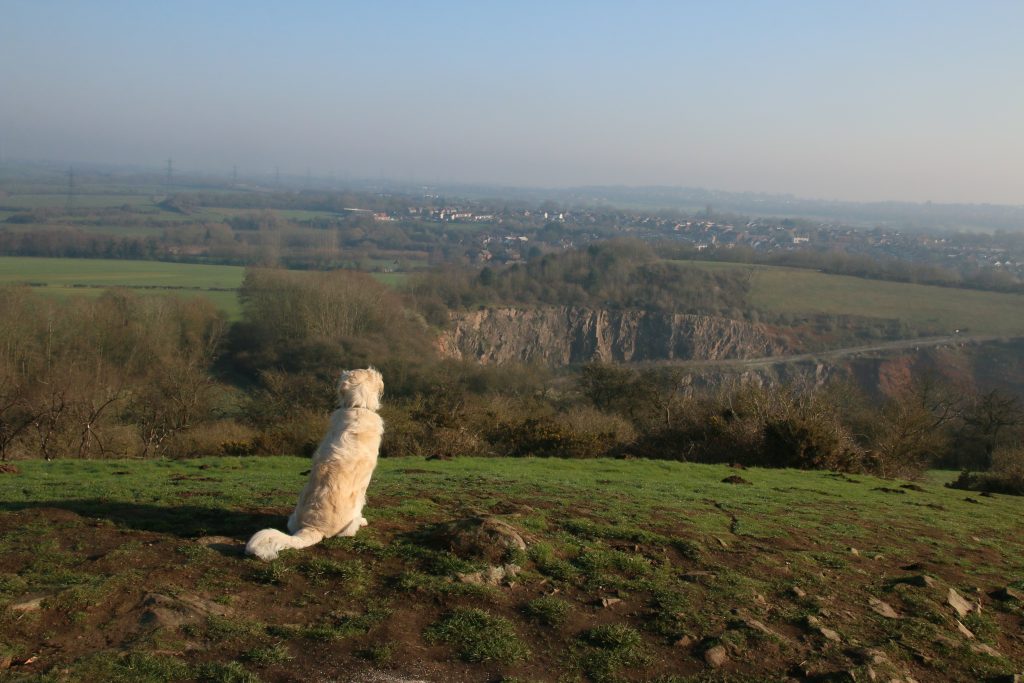
We climb out of the trees and up onto Croft Hill itself. The kissing gate, which we have just passed through, clangs, and I give a wave through the trees below us to one of the local dog walkers from the next village, who has looked after our dogs in the past. We pause at the top of the Hill just to enjoy the view and the warmth of the strengthening sunshine. Sam, in particular, enjoys the view – he has always been a dog that likes to sit and observe his surroundings.
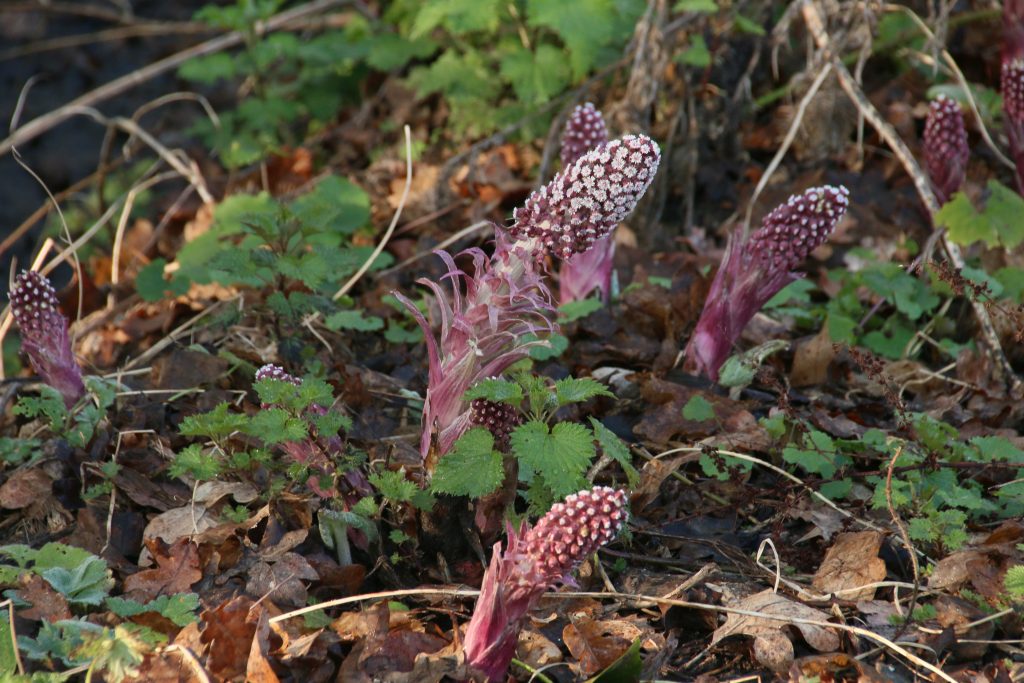
Descending to the path towards the village we meet cockapoo Taffy and stop for a brief chat with his owner, who comments that she is overdressed for an unexpectedly mild walk. We cross the road to join the Lane towards Potters Marston, where Butterbur flowers emerge from the ditch running alongside the lane. By mid-summer these plants will be tall, with leaves up to 1m across spreading across the damp area between the lane and Croft Glebe.
Leaving the Lane we continue behind the Glebe, circling back along the muddy path that leads back to the road into the village. Well-trodden, damp and under trees, this is one of the last paths to dry out in spring, and today it is wet. Golden Retrievers are notorious for enjoying a run, and maybe a roll, in mud. We are lucky. Ours always avoid squidgy wet mud if they can, and they find a narrow track through the trees, avoiding a large muddy puddle, to keep relatively clean.
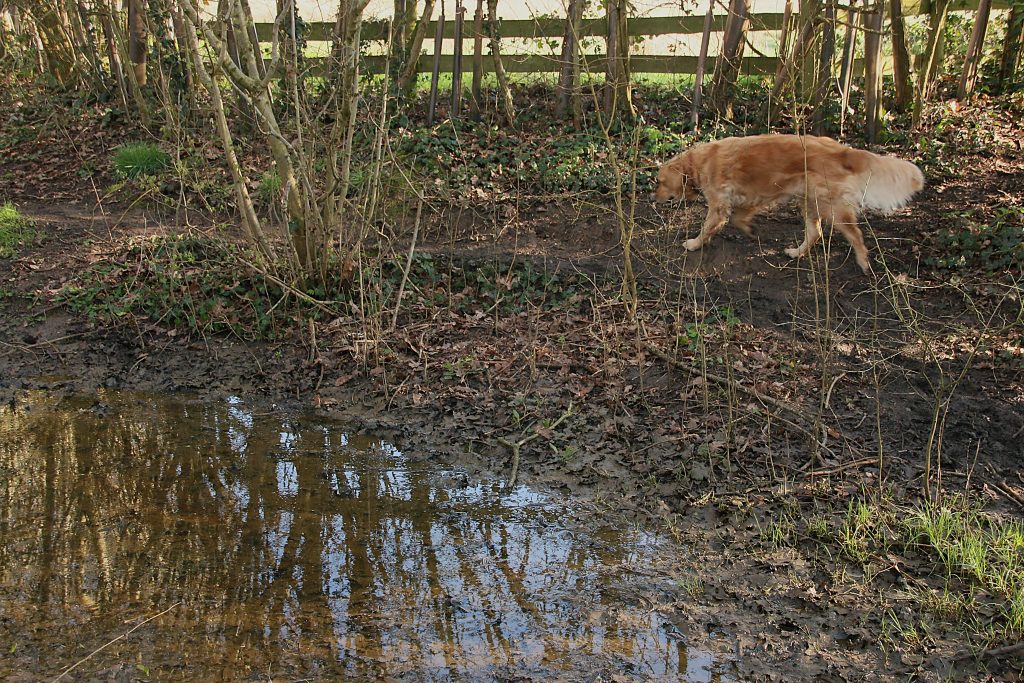
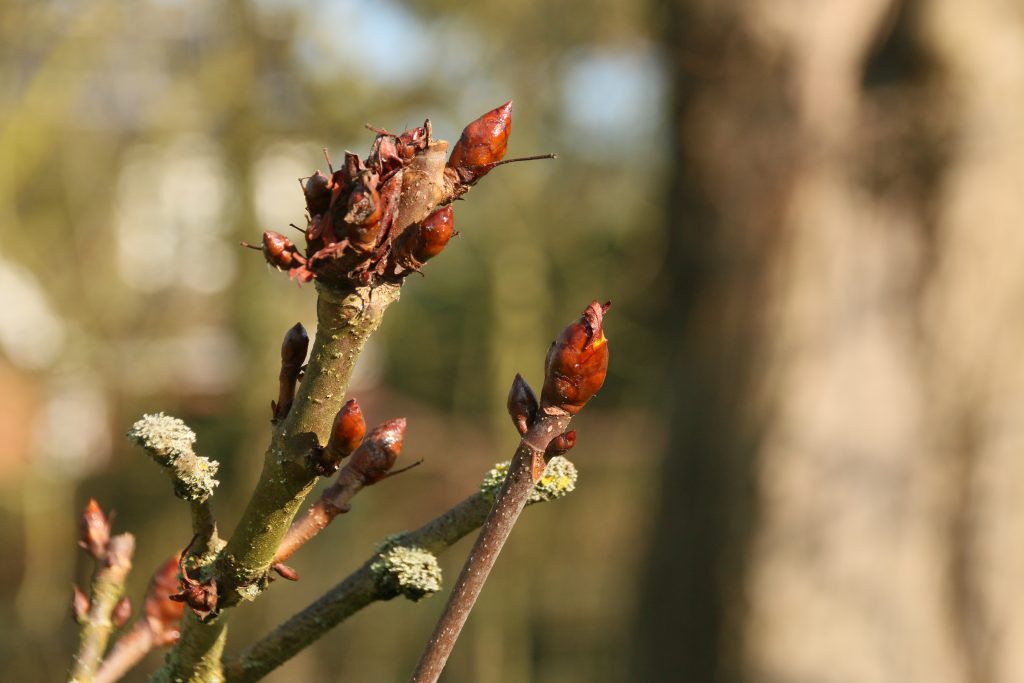
On Croft Glebe, a large field with mature trees, the sticky buds of horse chestnuts, Conker Trees, have appeared. Horse Chestnuts are not native trees, only introduced into the UK about three hundred years ago, and so are more common in parks and managed landscapes than in woodland. Croft Glebe was once the village cricket field but has been managed by the Woodland Trust since the Millenium.
Back at home I take advantage of the warm weather for some gardening – at last the soil is dry enough to allow me access to shrubs for pruning. I notice a sprayer traversing the cereal crop in the field behind us, probably herbicide or fungicide. As the sprayer moves back and forth across the field, a hare leaps up in front of the vehicle, circles around, and flees across the field, heading for the hedgerow and safety of the adjacent field, at least until the sprayer moves into this next field to continue applying the chemical across the land.
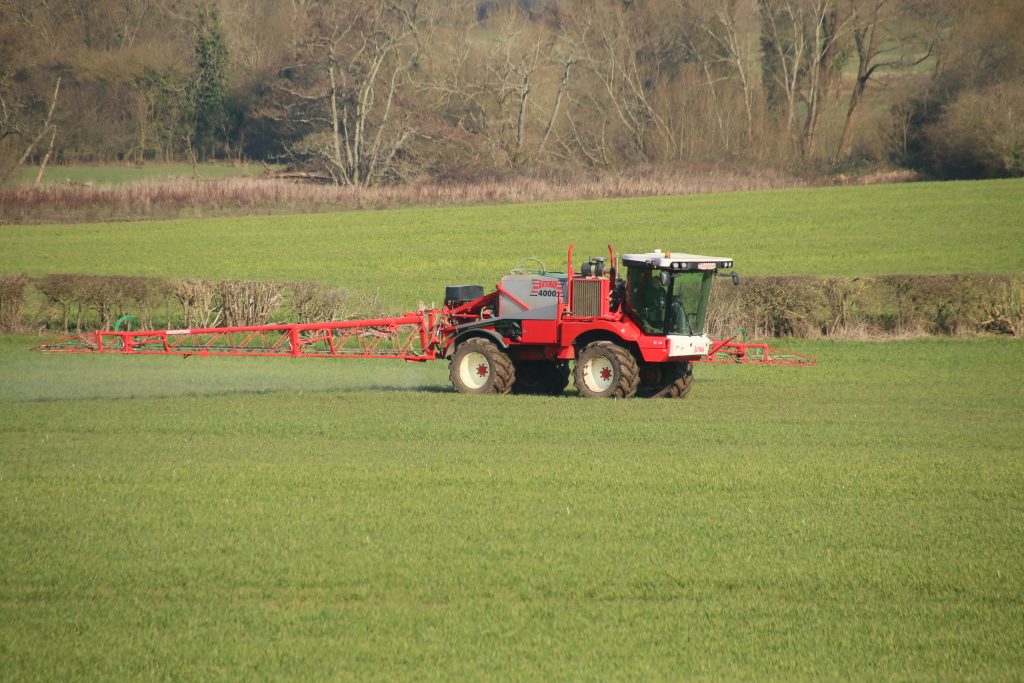
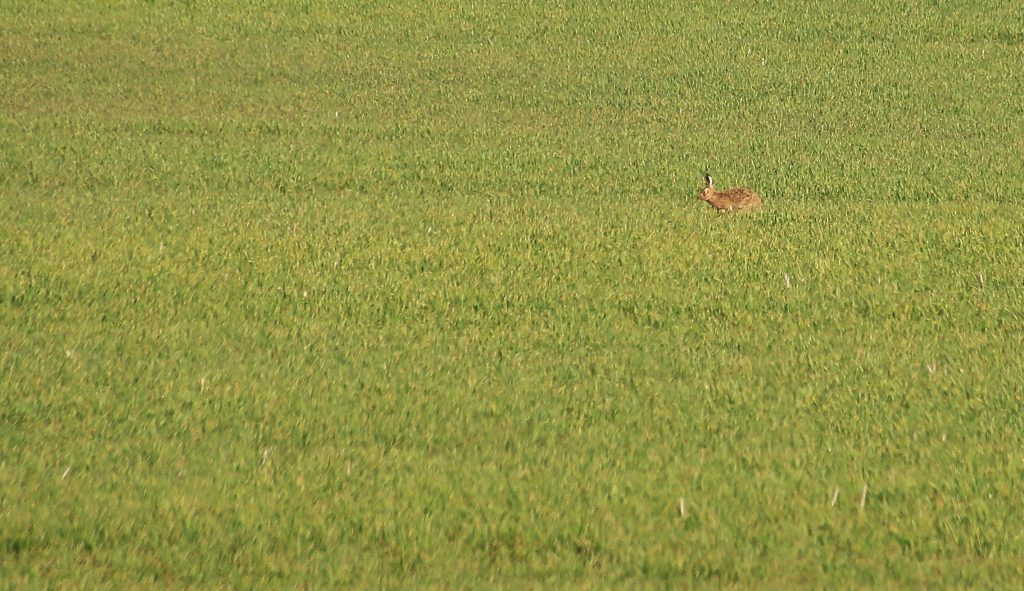
25th February 2026
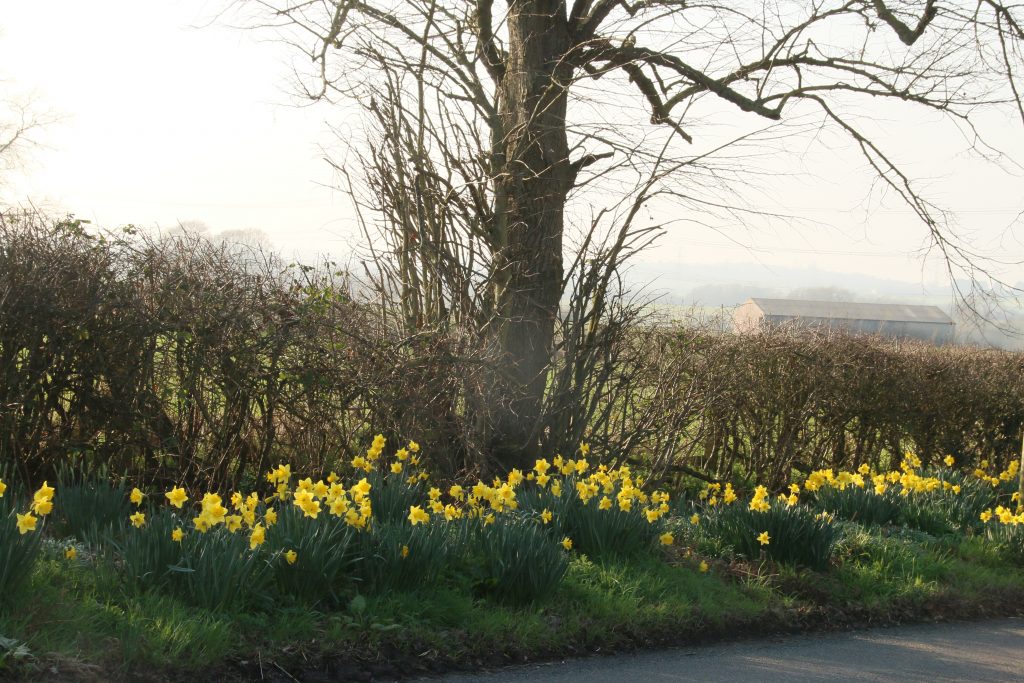
The weather continues to be mild, but still with enough rain to stop the ground from drying. In a few days’ time, on 1st March, Meteorological Spring starts, although some of our more traditional friends insist that Spring doesn’t start until 21st March, after the spring equinox. Nature seems to opt for the earlier date, with Spring flowers beginning to bloom under hedgerows.
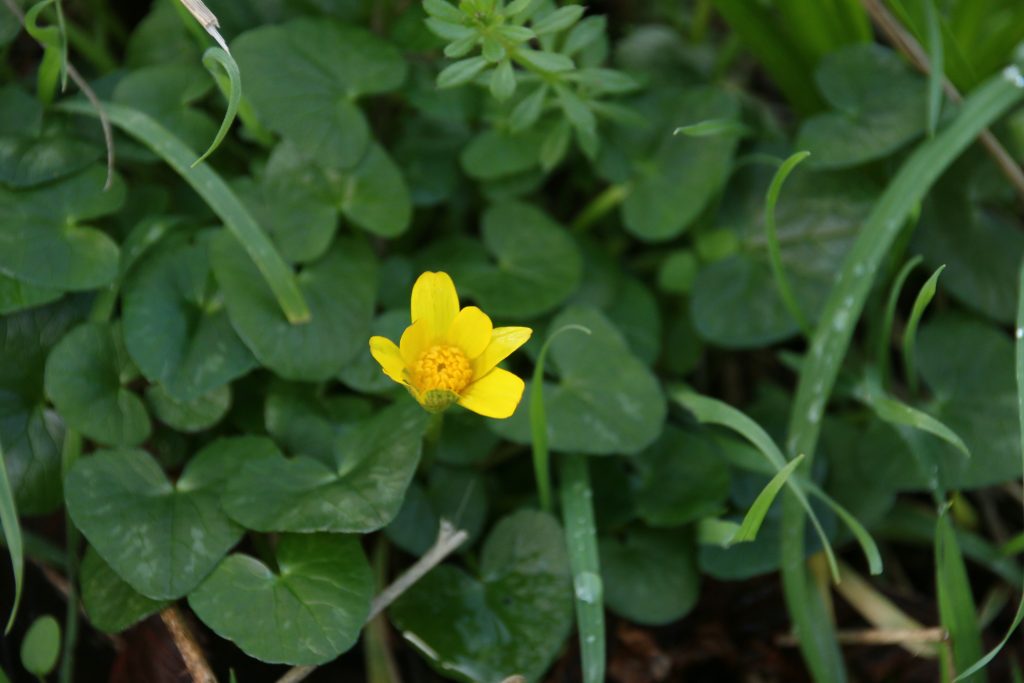
Yellow dominates at this time of the year, when flies, with limited colour vision, are the main pollinators. The buds of some of the earlier daffodils, planted along the grass verge on our Lane, are beginning to burst, but in the countryside, it is Lesser Celandine that is the first truly wildflower to greet the new season, glossy yellow flowers backed by glossy heart shaped leaves nestling under trees.
Further along the path Coltsfoot is flowering, another yellow spring flower that hugs the ground beneath the trees. Unlike Lesser Celandine, the Coltsfoot flower appears before the leaves.
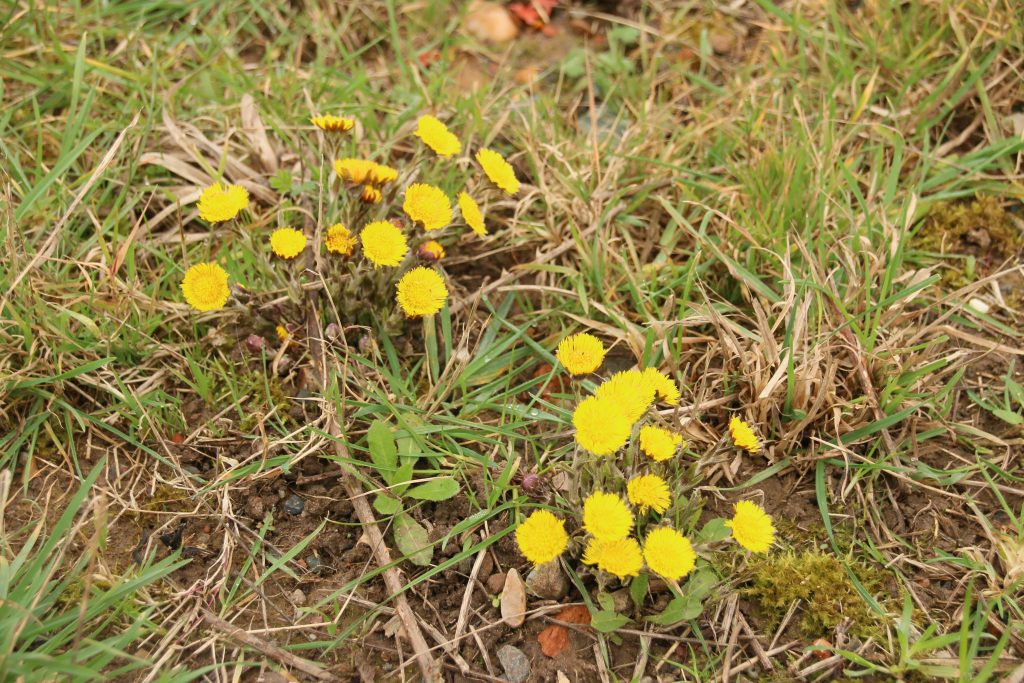
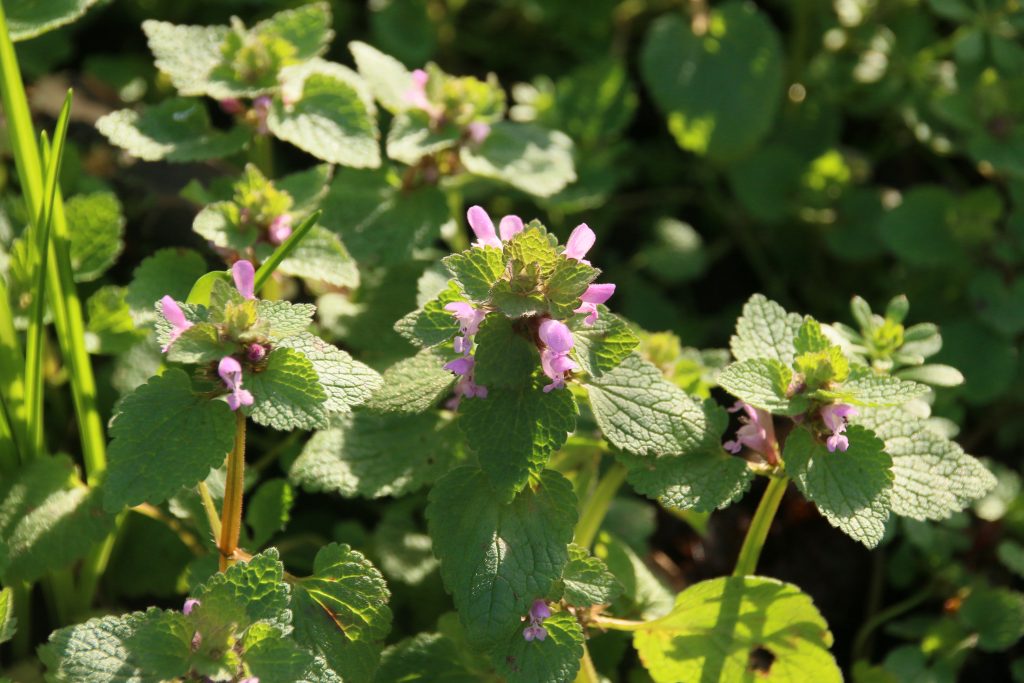
It is not all yellows among the greens in the countryside. Purple dead nettle, also called red dead nettle, is another flower that hugs the ground. This nettle does not sting, and the early flowers are a source of nectar for bees, mostly solitary and bumble bees, that can be seen flying on the warmest days.
Above the purple flowers of dead nettle is the white blossom of the wild cherry shrub. This cherry blossom has been in bloom for several days. The cultivated cherries in gardens have yet to flower.
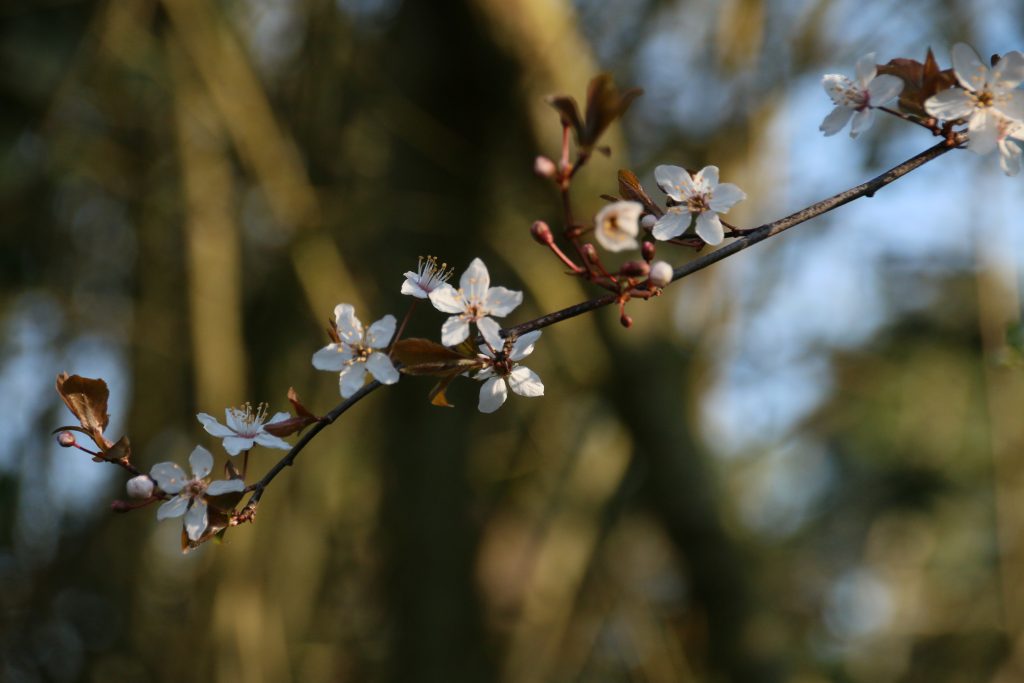
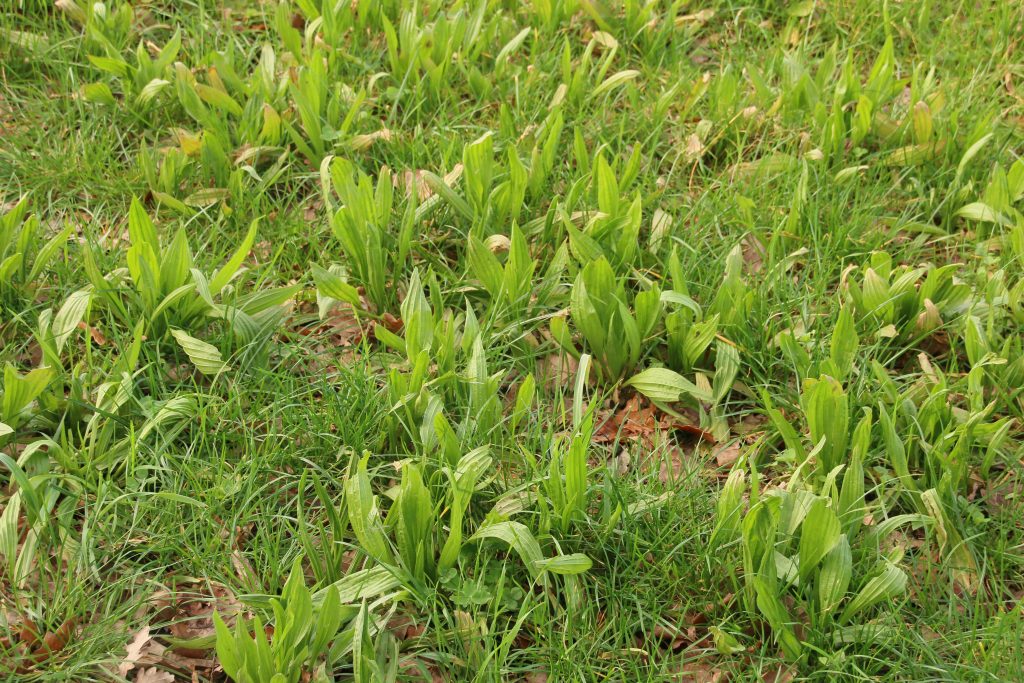
We cross the road and follow the public right of way along a private road, Croft Glebe on one side, and large detached houses, some gated, on the other. The road opens onto a field which has been arable for many years, but the farmer now plans to graze cattle on the land. Grass has been sown, mixed with Ribbed Plantain, or Forage Plantain. The Plantain supplements the grass, allowing grazing earlier than if just grass is sown. Cattle will probably be restricted, by electric fencing, to a small area of the field, the grazed area being moved around the field to allow the grass to recover for a while.
Leaving this field, we cross a stile to turn back towards Croft Glebe. A gate opposite the stile leads to a horse’s field, but for the first time in a while there are no horses. The area of mud has finally exceeded the grass, and the horses have had to be moved to a field further from the road, further for the lady who owns the horses to wheel bags of food for the horses in her wheelbarrow. Even more than the rest of us, she will be glad when we get a dry warm spell to dry the ground.
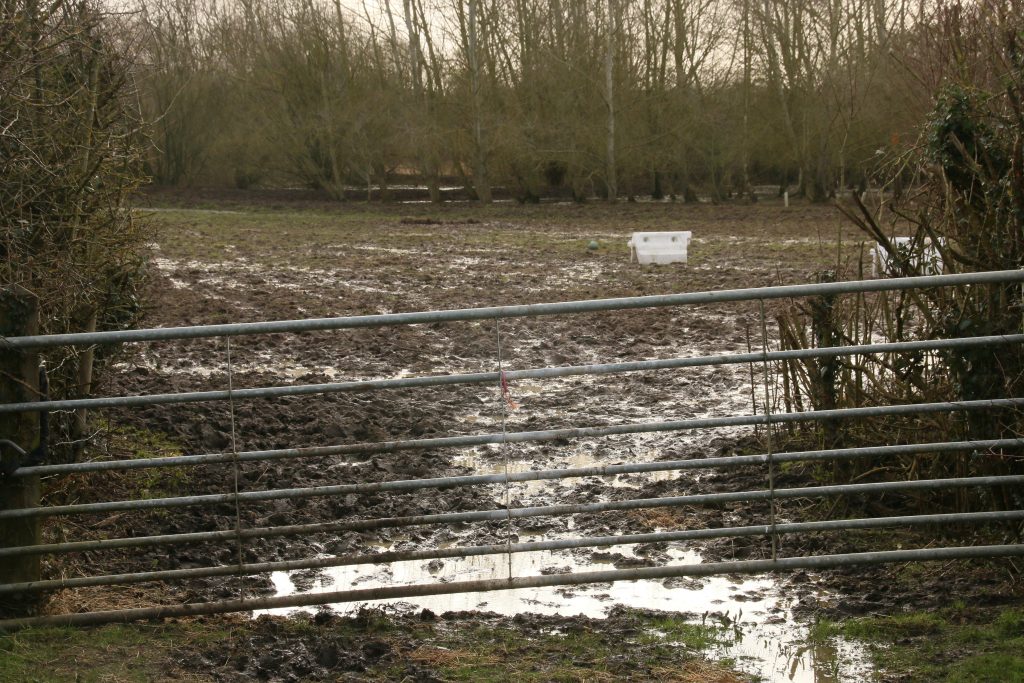
21st February 2026
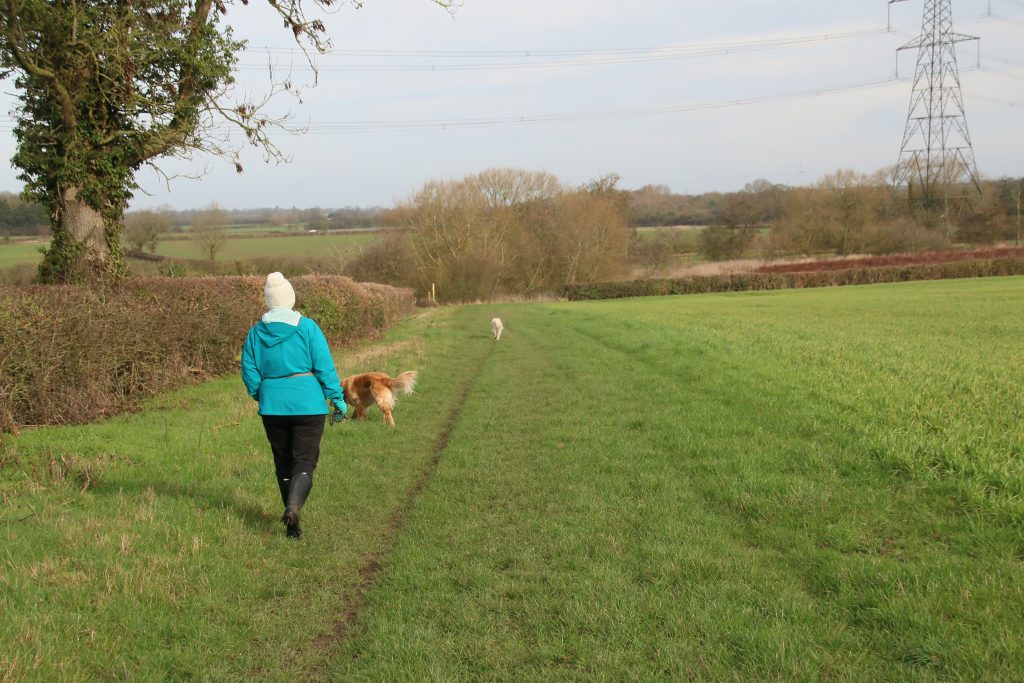
We seem to in a weather pattern of one dry day sandwiched between two or more days of rain, and we make the most of the more pleasant days by taking the dogs for longer walks, although some routes are still avoided as being too muddy. The field side track behind our home is dry enough, but the riverside “sheep field” at the bottom of the track still squelches underfoot, and the river remains high.
Thanks to brighter days, with longer daylight hours and somewhat higher temperatures, the cereal crop beside the track is growing noticeably. I have no idea what the cereal is, and since I am not a farmer, I won’t know until the seed heads develop in Summer. Wheat is the most common crop in these fields, with oil seed rape every two or three years. Tall maize was grown in one year. Maize is harvested in Autumn, and this was a particularly wet Autumn. Tractors got stuck, trailers overturned, and the field and adjacent track were muddy and deeply rutted for months.
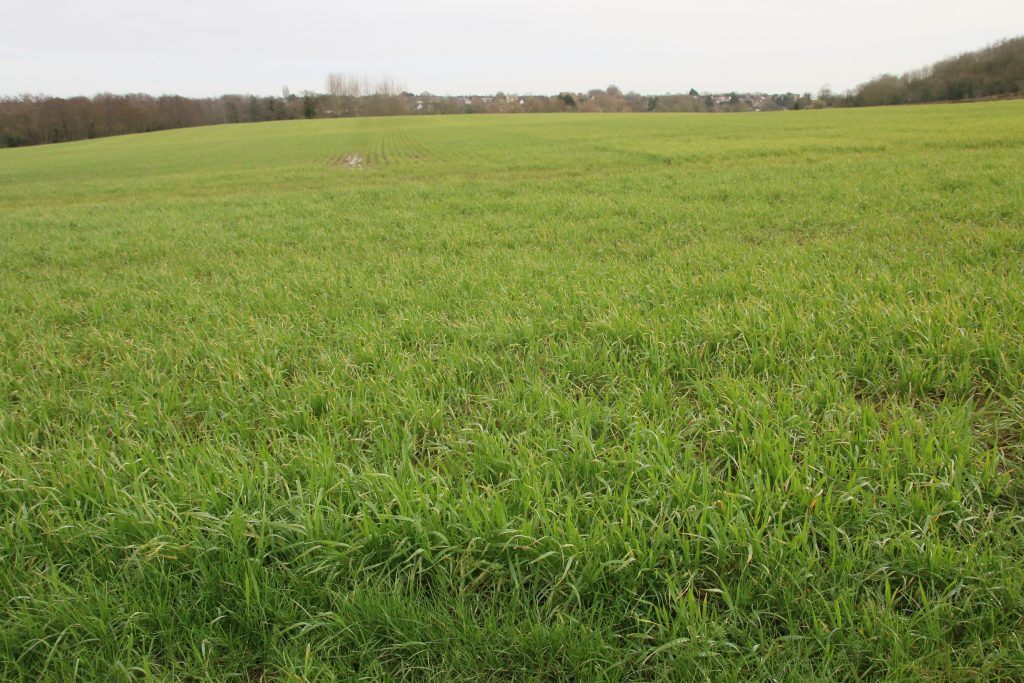
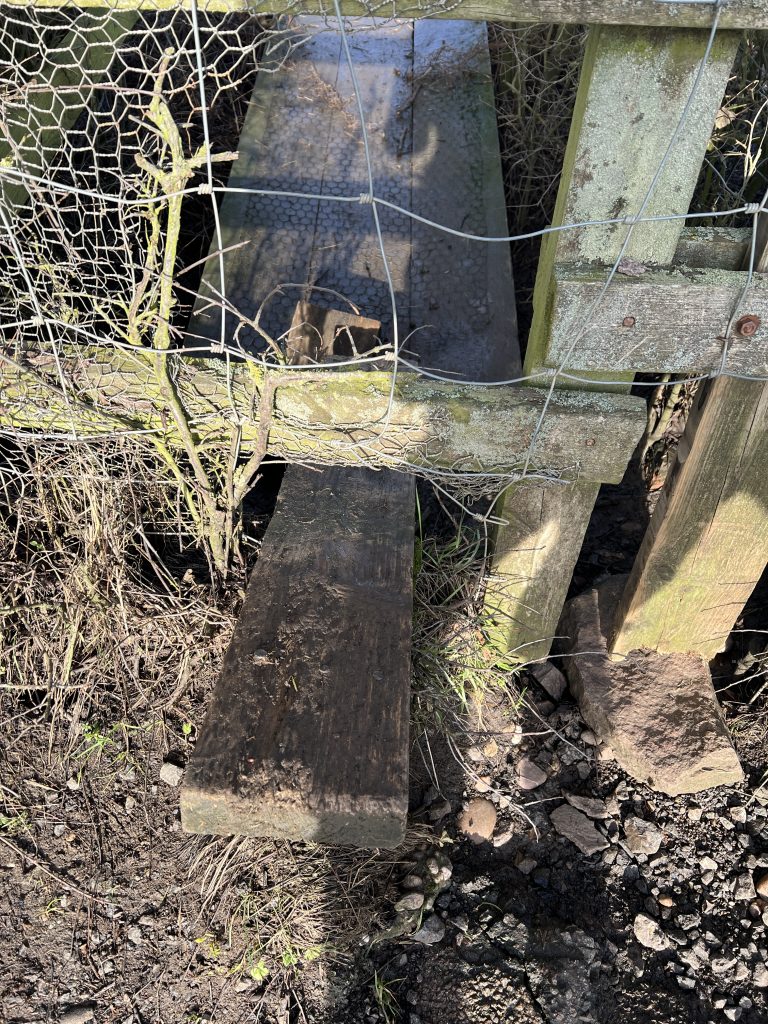
We walk across the sheep field and very carefully climb over the stile and wooden bridge on the far side. Repeated flooding has damaged both the stile and wooden bridge that cross the ditch on the other side have been damaged by recent floods. This is the third time that they have been damaged this winter, and on each occasion, I have made an online report to the County Council, but on each occasion the landowner made the stile and bridge safe, although still in poor condition, before the Council inspected the damage. I have suggested to the Council that the bridge be upgraded to a more substantial concrete structure, as crosses the river on “our” side of the field.
We follow the footpath alongside the field on the other side of the stile and up to the farm track at the top, following the track briefly before circuiting a field bridleway back to our route home. I spot prints of cloven hooves in the mud beside the farm track, and initially suspect deer, maybe Roe deer, since the tracks are too large for the Muntjac that are common, although rarely seen, around here. A little further on there are multiple tracks along the track, and I realise that these are not from deer. Sheep have been driven between the farm and fields further down the track.
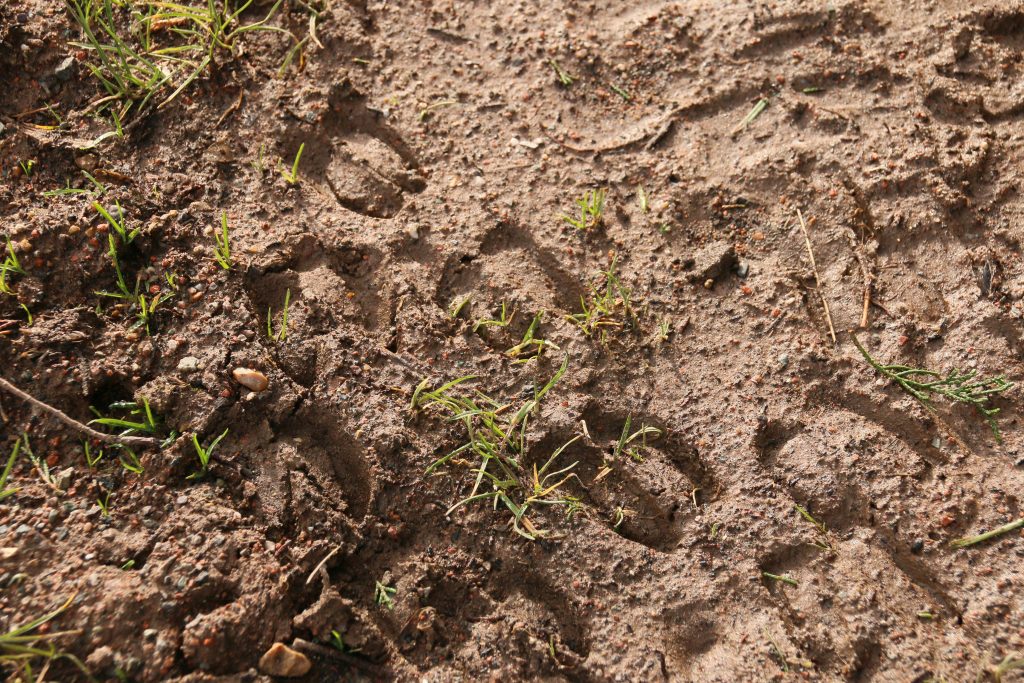

A lone horse rider appears some distance behind us on the bridleway, waiting to see if we are continuing into the woods or branching off along a field path. We follow the path, and I keep the dogs close, expecting the rider to canter down the straight slope towards the woods, as we sometimes see riders do, but she doesn’t and she follows us at a steady pace. No doubt the path is too wet and potentially slippery to risk a fall and injury to horse and rider.
Back across the squelchy sheep field and up to the gate onto our Lane, where snowdrops bloom abundantly along the roadside. Behind them daffodil stems are beginning to grow tall, but it will be two or three weeks before the first yellow blooms appear.
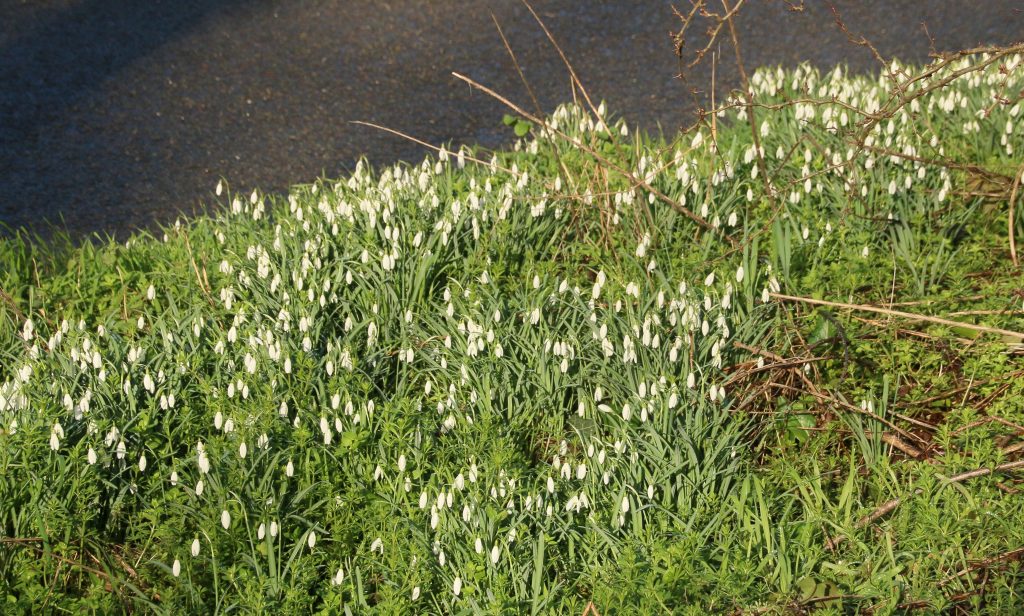
14th February 2026
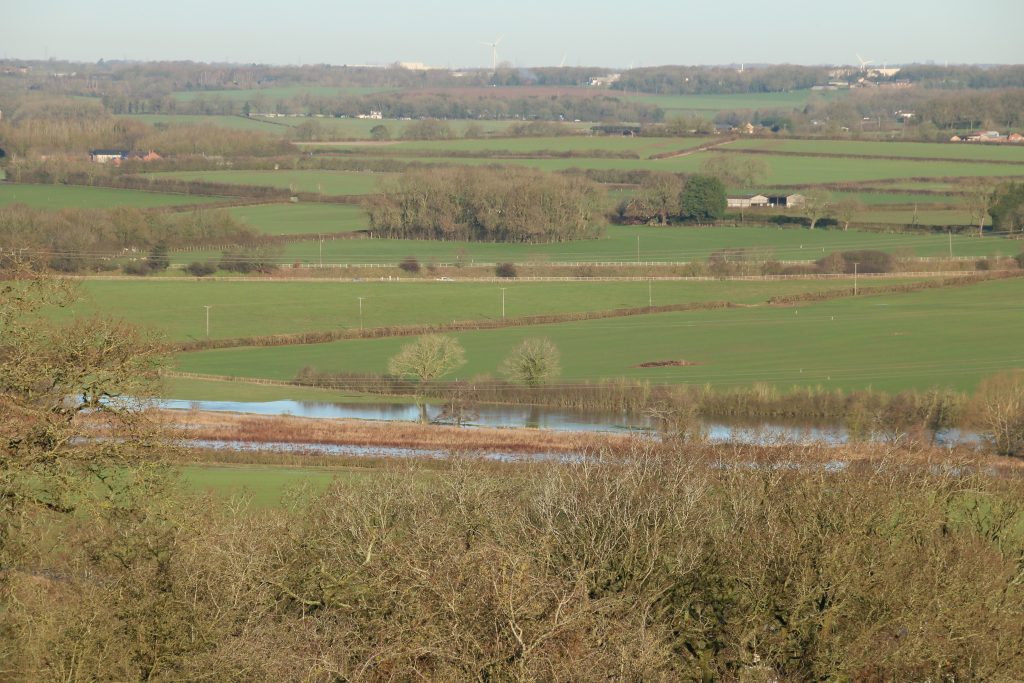
After day after grey day we wake to a clear sky with a touch of frost, and as I enjoy my morning tea and toast sunshine illuminates the top of the trees in the shallow valley behind our home. The riverside fields behind us are waterlogged, and so we decide to walk up Croft Hill and back down along the path to the village.
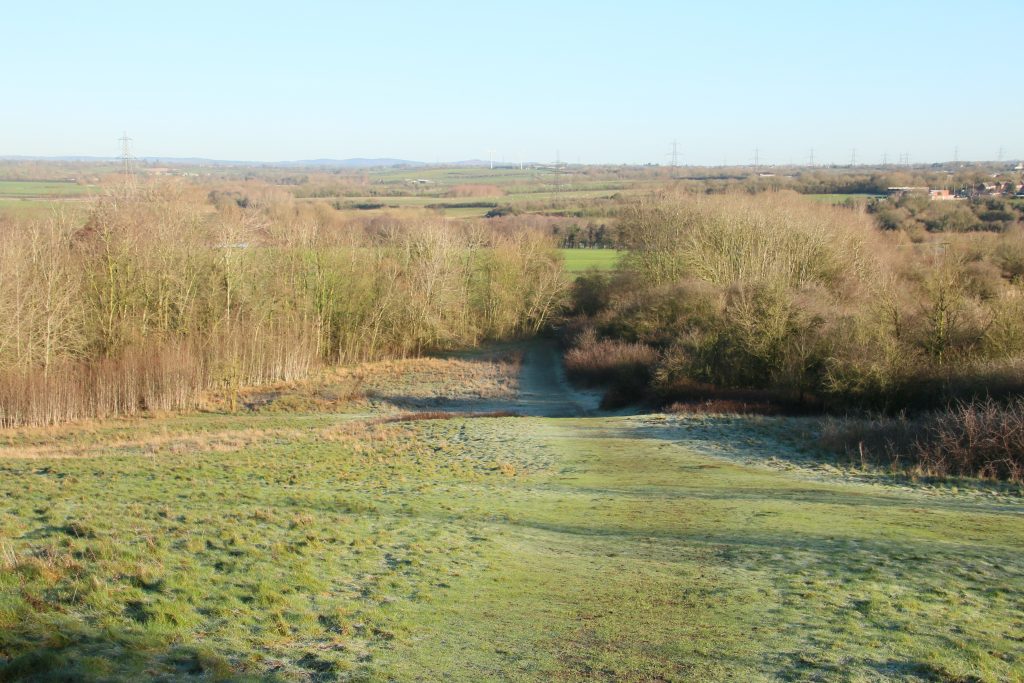
Walking around the bottom of the Hill, a young mastiff appears out of the low sunshine, much bigger than our two, and quite lively. The owners are just behind, sounding a bit concerned, but I assure them that my Goldies are laid back, although I think that they are a little wary of such a big boisterous pup, and we move on, climbing the Hill, looking down the frozen slope below. The final few metres are steep, and I slip where wet ground has frozen, but stay on my feet.
A couple without a dog are admiring the view at the top of the Hill and a man with a small dog on a lead is seated on a rock a short distance away. I put ours on a lead, since not everyone, especially people without their own dog, appreciates enthusiastic greetings from two muddy Golden Retrievers. In fact, the couple are happy to say hello to the dogs before they walk hand-in-hand back down the Hill.
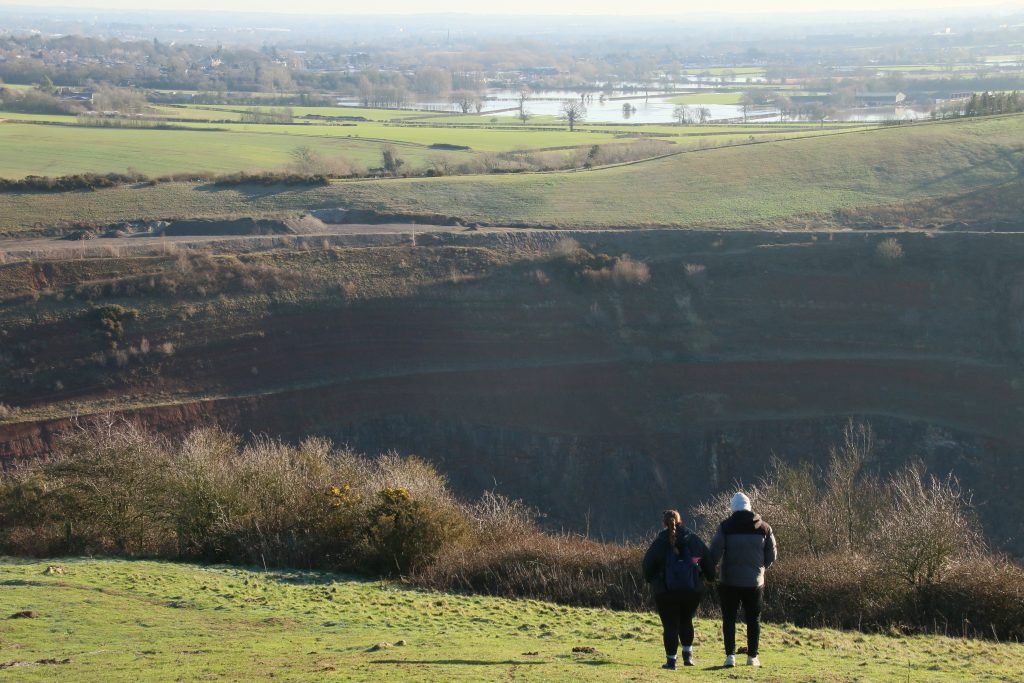
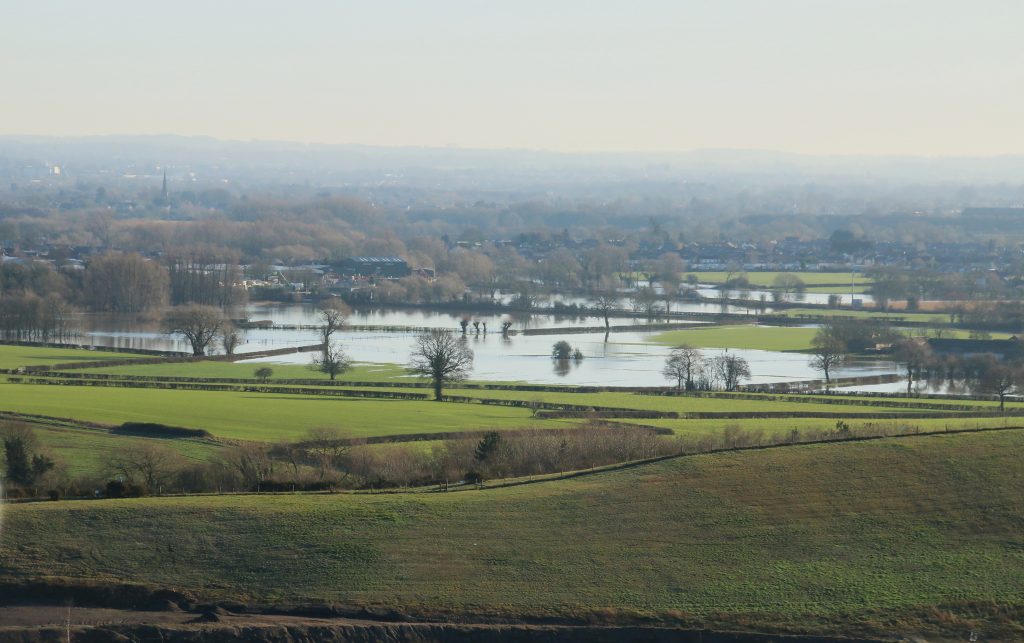
It is just as well that Sam and Ellie are on leads, since as soon as the small dog spies my two it begins to bark loudly and aggressively. I’m sure that my two would have stayed clear, even if off lead. I greet the owner, before stopping briefly to admire the view myself – the landscape around us is wet, very wet, with flooded fields in all directions.
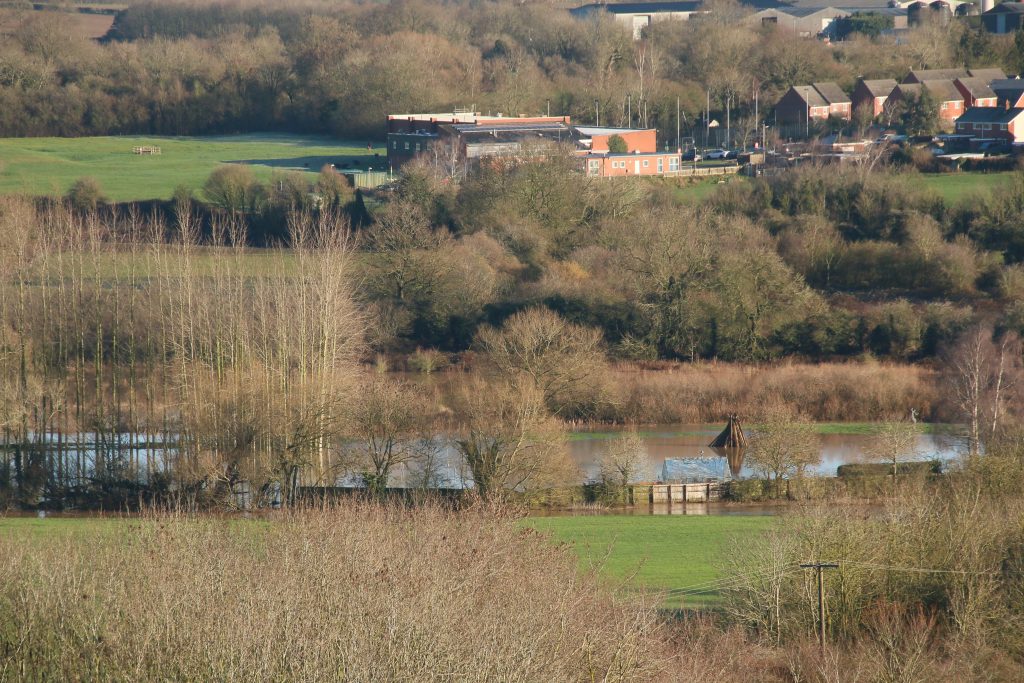
I carefully descend the Hill, staying on rough grass as the dogs confidently run and play around me. With Four-Paw-Drive, they are not going to slide uncontrollably down the frozen ground. The track from the Hill down to the road is thawing in the sun, and the dogs begin to get muddy, as they have been after every walk for weeks. In an attempt at mud-minimisation I choose not to cross the road to walk on the Glebe – the path to the entrance gate is ankle-deep in liquid mud. Instead we walk down to the village along the tree-lined top path, returning along the lower path, where we a greeted by a cheerful group of crocuses, one of several growing between the two paths.
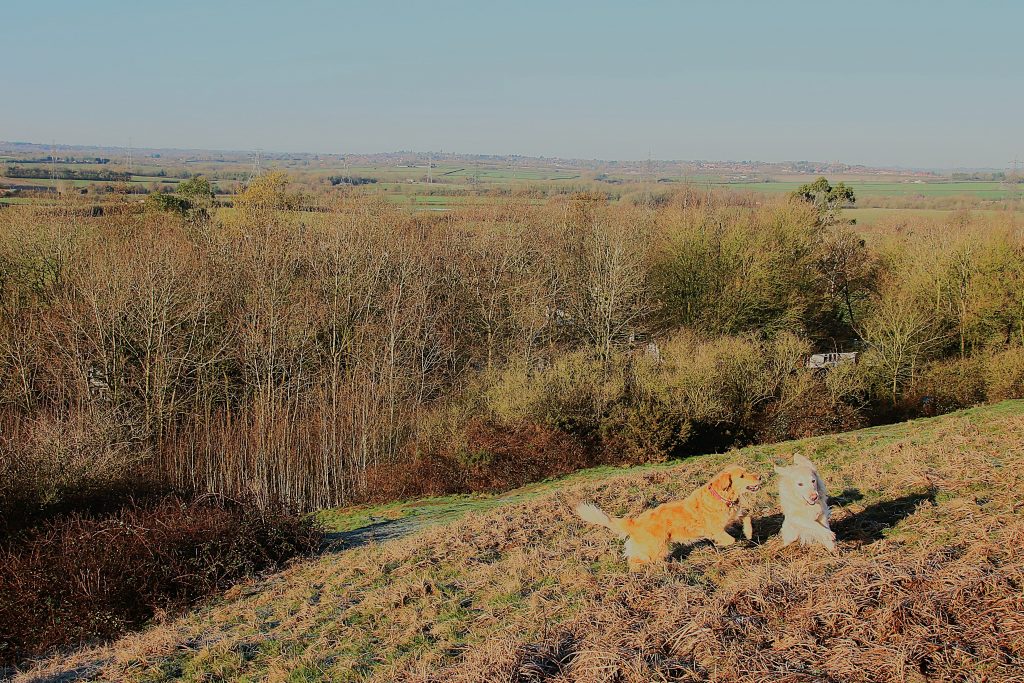
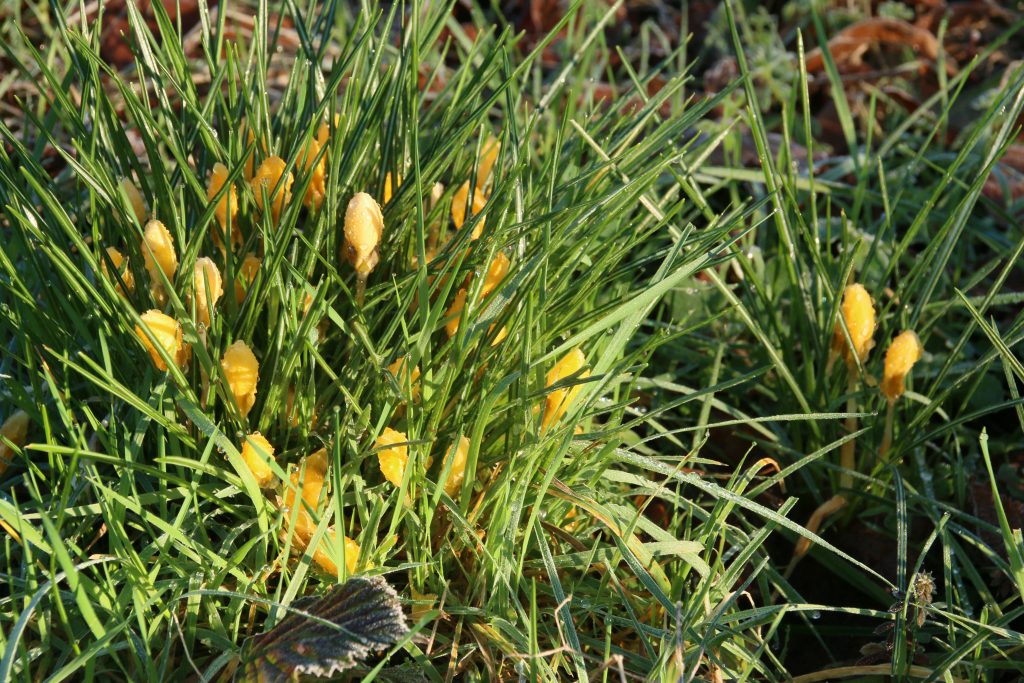
2nd February 2026
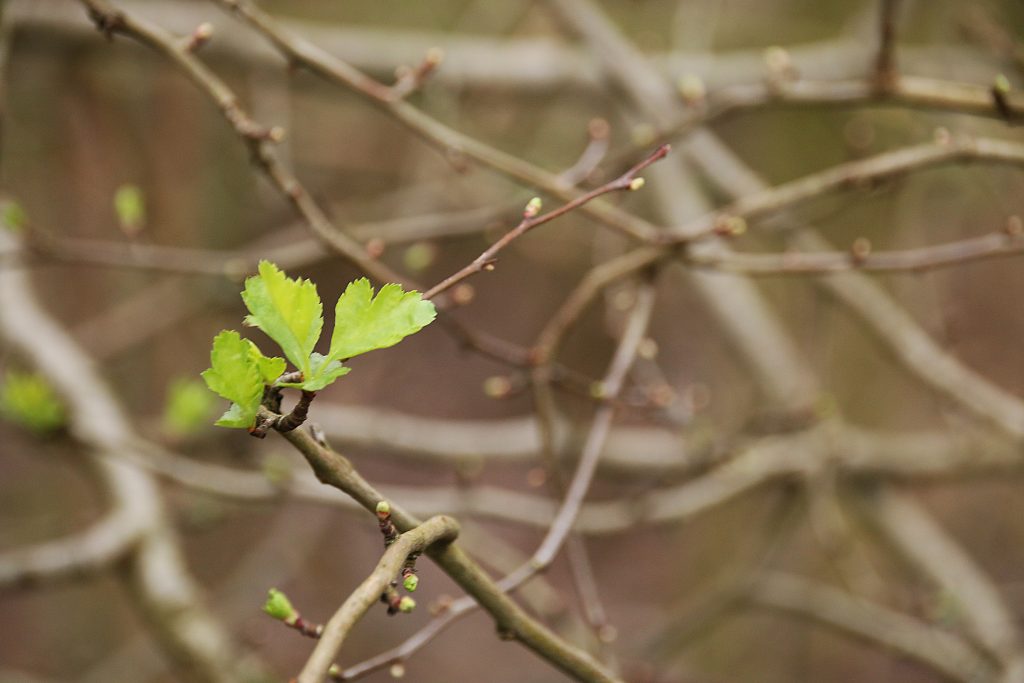
Another small but promising sign that Spring is on the horizon – a tiny first leaf on a Hawthorn bush at the bottom of Croft Hill. Just the one leaf, hardly the “sheen of green” that will appear on hawthorn hedges in a few weeks, as each branch is covered in buds and newly emerged leaves, a coating of powdery green over the underlying bark of the branches beneath.
A large flock of crows, a “Murder” of carrion crows, sits in the trees around the quarry edge, all but a few casually flapping away as we approach, to circle lazily around us and settle back into the bare branches behind us. Although there a lot of crows around the quarry, it is unusual to see so many gathered together in the highest branches of just two or three high trees. We usually see them circling below in the quarry, or higher in the sky, mobbing birds of prey.
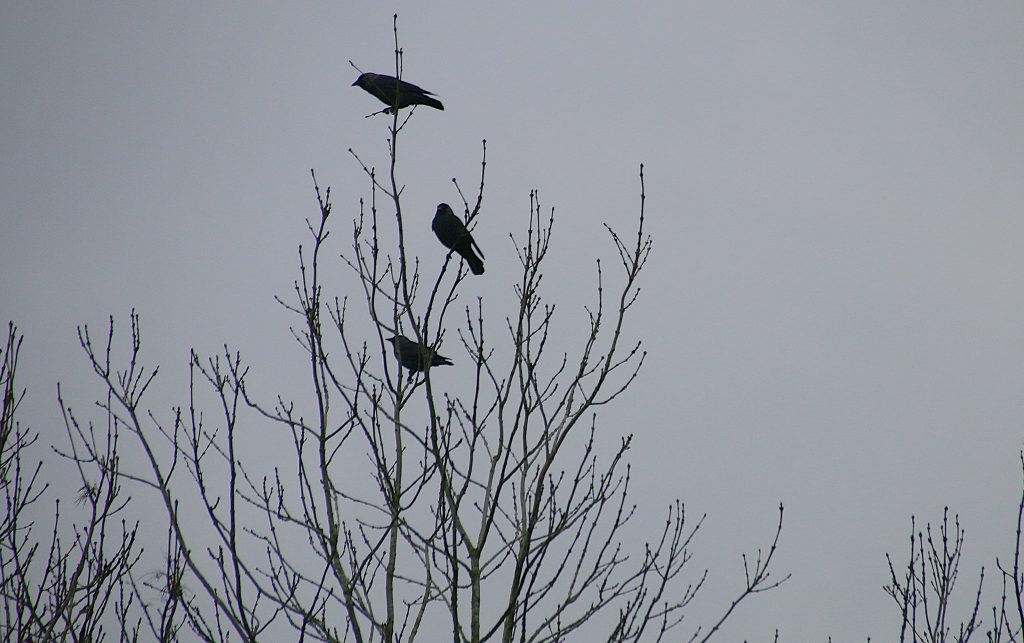
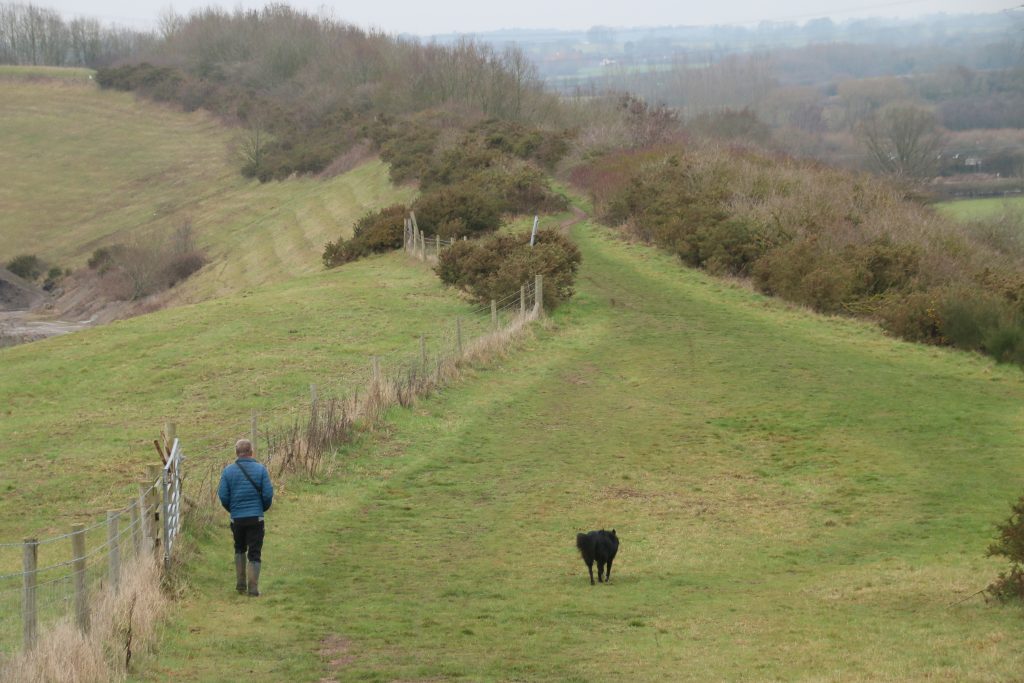
Ahead of us we see a dog-walker approach in the distance, and as we get closer my two dogs recognise the dog as a fellow Golden Retriever. The three dogs crouch on the ground, tails wagging, before they rush towards each other, running together in circles – Goldies always seem to recognise each other, and are enthusiastic in their greetings. Unusually the owner was not so enthusiastic, and after a brief nod and smile continued on, calling his dog, without the usual chat between owners of the same breed. A couple of minutes later we meet a Collie and his owner, regulars on our routes, and we stop to chat, the usual topic between dog walkers at this time of the year – weather and mud.
We descend through the woods, mostly birches, with views of the river and flooded fields visible below through the bare trunks and branches. Between the silvery bark of the trees the woodland floor dominated by tired looking brambles, and much more verdant green moss, thriving on lower tree trunks and path-side rocks. This slope faces north, the ground damp, allowing cushions of mosses to thrive. During the drought and heat of last summer, the moss dried to a green-tinged brown, but moss is resilient, and now the soft green growth almost fluoresces in the shade of the woodland.
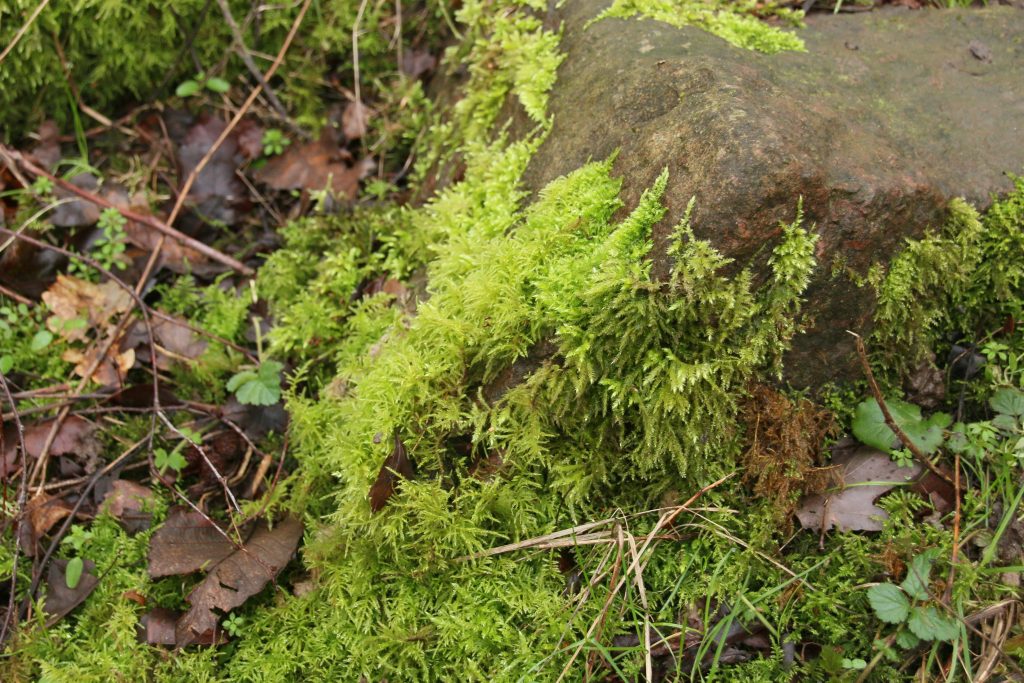
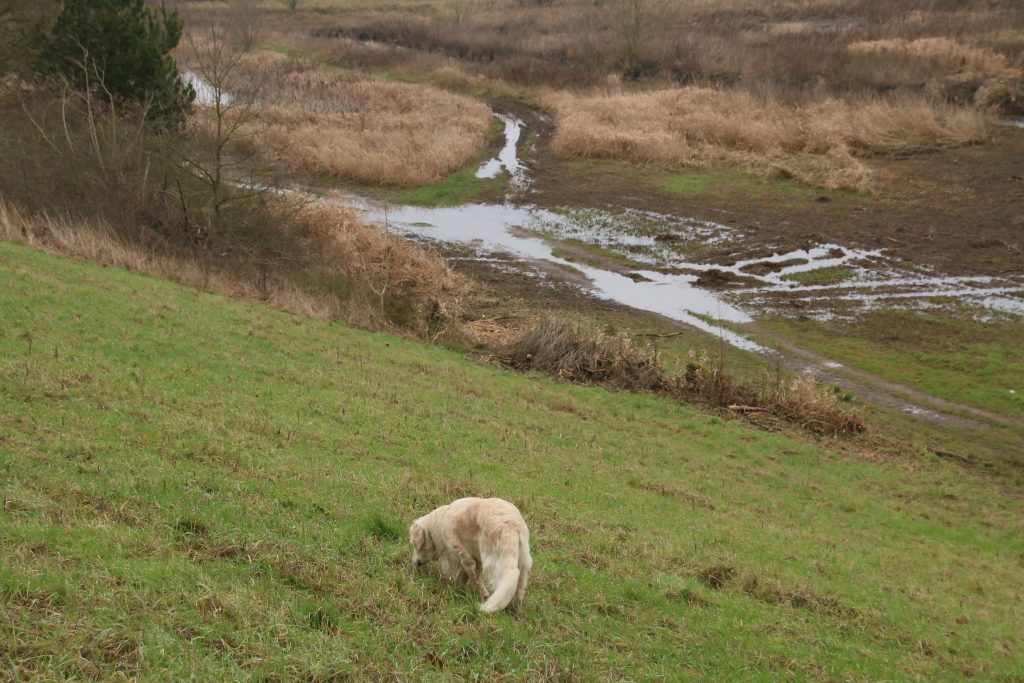
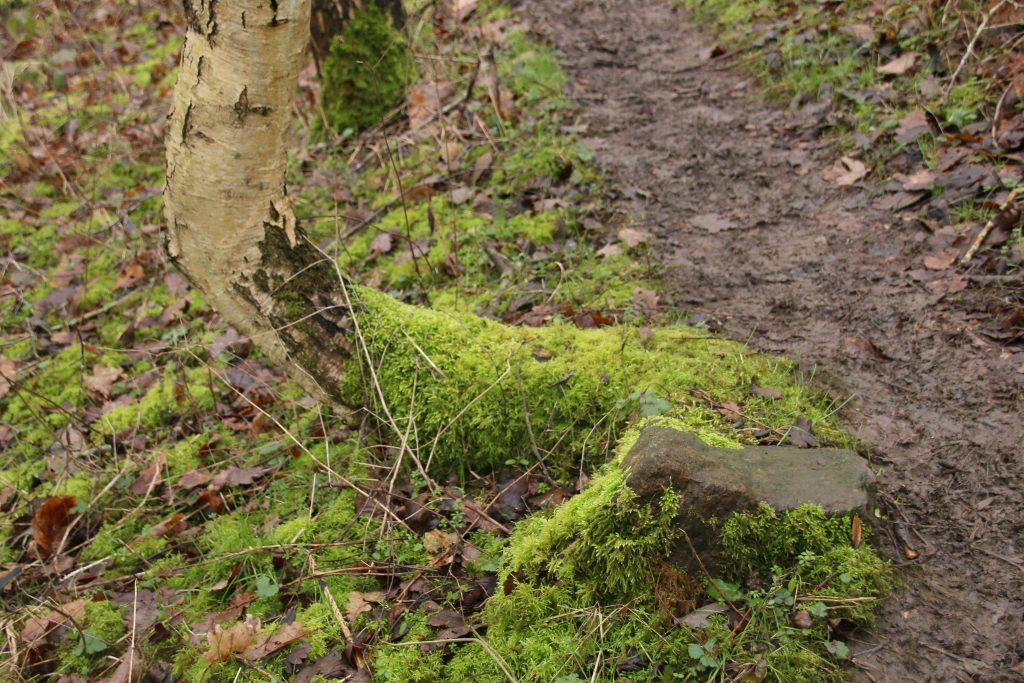
Emerging from the trees onto open grass, I see that the path below is flooded, the water edged with mud. I decide to ascend the grassy slope back to the upper path, seeing another regular dog walker, striding along the edge with his walking stick, his Border Terrier at his heels. We are not yet within hailing distance to greet him, and in any case, Sam has decided to sit on the grassy slope behind us, just admiring the view. I call him to me, and we climb up to the higher drier path. We don’t avoid the mud completely – the slope back down to the bottom of Croft Hill is slippery with liquid mud, although not deep. The dogs, very sensibly, manage to keep to the edge, staying reasonably clean.
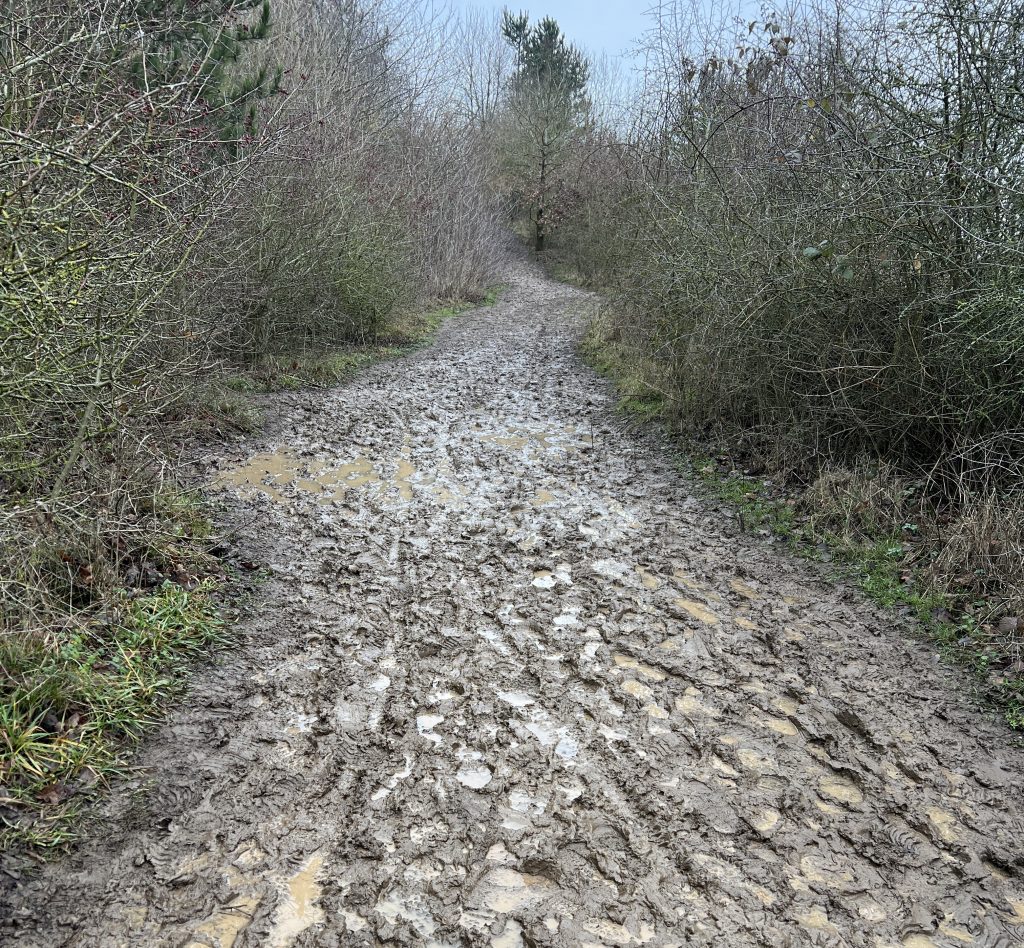
24th January 2026
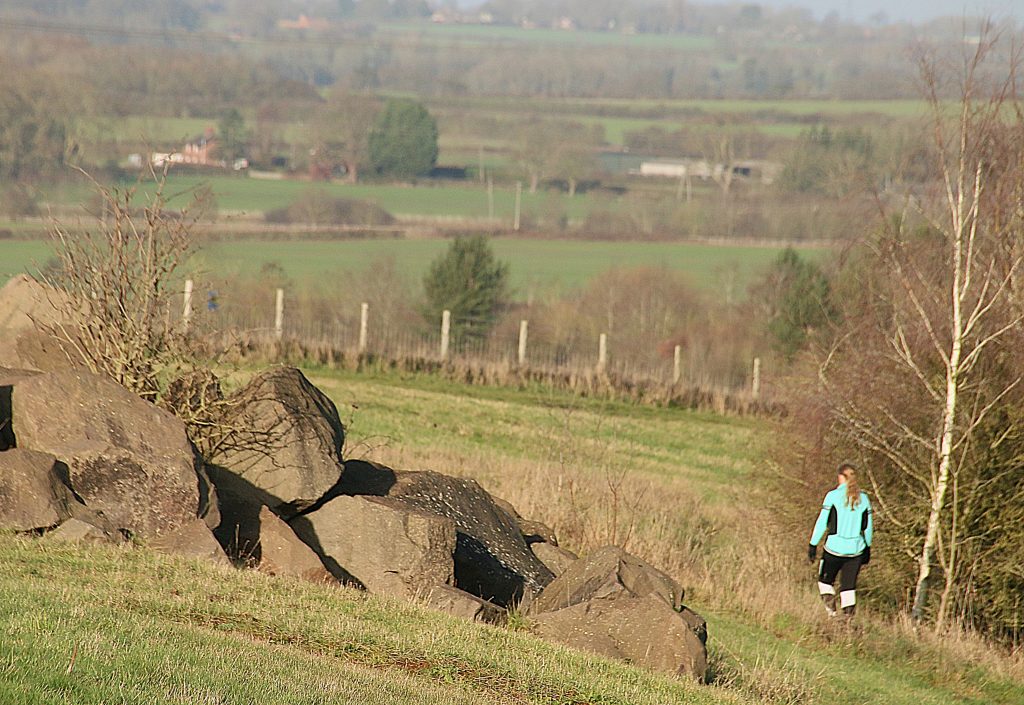
Bright sunshine and blue sky, and so it is surprising that other walkers are few and far between. We walk onto the bottom of Croft Hill, the breeze rattling the branches of young birch trees that line the path. Up the muddy incline onto the quarry edge path, gradually ascending and enjoying the clear views. A lone walker emerges from the grassy slope above the lower path. I suspect that she has decided to join the higher path to avoid the worst of the deep mud at the bottom of the slope. My “Good Morning” as I keep the dogs close is greeted with a wave.
Our descent is also along a muddy path, although merely slippery rather than semi-liquid, the path following the quarry fence until we cut down through woods to the river. I put the dogs on leads – this is a favourite swimming spot for them in warmer weather, but today the water will be too cold, especially as they will be wet for a while before we get home.
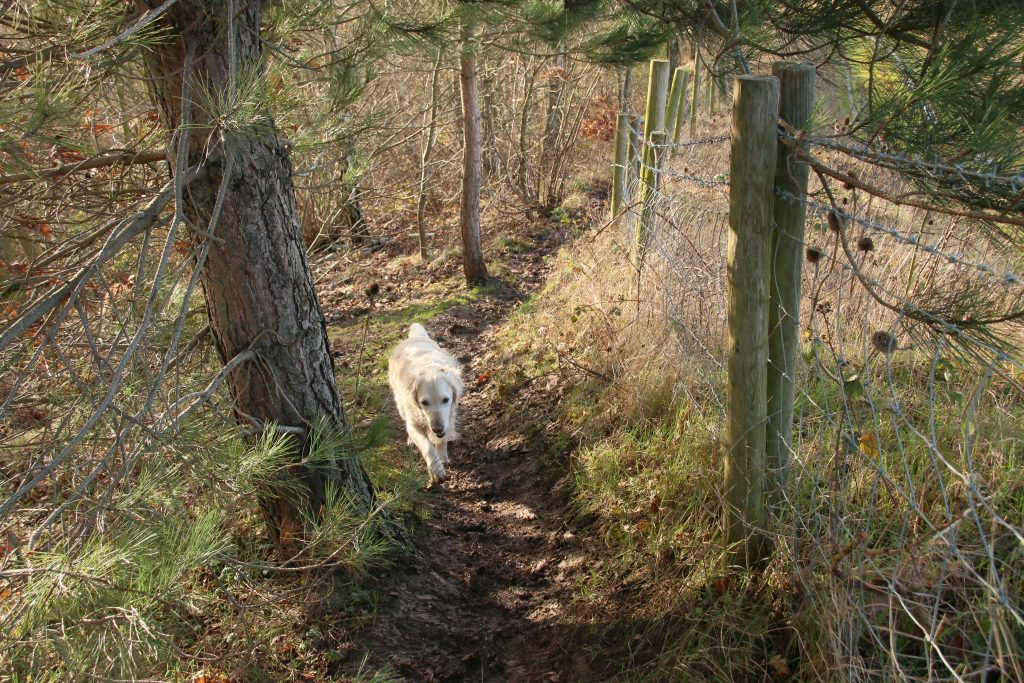
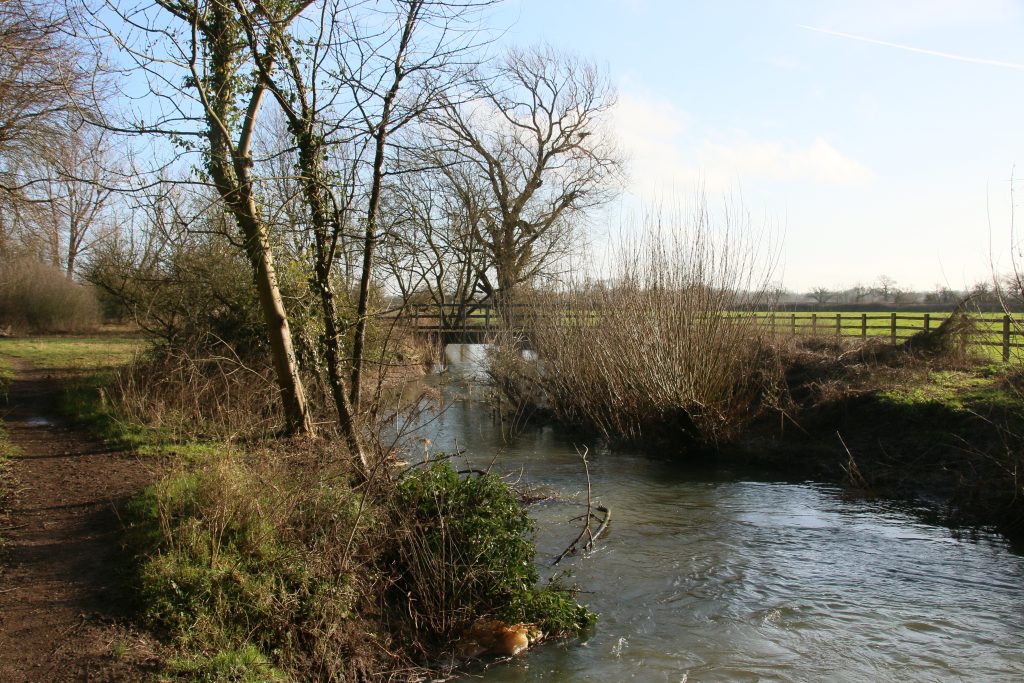
The next few hundred metres is not pretty, the path sandwiched between the Leicester-Birmingham railway and quarry buildings, the route lined with steel fencing. Locals are still grateful for this route, created by the quarry a few years ago. Until the path was constructed there was no way of circuiting the quarry from the local village, and despite its urban appearance, the route is popular with local dog walkers, a convenient 3 mile circular walk from the village, with the option of climbing Croft Hill.
The path eventually leaves the railway, twisting up a short ramp to join the quarry access road, a fence separating walkers from the quarry lorries that rumble past on weekdays. This is only a short stretch before we reach steps down to the village recreation ground, but it is along the short narrow path beside the quarry road that we meet our first dog walkers, three groups, one after another, and we have to pass close, constrained by the fence – luckily all dogs are friendly, and merely want to “meet and greet”.
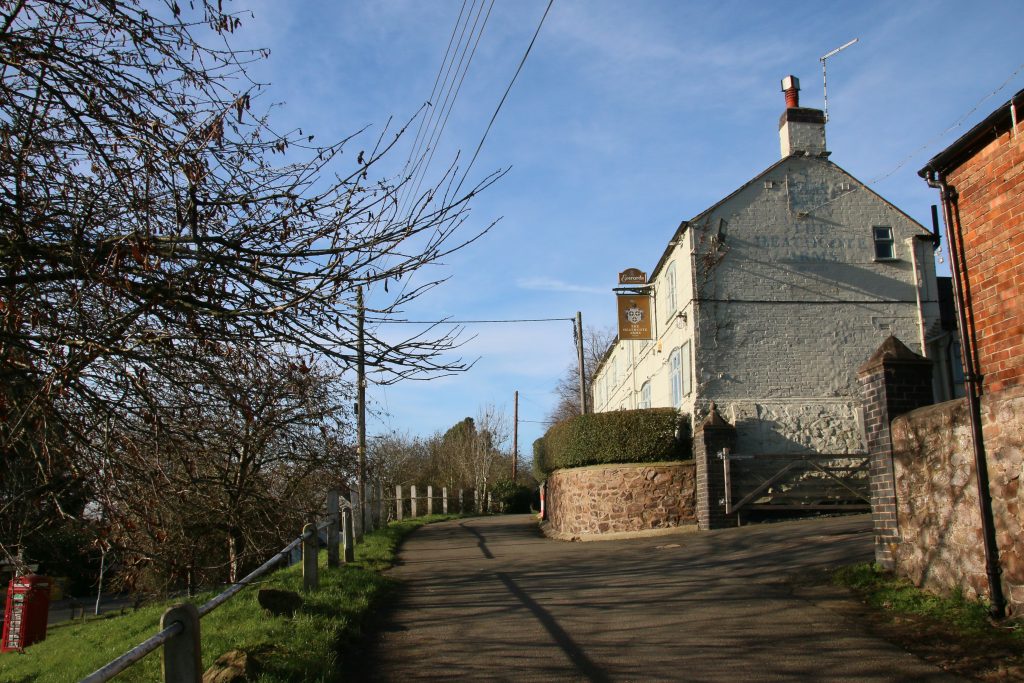
Crossing the recreation ground we eventually get the old village, originally a cluster of terraced quarry-workers houses huddled around what was then the quarry entrance. Now this road is a quiet cul-de-sac, the terraced houses supplemented by larger houses of various ages. At the end of the road we pass the pub, my local, and then the village church, where we turn to follow the track along the lane back home. At last, I see what has been reported elsewhere for a week or so – wild snowdrops, the first true sign that spring is on the horizon.
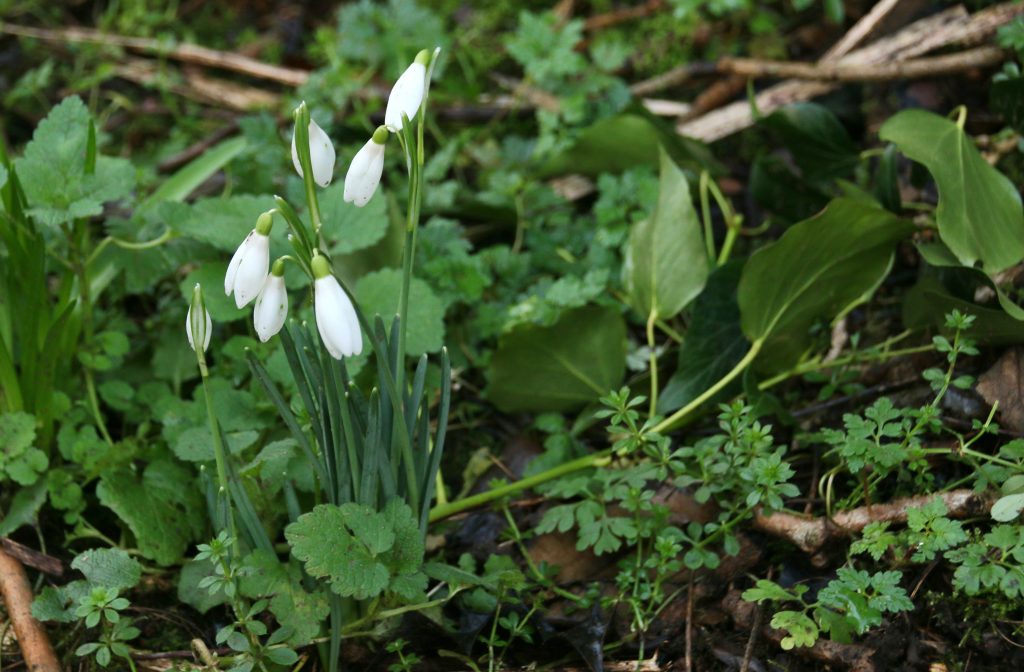
22nd January 2026
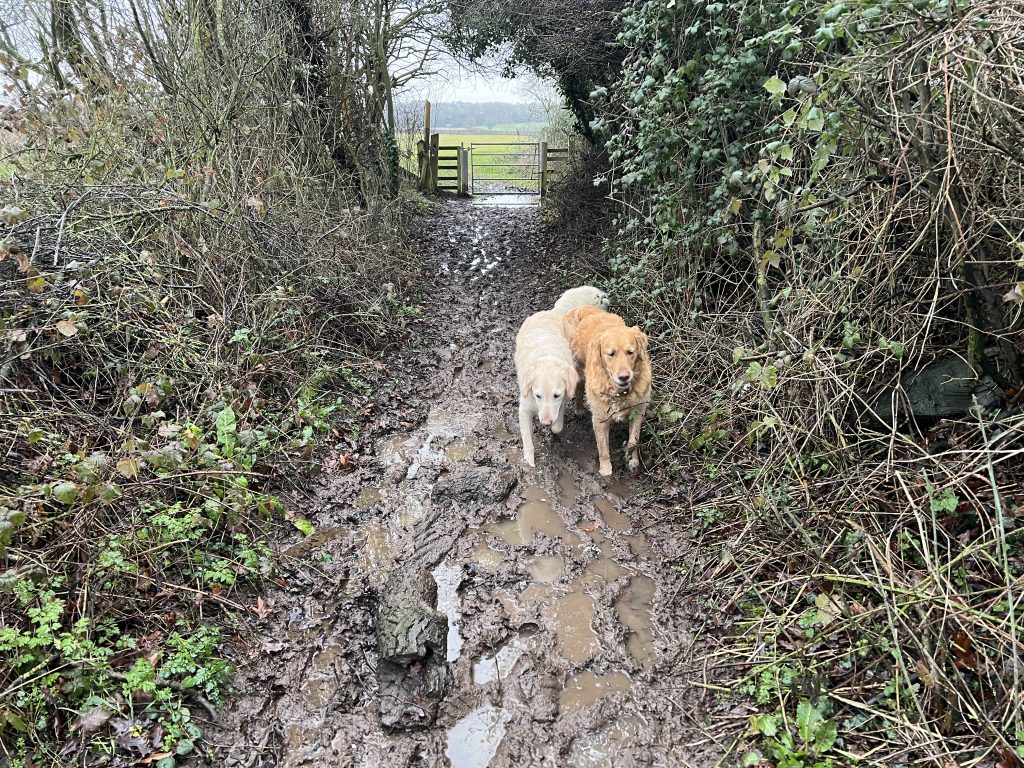
When folk in town fancy the idea of moving to a nice place in the countryside, with all those bracing country walks, they probably haven’t visited the countryside in January. In January much of the countryside can be described in one word. Mud. Pastureland squelches underfoot. Arable land becomes claggy, wet soil transferring onto boots if one strays from the path onto young crops maybe to avoid pools of brown water across footpaths. And as for the footpaths themselves, at best they are slick with mud, but anywhere well-trodden, such as gateways or stiles, the ground is a quagmire.
Today my wife has to take her car to a local garage for a service, and she drops me and the dogs at the next village, so we can walk back home via the scenic route. We set off along a disused railway, now a popular dog walking route, two miles of tree-lined compressed stone path, serviced with regular dog waste bins, and access points into the adjacent housing estate. We leave the surfaced route after half a mile, climbing over a high stile, fortunately with a gap beneath for dogs, to follow a footpath across fields back to our Lane. Sam promptly runs off among adjacent trees, glad to be back on grass, but returns when whistled.
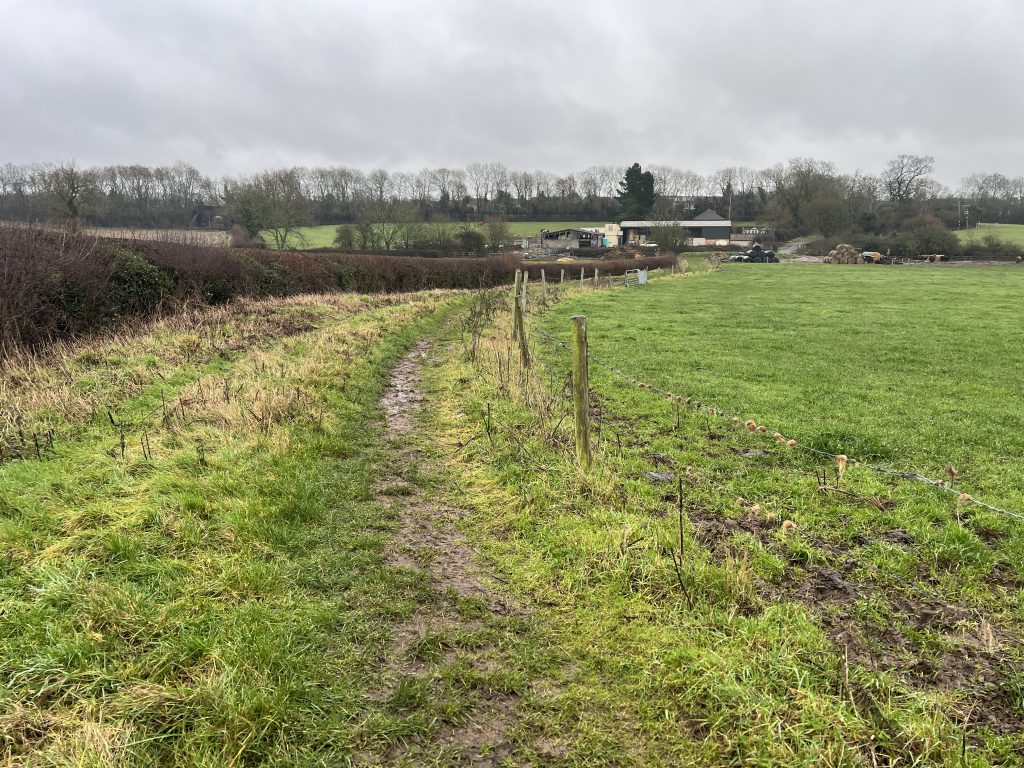
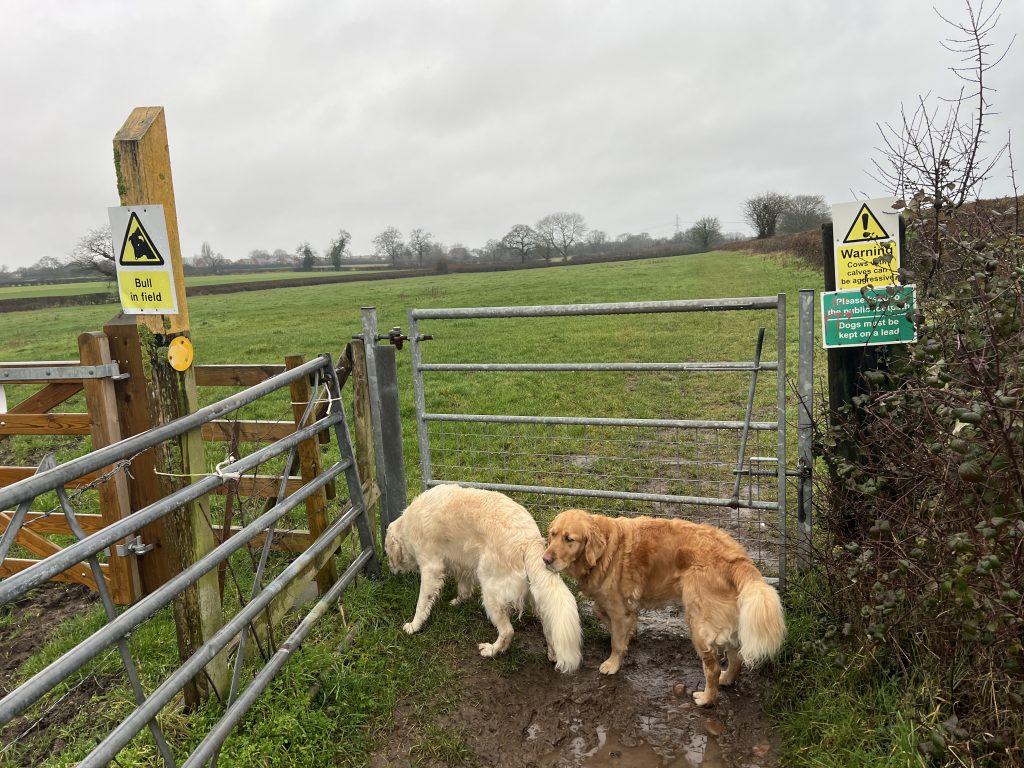
We walk past a farm and follow a field edge path to a gate into an open field. Having often walked this route over Summer I am not concerned about warning signs about a bull, or cows and calves. There has never been a bull in this field, and cows, when in residence, have never been accompanied by calves. Many years ago, we followed a footpath through a field with cows and calves, and were chased, the cows not all intimidated by shouts or being hit with a stick. We escaped into a neighbouring garden – a retired farmer in the garden saw the situation and shouted us over. Our dog at the time, a German Shepherd, was able to outrun the cows, and joined us. Without the gardener, we would have been trampled. Today the fields on our route are all empty of livestock.
The gateways along the route are all flooded, but easily passable in wellies. Some gates are surrounded by deep liquid mud, passable but the going along these few metres is not easy.
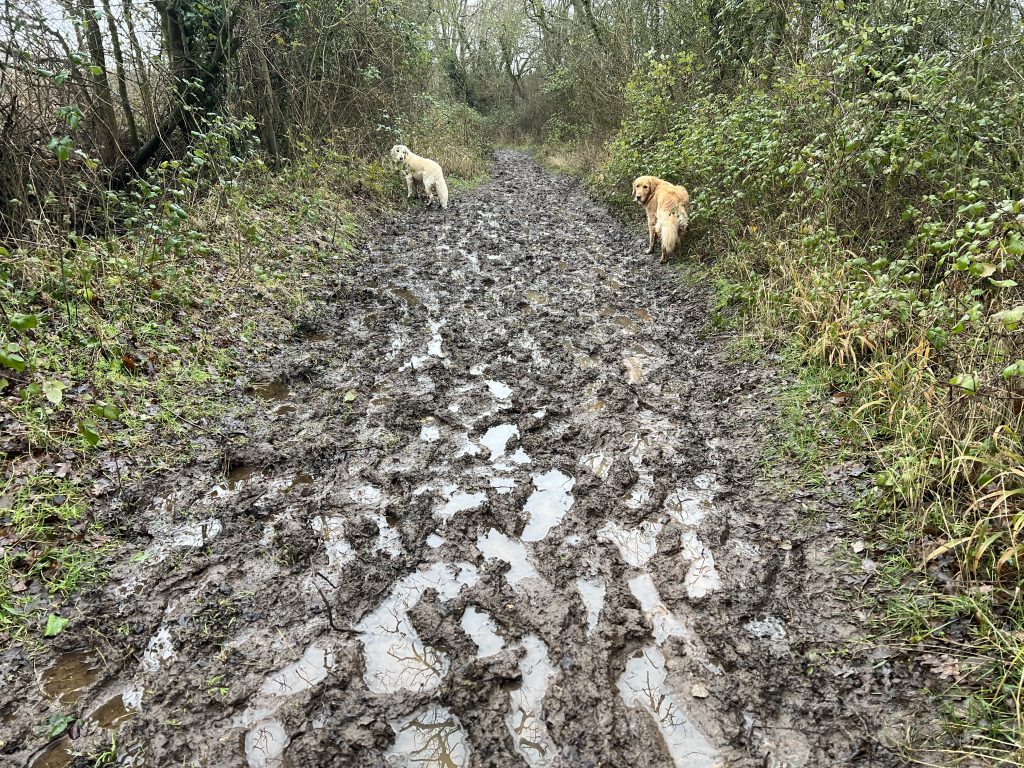
We finally reach a road, and cross to the end of a bridleway that will lead to the fields behind our home. Whole stretches are ankle deep in mud. The dogs sensible hug the narrow edges beneath the hedgerows, but this isn’t an option for me, and wading through the porridge-like consistency is hard work, with the potential to end up on my back for an unplanned mud bath. Along one of these semi-liquid paths we meet a couple with a large Rhodesian Ridgeback on a lead. I manage to get my two on a lead, as they explain that their dog gets very excited when meeting others. We agree that this area is not the best for dogs to play in, or even “meet and greet” on lead, with the potential for dogs to pull owners onto their faces in the mud.
Once home, it takes a while to de-mud the dogs with a hose, dry them, before any of us are allowed back into the house.
17th January 2026
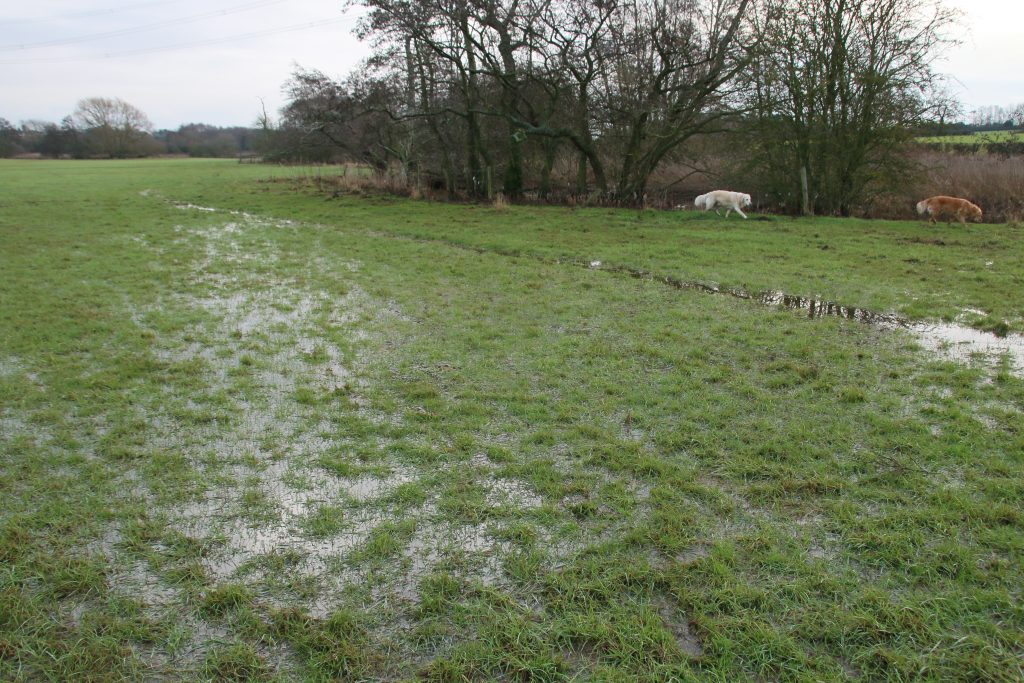
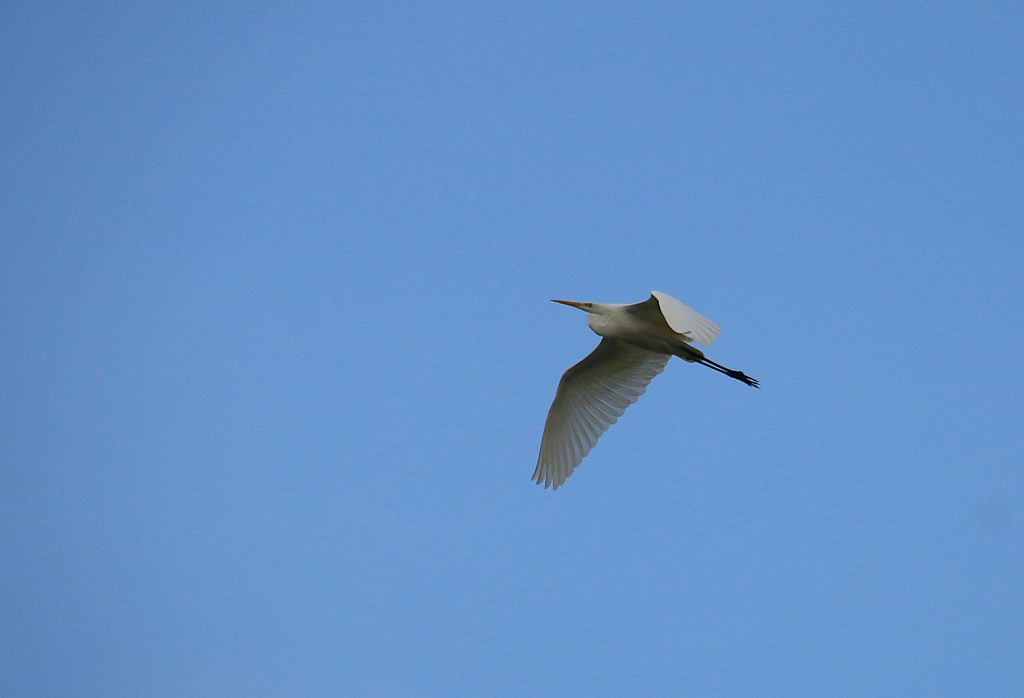
For various reasons it’s going to be short walk today, just a circuit of the Sheep Field. As we walk down the field track behind our home a Great White Egret takes off from a riverside rough land area in front of us. For several years this area was cultivated, but thanks to regular flooding the landowner has given up trying to grow crops, and the area has been allowed to “rewild”. At present the area is flooded, with marshy areas around the perimeter, and we often see the egret and a local heron standing in the water. I expect the egret to circle and either fly away from us over the Sheep Field, or settle back onto the marsh, but instead it flies over us before turning and landing further along the river.
We cross the river bridge into the Sheep Field. Thanks to last week’s snowmelt followed by a couple of days of heavy rain the ground squelches beneath my wellies, and the dogs run through pools of water. The track through the grass left by the sheep when last in residence is a rivulet of standing water.
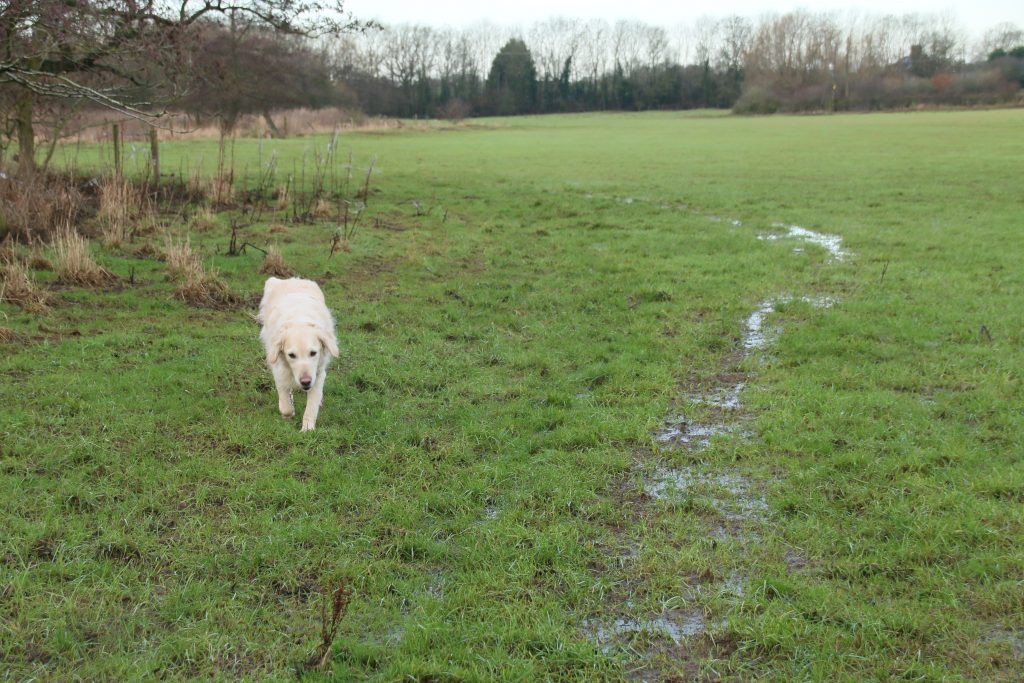
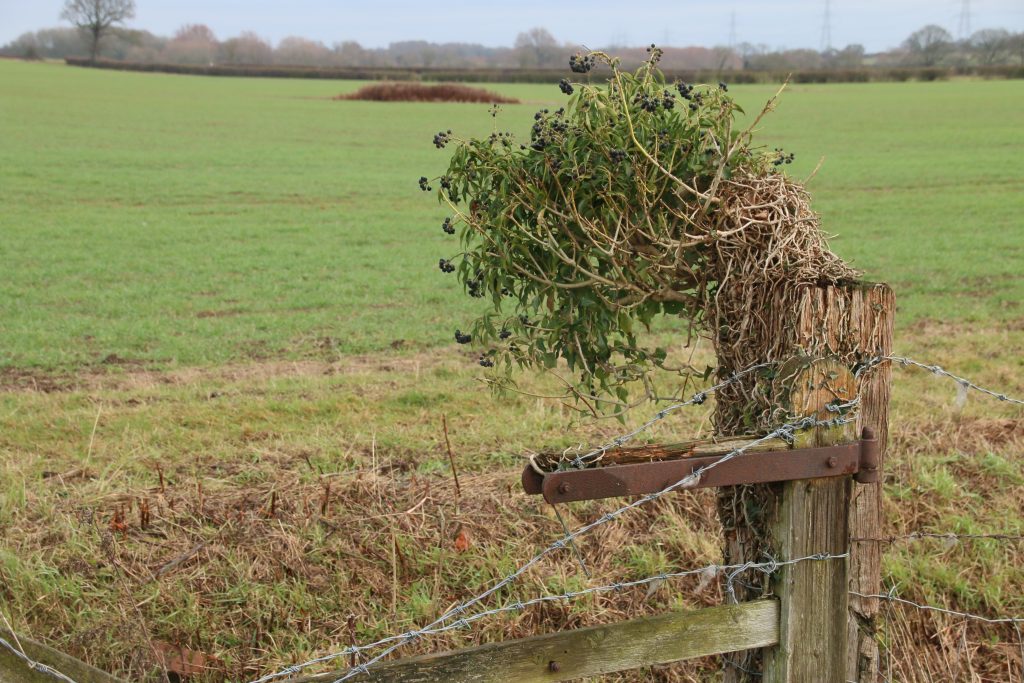
Following the edge of the field, a gate post sprouts a bunch of ivy, what is left after the overgrown gate and fences were cleared earlier in the year to allow access into the field by sheep, driven from the farm across the fields. Two days ago, on a frosty morning, I looked over the gate into the field beyond, watching half a dozen hares chasing each other around the field. Today I just see one solitary hare grazing, before splash back across the field to cross back over the river bridge.
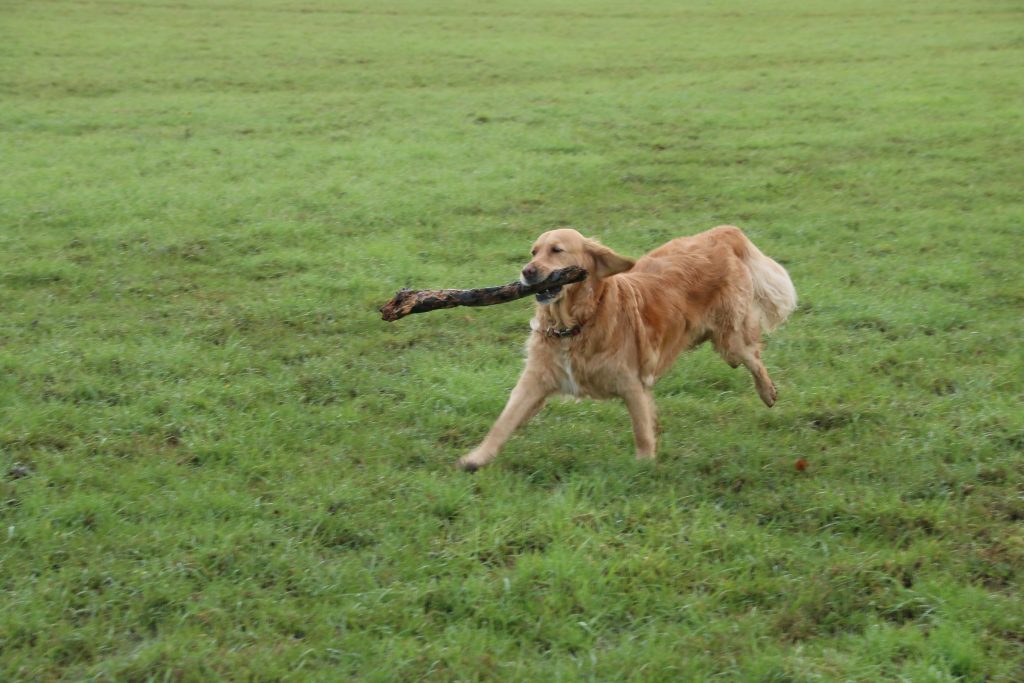
12th January 2026
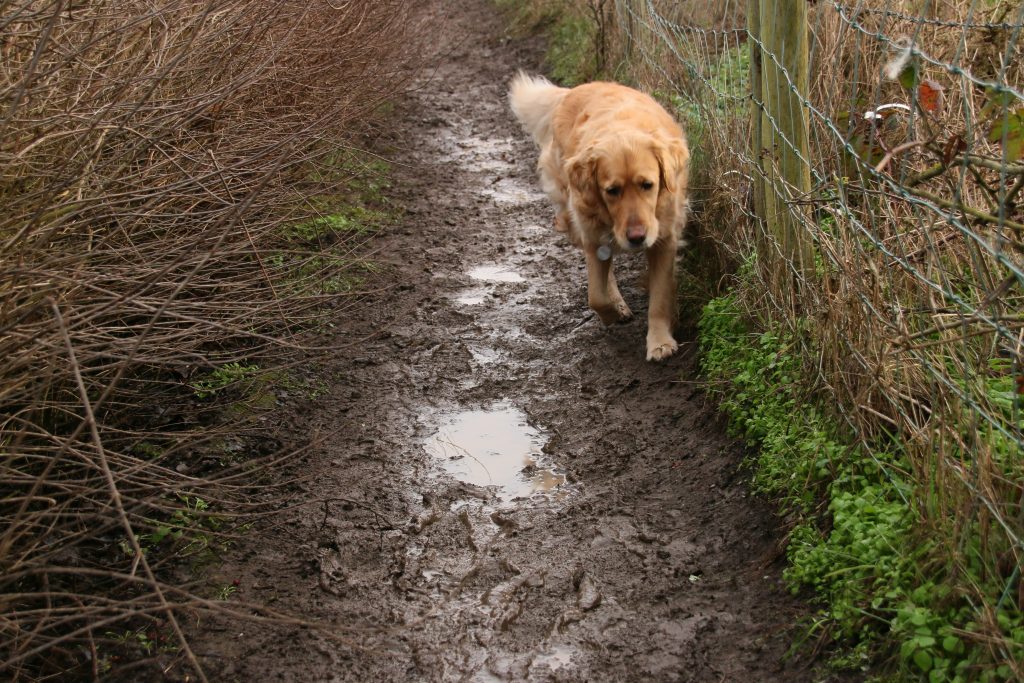
After a few days of frozen ground, we are back to muddy footpaths, the dogs trudging through brown sludge under a grey sky. The best that can be said is that the air is mild – not in any way springlike, but it is nice to be out and about without gloves. I also trudge through the mud, once again wearing my heavy wellies, and it is hard work ascending the short, but steep, slope up the “New Hill”. By the time that I get to the top my legs are aching, and am glad when the gradient eases along the top, and I can enjoy the views despite the gloom. On our way back we meet Cockapoo Taffy and his Mum. Although a tad older than me, Taff’s Mum is a fitter, faster walker, but even she grumbles about the effort needed to climb the muddy-slippery slope.
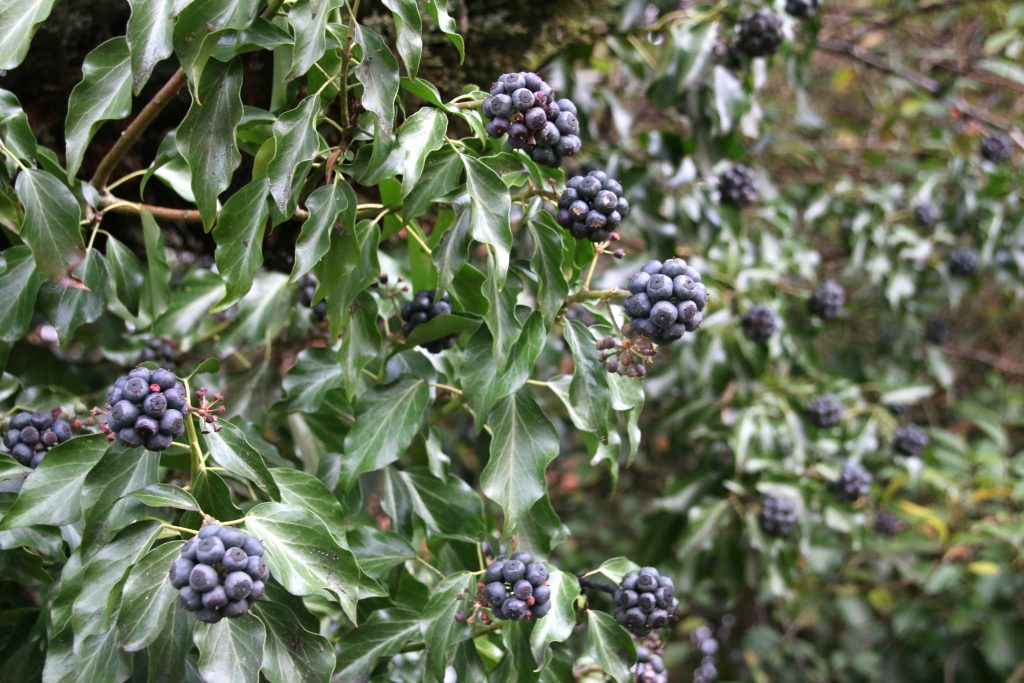
I decide to look out for any early signs of spring but only find those signs of nature that are part of the winter’s scene. At the top of our Lane ivy grows thickly over a hedge and out into the narrow verge, forcing walkers onto the road. The dense shiny dark green climber has produced masses of dark berries, welcome food for larger birds, such as blackbirds and thrushes, who cannot take advantage of hanging feeders in nearby gardens.
We had a particularly abundant crop of sloes this year, the berry of the Blackthorn shrub. Locals have picked what they need for sloe gin, or, in the case of one lady who I meet on Croft Hill, to make fruit tea, the sloes infused with other berries and herbs. Birds have had three months to feed on the sloes, but still the Blackthorne bushes bordering paths and fields bear a lot of the berries, now frosted and so technically at their best for Sloe Gin. I, like most people who make Sloe Gin, pick in October, before birds strip the bushes, at least in normal years, and then “frost” the berries in the freezer.
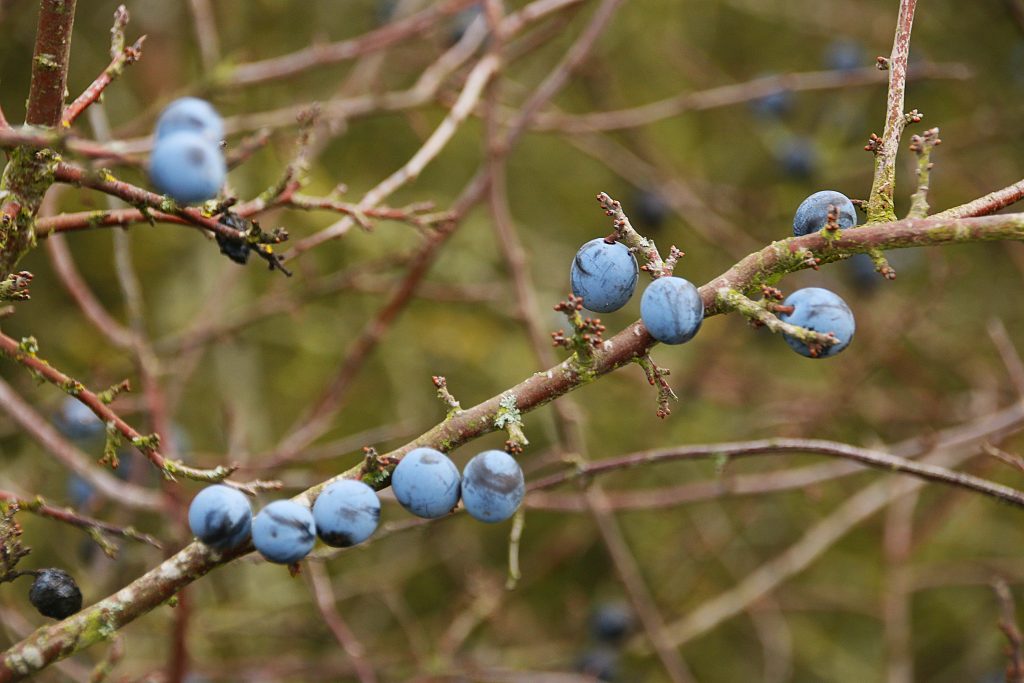
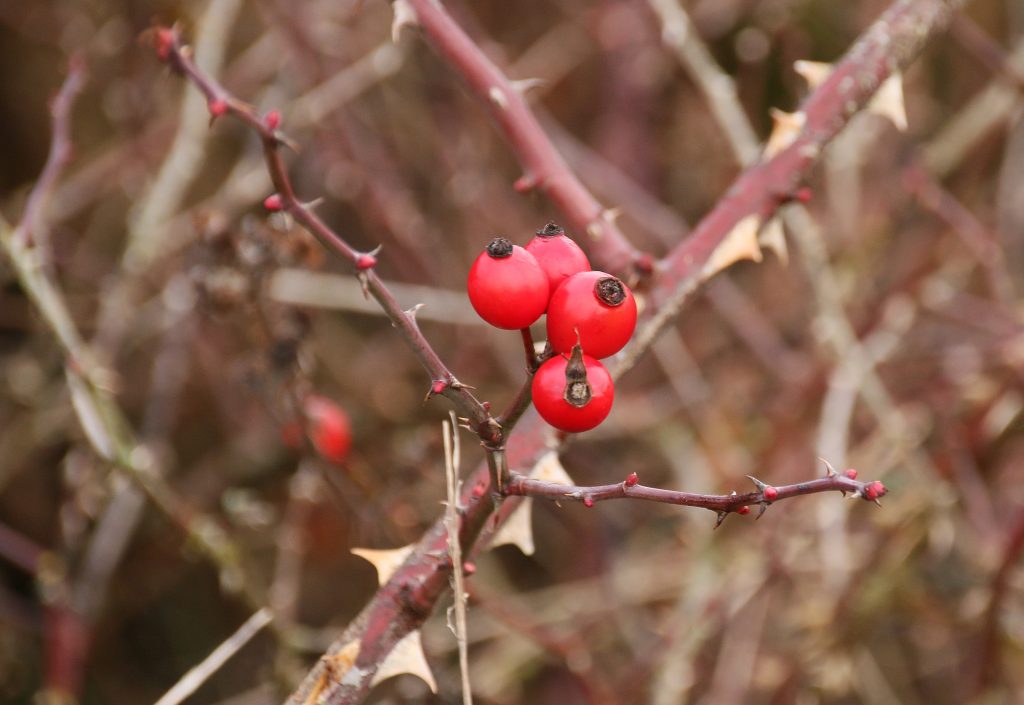
Rosehips, the berries of wild dog rose shrubs, are less abundant, but still quite common among the tangled hedges around the quarry. These berries, full of vitamins, can be used to make jelly, syrup or fruit tea, although I haven’t tried any of these recipes.
Hazel catkins dangle from large shrubs that border the lower path down from the Hill to the bottom gate onto the Lane. Hazel bears male and female catkins on the same plant, those fluttering in the wind, resembling tiny wriggling lambs’ tails being the female. No insects at this time of the year – the catkins rely on wind to distribute pollen.
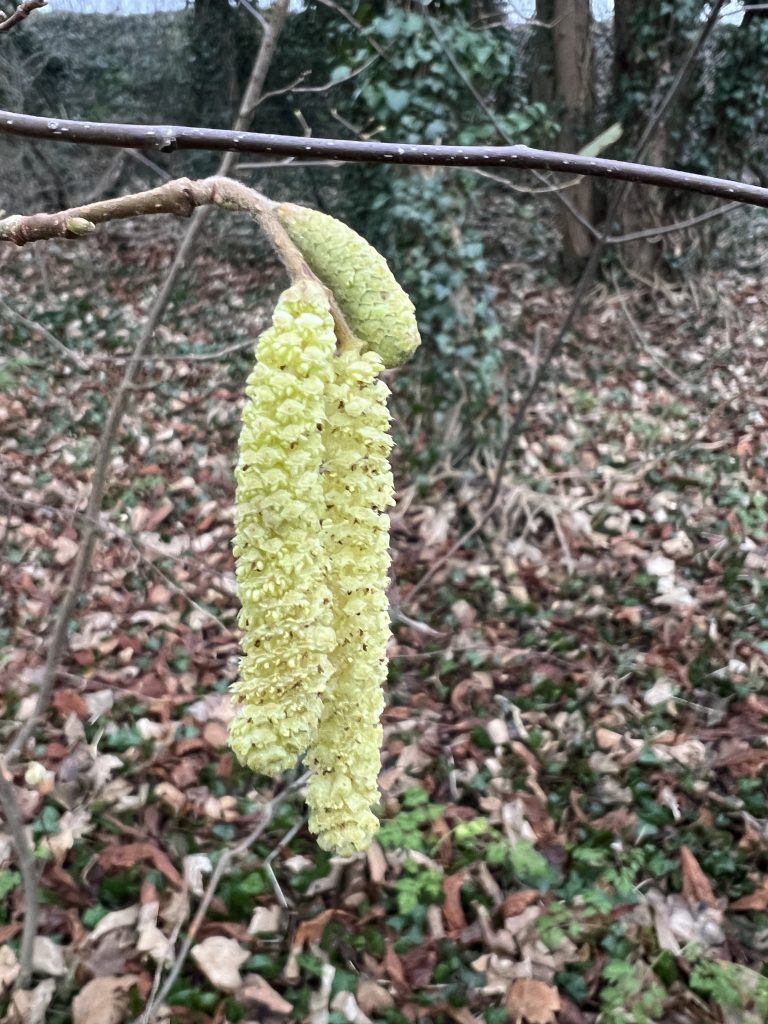
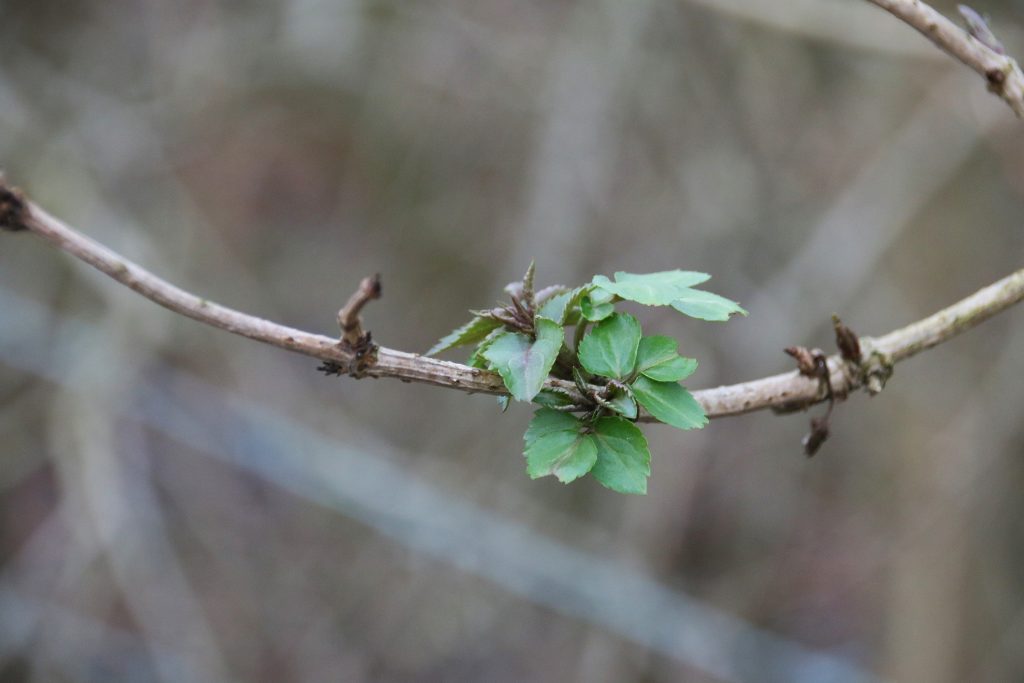
Elder leaves have already emerged, always one of the first shrubs to do so. At time of the year the shrub is barely noticeable but is summer it will produce the showy white umbrellas of blossom, which some collect to make elderberry wine or cordial.
At the top of the Hill a kestrel hovers, taking advantage of the updraft of air rising from the quarry floor and cascading over the ridge above. As we approach the kestrel swoops towards the ground before rising to hover a little further ahead, always keeping his distance from us. We are lucky here – we commonly see kestrels at all times of the year. In many parts of the country these birds are in decline.
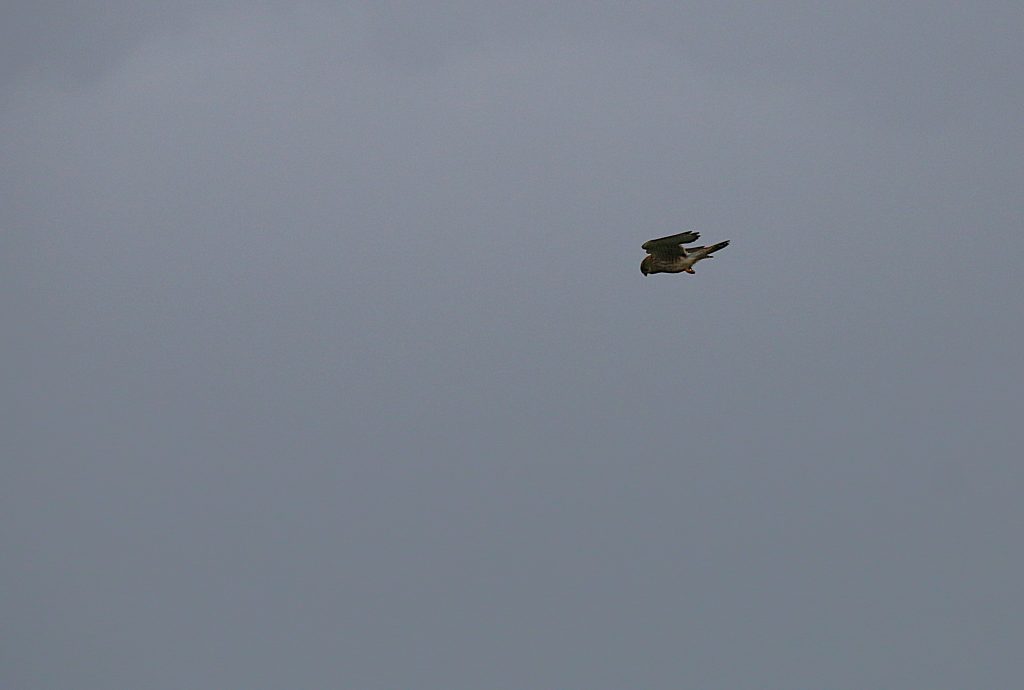
10th January 2026
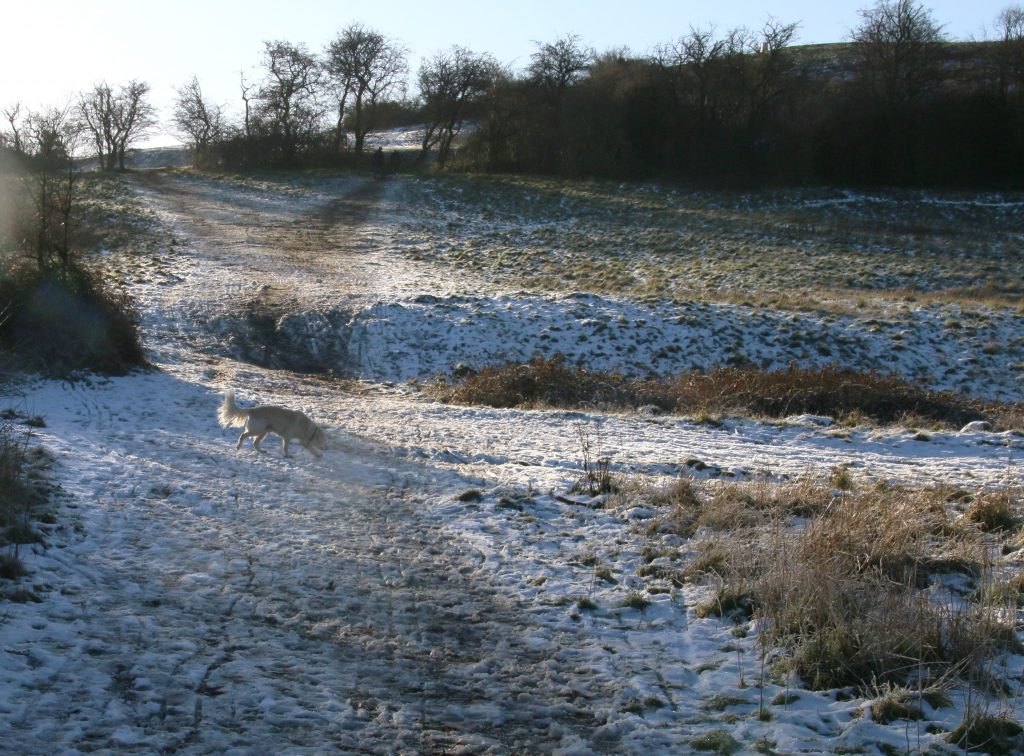
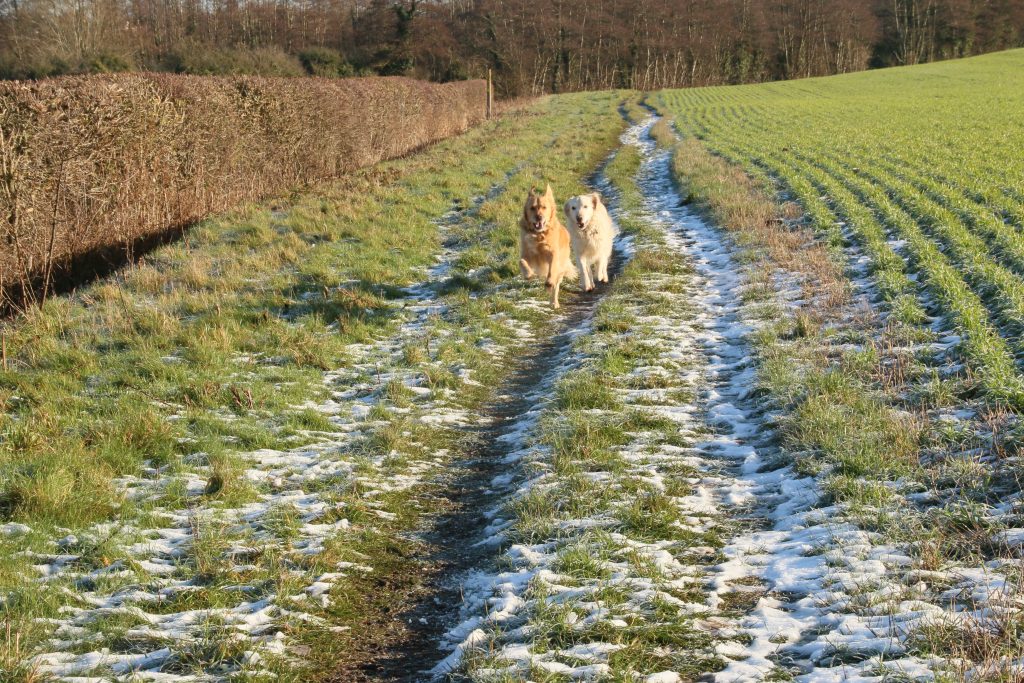
As expected yesterday, and forgotten, thawing snow melt has created large pools of water in a soggy Sheep Field, and so instead of crossing the bridge into the field, we turn right along the field edge track. The ground is frozen, the remaining snow crunching underfoot. The adjacent ditch has overflowed onto the track in places, before freezing, and the ice already broken by earlier walkers.
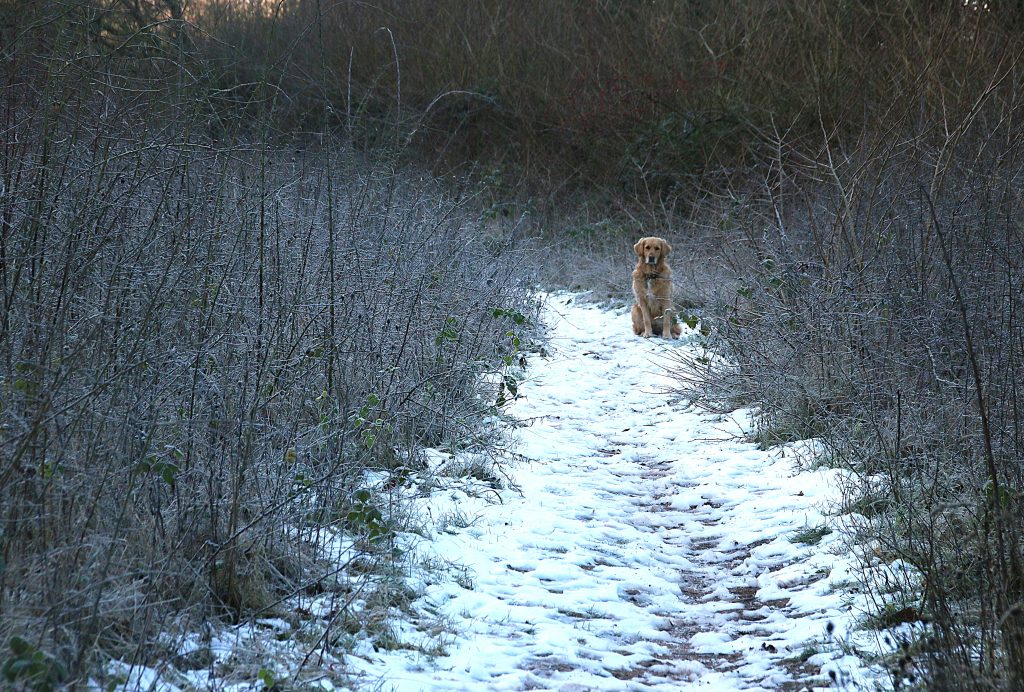
Emerging onto Croft Hill, the original “Old Hill” the path up is as icy as it has been for a few days, but today the overlying frozen snow gives grip as we climb. Two runners come up from behind and pass us, heading for the top. The dogs ignore them – they have long learned that runners do not stop to give them a fuss and a treat. The runners continue upwards and disappear through the line of bushes that grow below the Trig point at the top of the Hill.
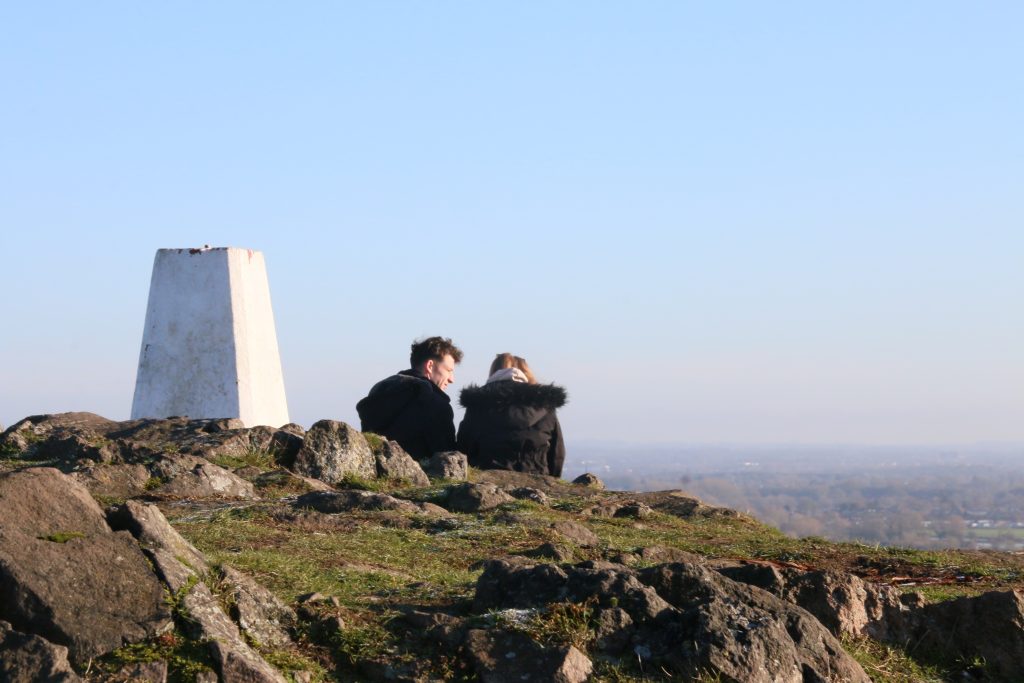
Another wintery walk in bright sunshine. Thanks to a logs delivery, it is a later then usual dog walk, and in consequent we meet dogs who we don’t usually come across, plus at least one regular. A boxer comes towards us, and since it is on lead I call my two to put them on lead, as required by dog walkers’ etiquette. The owners of the boxer shout out to reassure me that I don’t need to – their pooch is just not very good at “recall” – returning when called. We chat, and the boxer, just 9 months old, is released to run around with Sam, since if I call Sam, then the boxer will follow. Cockapoo Freddie arrives, and we all chat while dogs play, but an approaching lurcher on a lead persuades the others to continue up to the Lane while we go to meet the lurcher, only on lead because, as you would expect, the sight of any rabbit, hare or pheasant would result in the lurcher disappearing in hot pursuit.
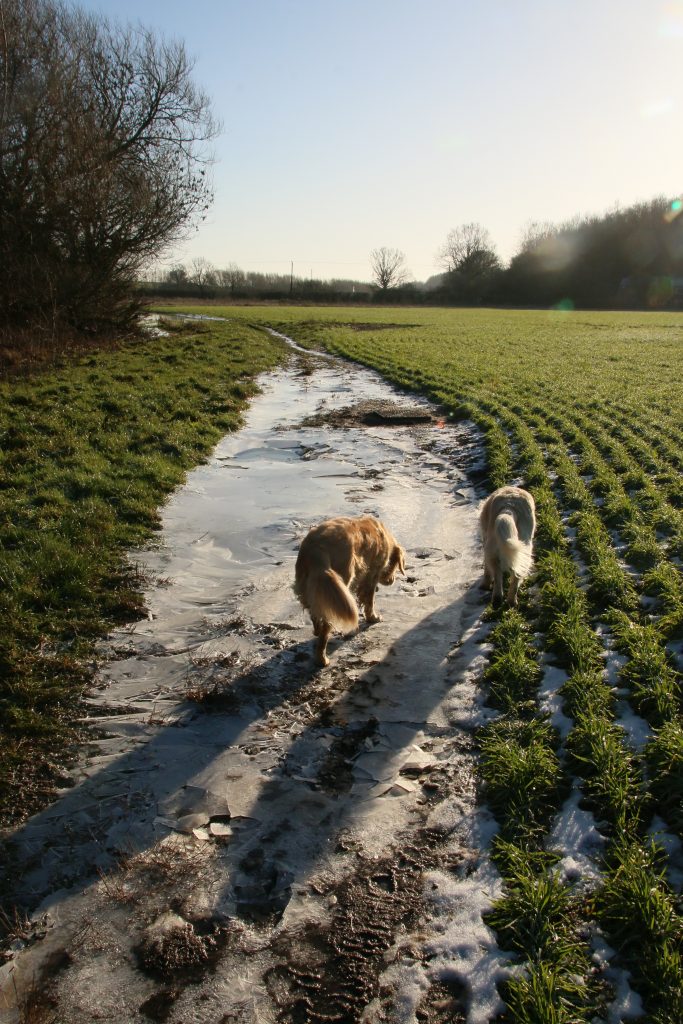
We cross the road to walk up the steep and rutted track up the side of the “New Hill”, this track usually muddy and so mostly avoided at this time of the year, but today frozen, as the path climbs between the wintery-bare shrubs and grasses on the side of the hill. At the top we meet a family, Mum, Dad and young daughter. Mum and Dad are keen to say hello to Sam and Ellie, the daughter less so, despite sharing her name with Ellie, and I hang on to the dogs collars to prevent an over enthusiastic greeting to Ellie the daughter, who is shorter than pooch-Ellie would be if she chose to jump up to give a hug.
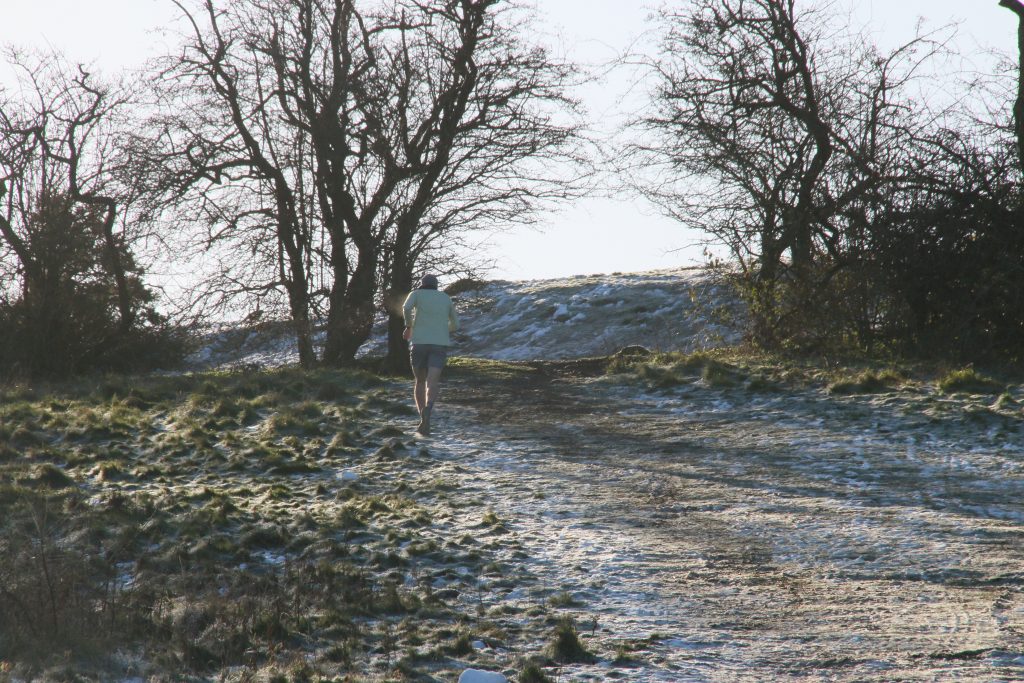
As we approach the top, I see a young couple sitting close together on the rocks around the Trig Point, looking out across the view of South Leicestershire. I put both dogs on lead – the couple will not want their shared time together enjoying the wintery scene interrupted by two bouncy and over friendly Golden Retrievers. The girl comments than my dogs are cute. She wouldn’t be saying that if she was being mugged by Sam trying to give her a hug. We continue down the Hill and back home. I have logs to stack.
9th January 2026
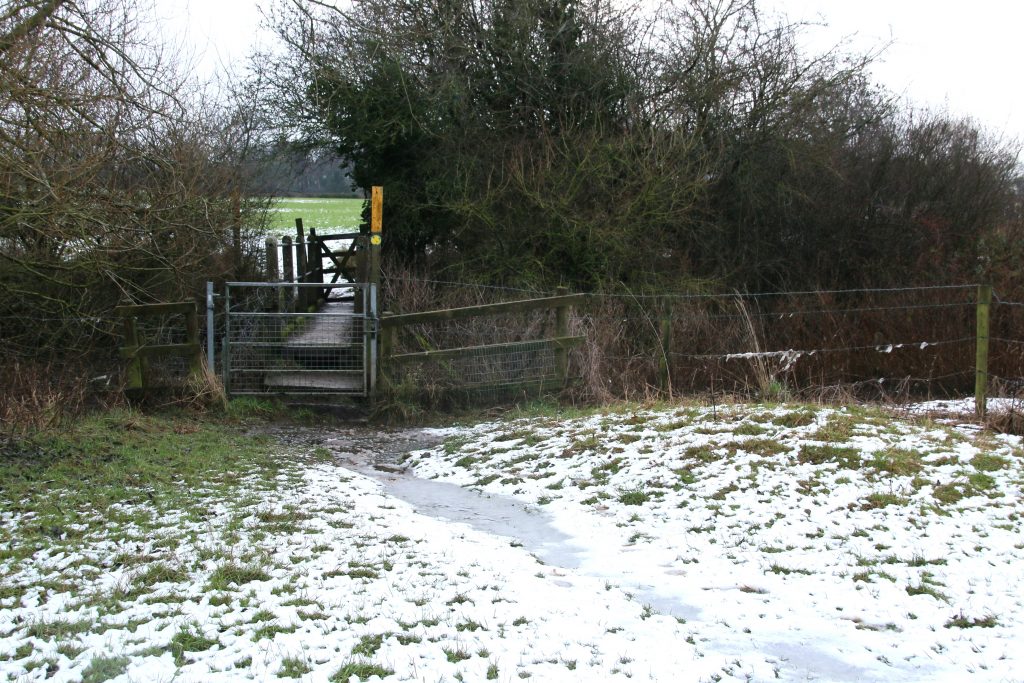
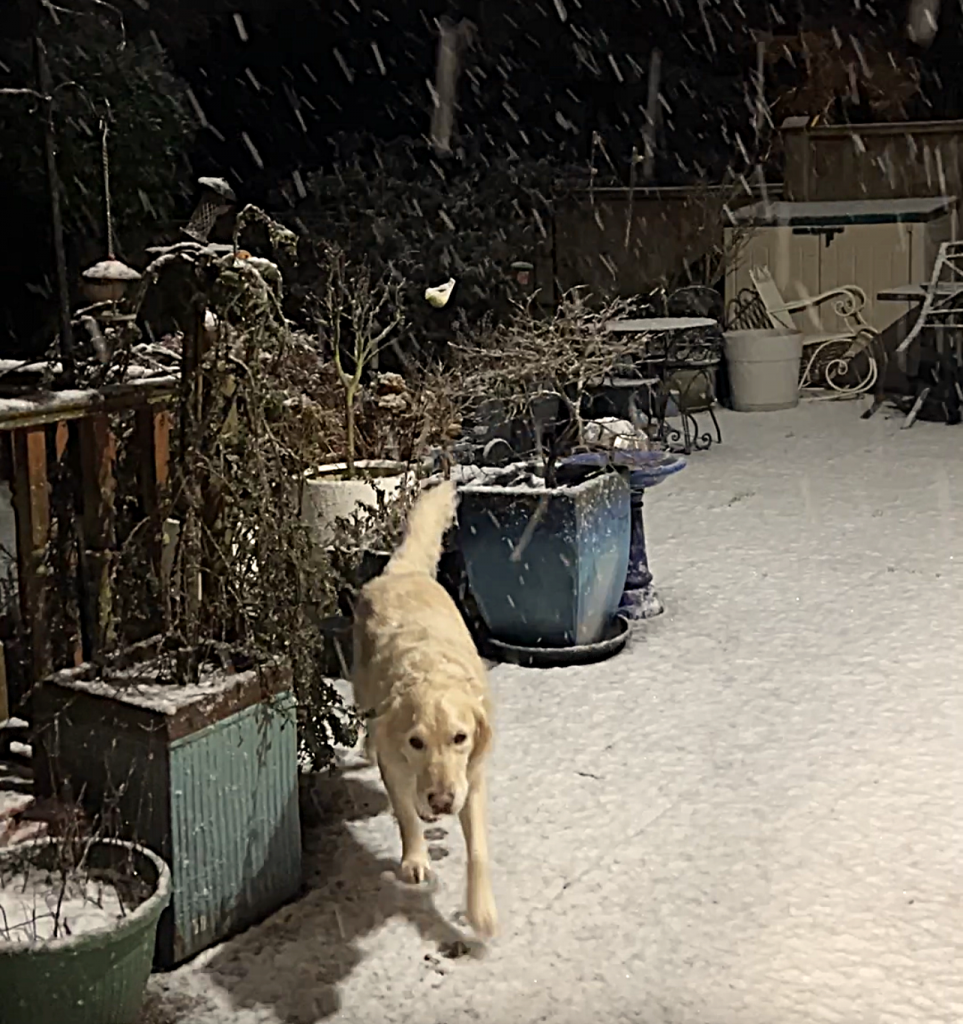
The river is high, almost but not quite breaching the banks, although if the thaw continues there is the chance of some flooding across this low-lying pasture. The field has already flooded two or three times this winter, and with the ground quite compact thanks to sheep grazing here until late November, it can take several dry days for the water to drain away.
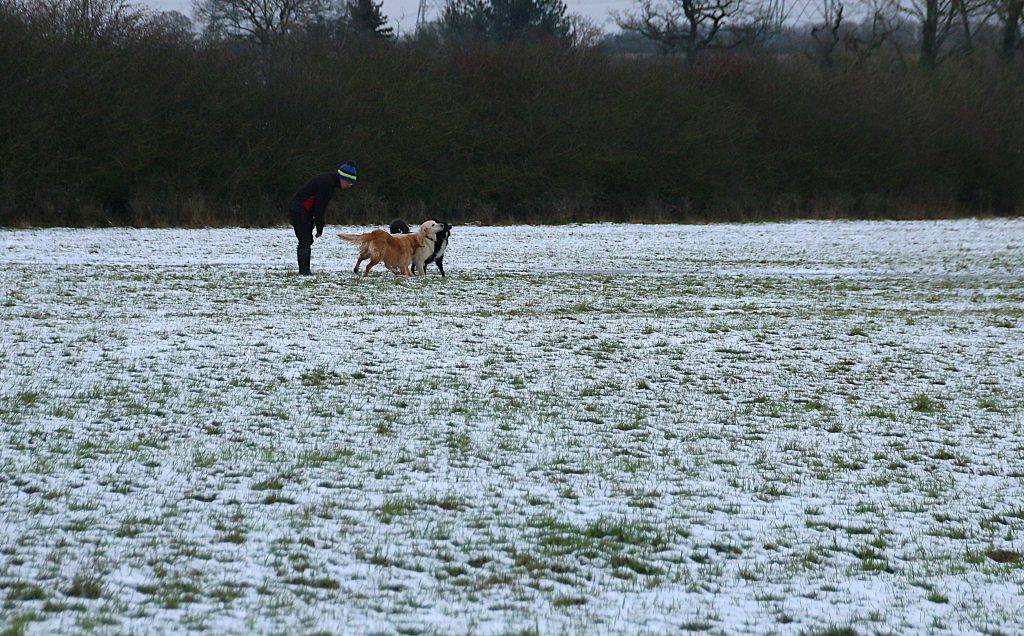
I quickly wash and dry the muddy dogs – the hose is still frozen, and so once again Sam and Ellie are treated to warm water from a watering can. I put both dogs in the back of my car and we set off to meet my cousin for a walk around Aylestone Meadows, a huge nature reserve that stretches from outside of Leicester City boundary to within half a mile of the City Centre, following the routes of the Great Central Railway, now a walking and cycling route, the Grand Union Canal, and the River Soar. We walk along the Great Central Way, turn off to cross a packhorse bridge, and follow well defined tracks to join the frozen canal. I put Sam on his lead – he shows an unhealthy interest in Moorhens on the ice at the far side of the canal. It is a lovely walk, and it only the well-maintained paths and regular waste bins that reminds us that this countryside so close to city urban development.
Heavy snow last night, large wet flakes that settled, but with roofs and gutters already dripping while snow fell. There is a covering of wet snow when we set out on our walk, but certainly not deep and crisp and even. The dogs love it though, running through the snow, slush and patches of mud as we make our way down to the sheep field for a quick circuit – we are out and about again later, and so a short early walk will suffice. We have the field to ourselves, and the dogs run through the lying snow, playing and exploring the scents of the riverbank.

Collie Bryn emerges from the dog gate through the hedgerow, closely followed by his owner climbing over the adjacent stile, and my dogs run to “meet and greet” both. Bryn’s owner reports that the wooden bridge over the ditch on the other side of the stile is floating on the high water of the ditch. Hopefully the bridge will settle back into place as the water recedes back into the ditch. We all walk back along the field edge to our Lane, and when we reach our home, Bryn’s owner says that Bryn always stops for a drink from the water bowl that I leave out, but, oddly, will only actually drink from the larger of the two bowls that I “turn and turn about” to keep the bowls clean. The two bowls are almost the same size.
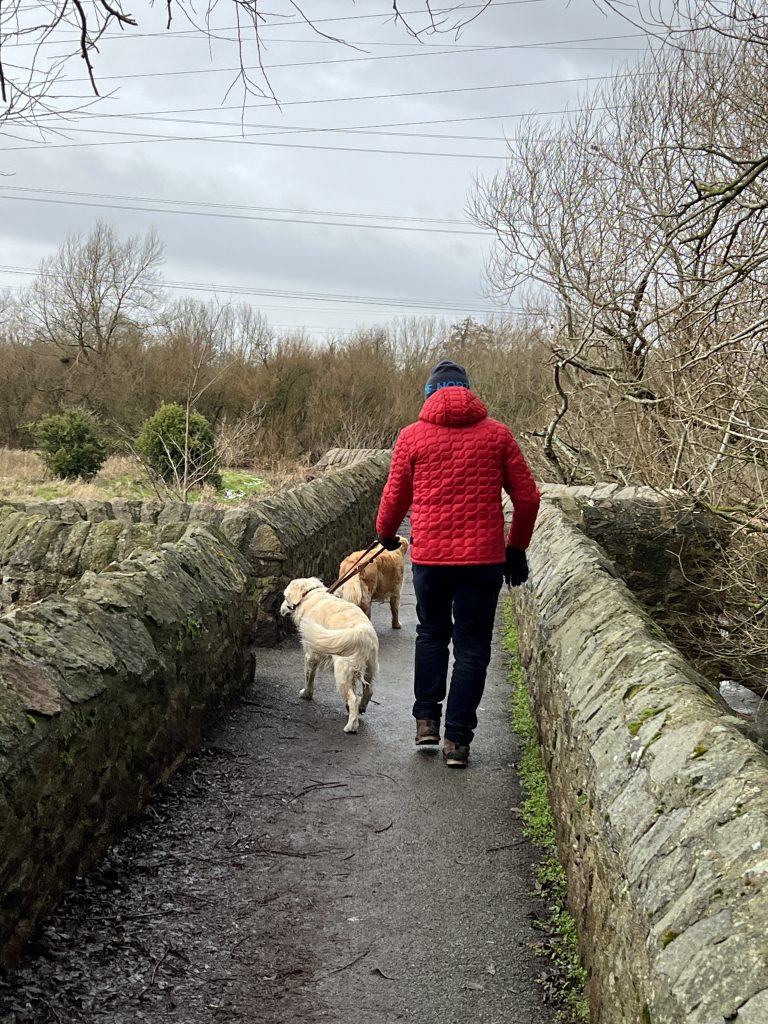
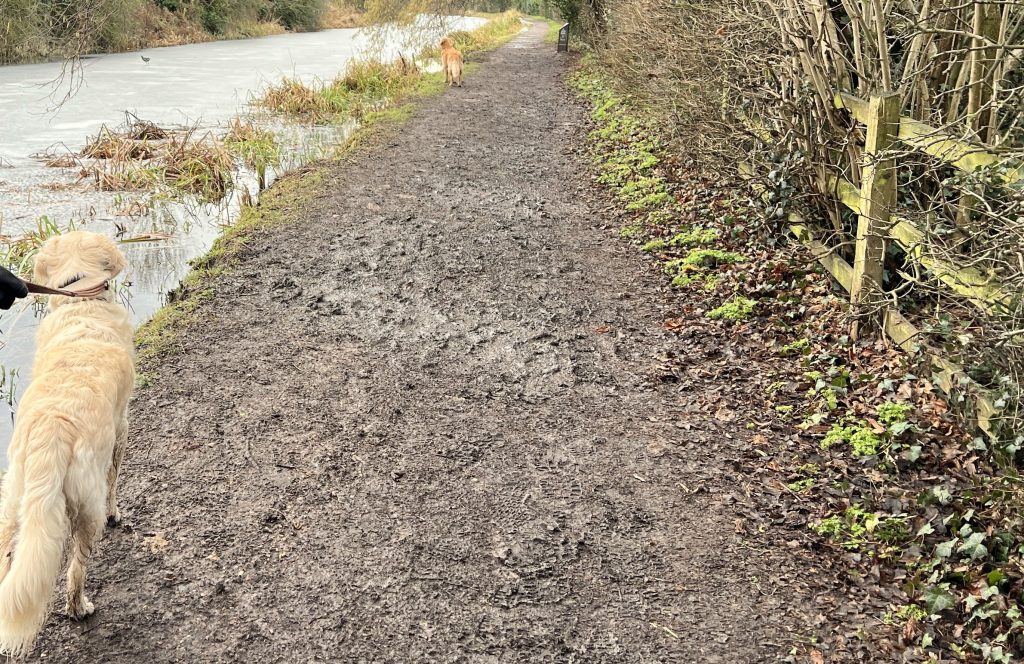
8th January 2026
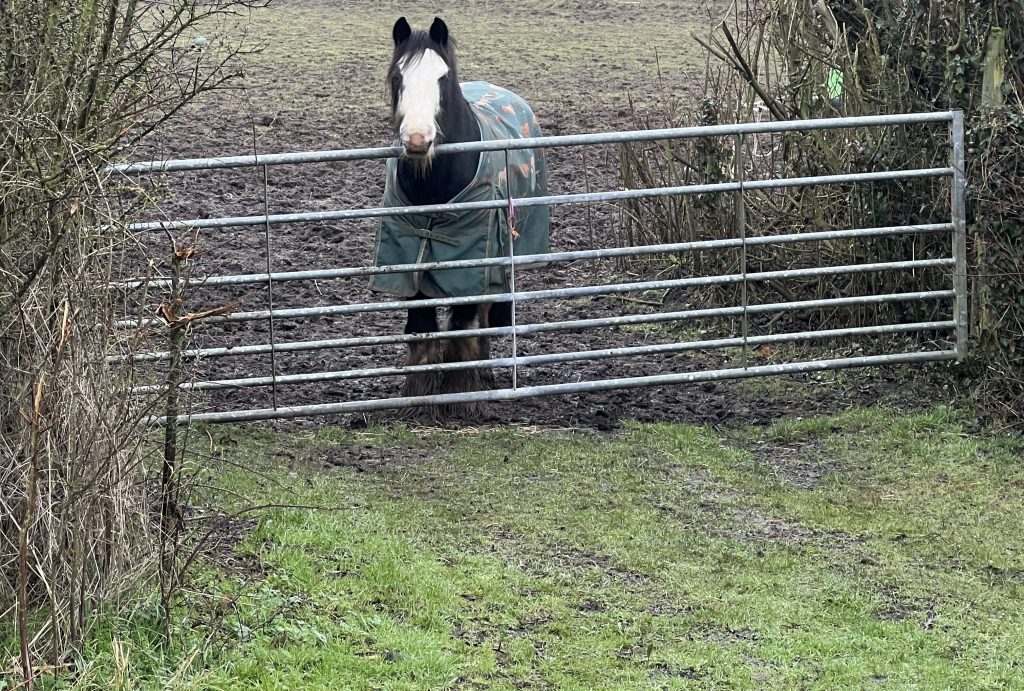
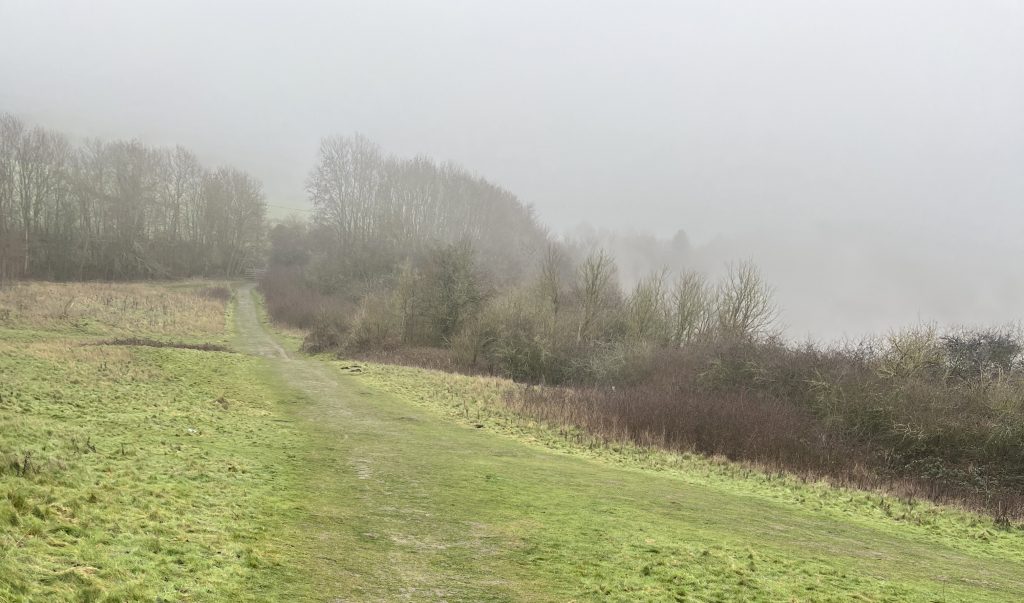
We cross the road to follow a private lane leading to a bridleway. A man in a high-viz coat is bending down by his car at the top of the lane, and I wonder if all is is well, but he explains that he always stops here to feed a robin that sometimes lands on his hand – the robin flew into the hedge as we approached. He usually drives down the lane and along the bridleway in his car, not a 4×4, to take food, and today containers of water, to a field where his daughter keeps horses. I’ve not met him before, but I knew from other dog walkers that this was a daily event. Today he decided that the bridleway is too slippery for his car, and he has dropped off the horse supplies at the bottom of the lane. I meet his owner coming along the bridleway pushing a wheelbarrow to collect the supplies. We stop to chat – she rents three fields, using just one at a time so that she can move the horses around to prevent the ground from being churned up. The current field is muddy by the gate, but mud free beneath trees at the back – they will stay there for the time being
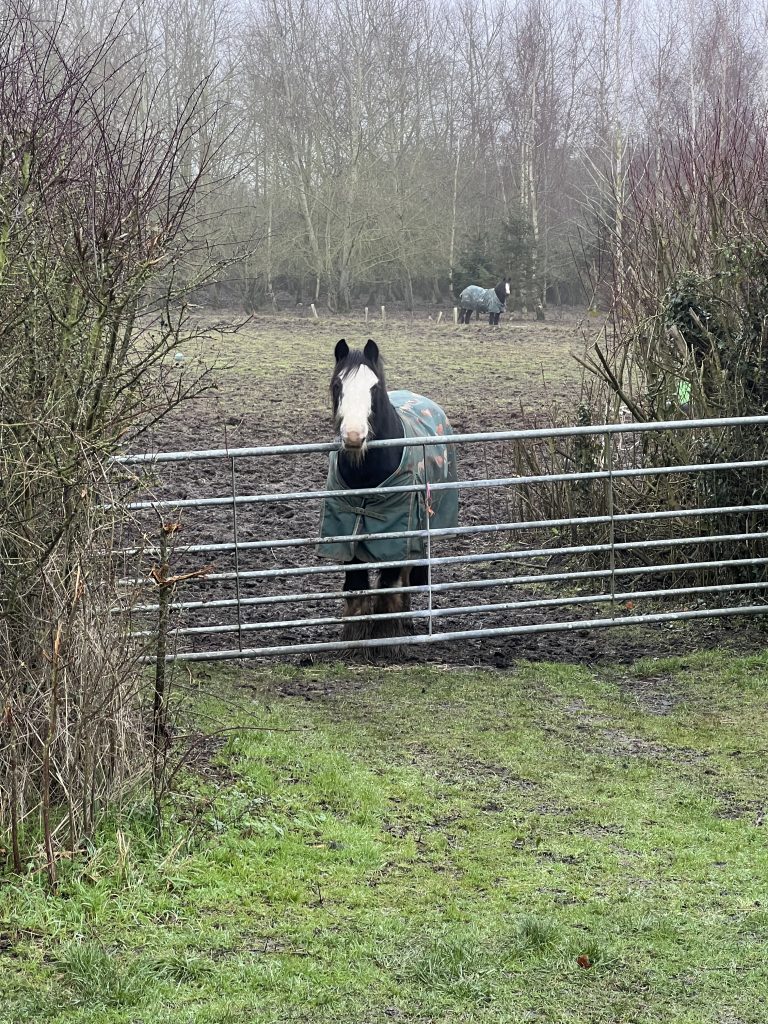
We return through Croft Glebe and do an extra circuit when we meet a friend and her two lurchers. At least we meet the owner – the dogs are running circuits around the Glebe. We leave the lurchers and cross back over road to continue back up track towards home, meeting mongrel pooch Pebble and her Mum. We happily chat about our respective Christmas days, in both of our cases the day dominated by keeping Mothers-in-Law happy. Having caught up with the local gossip me and my two continue on the path, noting that Hazel catkins have appeared alongside the path. We skirt around the bottom of Croft Hill rather than attempt another slippery ascent, and head for home.
We have lost the bitter easterly wind and so, despite thick mist under a slate-grey it actually feels relatively mild despite the temperature still hovering above zero. I start this morning’s walk by climbing up Croft Hill, hoping that yesterday ice has thawed sufficiently to allow my boots to grip, unlike yesterday. The ice has not thawed, but I manage to climb to the top before walking back down safely through the grass on the far side. We continue down towards the village, meeting a regular dog walker with a pair of Foxhounds. Since they are both on leads, I put my two on a lead, despite knowing that the Foxhounds are friendly – they on lead because off lead they would probably pick up a scent and be gone, following the scent deaf to the cried of their owner calling them back.
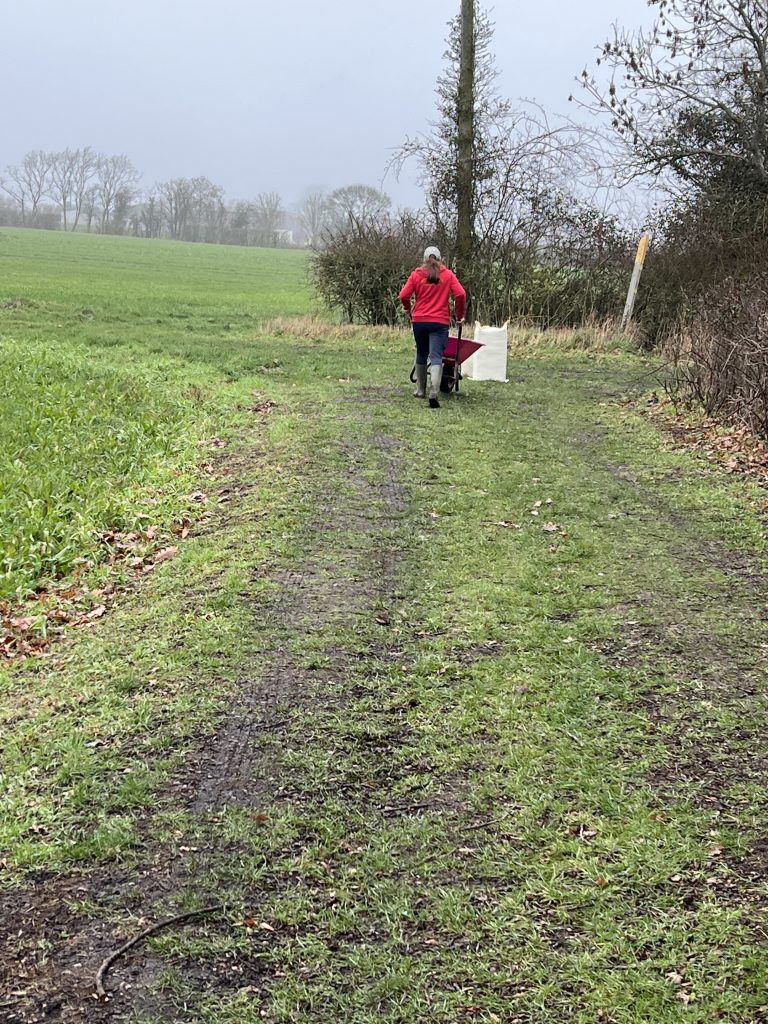
We pass the horses, waiting patiently behind the field gate for their breakfast. They neigh at us, expecting to be served, but are disappointed as we continue past. The dogs totally ignore the horses. A friend must put her spaniel on a lead when passing. There are often carrots in the field, and her dog is able to squeeze beneath the gate and steal them for a morning snack – my friend worries that her dog may be trampled beneath substantial hooves.
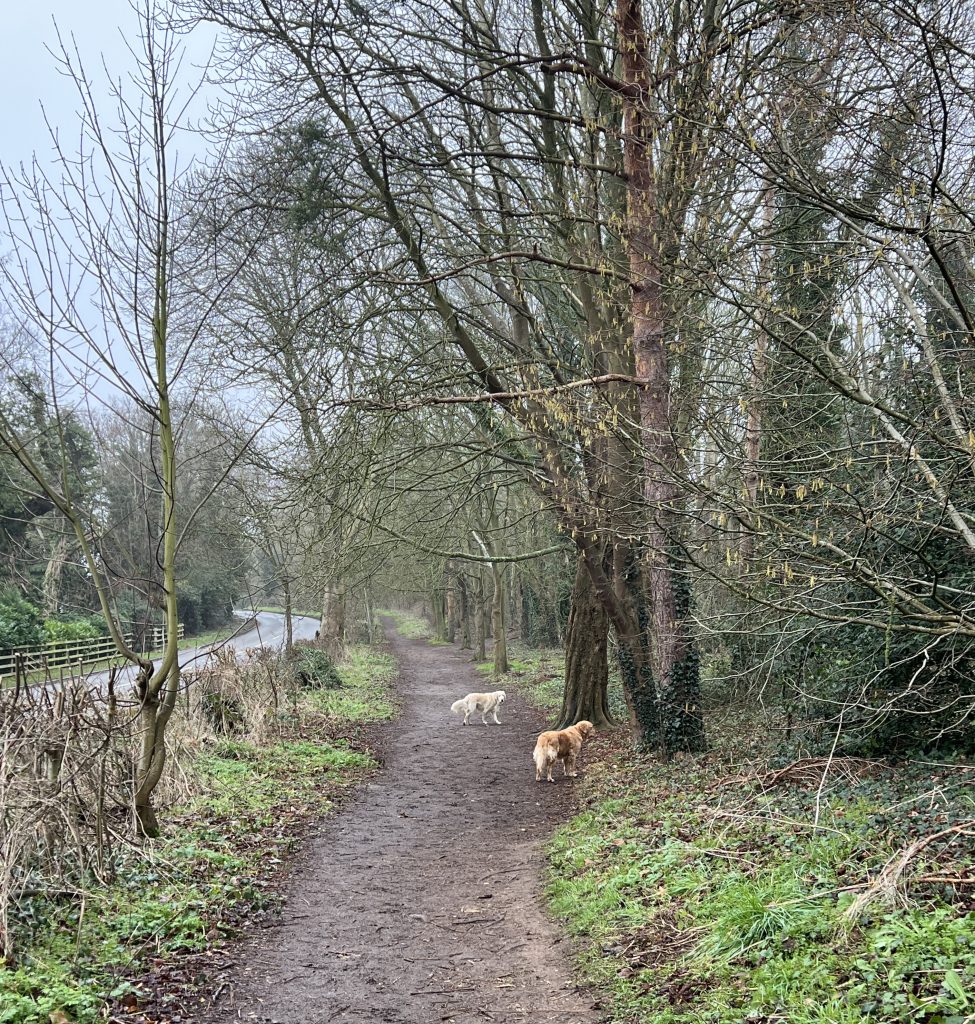
7th January 2026
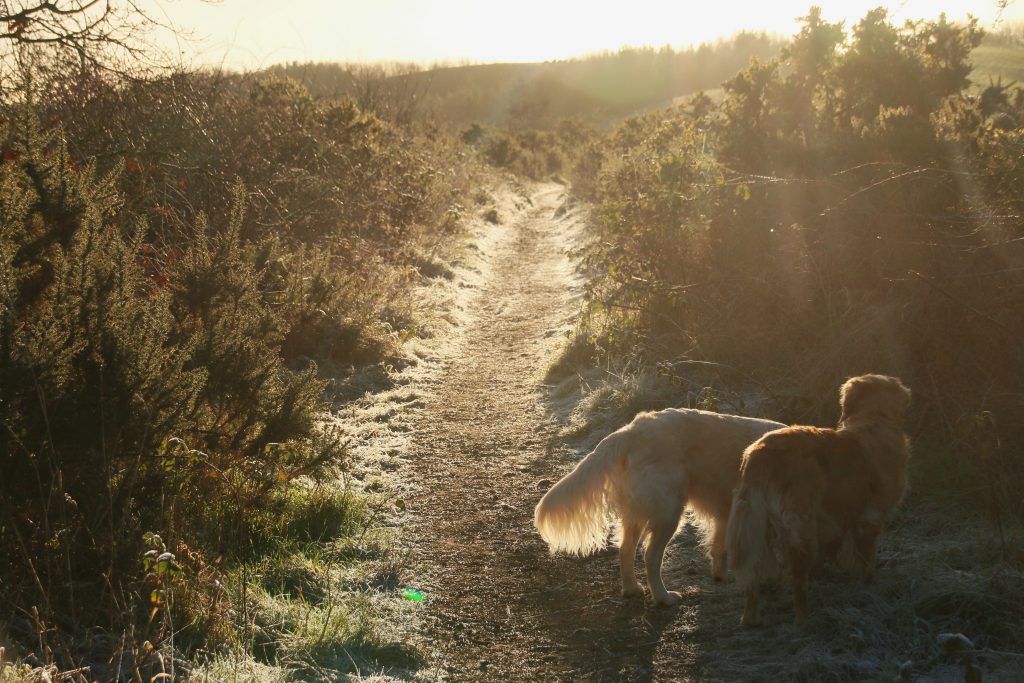
Bright sunny intervals between white clouds scudding across a blue sky looked almost springlike from indoors, but there bitter and strong easterly wind, and the cloud carried occasional sleety-freezing rain showers. We met a cockapoo, and I wasn’t sure whether the owner was a regular or not – he was muffled up inside a large hood pulled over his face, and my greeting of “Morning! It’s a tad fresh today!” was met with “Its so COLD…” We both kept walking.
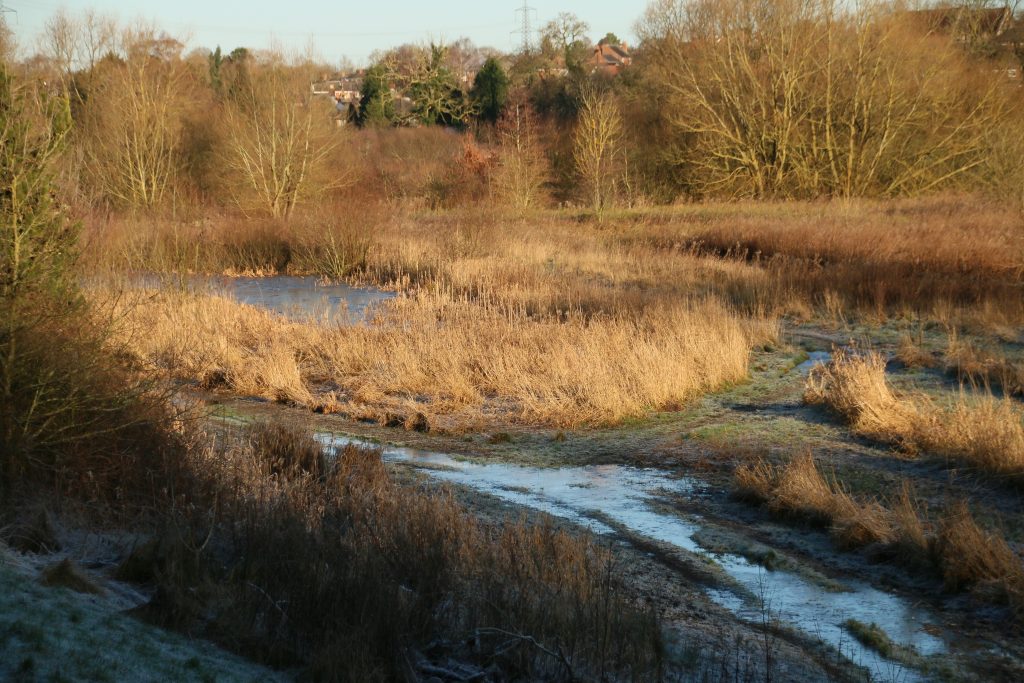
I start to ascend Croft Hill, but in these drier more open windswept surroundings there is no mud. Instead, the well-worn path is a sheet of ice over the track. I am back in wellies after a few days of wearing walking boots over frosty ground, and it difficult for my wellies to grip the ice, despite Vibram soles, and I walk on the rough grass to the side of the path. The hill is steeper on the far side, where I usually drop back down, and so halfway up I opted to cut across the grassy hillside back to the kissing-gate at the top of our Lane.
The ground has been frozen for a few days, and it has been a delight returning home with clean mud-free dogs, requiring just a wipe of paws with a towel before we could come inside into the warmth. Today the temperature was a degree or so above freezing, and he result is mud over ice, barely a centimetre or so of mud, but enough to splash onto the dogs, spraying up legs and under bellies. They will need a brief hose down when we get home
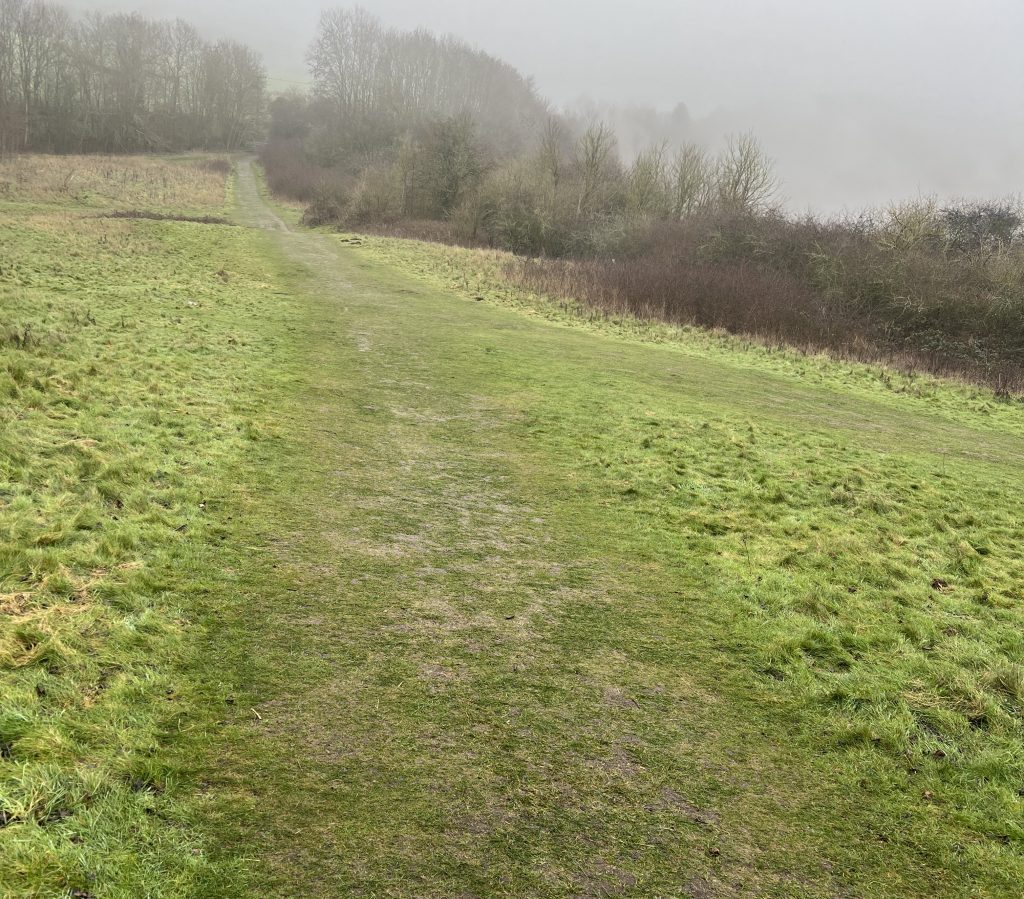
Back at home I had a problem. I have two muddy dogs, but the outdoor hose is still frozen. The dogs benefit – my only option is to wash them with warm water from a watering can, rubbing the mud away before retiring indoors for, in my case, coffee and one of the remaining Christmas mince pies.
5th January 2026
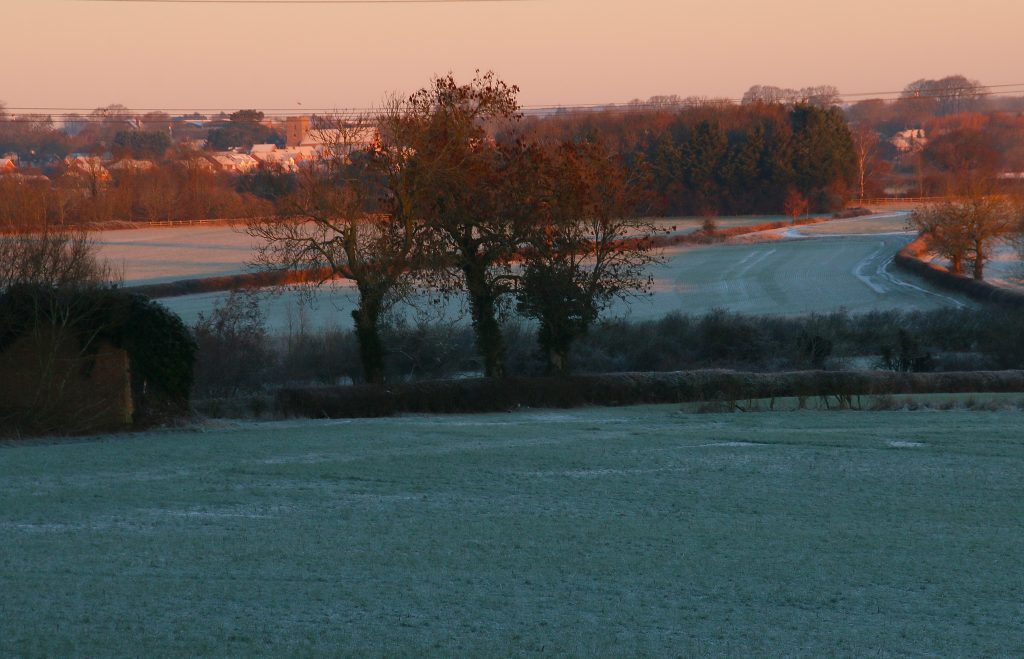
Twelth Night, when Christmas decorations should be down, but more importantly for we dog walkers, the day when sunrise begins to get earlier. Evenings have been getting lighter since well before Christmas, but mornings get lighter from today.
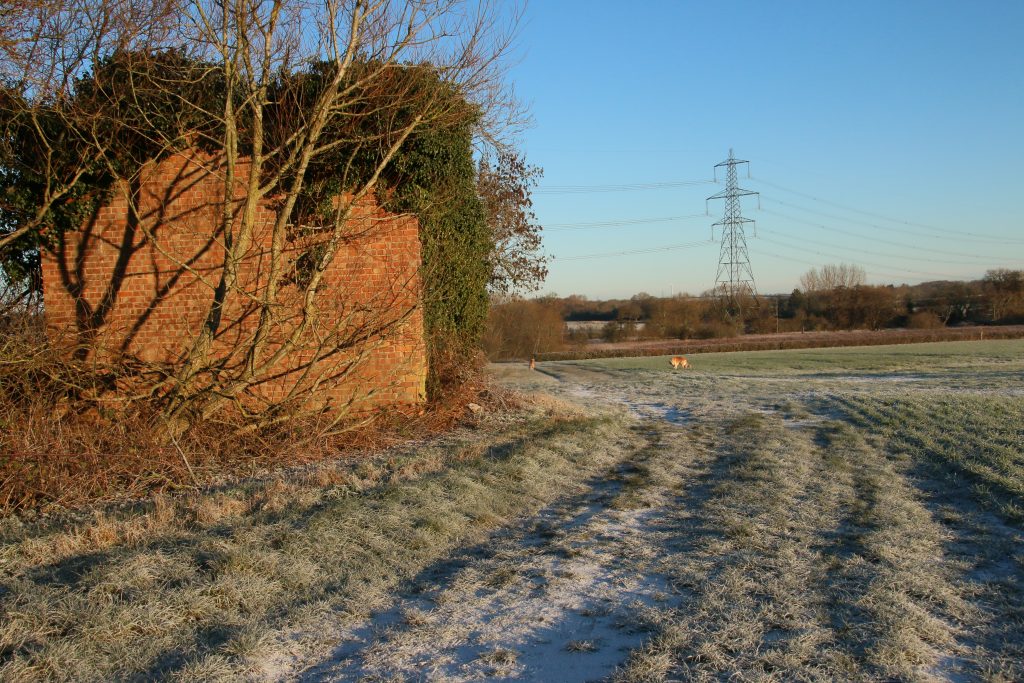
A month or so ago, from the top of Croft Hill, I noticed that there was a lot of sheep across the landscape, more than usual. In winter cattle are often brought indoors, but sheep are left outside, even, around here, when lambing, since their lighter weight is less likely to damage damp pasture. But then most fields were emptied of sheep. Maybe there was a seasonal increase of price and demand for lamb. Sheep are starting to appear again in some fields, possibly pregnant ewes prior to lambing – too early to tell.
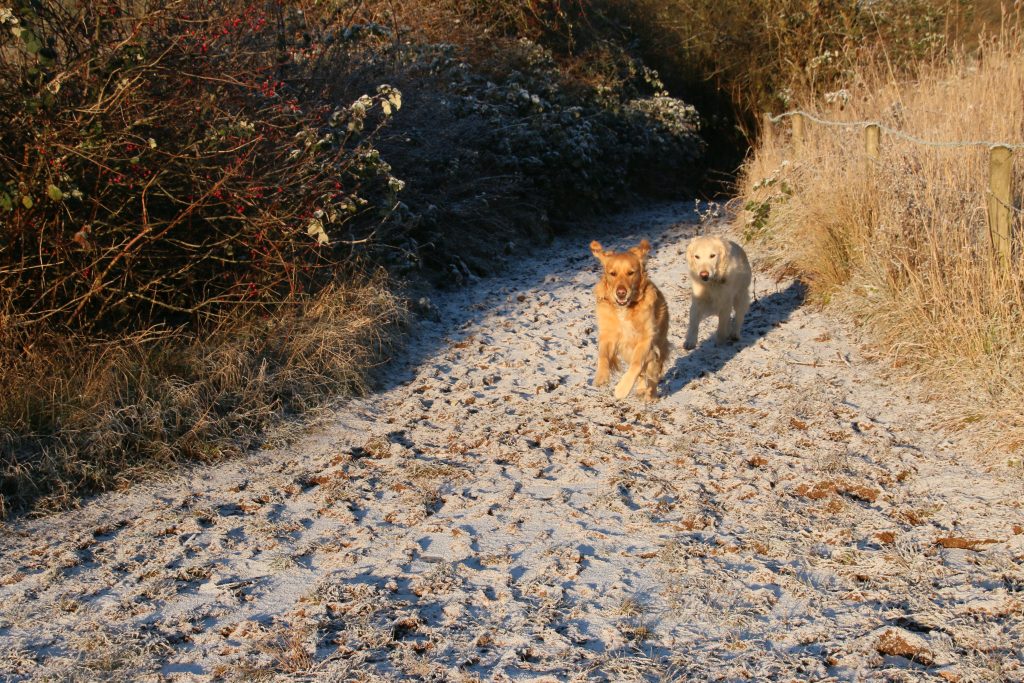
Before we emerge from the enclosed trackways back onto turf tracks beside arable fields we pass a small stream, usually an opportunity for the dogs to have a dip and swim, but not today. Far too cold for paddling.
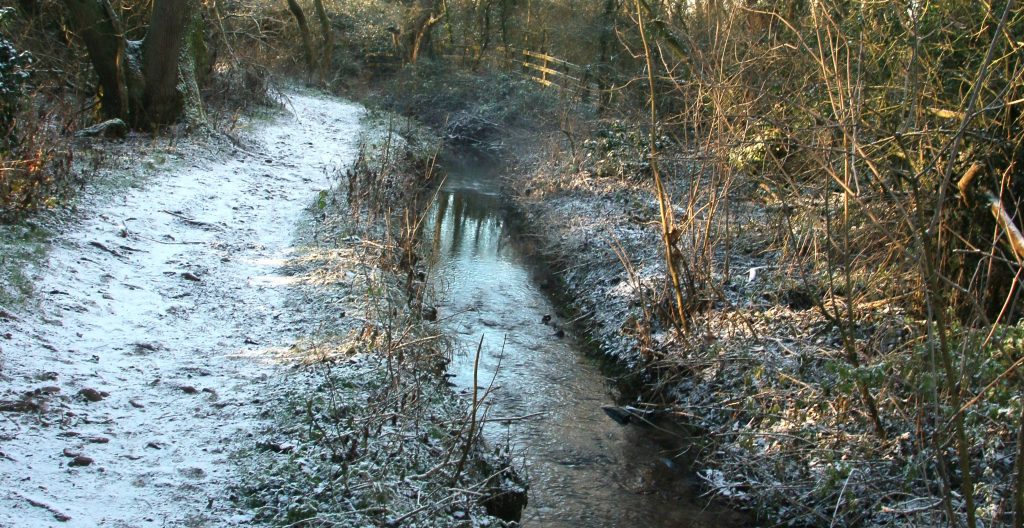
After 3 days of hard frost (-5C at sunrise) I decide to walk a route that is usually almost impassable at this time of year, thanks to deep squelchy mud. But to today we walk over the white-frosty ruts across the mud at several places along the paths, after first walking along the turf of the field track behind our home, past the old barn, noting a buzzard and heron flying low ahead. With thick gloves to be removed before raising the camera, it is not a day for wildlife photography, and I just appreciated watching both in flight, one gracefully gliding, the other languidly flapping.
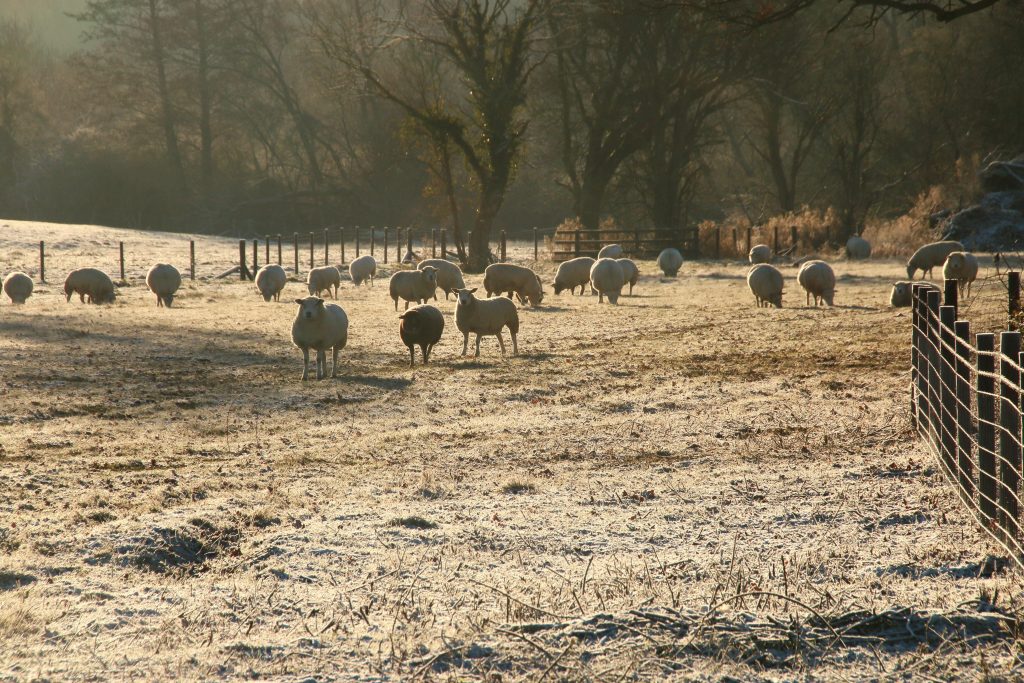
It is the paths beyond the sheep that are notoriously muddy throughout winter, bridleways accessible by horse riders and mountain bikers – we don’t often come across either, but it doesn’t need many hooves or tyres to churn up the wet surfaces. But today the paths were a delight, solid, if bumpy, ground, the paths meandering between sparkling hedgerows.
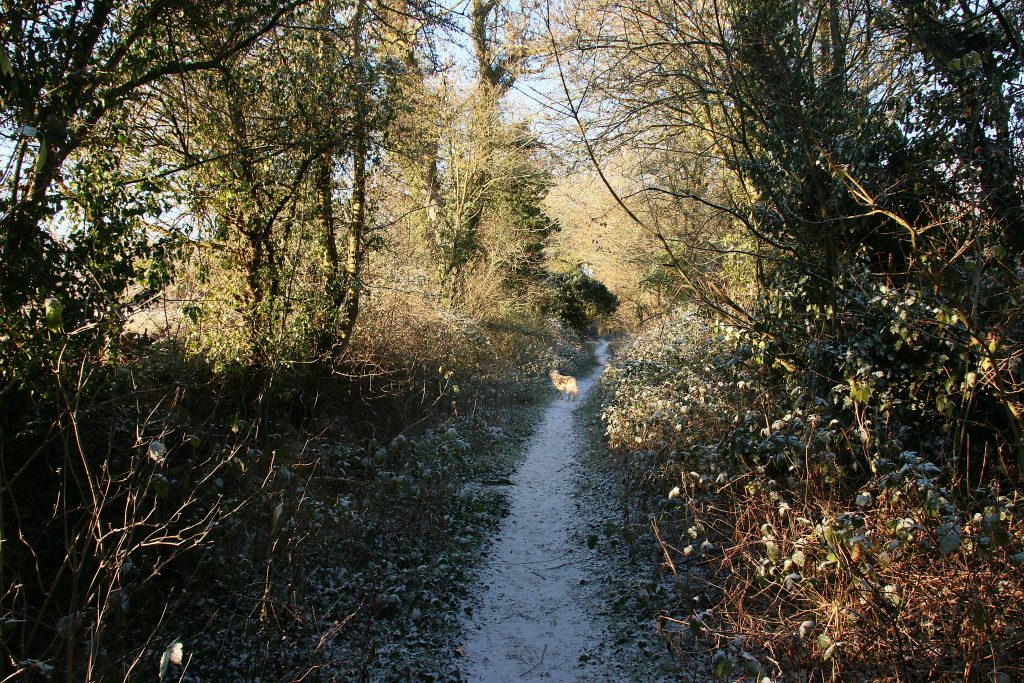
And so back home along the frosty field tracks which are more regular and familiar routes at this time of the year. We may not have had the dump of snow experienced elsewhere in the UK after the last day or so, just an overnight sprinkling here, but it has been a glorious winter walk under a deep blue sky, a peaceful walk – no other dog walkers out and about on our route today
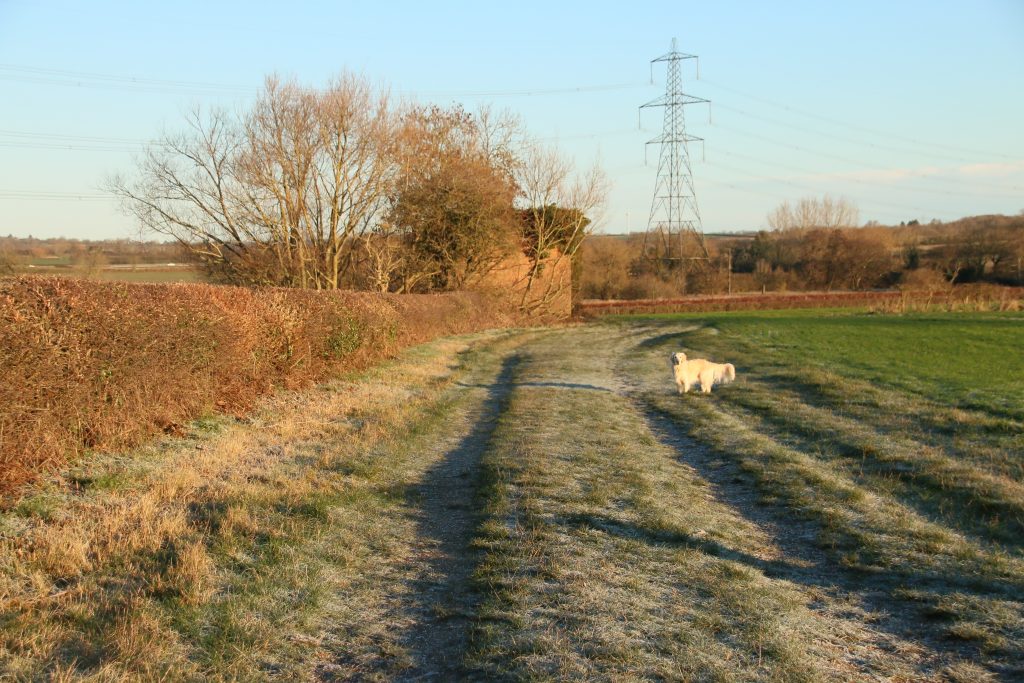
2nd January 2026
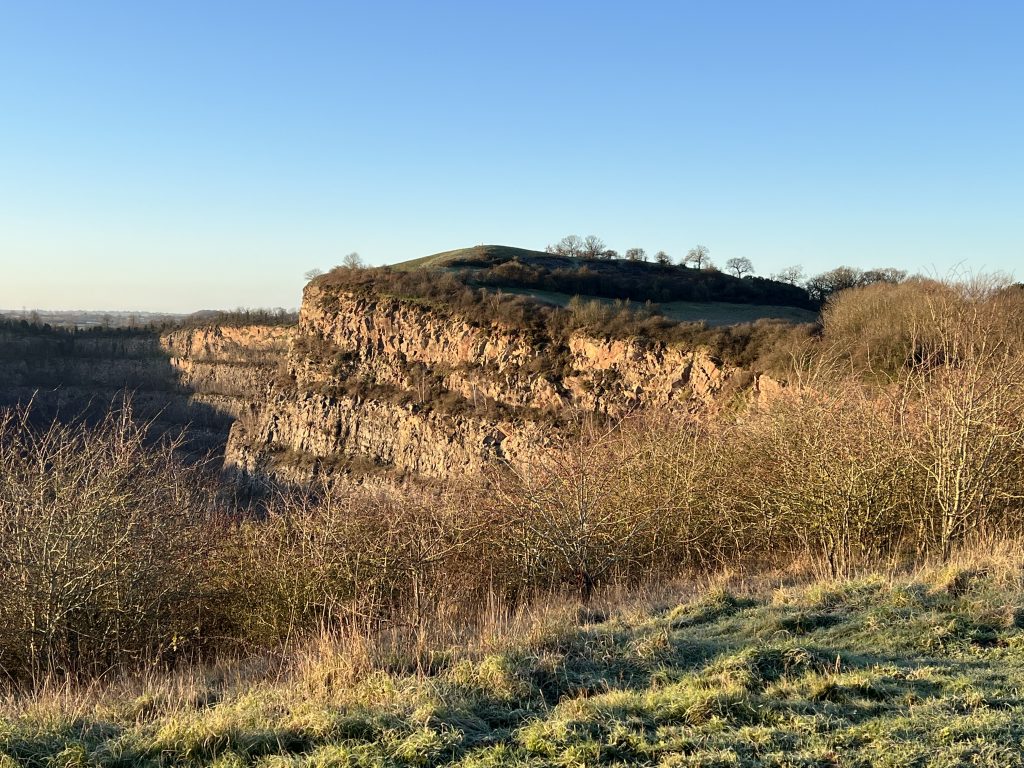
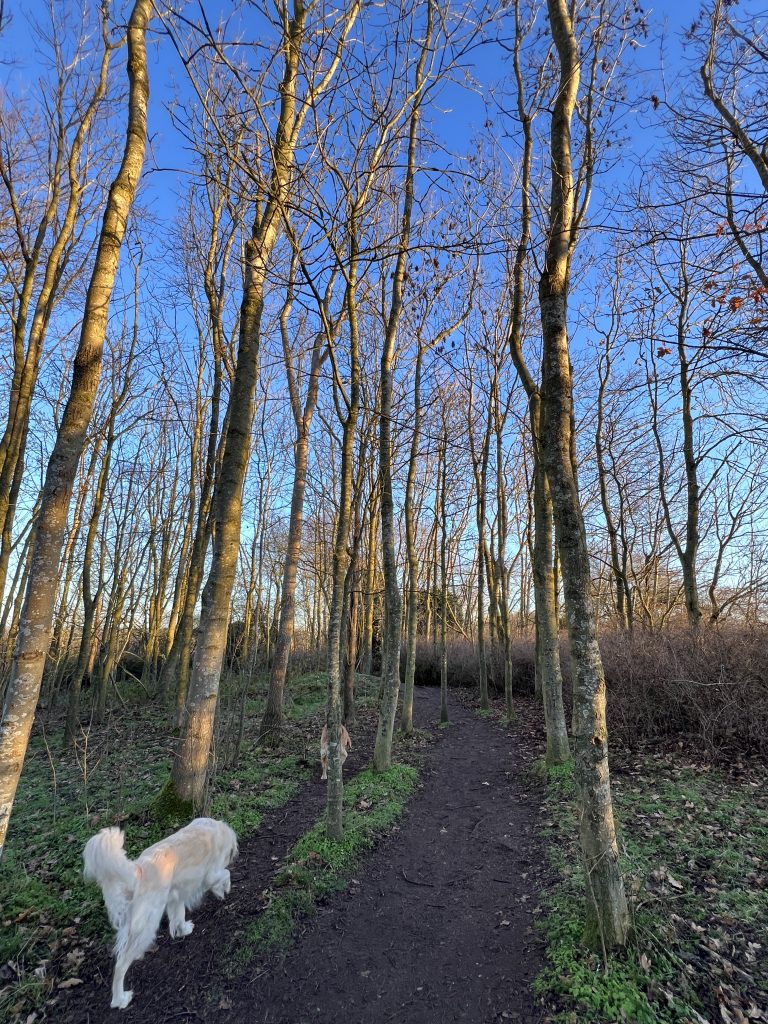
A cracking morning dog walk, a cold wind but a clear blue sky and bright winter sunshine, the ground frosty in places. The cold easterly wind of recent days has dried the muddy paths, and this, together with a touch of frost, means that the ground is firm, and there is a chance that I might get the dogs home clean. We walk through the spinney at the bottom of Croft Hill, and follow the steep path to the quarry edge, appreciating that we can walk over the rutted areas that at this time of the y/ear can be a bit of a quagmire, thanks to the popularity of this route with walkers and mountain bikes.
I see two people approaching, coming at us along the narrow path, out of the low sun that is directly in front of us. I realise that that they are runners, and I call the dogs to me and tell them to “Watch Me”. Generally, runners don’t appreciate being enthusiastically greeted by muddy Golden Retrievers, although today they are still clean, but these two runners breathlessly assure me that they are glad of an excuse to stop briefly to fuss the dogs – they both have dogs at home.
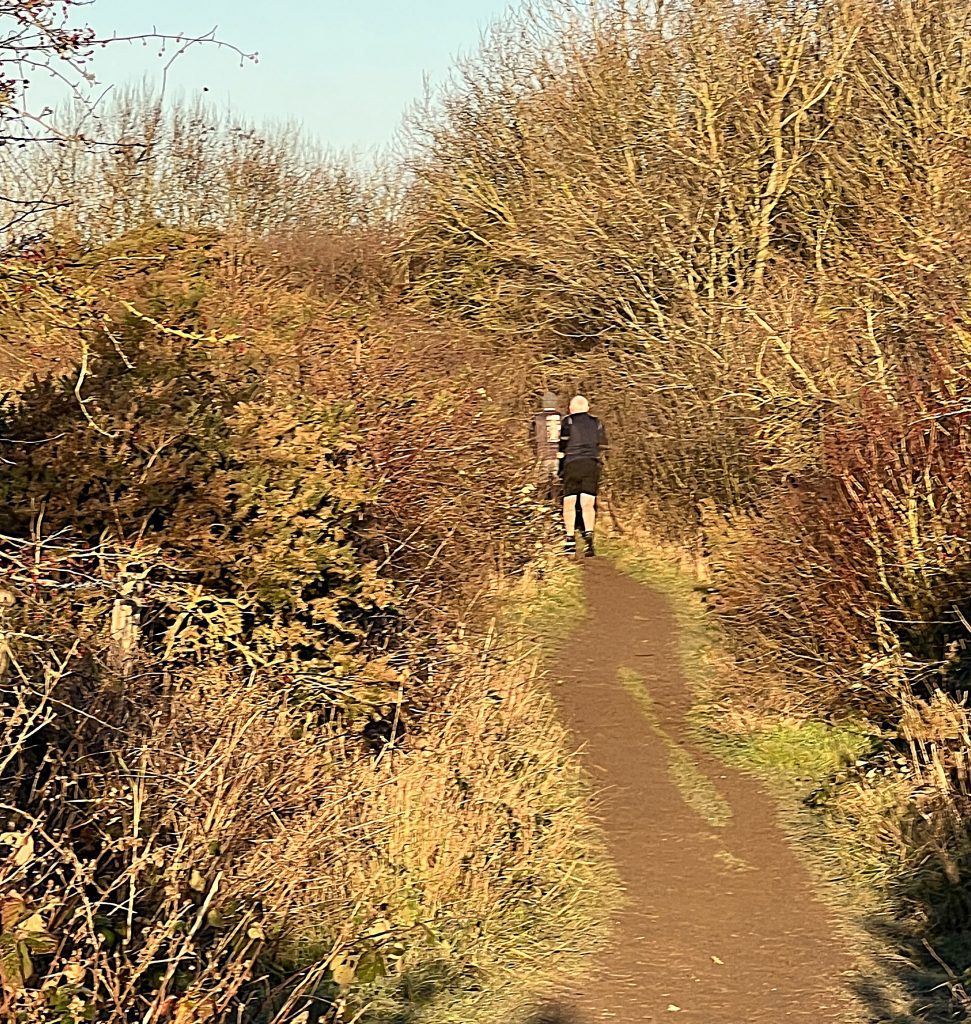
Further on we meet Trevor and Peter the Pugs. Their owner tells me that Peter has just been put on a diet – the vet has decreed that 15kg is a little too much for a dog of such small stature. Nevertheless, both Peter and Trevor are allowed treats from me, and my two demand treats from the owner of the pugs.
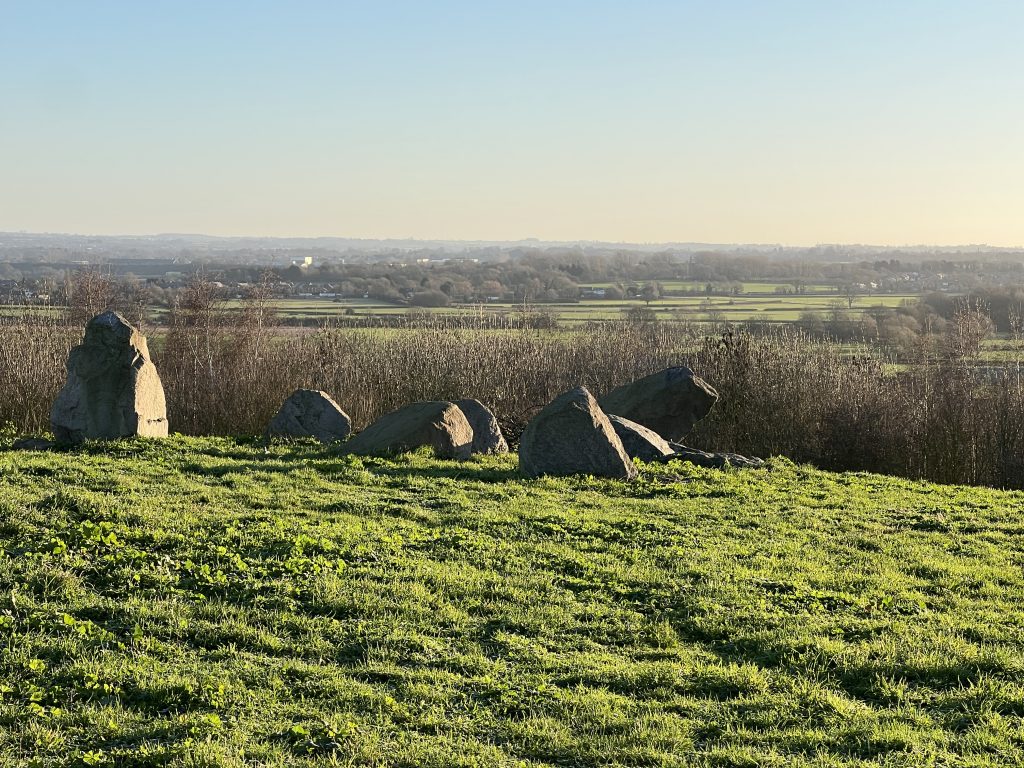
We descend through woodland, the steep and uneven path created a few years ago by mountain bikers. The entrance to path starts discretely a short distant from the quarry edge, close to ancient-looking standing stones, in fact just a few decades old, placed there at the top of the high artificial hill of spoil created around the quarry. The dogs run off into the trees, always visible among the bare sunlit trunks at this time of the year.
We emerge from the trees just above the river and wildlife ponds where a contractor is clearing levelling an area, previously thick with reeds and grasses – probably management of the environment rather than anything more destructive. We will see over the next few months. He uses an intriguing machine, a small remote controlled tracked vehicles with a digger/bucket on the front. In the summer I have seen the same item of plant being used to cut grass on steep hillsides, on that occasion with a mower on the front.
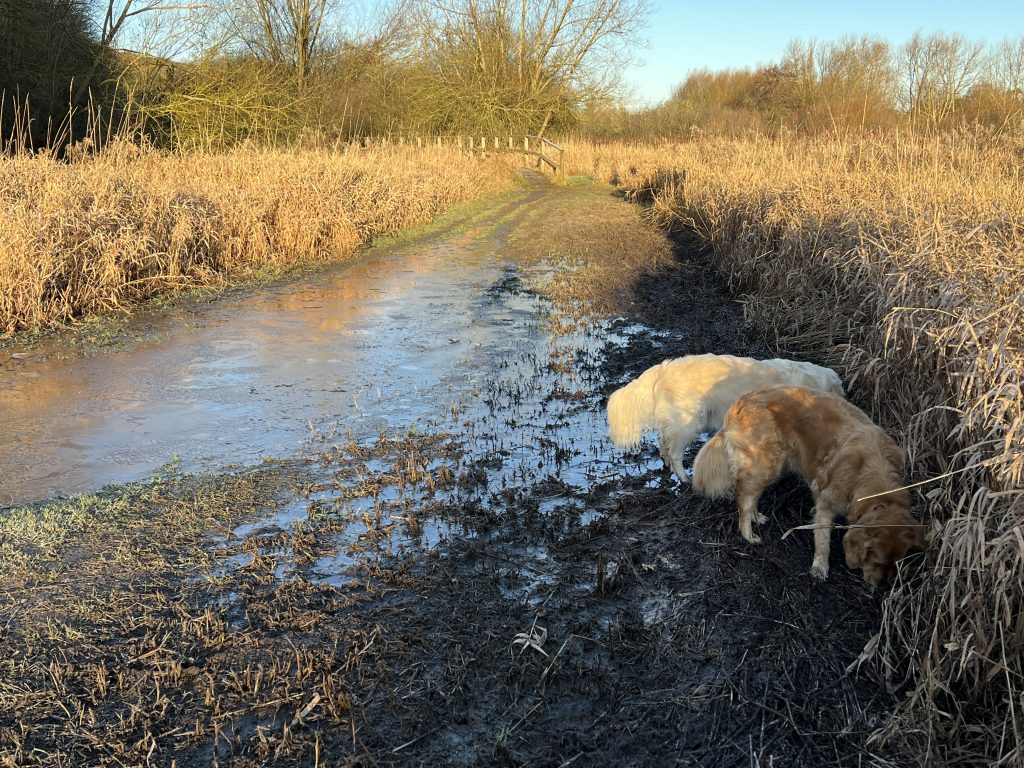
Passing the wildlife ponds, I cross an icy-slippery boardwalk and meet a mum and adult son. They are not accompanied by a dog but, like the runners, want to greet my two. Mum would like a dog, but her husband won’t have one. Too much fur, and too much of a tie. He has a point. By the time that we part and they head for the boardwalk, she is covered in white hairs from Sam, trying with limited success to dislodge most from her woollen gloves.
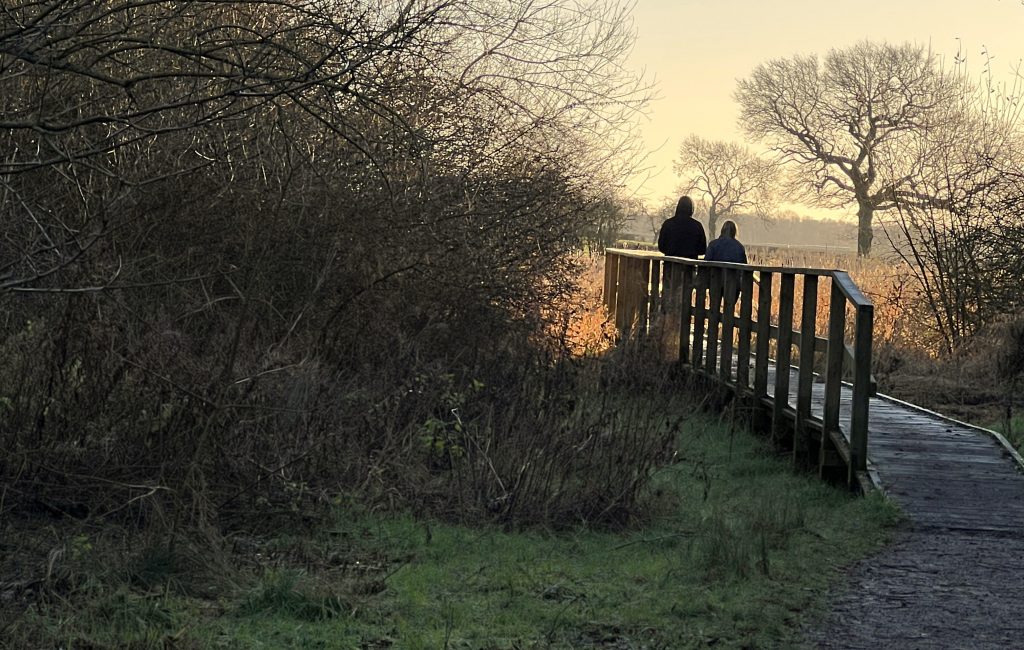
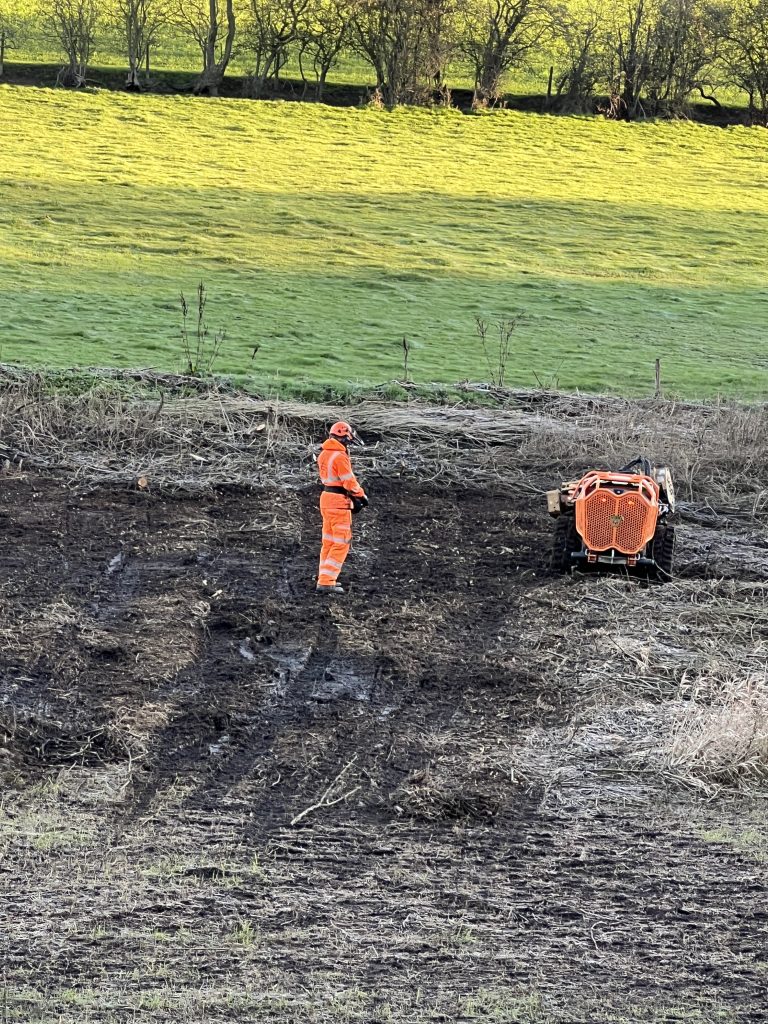
Our route continues along the wet lower path, puddles and mud frozen but not enough to support dogs’ paws. Their legs will need hosing when we get home.